
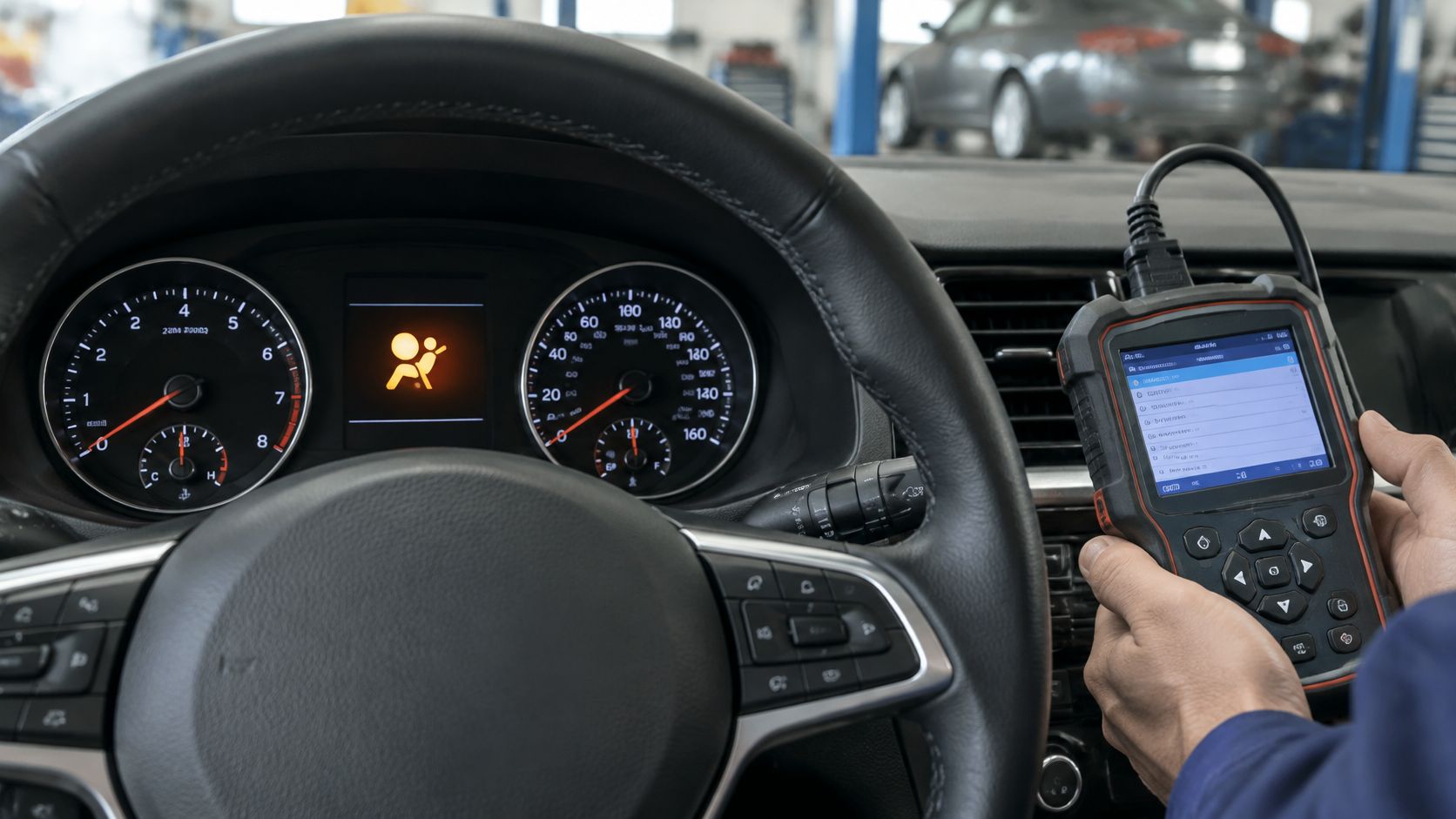
You turned the key this morning, the dash lit up like it always does, and then one light refused to leave. The engine sounds fine. The car steers and brakes fine. So you're left asking why is my car airbag light on, and whether you can safely drive to work, pick up the kids, or wait until the next oil change. That lamp isn't a maintenance reminder. It's the restraint system telling you it found a fault and hasn't cleared it.
Table of Contents
- Why the Airbag Light Stays On
- How the Airbag System Watches the Car
- Common Reasons the SRS Warning Appears
- Three Cars With the Same Warning Light
- How to Find the Fault Before Clearing It
- Choosing a Reset Repair or New Parts
- What to Do Next With a Persistent Airbag Light
Why the Airbag Light Stays On
At startup, the airbag lamp should come on for a bulb check and then go out. When it stays on, the supplemental restraint system, or SRS, has stored a fault somewhere in its network. That doesn't mean an airbag is torn, hanging out of the dash, or visibly damaged. It also doesn't prove every airbag is dead. It means the controller can't confirm that the whole system will work as designed.
Think of the lamp as a symptom, not a diagnosis. A fever tells you something's wrong, but it doesn't tell you whether it's a cold or an infection. The SRS light works the same way. The cause could sit in a seat, in the steering wheel, in a belt buckle, or in the control module itself.
A Simple Drive or Stop Decision
Use this split before you do anything else.
- After a crash or deployment: Stop treating the car as normally protected. If airbags deployed, a belt locked, or a belt stopped retracting after an impact, don't rely on the system until you know the stored code.
- No recent impact: Limit driving and get a restraint-capable scan soon. Don't wait for a routine service interval and hope it clears itself.
- Light appeared while driving: Note what else changed. A dead horn, a passenger airbag off message, or a seat you just moved can point a technician toward the right circuit.
It starts, it steers, it stops. None of that tests whether an airbag will deploy.
That gap is why delay can be costly. NHTSA recall documentation describes a condition where an illuminated airbag lamp could precede possible driver airbag non-deployment by roughly 300 to 400 miles, as detailed in the NHTSA recall report on a warning lamp preceding possible non-deployment. In plain terms, the lamp can be an early warning that protection is fading, not proof that you still have plenty of time.
Inspection rules add another layer of confusion. Maryland treats an illuminated airbag warning as something an inspector must document, not as an automatic rejection item on its own. Rules differ by place, so blanket claims that the car is automatically illegal or automatically fine are both misleading. Passing an inspection where you live doesn't restore a faulty restraint circuit.
Your first job isn't to turn the light off. It's to find out which part of the network asked for help.
How the Airbag System Watches the Car
The airbag module is a computer found in all vehicles equipped with an airbag system. It acts as a controller, linked to impact sensors, seat belts, airbags, and the clockspring. Picture a home alarm panel in a hallway closet. The panel doesn't stop a break in by itself. It watches door contacts, motion sensors, and sirens, and it lights a trouble indicator when any zone drops offline.
Your SRS module does a similar job. It supervises crash sensors that report impact direction and severity. It watches airbag circuits in the steering wheel, dash, seats, and roof areas depending on the vehicle. It also monitors seat belt pretensioners, buckle switches, and occupant detection components that help it decide whether a passenger seat is empty, holding a child restraint, or holding an adult.
This map shows why the lamp covers far more than the bag in front of the driver.
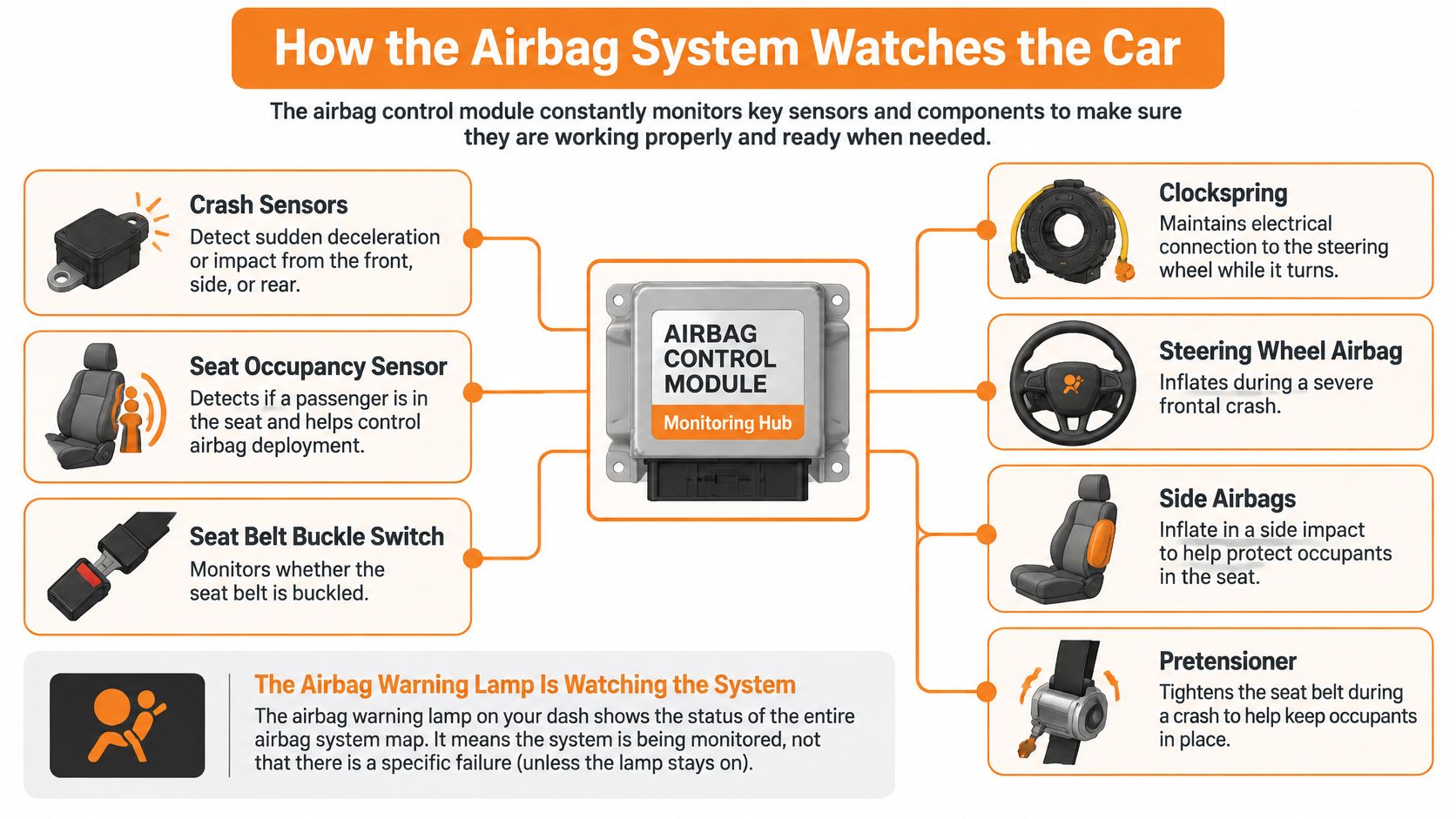
Why a Seat Wire Can Light a Dash Warning
Wiring and connectors connect every zone to the panel, and they're often the weak link. NHTSA recall documentation gives concrete examples. Spilled liquid reaching an airbag control module connector can illuminate the SRS light. Movement or contact involving wiring beneath a front seat can create electrical resistance and potentially prevent a seat mounted side airbag from deploying. Repeated bending of wiring beneath a passenger seat can break a harness, set SRS fault codes, and interfere with occupant classification, which could affect whether the passenger airbag is appropriately suppressed for a child restraint, as described in the NHTSA recall notice covering module connectors and seat wiring faults.
None of those failures would be visible from the driver's seat. The airbag covers can look perfect. The belts can still buckle with a clean click. The problem lives in a connector pin, a chafed wire, or a sensor reading that falls outside the range the module expects.
The clockspring behind the steering wheel deserves a quick mention because it moves every time you turn. It carries the driver airbag circuit through a rotating connection. If that ribbon wears or breaks, the module loses contact with the steering wheel airbag and stores a fault, even though the airbag itself never fired.
Practical rule: Disconnecting the battery may blank a display, but it doesn't repair a wet connector, a broken wire, or a failed sensor.
That's the core lesson of the system map. The lamp watches the whole network. A proper repair starts by finding which zone went offline and why.
Common Reasons the SRS Warning Appears
Owners often search for one cause, but shops think in fault families. Sorting your situation into the right family prevents the most common mistake, which is buying a part before anyone has read the code. Start with what changed right before the light appeared.
Low or unstable battery voltage can confuse the module during a slow crank or jump start. The clue is timing. The SRS lamp shows up alongside other warning lights or hard starting. Don't assume a new battery finished the job, because a stored code may remain after voltage returns to normal.
A loose connector under a seat often follows vacuuming, detailing, seat removal, or sliding a seat fully forward or back. The fault may come and go as the seat moves. Don't assume pushing a plug together by feel is a verified repair, and don't work on these connectors casually.
Faults That Look Similar on the Dash
A failed clockspring can arrive with a horn or steering wheel buttons that stop working at certain wheel angles. A bad impact or occupant sensor may give no clue except the lamp, or a passenger airbag off message with an adult seated. An open or shorted pretensioner or buckle switch circuit can follow a collision, water intrusion, or damage near the belt anchor. Drivers researching a buckle related fault can review how a seat belt buckle pretensioner fits into the restraint circuit, but the code still has to identify the failed side and circuit first.
Water contamination is easy to miss. A spilled drink, a cabin leak, or flood exposure can affect connectors and modules mounted low in the vehicle. Stored crash data is different again. After deployment, the module may keep reporting a post crash state even after body panels and airbag covers have been replaced.
NHTSA documentation identifies connector failure as a likely cause of a continuously illuminated warning light and cautions that airbags or pretensioners may not deploy when that light remains on, as set out in the NHTSA remedy instructions for a continuously illuminated SRS warning. In rarer electrical failures, unintended deployment is also a concern. That's why this lamp is a functional safety warning rather than a reminder you can snooze.
| Situation | Circuit often involved | First safe check |
|---|---|---|
| Light after a weak start | Module power supply | Test battery and charging system |
| Light after seat movement or cleaning | Seat connector or occupant sensor | Scan the SRS and inspect for obvious damage |
| Horn works only sometimes | Clockspring or steering wheel airbag | Record the code before removing anything |
| Light after a collision repair | Crash data, pretensioner, or airbag circuit | Confirm every deployed part was addressed |
| Passenger airbag message seems wrong | Occupant classification | Check codes and required calibration |
A generic engine code reader often can't talk to the restraint module. No powertrain code doesn't mean no SRS fault. It usually means you used a tool that knocked on the wrong door.
Three Cars With the Same Warning Light
Three cars can park side by side with identical lamps and need three completely different repairs. Seeing the contrast helps you place your own car in the right story.
The Repaired Collision Car
The first car looks finished. The bumper lines up, the paint matches, and fresh airbag covers sit where deployed bags used to be. Yet the lamp stays on because the module still holds the crash record and sees a pretensioner or airbag circuit that is no longer in its expected electrical state.
A pretensioner is a pyrotechnic device. In a crash, it fires once to pull belt slack tight, and the system records that deployment. NHTSA material ties an illuminated SRS warning to activated pretensioners, and it also names failed buckle switches and passenger occupant detection faults as triggers, as explained in the NHTSA correspondence on activated pretensioners and SRS warnings. During an accident, the airbag module writes crash data and stores it in the memory chip, and the airbag light goes off, making the module considered useless until that stored event is properly addressed. New covers alone don't rewrite that memory.
The Older Used Car
The second car is an older sedan bought from a private seller. There's no obvious crash damage, and the seller calls the lamp an aging sensor. That may be true, but it may also be an open safety recall. Recall status depends on the vehicle identification number, not just the model year, trim, or what the previous owner remembers. Cars move between states, owners miss mailed notices, and a remedy may never have been completed. Paying for a module or sensor before checking the VIN can mean paying for work the manufacturer already owes you.
Same lamp, different paperwork. One car needs crash memory addressed, another needs a manufacturer remedy, and a third needs a wire repaired.
The Daily Driver With No Crash History
The third car has never been wrecked. Its owner spilled coffee near the console months ago, or the passenger seat slides back and forth daily for carpool duty. One morning the lamp stays on. Here, a contaminated module connector or a harness damaged under the seat is a more plausible starting point than crash data.
The driver notices nothing else because the SRS doesn't change how the car drives. That's exactly why the lamp exists. Without it, you'd have no way to know a pyrotechnic circuit had developed too much resistance or lost contact entirely.
Ask which story fits your car, then prove it with a code. Guessing from the lamp alone is how a recall gets mistaken for a repair bill, or how crash memory gets mistaken for a loose plug.
How to Find the Fault Before Clearing It
Work in an order that protects you and preserves evidence. The code is evidence. Clearing it first is like deleting a voicemail before listening to it, then asking who called.
This sequence shows the order to follow, from the bulb check through verification.
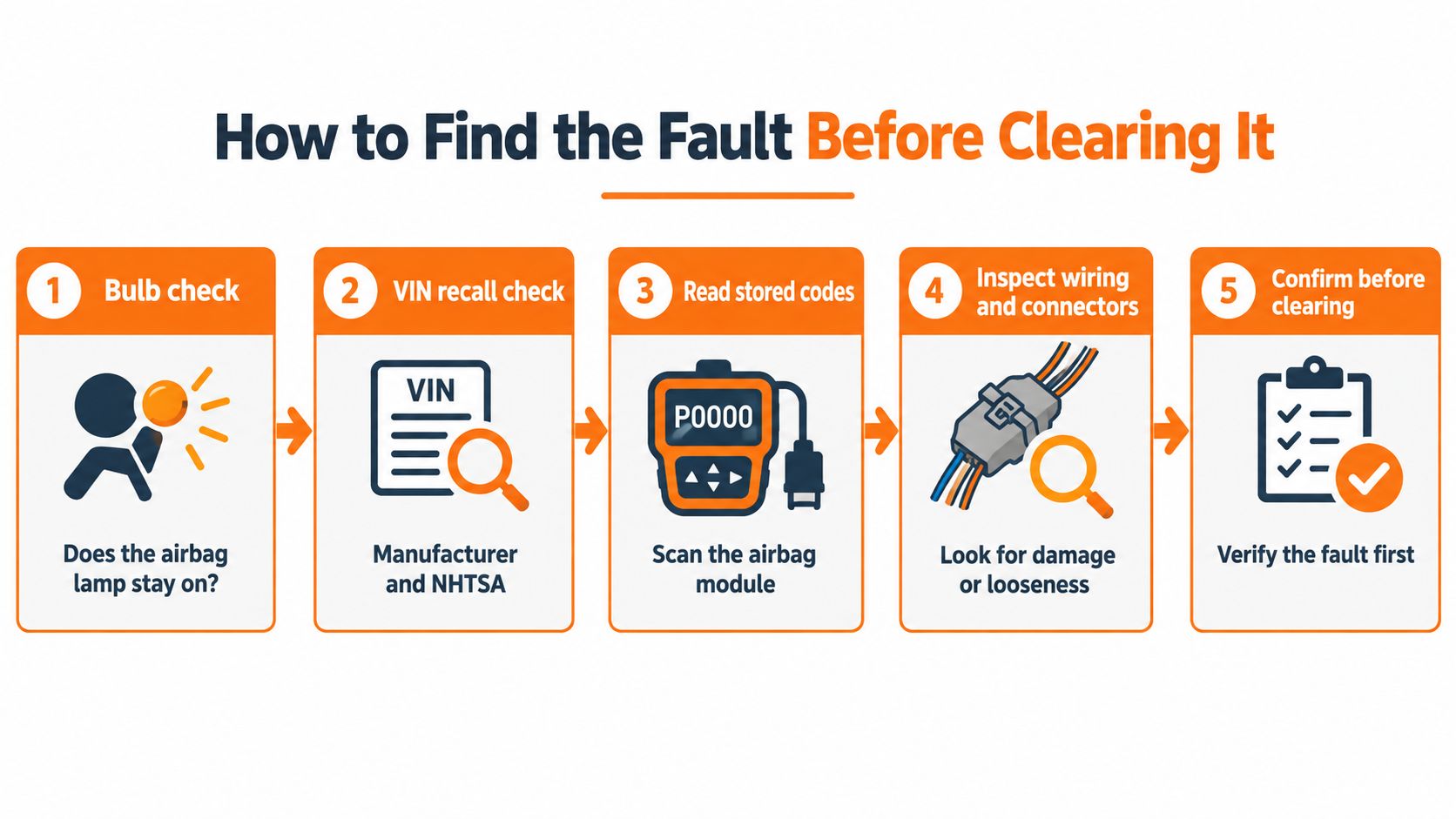
First, confirm the behavior. Does the lamp complete its startup check and then stay on, flash, or return while driving? Write that down with the date and any recent battery work, seat work, collision, spill, or jump start. Small details save diagnostic time later.
Second, check the VIN for open recalls with the manufacturer and NHTSA before authorizing paid parts. The Takata campaign alone covers approximately 67 million recalled inflators in the United States across 19 manufacturers, according to the NHTSA Takata recall spotlight. When a VIN has an open recall, the manufacturer remedy path comes before a paid module or belt repair. Heat, humidity, and time can degrade inflator propellant, so an older car deserves this check even if it has changed owners and regions.
Third, scan with a tool that explicitly supports that vehicle's SRS. Record the exact diagnostic trouble code and its description. A generic powertrain reader may not communicate with the restraint module at all.
The video below gives a visual walk through of reading and interpreting the warning before anyone reaches for a reset button.
Fourth, inspect only what's safely accessible and verify battery and charging health. Look for a disconnected plug, pinched harness, corrosion, or seat rail damage. Don't probe airbag initiator circuits with ordinary meters. Don't disconnect SRS connectors with the battery connected. These circuits involve pyrotechnic devices, so follow the manufacturer's service procedure or leave the inspection to a qualified shop.
Finally, fix the trigger and then clear and rescan. Clearing without correction lets the lamp return and proves nothing about protection. If you install a different airbag module, it requires programming to the vehicle's VIN, which requires a dealer. A junkyard unit isn't a plug and play shortcut.
You should finish this stage with two facts in writing. You have the exact code, and you know whether a recall is open.
Choosing a Reset Repair or New Parts
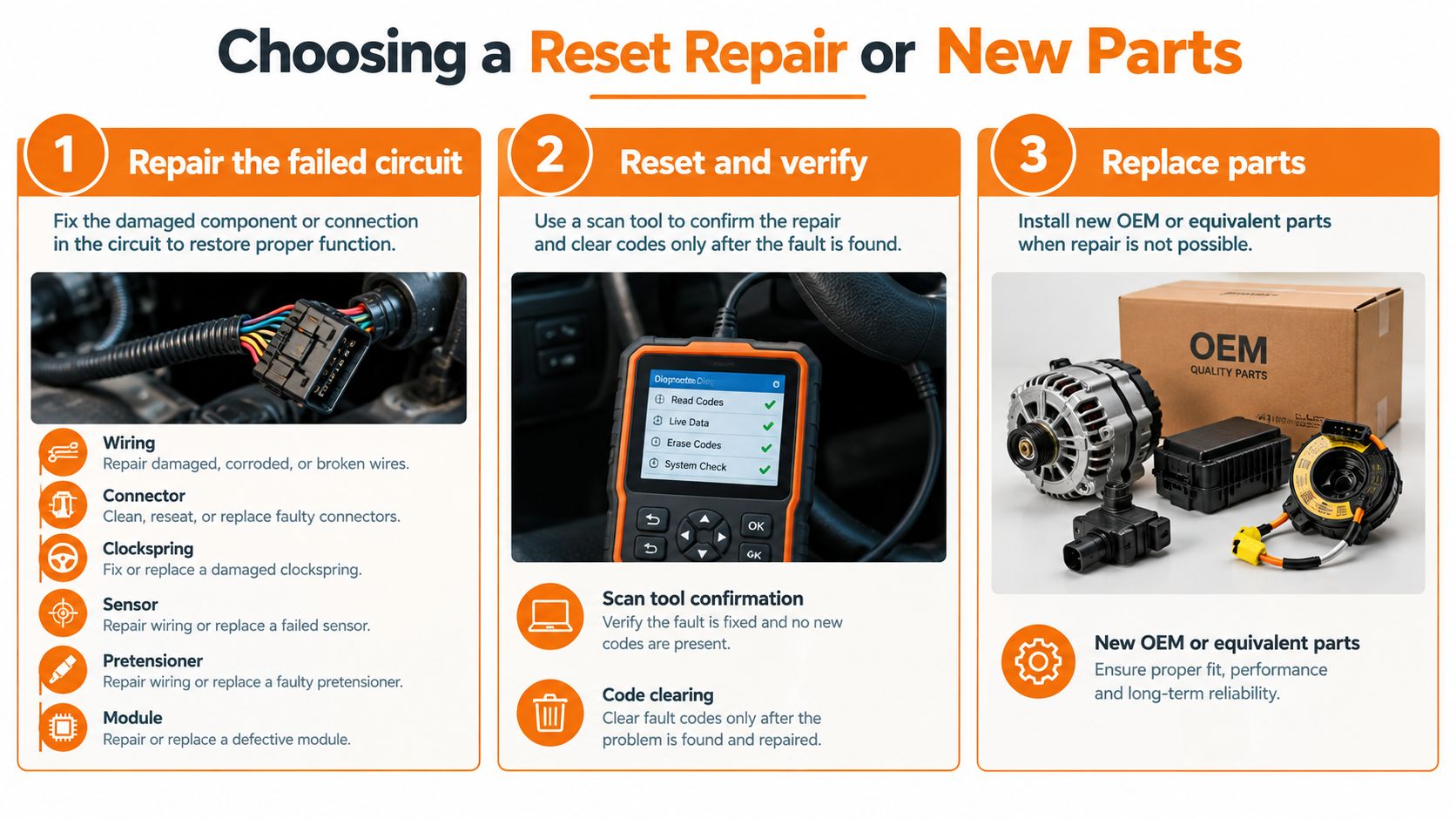
Once the code names the fault, three legitimate paths emerge. Choosing the wrong one usually doesn't fail dramatically. The lamp just comes back, and you've spent money without restoring protection.
Repair the failed circuit when the code points to wiring, a connector, a clockspring, a sensor, a pretensioner, or an occupant classification component. Repair or replace that failed item using the manufacturer's procedure, then run a post repair SRS scan. A module reset can't mend a broken wire, and clearing a code can't calibrate a seat sensor that requires calibration.
Restore the original module when the remaining problem is stored crash data after the physical repairs are done. This path fits a car that has been in an accident or crash, or was purchased from a salvage yard with airbags deployed or seat belts blown or locked. Deployed airbags, damaged belts, and broken wiring must already be addressed. Otherwise the restored module will detect the same faulty circuits again.
For a belt that locked or blew in the collision, Seat Belt Repair After Accident is described as an OEM seat belt repair service for locked or blown pretensioners after an accident. The related service information for an airbag module reset concerns the customer's original controller once crash data is the issue being addressed.
Replace the module or assembly when hardware is physically damaged, water damaged beyond proper restoration, or otherwise not serviceable under the manufacturer's guidance. A different module brings VIN programming into the job, as covered in the diagnostic section above. New parts can be the right call, but they don't excuse skipping the circuit inspection.
This comparison lays the three paths side by side so you can match the repair to the code.
The stakes justify the careful match. The Insurance Institute for Highway Safety reports that NHTSA estimated frontal airbags saved 4,330 lives in 2019 and 70,059 lives through 2019. In frontal crashes, airbags reduce driver fatalities by 29% and fatalities among front seat passengers aged 13 and older by 32%. Combining an airbag with a lap and shoulder belt reduces frontal crash death risk by 61%, compared with 50% for belts alone and 34% for airbags alone, according to the IIHS overview of airbag effectiveness research.
Belts and bags do their best work as a team. Pick the path that restores the team, not just the dashboard appearance.
What to Do Next With a Persistent Airbag Light
Leave the diagnostic appointment with three notes on paper or in your phone. Write the exact SRS code. Write whether the VIN has an open recall. Write whether the fault followed a crash, a deployment, or neither. Those three facts decide who should do the next step and who should pay for it.
If a recall is open, pursue the manufacturer remedy first. If the code points to a wire, connector, clockspring, sensor, or pretensioner, repair that circuit and verify it with a clean post repair scan. If a belt remains locked after the collision, information on how to fix a locked seat belt after an accident can help you separate belt hardware from module memory before you order anything.
If damaged airbags, belts, and wiring are already repaired and the scan still shows crash data or hard codes that an OBD airbag scan tool can't erase, restoring the original module becomes the practical next step. The SRS Airbag Module Reset is described as a service to reset your airbag light after an accident, clearing all crash data and hard codes in your SRS module. We clear crash data and hard codes to reset the airbag light, restoring the module to factory condition without additional programming. Our reset also erases crash data and hard codes that dealers and OBD airbag scan tools cannot reset, and we offer free shipping on that reset service.
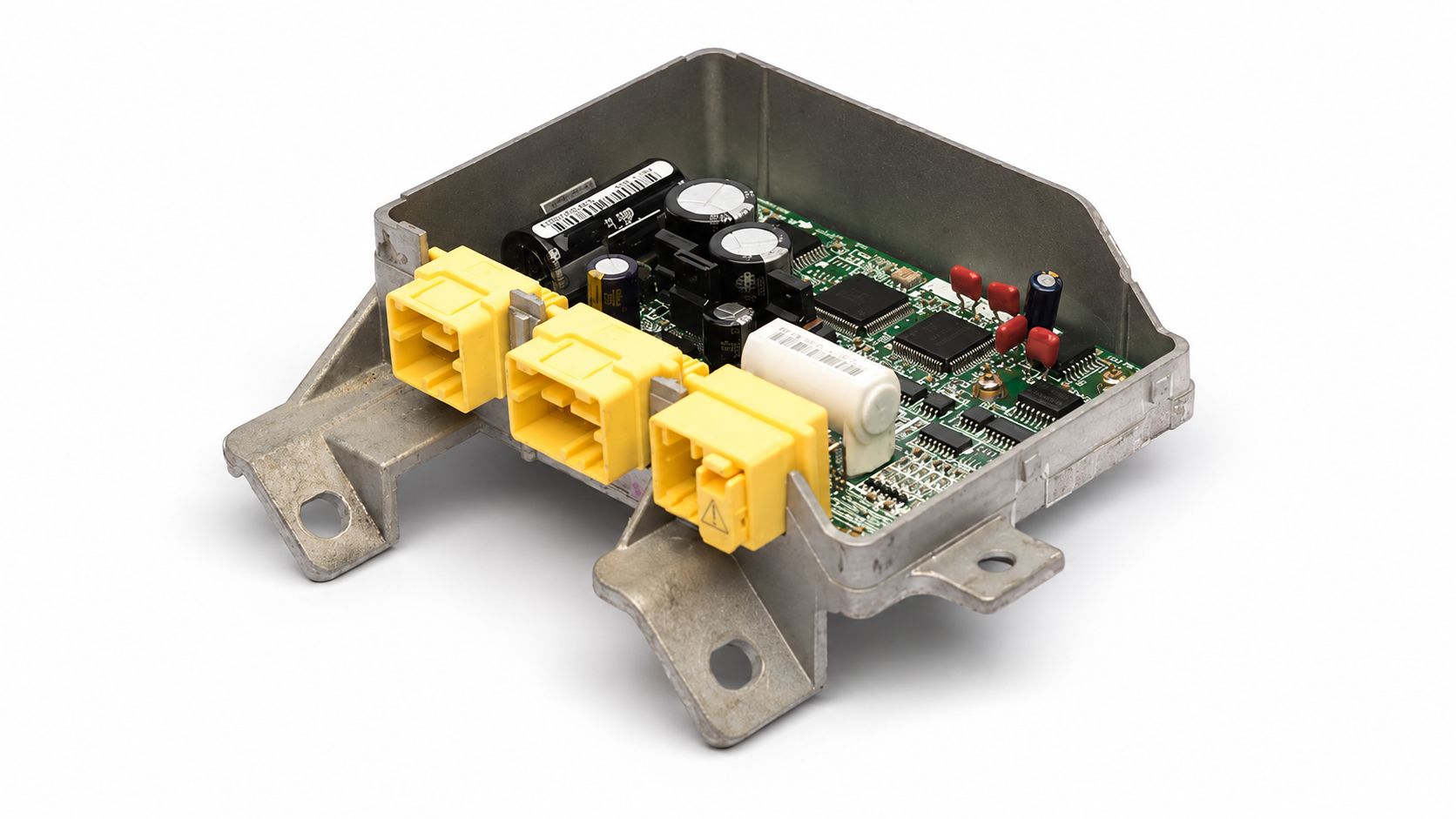
Sending your own removable controller avoids the mismatch problem that comes with an unmatched replacement unit. It doesn't replace a recall remedy, and it doesn't repair a chafed harness. Treat it as the step for stored crash memory after the rest of the restraint system checks out.
A dark dashboard isn't proof of protection. A clean post repair scan after the trigger is fixed is much stronger evidence.
Owners sorting out repair and insurance questions after a collision sometimes also need liability information, including who pays after Big Island crashes for Hawaii related situations. Keep that paperwork separate from the technical decision. The car still needs the right code, the right repair, and a final scan.
Do one thing next. Get the code and recall answer in writing, then act on the path those facts support.
If your scan confirms stored crash data or hard codes in the original module after the deployed parts and wiring have been repaired, we can restore that controller for reinstallation without additional programming. Send us the module rather than gambling on an unmatched replacement, then verify the repair with a post repair SRS scan. Visit Safety Restore to start the mail in process and get your restraint system checked back into service properly.

