
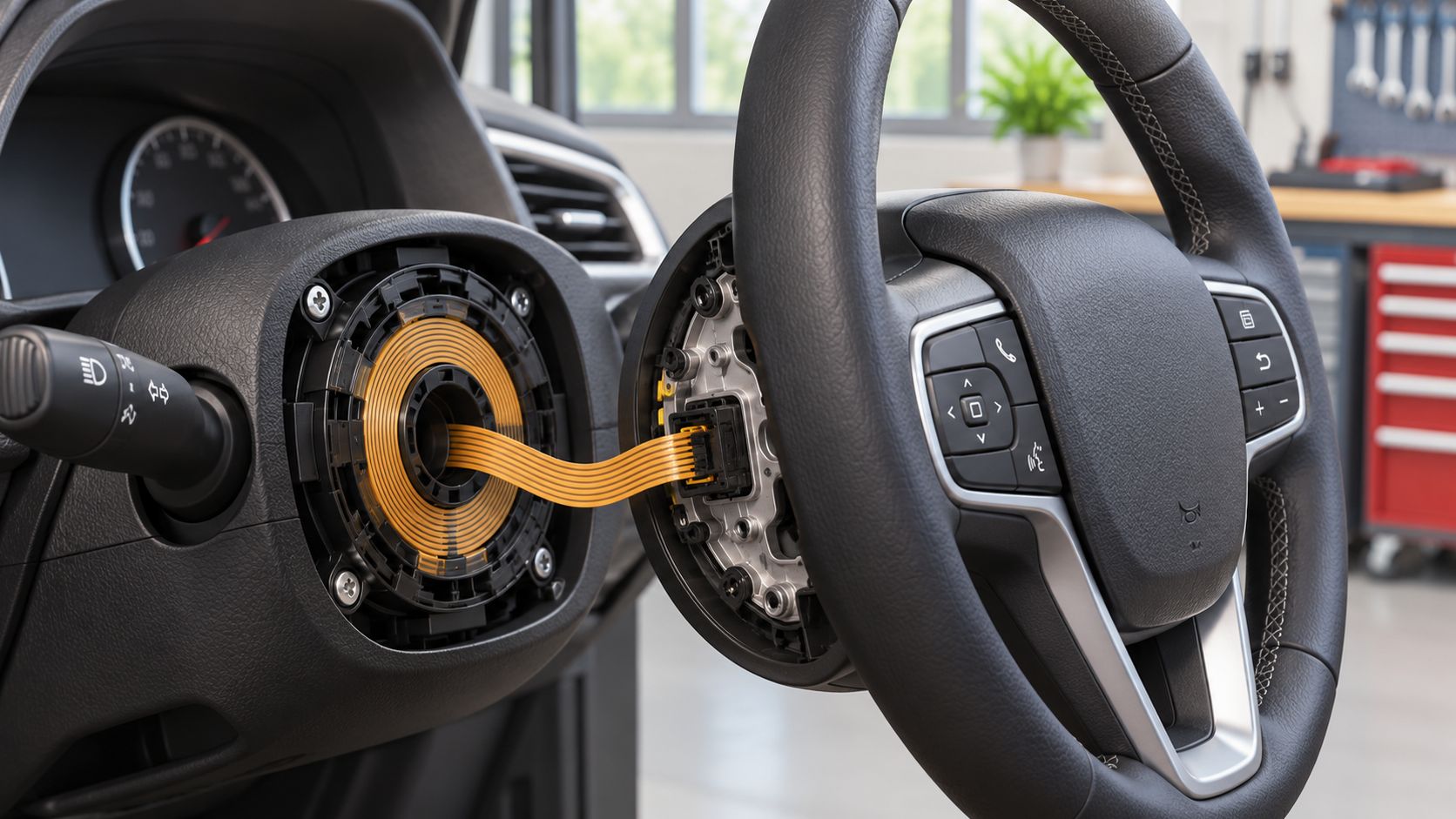
The horn works when you're driving straight, then cuts out as you turn into a parking space. Or the airbag light appears after a tight U-turn, while the wheel and the airbag itself seem fine. Those clues can point to the same small part hidden behind the steering wheel: the car clock spring.
The name sounds mechanical, but its job is electrical. It keeps circuits connected between the fixed steering column and the rotating wheel. Understanding which circuits it carries helps you distinguish a likely spring failure from a bad switch, a different SRS fault, or crash data that needs separate attention.
Table of Contents
- What a Car Clock Spring Actually Does
- Clock Spring Symptoms and Three Familiar Cases
- How the Ribbon Feeds Controls and the Airbag
- Why Clock Springs Wear Out or Break
- Repair Replace or Leave the Clock Spring
- Clear the Airbag Light After the Spring Is Good
What a Car Clock Spring Actually Does
A driver turns into a parking spot, and the horn works until the wheel nears full lock. Later, the airbag light comes on. Those symptoms might seem unrelated, but both can trace back to a flat, coiled ribbon behind the steering wheel.
That ribbon is the clock spring, also called a spiral cable. It sits between the steering column and the wheel, with one end connected to the stationary column wiring and the other to the wheel. As the wheel turns, the ribbon winds and unwinds inside its housing, preserving electrical connections without twisting a fixed wire until it breaks.
Think of a coiled phone cord: it can stretch and retract as you move the handset, but repeated bending or a snag can eventually damage it. A clock spring does a similar job inside a compact cassette, except it carries several vehicle circuits and has a limited range of rotation.
Convenience circuits and the safety circuit
The ribbon can carry the horn, cruise-control switches, audio and phone buttons, and, depending on the vehicle, heated-wheel controls or paddle-shift wiring. If several wheel-mounted functions fail together, their shared connection through the spring becomes one reasonable suspect. A single failed button is less conclusive because the button or its switch may be faulty instead.
The safety role matters more. The driver airbag's electrical firing circuit, often called the squib circuit, also runs through the ribbon on a typical modern steering wheel. If that connection opens or becomes intermittent, the SRS system can detect a fault and turn on the airbag warning lamp even if the airbag itself hasn't been damaged.
A clock spring isn't a suspension spring, and it doesn't turn the wheels or steer the car. It's a rotary electrical joint. The clues that help identify its failure are the combination of affected functions, whether the fault changes as the wheel turns, and what an SRS-capable scan tool finds. Those clues also help separate a spring replacement from work on an SRS module that still holds crash data.
Clock Spring Symptoms and Three Familiar Cases
Start by matching the symptoms you already have to the circuit involved. A basic engine-code reader may not access the airbag system, so a normal-looking OBD scan doesn't rule out a clock spring fault.
| What you notice | Circuit usually involved | First check |
|---|---|---|
| Airbag or SRS light stays on | Driver airbag loop through the ribbon | Use an SRS-capable scan tool, not a basic OBD reader |
| Horn dies near full lock, works straight | Horn wire in the coil | Try the horn at center and at both locks |
| Several wheel buttons fail together | Cruise, audio, or phone wires in the coil | Compare with column stalks, which often bypass the spring |
| Cruise cancels only while turning | Cruise wire in the same ribbon | Note whether it returns when the wheel is centered |
| Click or scrape behind the wheel while turning | Ribbon rubbing or unwinding unevenly | Listen during slow lock-to-lock turns in a quiet place |
| One button dead, everything else fine | Often the switch, not the spring | Don't replace the spring on one button alone |
The table gives you patterns, not proof. A horn that never works might have a faulty relay, and one dead steering-wheel button may have a failed switch. Several functions failing together, particularly when the fault changes with steering position, make a shared connection more plausible.
Case one: The commuter sedan
The driver's cruise and volume buttons stop working around the same time. The horn weakens near full lock, but there's no airbag warning, and the turn-signal and wiper stalks still work. The stalks don't necessarily share the clock spring's wiring path, so their normal operation doesn't clear the spring.
A shop should check the faults at different steering angles and scan the SRS system. The history matters, too: has the wheel been removed, or has the car had a collision? A bundle of wheel-mounted functions changing with wheel position is more informative than one isolated button failure.
Case two: The SUV after a curb strike
A ticking sound starts behind the wheel after a curb strike. The next morning, the airbag light is on. The impact may have damaged the spring ribbon or its housing, even if the SUV still steers normally.
The technician should listen during a slow turn, note where the fault appears, and use a scan tool that can read SRS codes. The curb strike is relevant history, but the scan and inspection help determine whether the spring is at fault or whether another part of the restraint system was affected.
Case three: The salvage car that still has a warning
A salvage vehicle has a deployed driver airbag. A new clock spring is installed, but the airbag light stays on. If the replacement is centered and the controls now work, fitting a second spring may accomplish nothing: the SRS module may still hold crash data or hard faults from the deployment.
A shop needs to scan the SRS system and review the vehicle's deployment and repair history. The key distinction is whether the current fault points to the ribbon or to stored crash information and other deployed hardware. Those are different repairs, even if both keep the same warning lamp on.
How the Ribbon Feeds Controls and the Airbag
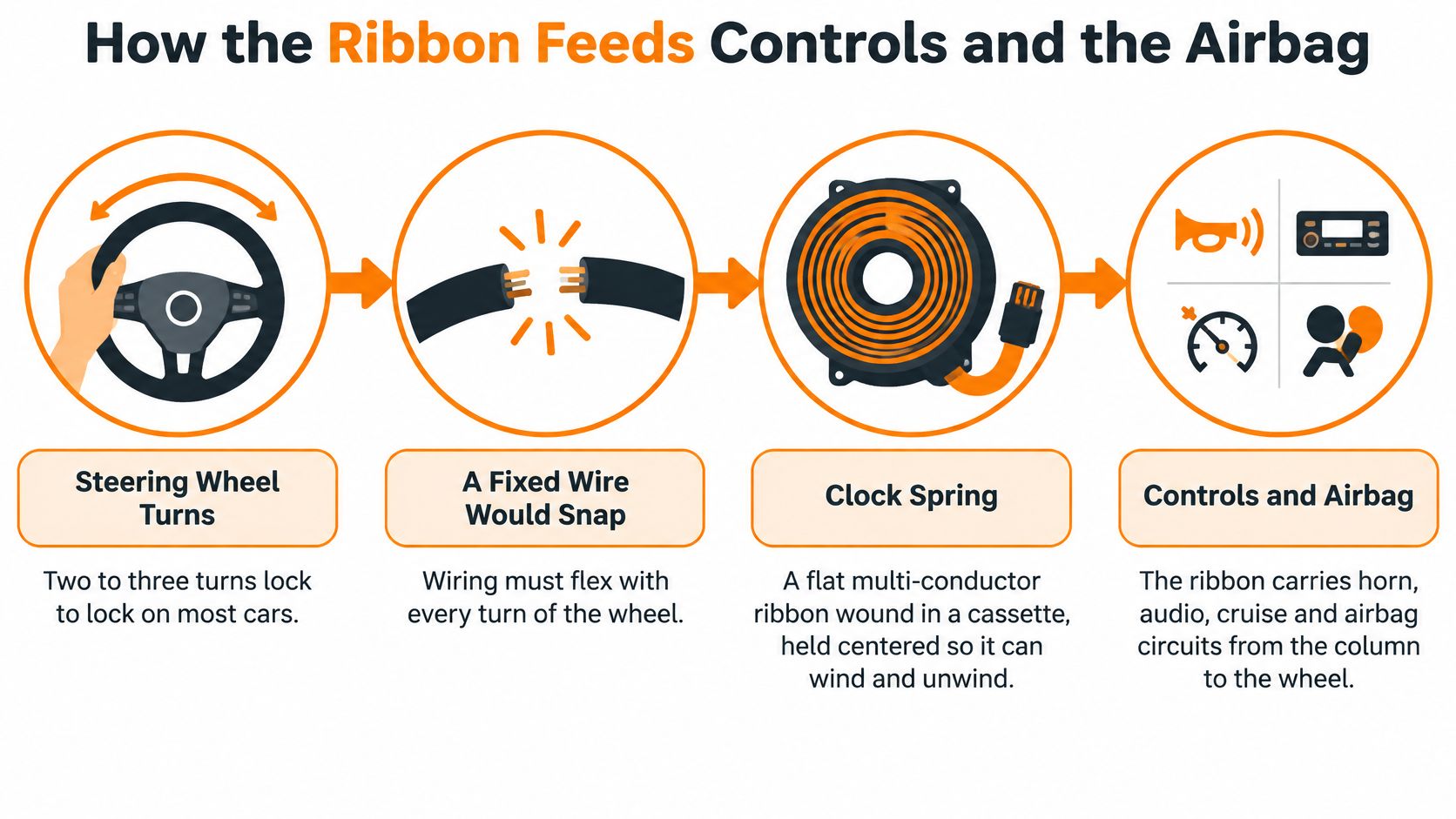
Start at the wheel and follow the wiring toward the car. The steering wheel rotates, while the wiring behind it connects to stationary wiring in the column. A fixed wire stretched across that joint would twist and eventually break, so the clock spring lets a flat ribbon flex inside a cassette instead.
From column to wheel
One end of the ribbon connects to the column harness; the other connects to the wheel. Turning one way winds the coil tighter in that direction. Turning the other way lets it unwind. The cassette must be centered correctly so it has enough travel in both directions.
Some vehicles package a steering-angle sensor in or near the clock spring assembly. Stability control and certain driver-assistance systems may use its signal to understand the wheel's position. If the spring or sensor is damaged, or the unit is installed off-center, the effects can reach beyond the horn and wheel buttons.
Two circuit paths through one part
Press the horn pad and the switch completes the horn circuit through the ribbon toward the horn relay. Press an audio or cruise button, and its signal travels through a different wire in the same flexible assembly.
The airbag circuit uses the ribbon too. The SRS module monitors the driver airbag squib circuit for an expected electrical condition. An open, short, or resistance outside the expected range can trigger a warning and may disable deployment through that circuit. A scan tool can identify the system or circuit reporting a fault, but the code alone doesn't always prove which physical part has failed.
On a typical modern steering wheel, the driver airbag shares the clock-spring ribbon with the wheel controls. It doesn't use a separate slip ring that bypasses a damaged ribbon.
Not every SRS component routes through the clock spring. Passenger airbags, seat belts, and impact sensors have their own connections, so a clock spring fault doesn't explain every airbag warning. The repair choice depends on whether the ribbon is damaged, a different circuit is at fault, or a separate SRS problem remains. Seat-belt pretensioner work is separate from clock-spring work; Safety Restore's seat belt buckle and pretensioner service addresses those components.
Why Clock Springs Wear Out or Break
Every turn flexes the ribbon. A car that spends much of its life making short trips and turning through parking lots puts the steering wheel through frequent movements, while a mostly highway-driven car may see fewer turns despite a similar odometer reading. Normal flex can eventually fatigue a ribbon, but there's no reliable mileage that predicts exactly when one will fail.
Damage from removal or a crash
A clock spring can be damaged during steering-wheel work if it spins freely after the wheel is removed. The unit has limited rotation; if it's no longer centered, it may run out of travel and tear when the wheel reaches full lock. The locking pin or shipping restraint must stay in place until the service procedure calls for its removal.
A collision can damage the wheel, column, or clock spring housing even when the car remains driveable. If the driver airbag deployed, the wheel and spring may both need replacement, but the full repair depends on inspection and SRS diagnosis. Replacing the spring alone won't fix deployed hardware or faults elsewhere in the restraint system.
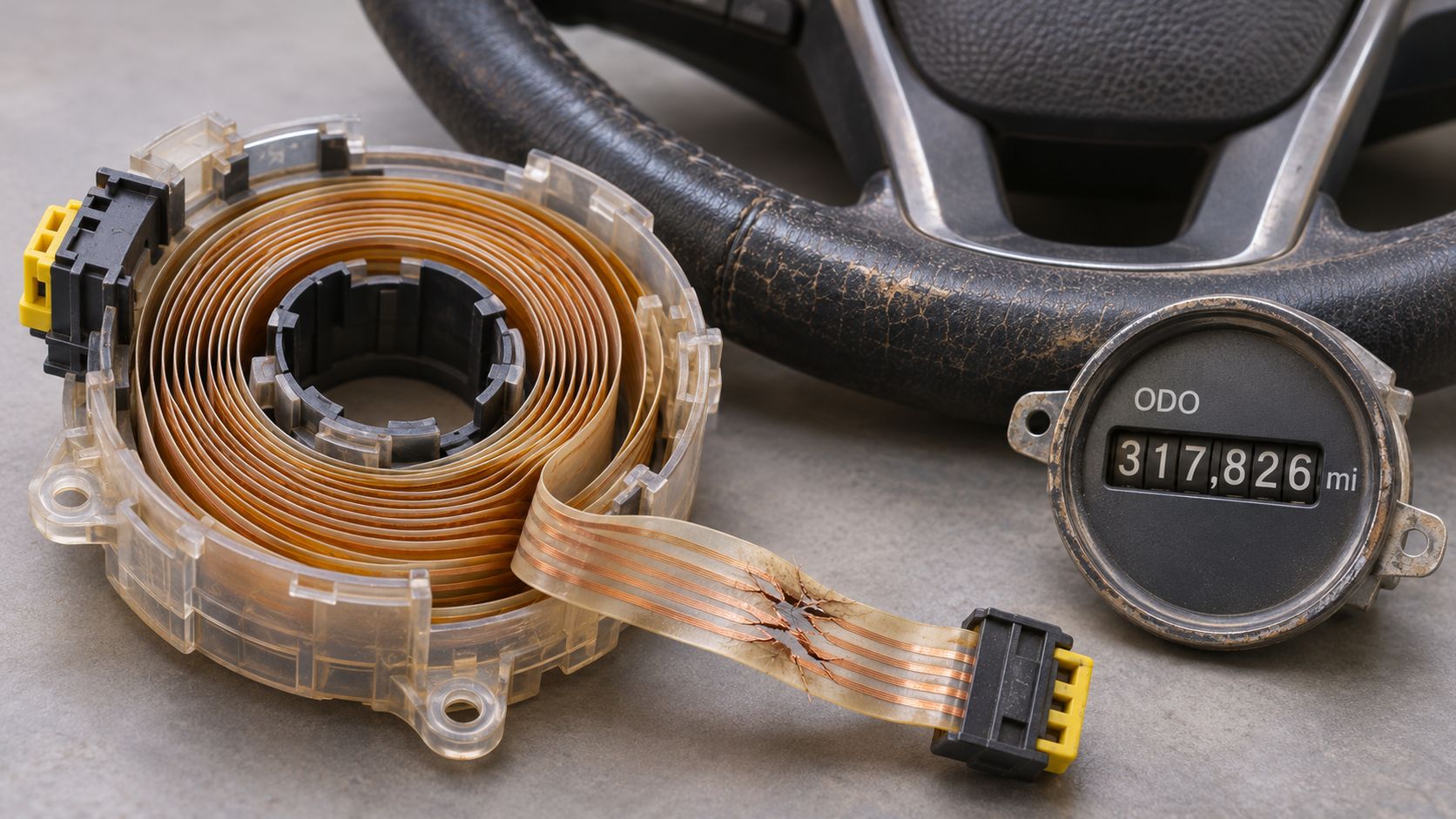
Water or corrosion can cause electrical trouble if moisture reaches the column area, such as through a leak or careless pressure-washing near the steering column. An aftermarket wheel or quick-release hub can also create problems if the installer doesn't provide a suitable way to keep the circuits connected.
Listen, but don't diagnose by sound alone
A click, scrape, or tick that changes with steering movement deserves attention, but noise by itself isn't proof of a broken ribbon. Cold weather can make a dry ribbon or its housing noisier; if the sound fades as the cabin warms, the change is useful to tell the technician, not a reason to assume the part is sound.
A new clock spring can fail on its first drive if it goes in off-center. Correct centering protects the ribbon from being stretched past its travel limit.
Before ordering a replacement, confirm the part matches the vehicle's equipment and connectors. A spring for a wheel without heating or extra controls may not support a wheel that has those features. Matching by vehicle configuration and part information is safer than relying on a similar-looking unit.
Repair Replace or Leave the Clock Spring
A torn clock spring is replaced, not spliced. The ribbon sits inside a sealed coil, and a patch or twisted repair can leave the driver airbag circuit unreliable.
The usual repair path is deliberate because the work involves the steering wheel and airbag:
- Confirm the fault. Scan the SRS system and check whether the symptoms change at different steering angles. Don't treat a fault code as proof of a failed spring until the circuit and other likely causes have been considered.
- Power down the system. Disconnect the battery and wait for the time specified in the vehicle's service manual before touching the airbag. Don't unplug an airbag connector while the battery is connected.
- Remove the module and wheel safely. Keep the front wheels straight, and keep the spring locked or pinned as directed by the service procedure. Don't test-fire an airbag or any restraint component.
- Fit the correct centered spring. Match the replacement to the vehicle's equipment. Keep it centered and secured until it's seated in its proper position.
- Reassemble and verify. Reconnect the system, clear codes with an SRS-capable tool, and check the horn and wheel controls. Confirm the airbag lamp behaves normally.
- Calibrate when required. Some vehicles need a steering-angle calibration, particularly when stability control reads that sensor.
A used spring from a wreck is a gamble if nobody knows whether it's still centered. Even an undamaged-looking unit can have too little travel in one direction if someone rotated it while it was off the wheel.
Spring replacement versus post-crash module work
| Situation | What usually needs work | Success looks like |
|---|---|---|
| Buttons or horn fail, no crash history, spring code | Clock spring replacement, wheel centered | Controls work at full lock and the lamp stays off |
| Airbag light only, no spring code, no crash | Diagnosis first, not an automatic spring | The stored code matches the failed circuit |
| Light returns after a new centered spring and a prior deployment | SRS module still holding crash data, plus any deployed parts | Lamp off after module service and completed vehicle repairs |
| Deployed driver bag and damaged wheel | Spring, wheel or bag, and module as the scan requires | No open squib codes and a centered angle sensor |
| Used spring installed off-center | Another new spring, correctly pinned | No click at full lock and no new circuit code |
A scan tool helps identify reported faults and verify the repair, but it doesn't physically repair a torn ribbon or damaged airbag. After a collision, the clock spring may be only one part of the repair; seat belts and other restraint components need their own inspection. Safety Restore's seat belt repair after an accident is a separate service for those components.
Clear the Airbag Light After the Spring Is Good
If the scan still points to the spiral cable, finish diagnosing and repairing the clock spring before pursuing module work. If the spring is new and centered, the horn and buttons work, and the warning remains after an airbag deployment or salvage repair, the SRS module may still hold crash data or hard faults.
The SRS module is the system's computer. It communicates with impact sensors, seat belts, airbags, and the clock spring, but a good ribbon can't erase crash information held in the module. Clearing codes with a general scan tool may not remove data that requires module service.
For a vehicle with a sound spring and completed repairs, Safety Restore offers an OEM SRS module reset to clear crash data and hard codes. Customers send in the module for factory reset and reinstall it after the repairs flagged by the system are complete. The service is $99.99 per module, includes free shipping, has a 24-hour turnaround after the module arrives at its repair center, and carries a lifetime warranty. Safety Restore's airbag module reset service returns the module toward factory condition; a reset doesn't repair a torn spring, replace a deployed airbag, or fix a locked seat belt.
Use this order: prove the spring is working, repair any deployed or damaged hardware, then reset the module if crash data is all that remains. If the airbag light is on, don't assume the system will protect you normally until the underlying fault is diagnosed and repaired.
Safety Restore offers mail-in SRS airbag module resets for crash data and hard faults, with a lifetime warranty on the reset service. If the clock spring is already sound and the repaired vehicle still has stored crash data, visit Safety Restore to learn about sending in the module.

