
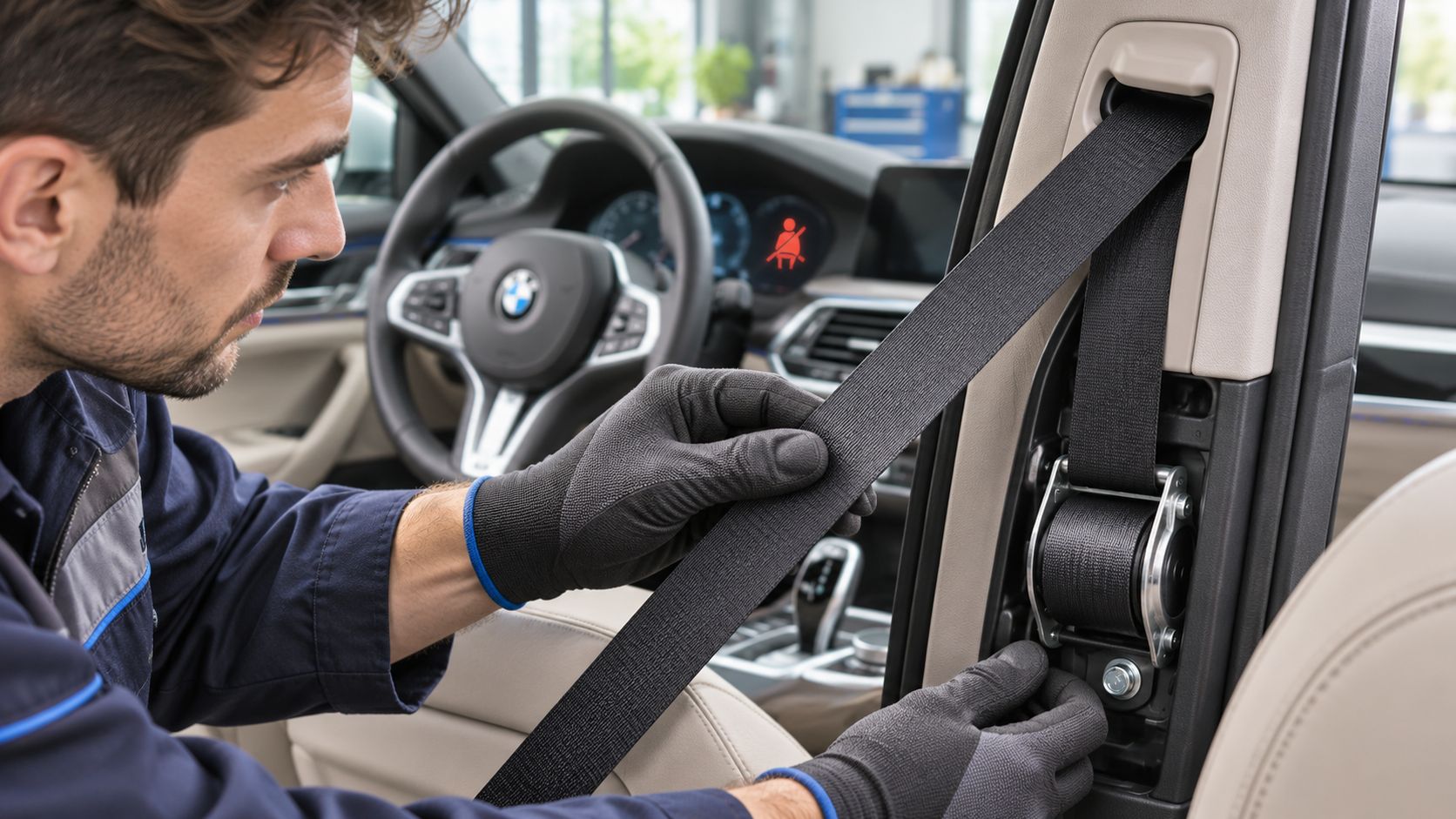
A crash can leave you with a BMW that looks mostly intact but has a belt you can't pull out and an airbag warning that won't go away. It's tempting to tug harder, clear the warning, or order a complete replacement assembly. First identify which part has failed: the retractor, buckle, webbing, or restraint-system electronics.
A normal-looking belt isn't proof that it's ready to protect you. The pretensioner can be hidden inside the retractor or seat base, where a fired charge leaves the mechanism locked even though the strap itself looks fine.
Table of Contents
- BMW Belt Symptoms After a Collision
- Repair or Replace the BMW Assembly
- How a BMW Pretensioner Works
- Pretensioner Layouts on Common BMWs
- How to Restore the Original Assembly
- Send the Original BMW Belt for Repair
BMW Belt Symptoms After a Collision
If the airbags fired and a belt is locked fully retracted, suspect a fired retractor pretensioner. Don't force it out. A pretensioner is a one-time device, and pulling harder won't restore its mechanism.
Use the symptom table to narrow down what needs attention before ordering parts.
| What you see | Likely cause | Next move |
|---|---|---|
| Belt locked and won't pull out after airbags fired | Fired retractor pretensioner | Repair the original retractor and pretensioner |
| Belt extends but won't rewind | Rewind spring, lock, or sensor fault | Rebuild the retractor mechanism |
| Buckle won't latch or release | Fired or damaged buckle pretensioner | Repair the buckle pretensioner |
| Webbing cut, frayed, or heat-marked | Damaged strap, not only the mechanism | Replace webbing on the original hardware |
| Airbag light stays on and belts look normal | Crash data still stored in the SRS module | Reset the module after the belts are repaired |
| Rear belt still works; only a front belt locked | Front stages fired; rear belt unfired | Repair only the affected front assembly |
Many BMWs place the pyrotechnic charge inside the retractor at the B-pillar or seat base. That means a strap can look undamaged while its pretensioner has already fired. A buckle may also contain its own pretensioner, so a belt that extends normally can still have a faulty latch assembly.
A warning light alone doesn't identify the failed part. A BMW-compatible scan tool can help distinguish stored crash data from an active circuit fault, but clearing a code won't repair a locked mechanism. For a belt that stays locked after a collision, guidance on fixing a locked seat belt after an accident can help you understand the repair route.
Pick the row that matches what you see before ordering anything. If more than one symptom applies, note each one: a fired pretensioner and damaged webbing may need separate work on the same assembly.
Repair or Replace the BMW Assembly
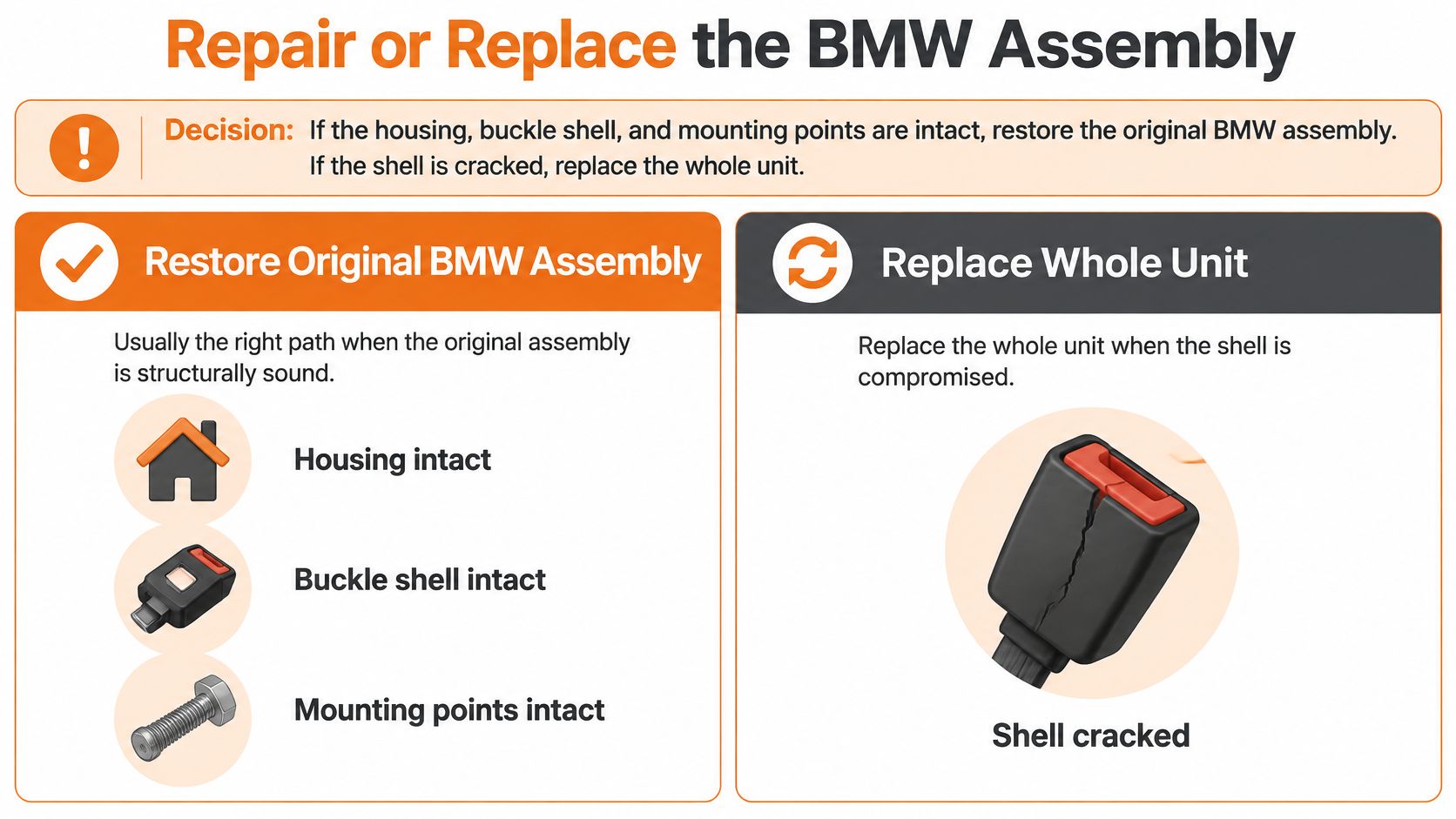
If the retractor housing, buckle shell, and mounting points are intact, restoring the original BMW assembly is usually the sensible route. Replace the whole unit when its shell is cracked, a buckle stalk is bent, or the mechanism has been burned or contaminated by floodwater.
| Criterion | Restore the original | New assembly |
|---|---|---|
| Best when | Housing, anchors, and plugs are intact | Shell is cracked, bent, burned, or flood-soaked |
| Fitment | Original BMW plugs and hardware stay | Must match year, chassis, and side exactly |
| Parts supply | Uses the belt already in the car | Older BMW numbers may be discontinued |
| What gets fixed | Spent charge, lock, and sensor | Entire unit, including undamaged parts |
| Webbing damage | Separate webbing service if the strap is cut | Included only if the new belt is complete |
| Downtime | Typically one day after the shop receives it | Depends on dealer or aftermarket stock |
The fitment advantage is straightforward. A repaired original assembly keeps the connectors, anchors, and belt color already matched to the car. A replacement has to match the BMW's chassis, model year, side, and restraint configuration. A used belt can appear compatible but may have a different connector or a charge that has already fired.
The repair route also has limits. Rebuilding a retractor won't mend a cut strap, and replacing webbing won't release a fired pretensioner. Some belts need both services. A cracked retractor housing, buckle torn from the seat frame, or flood contamination inside the mechanism pushes the decision toward replacing the assembly.
If you're sorting out repair paperwork or the value of a damaged vehicle, an independent appraisal after a crash can help document the vehicle's condition separately from the belt repair. For an airbag warning that remains after the mechanical work, the airbag module reset service addresses stored crash data, not a belt that still needs rebuilding.
Restore the original when the shell is sound; replace only when the shell itself is scrap.
How a BMW Pretensioner Works
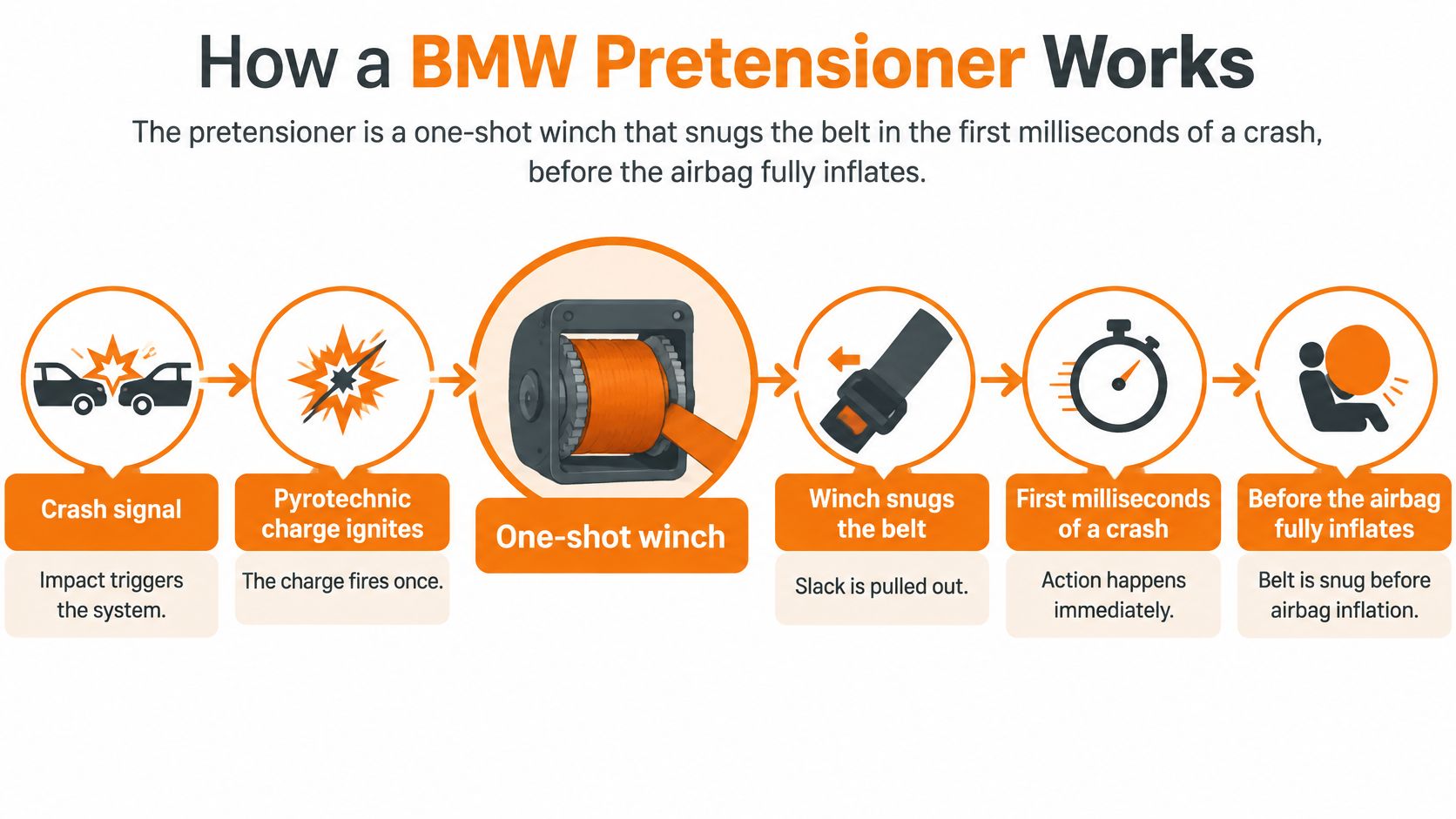
Think of a seat belt as a fishing reel. During ordinary driving, a rewind spring lets the strap out and pulls it back in. During a crash, a small pyrotechnic charge acts like a one-time winch, pulling slack out of the belt so the occupant is held in position before the airbag fully inflates.
The sequence starts when the restraint control module detects a crash severe enough to trigger the system. It sends a signal to the pretensioner. The charge ignites, and a piston or cable pulls the retractor spool, tightening the belt. That action happens in the first moments of the collision, when controlling slack matters.
The lock and the other belt parts
After the charge fires, the retractor may remain locked. That lock is intentional during a crash, but it means the belt may no longer feed out afterward. The spent charge can't be made usable again by tugging the strap or cycling the ignition.
The pretensioner isn't the same as the force limiter. The pretensioner removes slack early; a force limiter can allow controlled webbing movement later in the crash to manage load on the occupant. Some BMWs also have a separate buckle pretensioner at the latch. If that unit fires or is damaged, the buckle may stop latching or releasing even when the retractor seems free.
A warning light and a locked belt are related clues, but they're not the same repair. Clearing a fault code may address crash data stored in the restraint module, but it won't replace the spent charge or free a mechanically seized retractor. A scan tool that only erases a code leaves that mechanical problem in place.
For the retractor side of the job, BMW seat belt retractor repair focuses on restoring the mechanism inside the original assembly.
Restoration means rebuilding the one-shot hardware inside the original shell, not hoping the belt frees itself.
Pretensioner Layouts on Common BMWs
Start with the front outboard belt. On many BMWs, its pretensioner sits inside the retractor, mounted low on the B-pillar or at the seat. The yellow connector identifies a restraint-system circuit, but don't assume every BMW uses the same connector layout. Record how many connectors and circuits are present before removing anything.
A dual-stage unit has two firing circuits. If the belt has more than one circuit, the repair has to account for both. A connector that looks similar isn't enough to confirm fitment: match the side, mounting arrangement, and original hardware.
The buckle can be a separate unit
On some models, a second pretensioner sits at the buckle stalk. In that setup, the retractor may still extend and rewind while the latch itself won't travel properly. Check the buckle separately rather than assuming the retractor is the only part involved.
Say a front passenger belt pulls out, but the buckle won't accept the tongue. That points you toward the buckle assembly and its wiring, not automatically toward the retractor. Avoid forcing the latch or probing its connector.
Check the rear belt on its own
Rear outboard belts on many BMWs use a simpler retractor arrangement. If only the front airbags and front pretensioners deployed, a rear belt may not have fired. Test its operation and inspect it rather than replacing it by habit.
Some vehicles also use an anchor pretensioner at the lower mounting point, where the pull happens at the anchor instead of the spool. Count the connectors and label each part before shipping. A driver-side retractor and passenger-side buckle are two separate items, not one assembly.
When you remove a belt, tag it with its seat position and side. That small step helps ensure each repaired unit goes back to the correct location.
How to Restore the Original Assembly
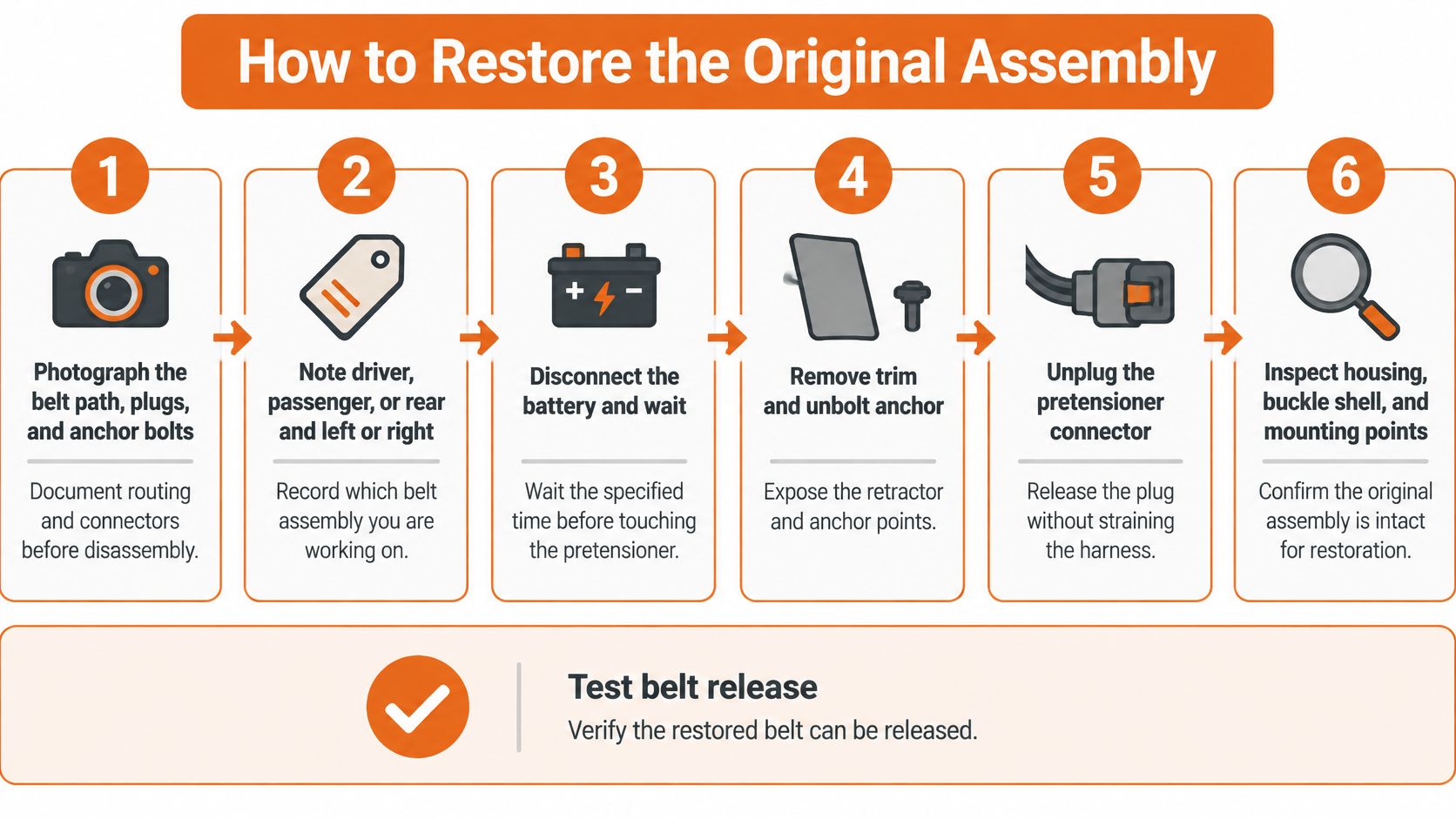
A safe repair starts with identification and careful removal. Don't cut, heat, open, or electrically probe a pretensioner. The charge and restraint wiring aren't driveway test points, and forcing a connector can damage the circuit.
Document the installation. Photograph the belt path, plugs, anchor bolts, and trim before disassembly. Write down whether the assembly is front or rear, driver or passenger, and left or right.
Make the vehicle safe to work on. Disconnect the battery and follow the BMW service procedure for waiting before touching any yellow restraint connector. The required wait is model-specific, so use the service information for your car rather than guessing.
Remove only the affected assembly. Unbolt the retractor and, if it fired, the buckle pretensioner. Keep the original hardware, labels, and tags together. Don't pull on the wiring to free a plug.
Inspect the shell and strap. Look for a cracked housing, bent buckle stalk, damaged mounting points, and cut, frayed, or heat-marked webbing. Those conditions can change whether the original assembly is a suitable candidate for restoration.
Send the parts that match the symptoms. Package each removed belt with its receipt and label its position. If both front pretensioners fired, repairing only the driver side leaves the passenger side unresolved.
Safety boundary: Removing a complete assembly is different from opening it. Leave the charge, internal lock, and sensor work to a qualified repair operation.
The mechanism repair restores the internal operation, including releasing the seized retractor and replacing the spent charge and sensor. The assembly should return ready to fit back into its original mounting points. Don't try to substitute an unmatched used retractor: it may already be spent or have the wrong connector.
Reinstall and verify
Refit the assembly in its original position. Route the belt through the guides as photographed, secure the anchors correctly, and reconnect the restraint plugs without forcing them.
Finish the restraint-system work. Reinstall trim and reconnect the battery according to the vehicle procedure. If the airbag warning remains, diagnose and address the module or any active fault after the mechanical repair. Clearing the module first won't make a fired belt usable.
Check function before carrying anyone. Confirm that the belt extends, locks when pulled sharply, rewinds fully, and latches and releases normally. Verify that the restraint warning is off after the system is checked.
Shortcuts can leave the car with a belt that looks repaired but still fails a basic function check. New webbing on a locked retractor won't make it feed out. A rebuilt mechanism with cut webbing still leaves a damaged strap in service. Pulling harder can damage webbing without resetting the charge.
Single-stage, dual-stage, and buckle units follow the same owner-side process: identify, disconnect safely, remove the complete assembly, and label it. A belt that still won't pay out isn't ready for use.
Send the Original BMW Belt for Repair
If the housing and mounting points are intact and the symptom points to a fired or locked pretensioner, you may not need to keep shopping for a complete replacement assembly. Safety Restore repairs the retractor and pretensioner inside original OEM belts, including single-stage, dual-stage, triple-stage, and buckle pretensioners.
For a locked or blown pretensioner, the OEM seat belt repair service is $99.99 per item. Pay online, remove the affected belt assembly, and mail it with the receipt. The repair is completed within 24 hours of receipt, then shipped back for reinstallation.
Send only the affected belts, and label each one by side and seat position. If the retractor is the problem, use the seat belt repair service; for a fired buckle, the Seatbelt Buckle Pretensioner Repair After Accident listing identifies the buckle-specific service. If the airbag warning remains after the belt is reinstalled, the restraint module may need separate attention.
When the original assembly is structurally sound, restoring it can avoid waiting for a replacement belt that may not be necessary.
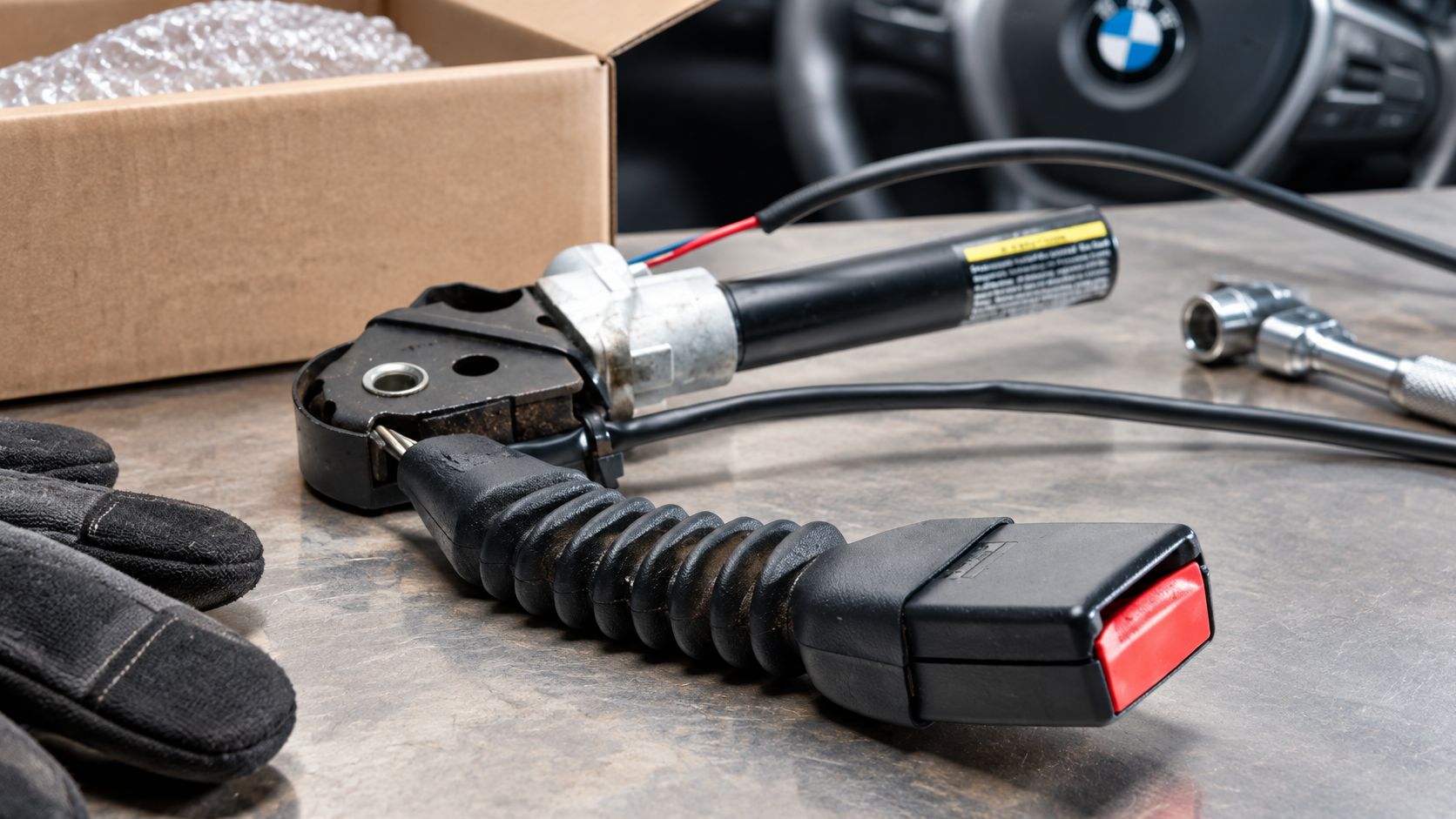
Safety Restore repairs original OEM seat belt retractors and pretensioners, including BMW assemblies, and returns them ready for reinstallation. If your belt is locked after a crash, visit Safety Restore to arrange repair of the affected assembly.


