
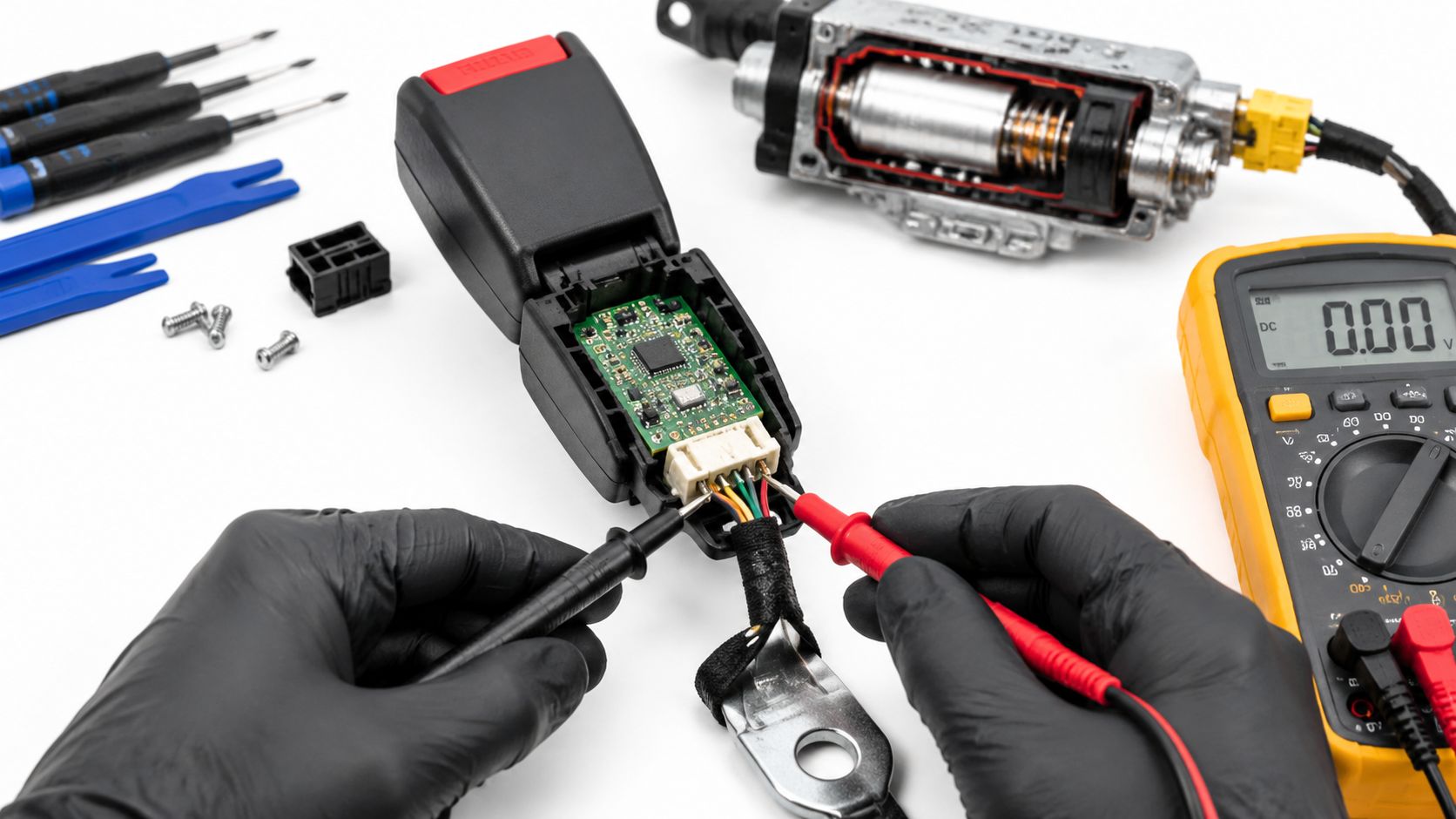
You've just had a minor collision, or perhaps only moved the seat after a repair. Now the airbag light stays on, the belt won't retract normally, or the buckle chime behaves as if nobody is wearing a belt. The car may still start and drive, but the restraint system is telling you it can't verify that every part is ready.
That warning deserves more attention than a comfort issue. A seat belt sensor, buckle switch, retractor, pretensioner, wiring harness, and SRS control module work as one crash-protection system. A scan-code reset might remove a message from memory, but it can't rebuild a fired pretensioner or repair a broken circuit. The right fix depends on what failed.
This guide follows the same logic a careful collision technician would use. You'll learn what each component does, which symptoms point toward a buckle, sensor, wiring fault, or module problem, how to diagnose the system without creating a new hazard, and when a mail-in repair makes more sense than replacing an entire OEM assembly.
Table of Contents
- Introduction Why Your Seat Belt Sensor Matters More Than You Think
- How Seat Belt Sensors and Pretensioners Work Together
- Common Causes and Warning Signs of Sensor Failure
- How to Diagnose Seat Belt Sensor and Pretensioner Faults
- Repair Options and When to Choose Each One
- Mail In Seat Belt and Module Repair With Safety Restore
- Final Checks and Getting Back on the Road Safely
Introduction Why Your Seat Belt Sensor Matters More Than You Think
After a minor crash, the belt may look normal while an internal safety part has already activated. The webbing might still pull through the retractor, yet remain locked, refuse to retract, or trigger an SRS warning because the pretensioner fired. In another vehicle, the belt can operate mechanically while a buckle switch or under-seat connector sends the wrong status.
The difference matters because the seat belt system is a connected safety network, not only a strap and latch. The vehicle's Supplemental Restraint System, or SRS, control unit compares signals from the buckle, occupant detection system, and restraint circuits while managing crash protection. An open circuit, short, deployment event, or implausible signal can turn on the airbag warning light.
The practical rule: If the light returns after clearing, the vehicle still detects a fault that has not been repaired.
Pretensioners and load limiters affect how the belt manages crash forces. NHTSA research found that vehicles equipped with these features had a 12.8% lower fatality risk compared with a belted occupant in a vehicle without them (NHTSA research on pretensioners and load limiters). A locked retractor or incorrect belt-position signal therefore needs safety-focused diagnosis, not repeated code clearing.
The correct repair depends on the failed part. A loose connector may need to be secured, while a fired pretensioner may require retractor rebuilding or replacement. A faulty buckle calls for buckle repair or replacement, damaged wiring needs circuit repair, and a crash-affected SRS module may need a reset after the physical restraint parts are restored.
Safety Restore offers a mail-in option for customer-supplied seat belt mechanisms and SRS modules. Send the relevant part only after diagnosis identifies it. Clearing crash data alone cannot reset a fired pretensioner, restore a broken wire, or correct a defective buckle signal. It may remove the stored message briefly while leaving the underlying failure in place.
How Seat Belt Sensors and Pretensioners Work Together
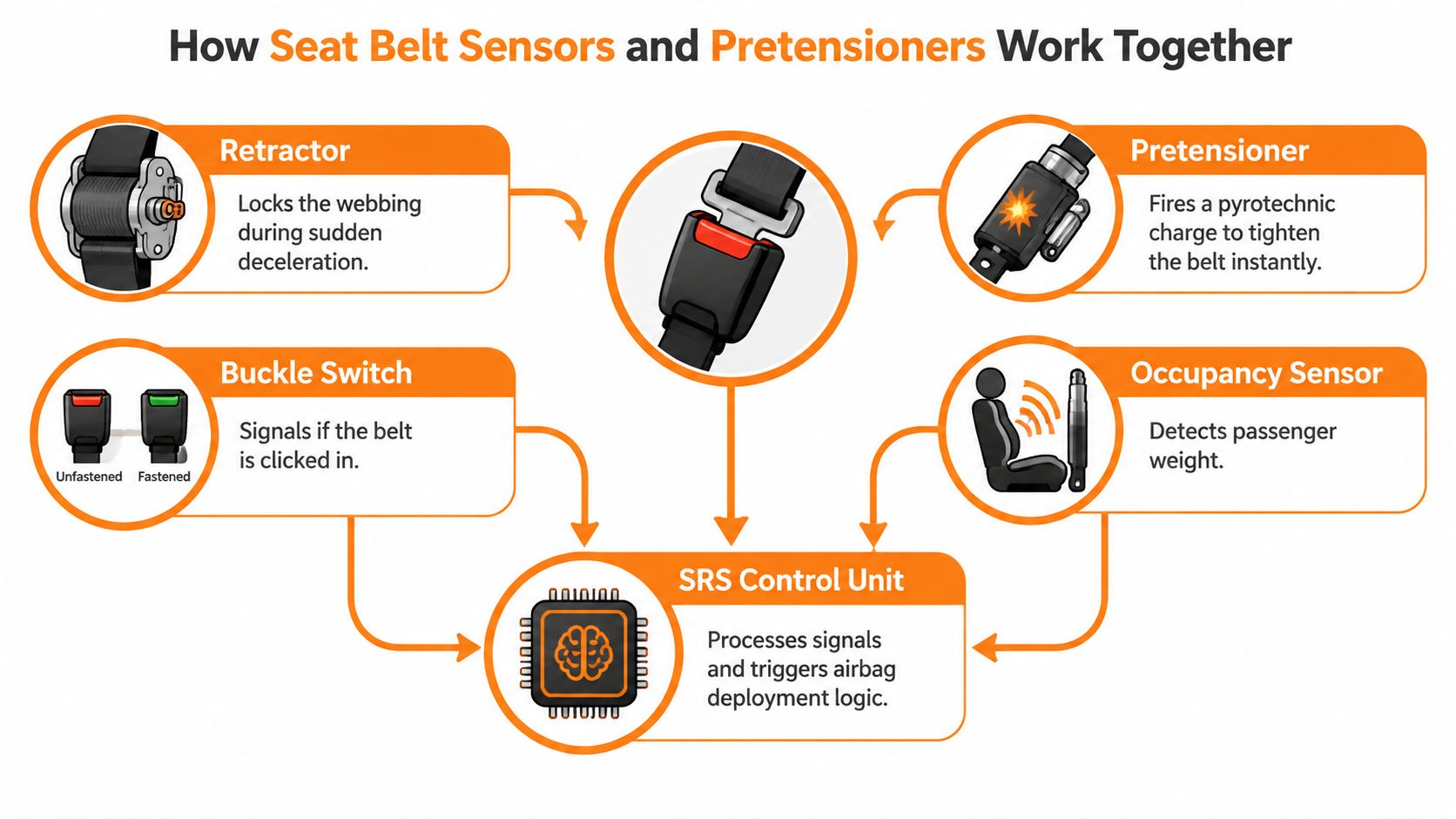
The restraint system operates as a coordinated safety network. The buckle switch reports whether the belt is latched. The occupancy sensor helps identify whether the passenger seat is occupied. The retractor controls the webbing and locks it during sudden movement, while the pretensioner rapidly removes slack when the SRS module commands deployment. The control unit compares these signals before deciding how the system should respond.
The main parts in the safety loop
The retractor holds the webbing on a spool and includes a locking mechanism that limits belt movement during abrupt deceleration. Some retractors also contain a pretensioner. Its pyrotechnic charge pulls the belt tight at the start of a crash sequence.
The buckle sensor, also called a buckle switch, confirms that the metal tongue is inserted. Depending on the design, it may send a switch signal or a resistor-based signal. The SRS module therefore may receive different electrical values for buckled and unbuckled states, rather than one simple on-or-off message.
The passenger seat may use an occupancy sensor or classification system. That circuit helps the SRS determine whether the seat is empty or occupied, while the buckle circuit reports whether the occupant is restrained. Either circuit can trigger an SRS warning, even when the belt appears to latch normally.
Why pretensioner stages matter
Some vehicles use one pretensioner firing stage. Others use multiple stages or a buckle pretensioner. Each stage can have its own circuit and trouble code, so a scan result that names a pretensioner circuit does not automatically prove that the entire belt assembly has failed.
The SRS module is the decision-maker, and it can also store crash data and hard fault information. Clearing that memory cannot restore a fired pretensioner charge, repair damaged webbing, reconnect broken wiring, or correct a faulty buckle signal. The physical restraint part and the module must both be ready before the warning can stay off.
The repair path follows the failed component. A buckle fault points to buckle service, a wiring fault requires circuit repair, and a fired pretensioner requires appropriate belt or retractor service. A crash-affected module may need a reset only after the physical fault has been corrected. Owners can review a specialized seat belt buckle and pretensioner repair service after diagnosis identifies the assembly involved.
Common Causes and Warning Signs of Sensor Failure
The same red SRS light can represent several different failures. Blaming the belt assembly immediately is a common mistake because the module monitors a network, not one isolated sensor. A useful diagnosis starts by grouping the failure according to what changed, what the belt is doing, and whether the warning returns after an attempted reset.
Crash deployment and mechanical damage
After a collision, the pretensioner may fire and pull the belt tight. The retractor can remain locked, or the mechanism can stop extending and retracting normally. The belt may look intact from the cabin, but a deployed pyrotechnic unit still needs proper repair or replacement.
Recall activity shows why these faults receive serious attention. Hyundai and Kia filed 11 safety recalls covering approximately 405,900 vehicles between October 2021 and March 2023 for pretensioner rupture concerns, according to the related recall documentation (Hyundai and Kia recall documentation). Ford also announced a U.S. recall affecting 419,967 Expedition and Lincoln Navigator vehicles in 2026 because a front seat belt pretensioner could interfere with proper retraction or extension (NHTSA pretensioner research and recall context).
Wiring and connector problems
Under-seat wiring moves whenever the seat slides forward or backward. A connector can loosen, a pin can lose contact, or the harness can become pinched and chafed. Moisture and corrosion can interrupt the low-resistance firing circuit or distort the buckle-sense signal.
Typical clues include a warning that appears after seat movement, an intermittent buckle chime, or a code that returns as soon as the seat is adjusted. If the belt works but the warning changes when the harness is touched or the seat moves, inspect the connector and harness before condemning the retractor.
Other faults that imitate a belt problem
A passenger occupancy mat, clock spring, impact sensor, or low-voltage condition can also illuminate the airbag light. Industry troubleshooting guidance lists these alongside seat belt faults, which is why the warning alone can't tell you whether you need a buckle, sensor, wiring repair, or module service (common airbag-light causes).
Watch for these patterns:
- Persistent airbag light: The SRS module has detected a fault that may be active, stored, or both.
- Belt won't extend or retract: Suspect a locked retractor, crash deployment, internal mechanism problem, or physical obstruction.
- Buckle status is wrong: The belt clicks, but the vehicle still reports unbuckled, pointing toward the buckle switch, sensor circuit, or wiring.
- Code returns immediately: The underlying circuit or component remains outside the module's expected range.
- Warning appears after an impact: Treat the system as potentially deployed until a restraint-capable scan confirms otherwise.
How to Diagnose Seat Belt Sensor and Pretensioner Faults
A safe diagnosis follows the signal path instead of guessing from the warning light. Start with the SRS module, then inspect the physical circuit, and only perform electrical tests with the vehicle-specific procedure and equipment.
Start with the correct scan
A basic engine-code reader may not communicate with the restraint module. Use a restraint-capable scan tool that can read SRS trouble codes and identify the affected seat, circuit, and firing stage. A code can narrow the search, but it can't always distinguish a fired pretensioner from an open circuit, short, damaged connector, or chafed harness.
Vehicles with multiple pretensioner stages may store separate faults for separate stages. That's why replacing a belt based on a broad description such as “seat belt fault” can waste time and leave the actual issue in place. Diagnostic guidance recommends reading the SRS code first, then inspecting the related circuit before selecting a part (pretensioner fault-code diagnosis).
Follow the circuit carefully
With the ignition off and the manufacturer's safety procedure followed, inspect the connector beneath the seat. Look for:
- Loose locking tabs: A connector that isn't fully seated can create an intermittent open.
- Bent or recessed pins: A terminal may no longer make consistent contact.
- Chafed insulation: Seat movement can wear through the harness.
- Moisture or corrosion: Contamination changes electrical resistance and signal quality.
- Evidence of deployment: A locked belt and deployment code point toward the restraint assembly, not just a loose plug.
Resistance checks require particular caution. OEM service data describes pretensioner circuits as low-resistance pyrotechnic loops, with model-specific measured values such as about 0.9 to 6.6 ohms for one front-driver pretensioner (OEM restraint service data). An ordinary multimeter can apply test current, produce misleading readings, or create a safety risk. Don't probe an active pretensioner circuit unless the manufacturer's procedure explicitly permits the test and you have the correct restraint-safe equipment.
Stop point: If the code identifies a firing loop, the belt is locked after a crash, or the harness is damaged near a pyrotechnic component, hand the repair to a qualified restraint technician.
A short instructional video can help you understand the inspection sequence, but it shouldn't replace the vehicle's service procedure or a professional SRS scan.
For a locked or non-retracting assembly, review the seat belt retractor repair service only after identifying the retractor or pretensioner as the failed component.
Repair Options and When to Choose Each One
Once the fault is identified, the repair should match the failure. A loose connector doesn't call for a replacement belt, and a fired pretensioner won't be repaired by deleting crash data from the module. The most useful question is not “How do I turn off the light?” but “Which part of the safety loop is still unable to perform its job?”
Match Your Symptom to the Right Repair Path
| Symptom and Code Pattern | Most Likely Cause | Recommended Repair | Why This Fix |
|---|---|---|---|
| Belt status remains unbuckled despite a secure latch | Buckle switch, buckle sensor, or connector fault | Inspect the plug, repair the harness, or replace the buckle assembly | The module isn't receiving a trustworthy latch signal |
| Belt is locked after a collision with a pretensioner deployment code | Fired pretensioner or damaged retractor | Repair or replace the original retractor or pretensioner assembly | A memory reset can't restore the fired mechanical and pyrotechnic parts |
| Fault changes when the seat moves | Under-seat harness chafe, loose terminal, or corrosion | Repair the wiring and secure the harness correctly | Movement is disturbing the electrical path |
| SRS code identifies stored crash data after physical repairs | SRS module memory issue | Perform a compatible module reset after all failed components are restored | The module needs its stored event data cleared, but it must also pass system checks |
| Airbag light remains on with occupancy or clock-spring codes | Non-belt SRS fault | Diagnose the named sensor, clock spring, or related circuit | Replacing the belt won't correct a separate SRS input |
Why clearing crash data alone fails
A crash-data reset clears information stored inside the control module. It does not replace a fired pretensioner, repair torn wiring, restore a damaged sensor, or rebuild a locked retractor. Current repair guidance makes the distinction clear: the reset addresses module memory, while the physical restraint components still require their own service (crash-data reset limitations).
That distinction also helps shops manage customer expectations. Repairing the original OEM part can preserve fitment and compatibility, while a new assembly may be appropriate when the existing unit is damaged beyond service or unavailable. The best choice depends on the diagnostic result, the vehicle's service requirements, and whether the repairer can validate the finished component.
Service centers that handle many repair decisions may also benefit from workflow tools such as Recepta.ai for service centers, particularly when organizing customer intake, repair status, and follow-up communication.
Mail In Seat Belt and Module Repair With Safety Restore
A mail-in repair can be practical when the diagnosis points to a removable seat belt retractor, pretensioner, buckle assembly, or SRS module. Instead of sourcing a complete replacement, the owner or shop sends the original component to a specialist for inspection and repair, then reinstalls the returned part after the vehicle-side problem has been addressed.
Safety Restore's stated workflow is straightforward:
- Place the order online: Select the appropriate service and identify the component being sent.
- Remove the part safely: Follow the vehicle's service procedure for disconnecting SRS components. Don't work on a pyrotechnic restraint circuit casually or with the battery connected.
- Package the component securely: Include the requested order information and protect the belt or module from impact, moisture, and shipping movement.
- Professional servicing: The provider repairs the supplied part, which may involve retractor or pretensioner work, sensor service, or SRS module reset depending on the order.
- Reinstall and scan: Put the restored component back in the vehicle, repair any separate wiring faults, and verify the SRS system with a compatible scan tool.
The publisher describes a flat $99 price per item, a typical 24-hour turnaround, and a lifetime warranty for its serviced components in its company information. Those terms should still be confirmed for the exact service before ordering, especially if more than one component needs work.
Avoiding shipping and installation delays
Before removing anything, photograph the belt's position, connector routing, mounting orientation, and identifying label. Ask a technician to handle removal if you're not familiar with SRS procedures. A missing connector, incomplete order detail, or incorrectly identified part can delay processing.
The Safety Restore airbag reset and seat belt repair information can help owners and repair shops understand which parts are commonly sent in and what the service is designed to address. The important boundary remains the same: mail-in repair can restore the supplied component, but it can't correct a vehicle-side harness fault or a separate occupancy sensor problem.
Final Checks and Getting Back on the Road Safely
Reinstalling the part is only the midpoint. A repaired retractor should mount securely, the belt should extend smoothly, retract without binding, and lock when tested according to the vehicle's service instructions. The buckle should latch and release cleanly, and the under-seat harness should be routed so seat movement can't pinch or chafe it.
After the physical repair, use a restraint-capable scan tool to clear applicable codes and confirm that no active SRS faults remain. Turn the ignition on and verify the airbag warning light performs its normal self-check, then goes out as expected. If the light returns, don't keep clearing it. The module is still detecting a fault, which may involve wiring, a sensor, another pretensioner stage, or unresolved crash data.
Use this final checklist:
- Mechanical operation: The belt extends, retracts, and locks correctly.
- Buckle response: The latch engages and the vehicle recognizes the belt status.
- Harness condition: Connectors are fully seated and wiring is clear of moving seat parts.
- SRS verification: A proper scan shows no active restraint faults.
- Professional review: A qualified technician confirms the system is ready before the vehicle returns to normal service.
The goal isn't to turn off a dashboard light. It's to restore the original restraint system so the belt, sensors, pretensioner, and SRS module can work together as designed.
If your seat belt is locked, your pretensioner has deployed, or your SRS module still stores crash data, Safety Restore offers mail-in repair for eligible seat belt mechanisms and SRS modules. Diagnose the vehicle-side wiring first, then send the correctly identified component for professional service and reinstall it only after the system has been properly verified.