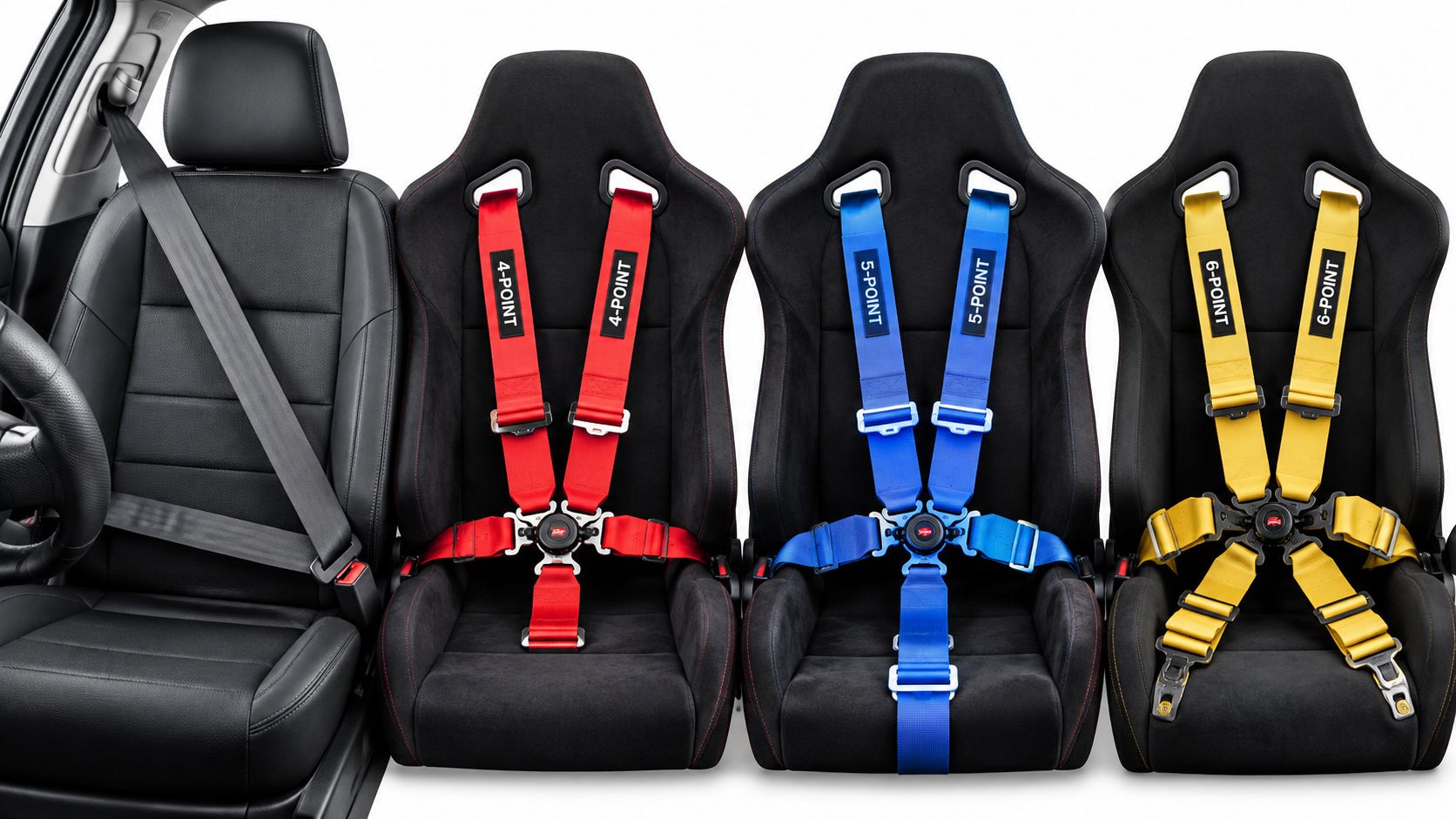
You're probably here because a belt did its job, and now it doesn't act normal.
Maybe the car was in a crash, the belt locked solid, and the airbag light stayed on. Maybe you bought a rebuilt vehicle and noticed one belt retracts slowly, another has frayed webbing near the latch, and someone told you, “It's fine as long as it clicks.” Or maybe you're looking at a race-style harness and wondering if more straps automatically means more safety.
That's where people get tripped up. A seat belt harness isn't just a strap. It's a restraint system with webbing, a retractor, mounting points, and often a pretensioner that works with the rest of the vehicle's SRS. When one part is damaged, twisted, stretched, heat-marked, or deployed, the whole system can stop working the way it was designed to.
I've seen plenty of post-crash belts that looked acceptable at a glance and were not acceptable once you slowed down and inspected them. I've also seen the opposite. Belts that looked ugly from dirt or staining, but still needed careful testing before anyone made a repair-or-replace call. The difference matters, because a harness has one job when things go wrong. It has to manage force at the exact moment your body wants to keep moving.
Table of Contents
- Introduction to Seat Belt Harnesses and Why They Matter
- How Seat Belt Harnesses Work and What Makes Them Effective
- Understanding Different Harness Types From 3-Point to 6-Point
- OEM Street Harnesses Versus Racing and Off-Road Harnesses
- Safety Standards Legal Requirements and Proper Fit
- Maintenance Inspection and When to Repair vs Replace
- Choosing the Right Harness and Next Steps for Your Vehicle
Introduction to Seat Belt Harnesses and Why They Matter
A lot of drivers only think about their seat belt when it jams, locks, or leaves a bruise after a hard stop. That's understandable. When everything works, you click it, drive, and forget about it.
But the history of seat belt harnesses explains why they deserve more respect than that. The modern three-point belt was perfected by Volvo engineer Nils Bohlin in 1959, first fitted to a production Volvo PV 544 on August 13, 1959, and later patented in the United States on July 10, 1962. Volvo then made the patent freely available, which helped the design spread fast. By 1968, seat belts were being required in all new American vehicles under federal law. Later estimates credited the three-point belt with saving more than one million lives worldwide according to the historical record of the three-point safety belt.
That story matters because it shows something simple and important. The winning design wasn't the one with the most straps. It was the one that could protect real people, in real cars, every day.
More than a buckle and a strap
When you pull a shoulder belt across your chest, you're using a system designed to hold your torso and pelvis in place while the vehicle structure, airbags, and crash energy management do their part. If the belt sits too high on the stomach, if the shoulder portion rides off the shoulder, or if the retractor has hidden internal damage, the design advantage starts to disappear.
Practical rule: A seat belt harness is only as safe as its fit, condition, and correct application.
That's why everyday drivers, collision shops, rebuilders, and motorsport enthusiasts all need the same basic understanding. What kind of harness is this? Does it fit the person and the vehicle? After damage or deployment, can it be serviced correctly, or does it need replacement?
Where people usually get confused
Three points cause most of the misunderstanding:
- Type confusion: People assume a racing harness must be safer on the street because it has more straps.
- Fit confusion: People think “wearing it” is enough, even when the lap belt is too loose or the shoulder path is wrong.
- Damage confusion: People inspect for cuts but miss locked retractors, fired pretensioners, melted fibers, or edge wear that changes the belt's strength.
If you understand those three areas, you'll make better decisions whether you're driving a commuter sedan, fixing a salvage vehicle, or setting up a track car.
How Seat Belt Harnesses Work and What Makes Them Effective
A driver gets hit in an intersection. The vehicle loses speed in a split second, but the driver's body still has the same forward motion it had an instant earlier. The harness has one job in that moment. It must manage that motion early, in the right places, and in the right order.
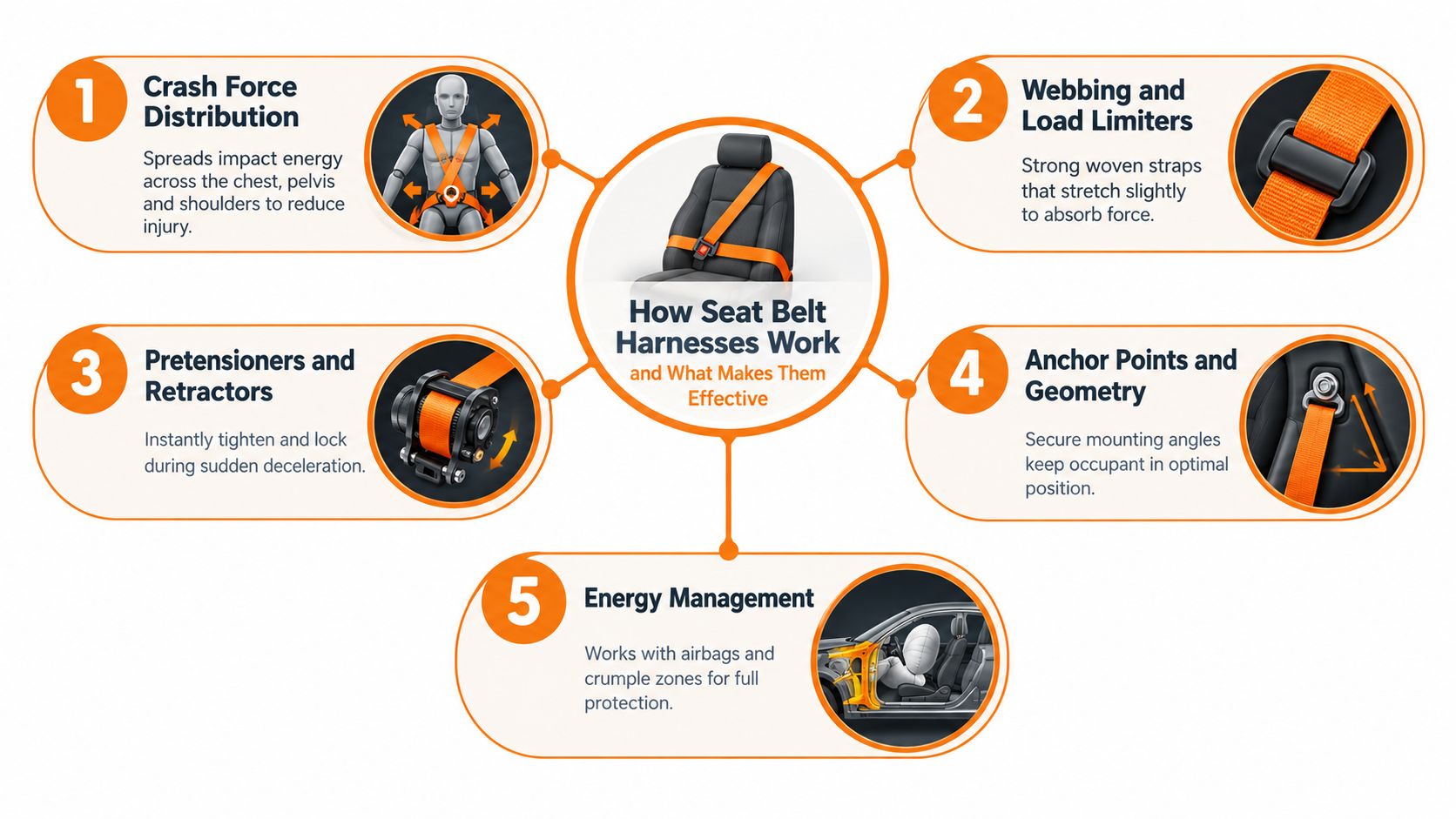
That is why a seat belt harness works less like a strap and more like a load path. In a good system, the webbing, retractor, anchors, seat, and airbags all help direct crash forces into stronger parts of the body while limiting how far the occupant moves.
The harness works by controlling motion, not just resisting it
A good belt does not wait for the occupant to surge forward and then try to stop all that movement at once. It begins controlling motion almost immediately. That early control matters because every extra inch of travel lets the body build more momentum before the restraint fully loads.
The layout of the belt is a big part of that. A proper lap-and-shoulder setup places force across the pelvis, chest, and shoulder. Those areas can handle crash loads much better than the soft abdomen or the side of the neck. Analysts in long-running crash studies found major reductions in serious injury and death when occupants wore properly designed three-point restraints, and federal safety reporting has long shown that seat belts prevent large numbers of injuries each year.
In the shop, the pattern is easy to recognize. Occupants usually fare better when the lap portion stayed low on the hips, the shoulder portion stayed centered on the chest, and slack was limited. The opposite is also true. A strong belt can still underperform if it starts in the wrong place or if the occupant slides out of position before the system fully engages.
Pretensioners remove slack before it becomes a problem
Modern restraint systems often include pretensioners, which pull the belt tighter almost instantly during a crash. That sounds like a small detail, but it changes how the whole system works. A loose belt lets the body gain speed before the webbing starts carrying load. A pretensioner cuts down that delay.
NHTSA explains this pairing of pretensioners and load limiters in its pretensioner and load limiter overview. One device helps remove slack early. The other helps control how much force reaches the chest once the belt is fully loaded.
That point matters after a crash too. A belt that locked, tightened hard, or shows signs of pyrotechnic activation may have worked exactly as designed and still no longer be fit for service. Repair-versus-replace decisions start to matter. A harness can look acceptable from arm's length and still have internal retractor damage or a spent pretensioner.
A restraint has to catch the body early, before forward motion turns into extra load.
Webbing strength matters, but condition and geometry decide how that strength gets used
People often focus on tensile strength because it sounds reassuring. Strength does matter. Federal requirements in FMVSS 209 set minimum performance levels for seat belt assemblies and webbing, including the force levels different parts must withstand, as described in NHTSA's FMVSS 209 interpretation on seat belt assembly strength.
But rated strength on paper is not the same as real crash performance in a used vehicle.
A belt only protects as intended when the webbing is flat, the latch holds, the anchors stay fixed, and the occupant loads the system the way engineers expected. If the belt is twisted, routed poorly, riding over the abdomen, or weakened by heat and abrasion, the design margin starts shrinking. That is why hidden damage is such a problem. Webbing can lose reliability long before it looks torn in an obvious way.
Small defects deserve attention:
- Cuts and frays can reduce the reserve strength built into the webbing.
- Melted or glazed fibers may indicate heat damage that changes how the belt stretches under load.
- Abrasion at the latch plate or guide point can wear fibers little by little until the belt no longer behaves like a healthy one.
- Twists and poor routing can concentrate force in the wrong spot and change how the belt tightens in a crash.
What makes a harness effective in real use
The best harness systems do several things at once:
- Place the belt on strong body structures, especially the pelvis and center of the chest.
- Engage quickly, so the occupant does not travel far before restraint forces build.
- Manage force progressively, using webbing stretch, retractors, pretensioners, and load-limiting features.
- Stay anchored in the correct geometry, so the belt loads the body as intended.
- Work with the seat and airbags, which depend on the occupant staying in the expected position.
That last point gets missed all the time. More straps do not automatically mean more safety. A well-fitted factory three-point system in the vehicle it was designed for often protects better than a poorly mounted multi-point harness that changes occupant position, leaves slack, or has damaged webbing hidden under the surface.
The design matters. Fit matters just as much. Condition can override both.
Understanding Different Harness Types From 3-Point to 6-Point
Drivers may use one harness type every day and see the others online, at off-road events, or in racing paddocks. The trouble starts when those different systems get mixed together without thinking about the seat, the mounting points, and the way the vehicle is used.
The familiar 3-point belt
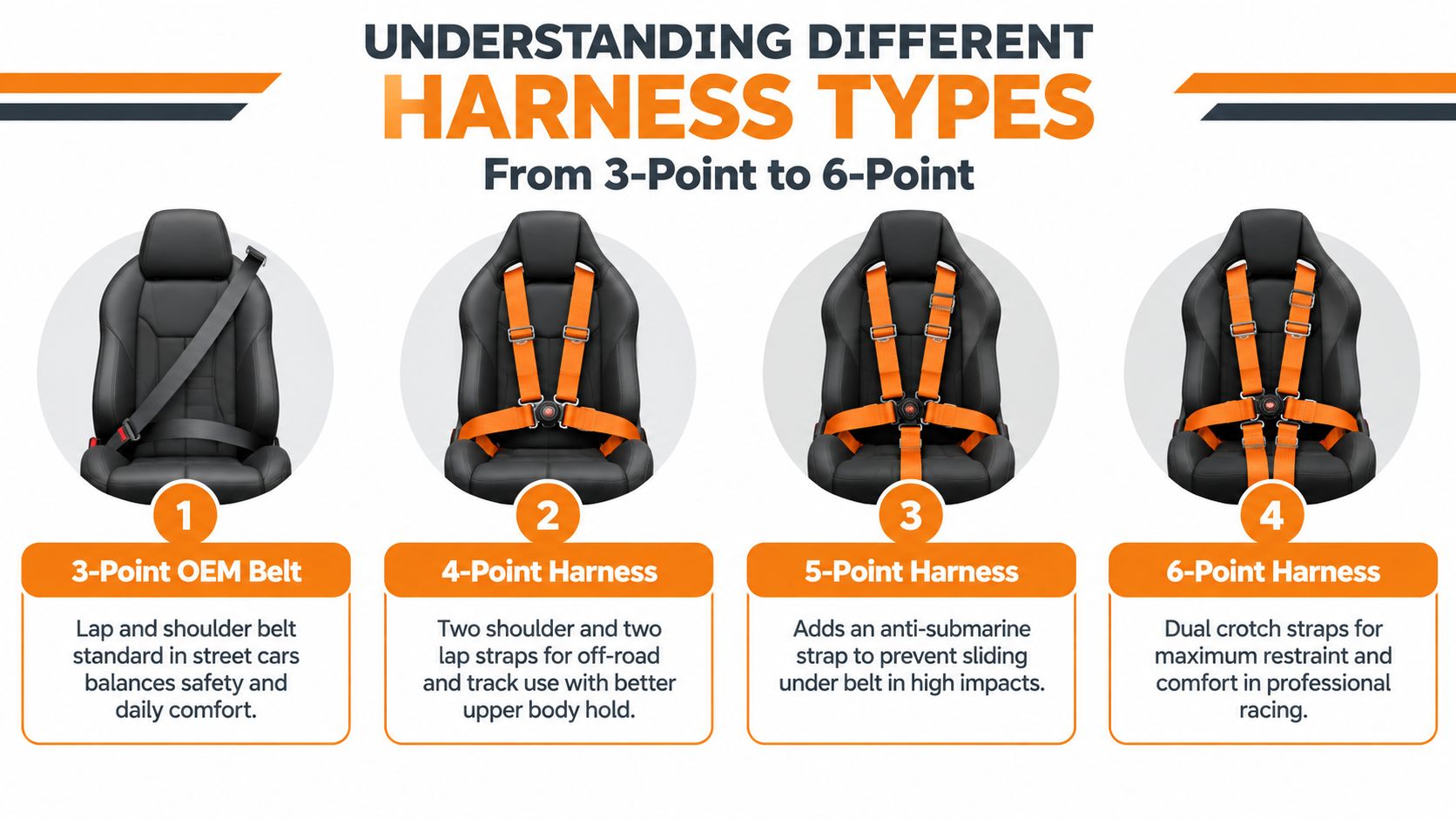
The 3-point harness is the standard OEM lap-and-shoulder belt found in street cars. One continuous belt crosses the shoulder and chest, then secures across the lap.
Its strength is balance. It offers strong everyday protection, easy entry and exit, and works with airbags, factory seats, and retractors designed for normal road use. That's why it became the dominant restraint layout in passenger vehicles.
Four-point systems
A 4-point harness usually adds two shoulder straps and two lap straps. It holds the upper body more firmly than a typical street belt and is common in some off-road and track settings.
But people oversimplify. A 4-point setup can hold you upright well, yet still create problems if the seat, mounting angle, or anti-submarine control isn't right. In plain terms, if the pelvis isn't controlled properly, the body can slide under the lap belt in a crash.
Five-point systems
A 5-point harness adds a single anti-submarine strap between the legs. That extra strap helps prevent the occupant from slipping downward and forward under the lap belt during a hard impact.
You'll see this layout in motorsport, child restraint systems, and other applications where upper-body restraint alone isn't enough. It improves control, but it also adds complexity. Fit gets more sensitive, and getting in and out takes longer.
Six-point systems
A 6-point harness uses two anti-submarine straps instead of one. That setup helps spread load more comfortably and can control occupant motion better in high-load motorsport conditions.
This is the sort of system built around a complete environment. Proper seat shell, correct harness openings, proper anchor points, and often head-and-neck restraint compatibility. On its own, a 6-point harness isn't a magic upgrade. It's one part of a dedicated system.
Harness Types Compared by Design and Best Use
| Harness Type | Strap Configuration | Best Application | Key Trade-off |
|---|---|---|---|
| 3-point OEM belt | One lap-and-shoulder belt | Street vehicles and daily driving | Less upper-body hold than multi-point setups |
| 4-point harness | Two shoulder straps and two lap straps | Some off-road and track use | Can be a poor choice without proper seat and mounting geometry |
| 5-point harness | 4-point layout plus one anti-sub strap | Motorsport and child restraint applications | More complexity and slower entry or exit |
| 6-point harness | 5-point layout plus dual anti-sub straps | Professional racing and high-load track use | Requires the most complete supporting hardware and setup |
More straps don't always mean safer
That's the part many enthusiasts miss. A multi-point harness can outperform a 3-point belt in the right environment, but it can also underperform badly when used in the wrong one.
Common mistake: Installing a race-style harness in a street car with factory seats and assuming the extra straps automatically add protection.
If the shoulder straps leave the seat at the wrong angle, if the lap belts don't sit on the pelvis, or if the anti-sub straps aren't supported by the seat and mounting layout, the system may hold you in a dangerous posture instead of a safe one.
A useful rule is this: choose the harness type for the vehicle's job, not for appearance.
OEM Street Harnesses Versus Racing and Off-Road Harnesses
A factory restraint and a racing harness solve different problems.
An OEM street system has to work for short trips, long trips, different body sizes, frequent entry and exit, and daily use with airbags, pretensioners, seat adjustments, and ordinary clothing. A racing or off-road harness is built around higher body control under more extreme movement, usually with a more fixed seating position.
Why OEM systems dominate on the street
A factory 3-point seat belt harness is practical in ways a race setup usually isn't. It retracts out of the way, adjusts quickly, and works with the crash timing and occupant position the vehicle manufacturer designed around.
That matters because street safety is not only about holding you tight. It's about letting the whole restraint system work together. Airbags, seat position, belt load management, and cabin packaging were engineered as a package.
Why motorsport harnesses need supporting hardware
A multi-point harness shines when the rest of the environment matches it. Think bucket seats with harness pass-throughs, proper mounting points, limited occupant movement, and often rollover protection.
Without those pieces, the harness can create new risks. Shoulder straps that pull downward too sharply can load the body poorly. Factory seats may not support anti-sub straps correctly. Daily driving also brings practical issues. Looking over your shoulder, reaching controls, and getting in and out all become less natural.
A practical way to decide
Use this quick lens:
- Stay OEM if the vehicle is a normal road car driven in traffic, parking lots, school drop-off lines, and highway commuting.
- Use motorsport harnesses if the vehicle is purpose-built for track or off-road use and the seats, mounts, and safety gear are designed around that harness.
- Avoid hybrid guesswork when someone mixes a race-style harness with factory seats just because it looks serious.
If the car lives on public roads, the factory restraint system is usually the right answer unless the whole vehicle has been re-engineered for a different job.
Safety Standards Legal Requirements and Proper Fit
A belt can pass every lab test and still fail the person wearing it.
That happens in ordinary situations. A winter coat leaves slack under the shoulder belt. A lap belt rides up over the belly instead of staying on the hip bones. A child has outgrown one setup but is not positioned correctly for the next one. On paper, the restraint is legal and approved. In a crash, the body only feels fit, angle, and force.
What standards cover, and what they do not
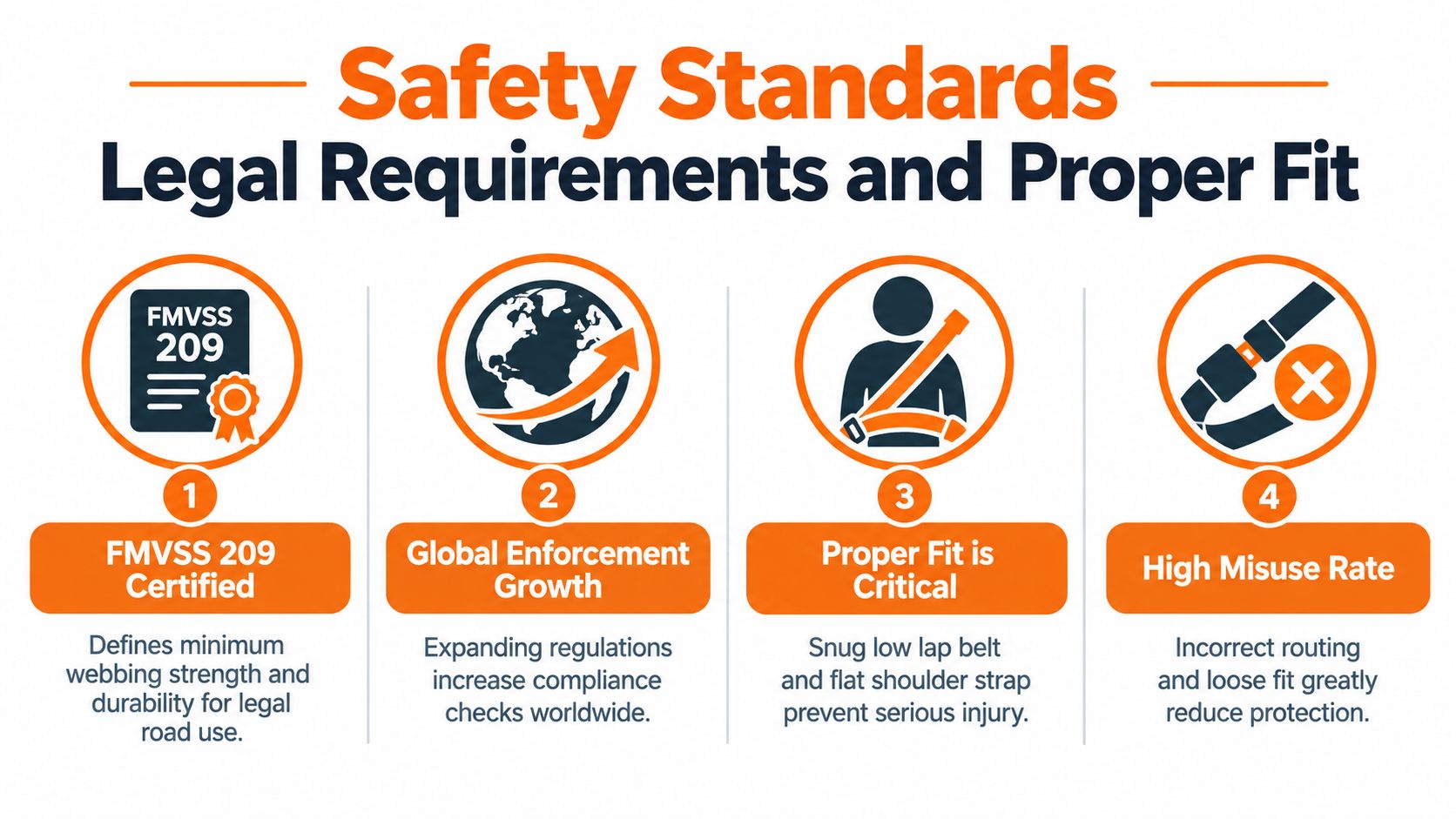
Rules such as FMVSS 209 set minimum performance requirements for seat belt assemblies. That tells you the hardware met a defined test standard. It does not mean any belt will protect any body equally well in any position.
Fit is the missing half of the picture.
A harness works like a load path. In a crash, it needs to send force into the strong parts of the body, mainly the pelvis, chest, and shoulders, without extra slack or bad belt angles. If the lap section sits too high, the load moves from the hips toward the soft abdomen. If the webbing is twisted, the force is no longer spread across the full width of the belt. Good design still depends on correct placement.
Legal use is not the same as safe use
Seat belt laws usually answer basic questions such as who must wear a restraint, where, and in what kind of vehicle. They do not guarantee that the belt is adjusted well, routed well, or matched well to the occupant.
That distinction matters for repair and replacement decisions too. A harness may still latch and retract, yet fit poorly because the webbing has shrunk from heat, stiffened from contamination, or been routed differently after interior work. A restraint can also look acceptable until you pull the full length out and find edge wear, flattened sections, or hidden damage near the anchor points. Misuse and damage often work together. One causes poor positioning. The other weakens how the system manages crash loads.
Fit problems that change how a harness works
Crash researchers, pediatric specialists, and restraint technicians keep seeing the same pattern. Injury risk rises when the restraint is present but worn incorrectly, especially for children and smaller occupants. That is why fit checks matter every time, not only after a crash.
Use this quick inspection checklist:
- Lap belt low on the hips: It should touch the pelvis, not the stomach.
- Shoulder belt across the center of the chest: It should stay on the shoulder, not rub the neck or sit under the arm.
- Webbing flat: Twists narrow the contact area and can concentrate load.
- Snug, not loose: Extra slack lets the body move farther before the restraint starts doing its job.
- Bulky clothing managed: Heavy coats can create hidden looseness even when the belt feels tight.
- Child fit checked by stage: Booster position, belt path, and harness snugness need a closer look because small changes matter more on a smaller body.
A certified harness only protects well when the webbing lies where the body can safely take the load.
Requirements keep expanding
Governments also keep updating seat belt rules as more vehicle categories come under mandatory use. In Hong Kong, authorities announced that from January 25, 2026, all seated passengers on public transport and commercial vehicles must wear seat belts, with penalties up to HK$5,000 and three months' imprisonment, while fitting requirements are extended to more vehicle categories according to the Hong Kong seat belt legislation announcement.
The practical lesson is simple. Start with a legal, approved restraint. Then make sure it fits the occupant, sits on the body correctly, and has not been compromised by wear, heat, crash loading, or bad routing. That is what separates a harness that only looks secure from one that is ready to work.
Maintenance Inspection and When to Repair vs Replace
Inspection starts with a simple question. Did this harness just get dirty, or did it get compromised?
Those are not the same thing. Dirt, spills, and child-seat messes can make a belt look terrible without changing its structure. But abrasion, heat, deployed pretensioners, locked retractors, cuts, and frayed edges are different. Those point to a restraint that may no longer behave the way the vehicle expects in another crash.
What to inspect with your hands and eyes
Pull the belt out slowly and inspect the full length in good light. Run your fingers along both edges and the center section. Look for fuzzing, cuts, stiffness, shiny melted spots, thinning areas near the latch plate, and contamination that may hide damage.
Then check function:
- Retraction: The belt should feed back smoothly without hanging up.
- Locking behavior: It should lock when it's supposed to, not stay stuck for no reason.
- Latch and buckle: They should engage positively and release normally.
- Post-crash condition: If the vehicle had an impact, assume internal parts may have been stressed even if the webbing looks decent.
When cleaning is enough and when it isn't
Routine cleaning helps you inspect clearly. If you're dealing with child-seat spills, snack residue, or mystery grime before inspection, a practical guide on which child car seat cleaner can help you remove debris without turning the belt or nearby restraint materials into a bigger mess.
Cleaning is not repair. If the webbing is damaged or the mechanism was involved in a crash event, washing it won't restore structural integrity.
Shop-floor reminder: A clean belt can still be unsafe, and a dirty belt can still deserve careful testing instead of automatic disposal.
Repair or replace decision points
Replace or professionally service the harness when you find any of the following:
- Deployed pretensioner signs or a belt locked after a crash event.
- Frayed, cut, or heat-damaged webbing.
- Retraction problems that don't improve after basic inspection and safe cleaning.
- Unknown history on salvage or rebuilt vehicles where restraint deployment is suspected.
For some OEM assemblies, repair of the original unit is a practical option. That can include restoring retractor and pretensioner function or replacing damaged webbing within the original assembly. One example is Safety Restore, which offers mail-in repair for seat belt retractors and pretensioners, SRS module reset, and webbing replacement on customer-supplied parts.
The key is to avoid guesswork. If the issue is cosmetic, address it as cosmetic. If the issue affects structure or crash function, treat it as a safety repair.
Choosing the Right Harness and Next Steps for Your Vehicle
The right harness is the one that matches the vehicle, the seat, and the way the vehicle is used.
For most road cars, that means keeping the OEM 3-point seat belt harness in proper working order and making sure it fits correctly every trip. For track or off-road builds, it means choosing a multi-point system only when the seat, mounts, and surrounding safety equipment are built to support it. More straps only help when the whole setup is correct.
If you're evaluating your own vehicle, keep the decision simple.
A good next-step checklist
- Check the type: Is this a normal street vehicle or a purpose-built off-road or racing setup?
- Check the fit: Does the belt sit low on the pelvis and flat across the shoulder?
- Check the condition: Any fraying, cuts, heat marks, poor retraction, or crash-related locking means the system needs closer attention.
- Check the history: If the vehicle was in a collision, don't assume the restraint is ready for reuse without inspection or service.
- Check the application: Don't swap in a race-style harness just for looks.
A seat belt harness is one of the few parts of the car that only gets noticed on a bad day. That's exactly why it deserves careful decisions on the good days.
If your belt is locked, your pretensioner has deployed, or your airbag module is storing crash data, Safety Restore repairs customer-supplied OEM seat belt assemblies and resets SRS modules through a mail-in service. If you need to keep the original fitment instead of chasing replacement parts, visit Safety Restore and review the service that matches your vehicle's restraint issue.