
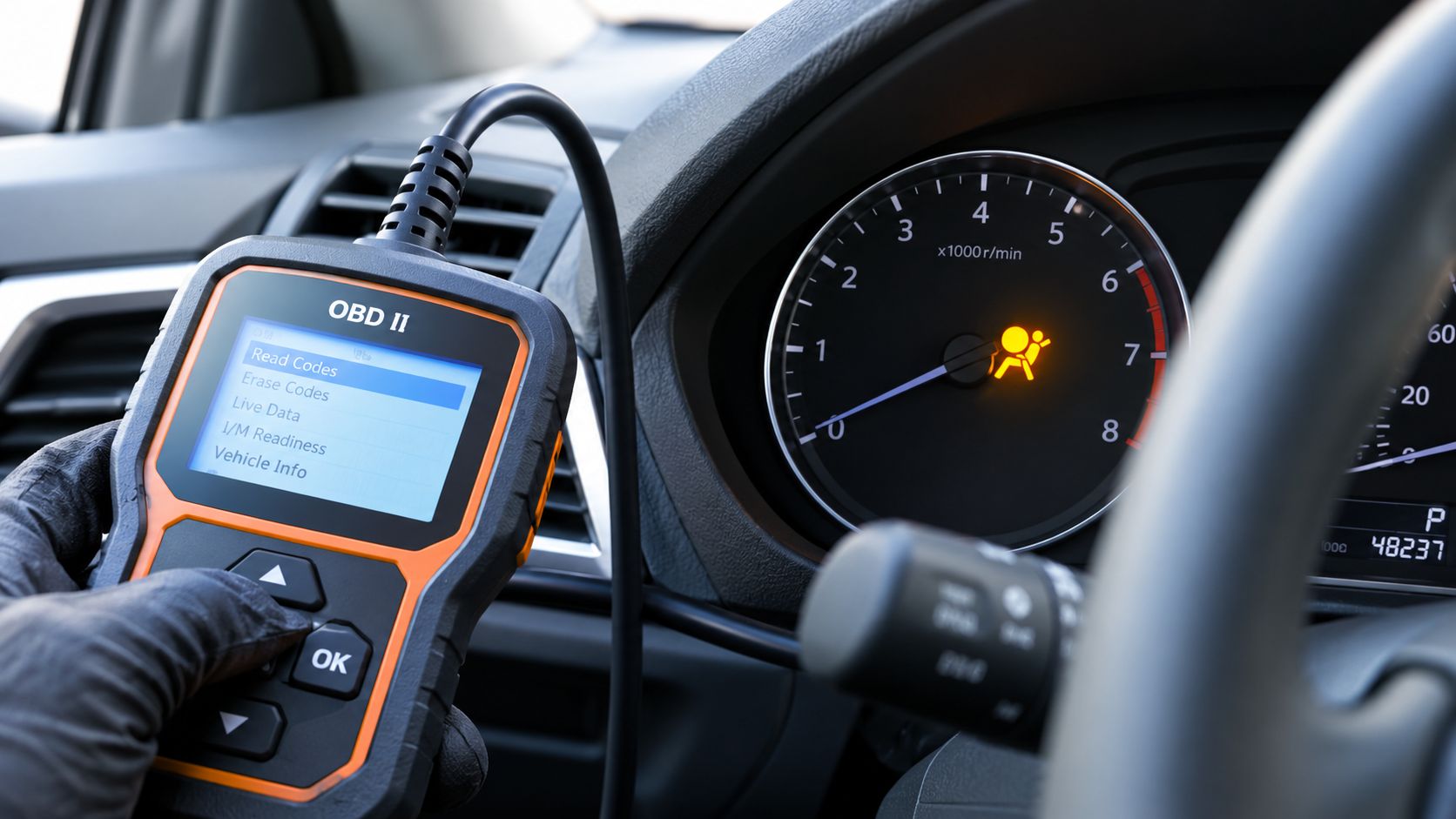
The SRS light should come on at startup, stay lit for about 6 to 7 seconds, and then go out. If it stays on, flashes, or never comes on, the car has detected a fault and the airbags and seat belt pretensioners may not work as intended until the problem is diagnosed and repaired.
You're probably looking at that light in the middle of an ordinary day. The car still starts. It still moves. It may even drive completely normally. That's what makes the SRS light on the dashboard easy to misread. The vehicle usually remains drivable, but the supplemental restraint system may be partly disabled or fully offline, and you won't know which without proper fault-code access.
In the shop, this is one of the most common mistakes I see. A driver assumes the light is “just a sensor,” or a general repair shop clears it with a basic scanner, the light goes away briefly, then comes right back. When that happens, the car hasn't healed itself. The module is telling you the fault is still there, or crash data is still stored, or a component in the system still doesn't pass the self-test.
Table of Contents
- Why Your SRS Light Is On and What to Do Next
- How the SRS Self-Check Actually Works
- Common Reasons the SRS Light Stays On
- Reading SRS Fault Codes the Right Way
- Dealership Replacement vs Independent Repair vs Module Reset
- What Happens When You Mail In Your Module or Seat Belt
- Clearing the Light Without Making the Problem Worse
- A Practical SRS Light Decision Checklist
Why Your SRS Light Is On and What to Do Next
You leave for work, start the car, and the airbag light stays on. The car still idles normally. It still shifts, steers, and stops the way it did yesterday. That combination fools a lot of drivers into treating the warning as minor, when it is really a restraint-system fault with a wide range of causes.
What matters now is not whether the car still runs. It is whether the airbags and seat belt pretensioners are available if you need them. In the bay, I see three situations over and over: a simple circuit fault such as an under-seat connector issue, a failed part such as a clock spring or pretensioner, or a control module that is holding crash data after an impact. Those problems all turn on the same light, but they do not have the same fix, the same cost, or the same downtime.
The practical answer on drivability is straightforward. You can usually move the vehicle, drive it to a diagnostic appointment, or pick up parts. That does not mean the restraint system is ready to protect you in a crash. With the light on, the safe assumption is that some part of the system is offline until proper SRS fault codes are read and the cause is confirmed.
That is also why clearing the light first is a bad habit. A generic code reader may not talk to the airbag module at all. Even if a scan tool does erase the warning, the light will return if the fault is still present, and if the module has stored crash data, a quick clear does not solve that either. It just delays the diagnosis and creates a comeback.
Start with context before anyone resets anything. Ask what changed.
- Recent collision or airbag deployment: Stored crash history can lock the module into a fault state, and deployed pretensioners or damaged wiring may still be in the circuit.
- Battery replacement or low voltage event: Weak voltage can trigger restraint faults on some vehicles, especially if there was a poor connection or the battery was disconnected during other work.
- Seat, carpet, or interior repair: Under-seat harnesses get stretched, pinched, or left partly unplugged more often than many shops admit.
- Steering wheel or column work: A damaged clock spring is a common reason for an SRS light, especially if the horn or steering-wheel buttons act up too.
- Previous “reset” attempt: If the warning came back, the system found the problem again. The light did its job.
One trade-off drivers need explained clearly is this: a sensor or wiring fault can often be diagnosed and repaired in the usual way, but a module with crash data follows a different path. In many cases, the choice is dealership replacement, an independent repair route, or a mail-in reset service for the module itself and sometimes the seat belts. That distinction matters because it changes the price and the timeline right away.
If you are sorting out multiple dash warnings, keep the SRS lamp in its own category. A service reminder or powertrain warning may affect maintenance planning or drivability. An airbag light affects occupant protection. For a contrast with a service-type warning, this guide to the Vauxhall spanner light shows how different those warnings are in purpose and urgency.
How the SRS Self-Check Actually Works
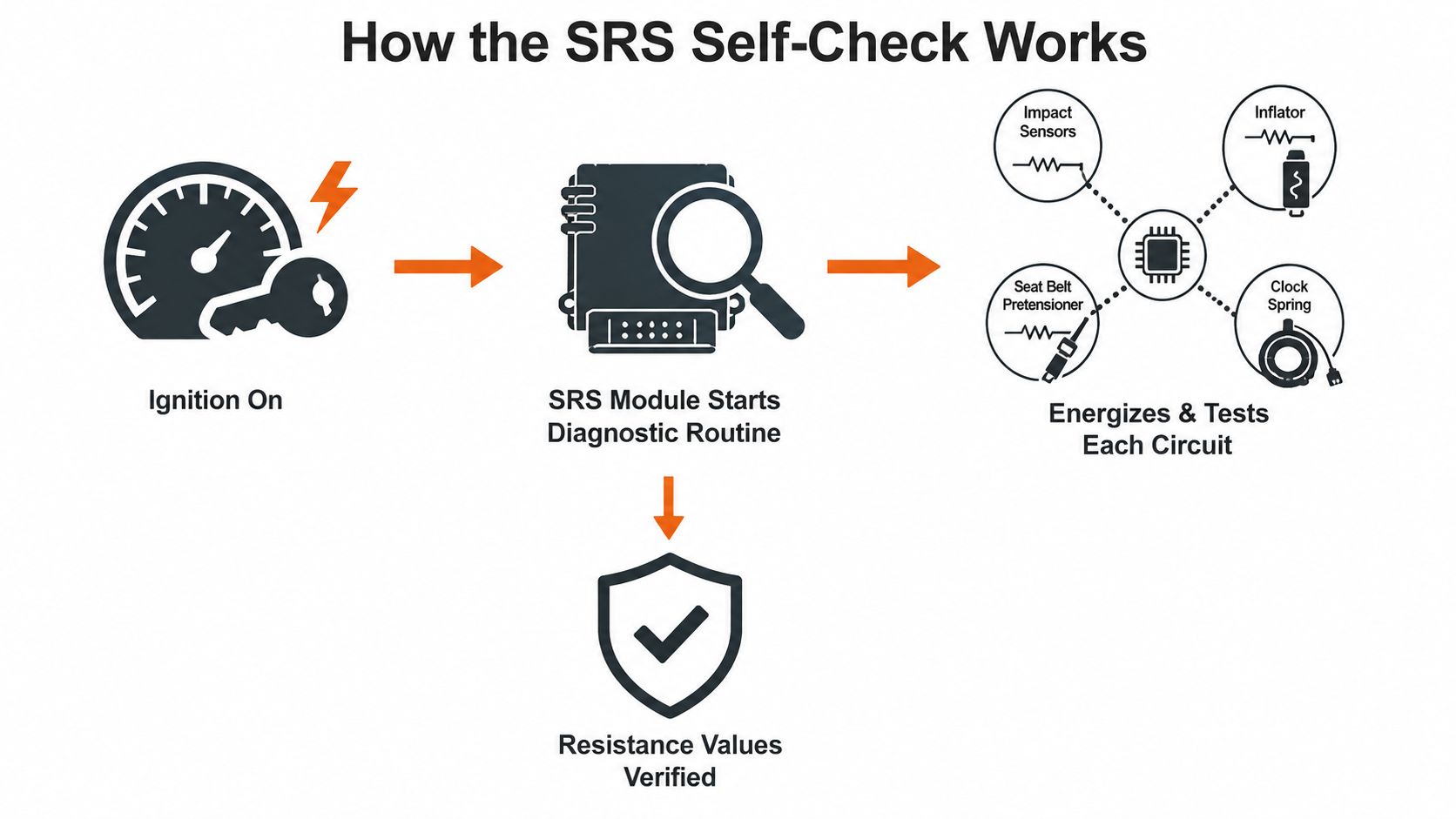
The SRS lamp follows a pattern for a reason. It isn't there to nag you about maintenance. It's the visible result of the restraint control module testing itself every time you switch the ignition on.
What the module checks at startup
On many vehicles, the SRS light illuminates at key-on, stays on for about 6 to 7 seconds, and then turns off if the startup diagnostic passes (NHTSA-linked service material). That short window is the module checking whether the core parts of the restraint system are available and within expected electrical values.
The module is typically looking at inputs and circuits such as:
- Crash sensors
- Airbag inflator circuits
- Seat belt pretensioner circuits
- Wiring continuity
- Steering wheel contact reel or clock spring
- Stored crash history
- Related lamp and module circuits
If those checks pass, the lamp goes out. If they don't, the lamp stays on, flashes, or in some cases never illuminates at all. That last one matters too, because a dead lamp can hide a system fault just as effectively as a lamp that stays on.
Why this light matters more than most
A lot of dashboard warnings tell you something needs service soon. The SRS light is different. It's a live safety-system status output. The control unit won't “hope for the best” and keep quiet if it sees an open circuit, a short to ground, an internal fault, or crash-related memory that hasn't been dealt with.
This is one warning lamp that can leave the car feeling perfectly normal while a critical safety function is unavailable.
That's why the startup behavior matters so much. If the lamp turns on and then goes out normally, the module completed its check and accepted what it saw at that moment. If the lamp returns later while driving, the car has detected a fault condition during operation, not just a harmless memory of an old event.
What a technician takes from lamp behavior
The lamp pattern is the first clue, not the diagnosis. A steady light, a flashing light, or a lamp that never appears each pushes the technician toward a different line of testing. But in every case, the next move is the same. Pull the exact SRS codes with a tool that can talk to the airbag module.
Common Reasons the SRS Light Stays On
By the time a vehicle gets to the bay, most SRS faults fall into three buckets. That's the fastest way to sort the problem from the guesswork.
Collision-related causes
After an accident, the obvious failures are deployed airbags and fired pretensioners. Less obvious is the module itself. Crash data can stay locked in the control unit until the rest of the restraint system is repaired and the module is properly cleared. Independent guidance on post-collision behavior notes that the module should only be cleared after airbags, pretensioners, sensors, and damaged wiring are fixed, and that connector-related faults remain a live issue in current recall activity (post-accident airbag light guidance).
Typical collision-related triggers include impact sensor damage, latched pretensioners, and wiring damage hidden under trim or in the seat harness after body work.
Component failures that show up with age
Not every SRS light means the car has been in a wreck. Plenty of them come from parts aging out or drifting out of spec.
Common examples:
- Clock spring faults: Often show up after steering-column work or plain wear.
- Seat occupancy or buckle-related faults: These can appear after seat removal, wet carpets, or movement in under-seat wiring.
- Sensor faults: Some sensors fail cleanly, others go intermittent before they fail hard.
- Module internal issues: Internal faults can live inside the control unit itself.
Electrical and connector faults
This group causes a lot of repeat visits because it gets misdiagnosed. A loose under-seat connector, a corroded terminal, prior aftermarket wiring, or a low-voltage event can all set the lamp. Technical guidance also warns that SRS circuits need the right testing approach, because ordinary ohmmeter use on squib circuits can be unsafe or misleading (Volvo SRS electrical guidance).
Intermittent SRS lights often point to wiring movement, connector tension, moisture, or seat-track movement. Hard faults usually point to a component the module refuses to accept every single key cycle.
Common SRS Light Causes by Category
| Category | Typical Causes | Symptom Pattern |
|---|---|---|
| Collision-related | Deployed airbags, fired pretensioners, stored crash data, damaged impact sensors | Usually persistent after an accident or repair |
| Component failure | Clock spring faults, seat sensor issues, buckle switch faults, internal module faults | May start intermittent, then become constant |
| Electrical and connector | Under-seat connector problems, corrosion, wiring damage, low-voltage events, poor grounds | Often appears after seat movement, battery issues, moisture, or recent interior work |
Reading SRS Fault Codes the Right Way
The car comes in with the airbag light on, and the owner says a parts-store scanner showed an airbag code. That is a starting point, not a diagnosis. On many vehicles, a generic OBD-II reader will miss the subcodes, status, and module data that tell you whether you are dealing with a seat circuit problem, a steering-wheel circuit fault, a crash sensor issue, or a control module locked by stored crash data.
What a proper scan actually does
A proper SRS scan tool does more than say "airbag fault present." It pulls the exact fault code from the restraint module, shows whether the fault is current or stored, and on some makes gives code status, event history, and direction for the next test step. Factory service information is built around that process. Read the code first, then test the circuit or component the module is complaining about.
Those details matter in the bay.
A code that resets every key cycle points to a fault the module still sees right now. A stored code after a low-voltage event may clear and stay gone once battery and charging problems are handled. A crash-data condition is different again. In that case, the module may communicate normally but remain locked until the crash record is removed or the unit is replaced.
Why generic code checks fall short
Basic scan tools are fine for emissions work. SRS is different.
Many low-cost readers either cannot access the airbag system at all or return a broad description that leaves out the circuit involved. That is how shops waste time on guesswork. One vague "driver airbag" readout could mean a clock spring fault, high resistance in the steering-wheel wiring, a connector issue, or a module seeing an internal problem in that loop. Independent consumer guidance also notes that SRS warnings can store different types of fault information that generic code checks do not always show clearly (AutoZone overview of SRS warning behavior).
I see the same mistake after collision work and battery issues. Someone clears the light with a generic tool, the light comes back, and now the car has lost the code history that would have made the fault easier to sort out.
What the codes should lead to next
The code tells you where to work, not what part to throw at it.
After the SRS codes are pulled, the next step is usually one of these:
- Connector inspection: Under-seat plugs, buckle connectors, steering-column connectors, and any area that was recently disassembled
- Harness inspection: Pin drag issues, rubbed insulation, corrosion, water intrusion, and poor previous repairs
- Clock spring testing: Common when the fault follows steering-wheel movement or points to the driver airbag circuit
- Circuit-specific checks: Per factory procedure, using methods appropriate for airbag and pretensioner circuits
- Module evaluation: After the external circuits and components have been checked and the code pattern still points back to the control unit
That last point gets missed a lot. If the scan shows internal module faults, no communication, or crash-event storage after the rest of the vehicle has already been repaired, the problem may be inside the SRS module itself. If the scan shows an active passenger pretensioner resistance fault, a module reset will not fix it. Clearing codes before the cause is fixed only guarantees the light will come back, and the car will be right back in the shop.
Dealership Replacement vs Independent Repair vs Module Reset
Once the scan points past a loose connector or simple circuit fault, the decision usually comes down to cost, downtime, and whether the original part can still be used.
A dealership is the right call when the vehicle needs a new OEM module, factory programming, or the crash involved broader electrical damage. That path is straightforward, but it is also the most expensive in many cases. Some dealers will replace the module and related parts as an assembly approach because it reduces liability and follows factory process, even when an independent shop might isolate the failed piece more narrowly.
An independent repair shop is often the better diagnostic value. A good shop can confirm whether the light is being caused by a wiring issue, a seat belt pretensioner, a clock spring, or a module that stored crash data and will not clear. The weak point is tool coverage and experience. Some shops can diagnose SRS faults accurately but still send the module or belt out to a specialty service once they know what failed.
A mail-in reset or repair service fits a narrower situation. It makes sense when the original SRS module is locked by crash data, or when a seat belt retractor or pretensioner has fired and the rest of the repair is already done. It does not fix an active wiring fault, a bad occupancy sensor, or a resistance code that is still present in the car.
Comparing SRS Repair Paths
| Path | Typical Cost | Turnaround | Best For | Trade-Off |
|---|---|---|---|---|
| Dealership replacement | Highest of the three options | Depends on parts stock, programming, and shop schedule | New OEM module replacement, factory programming, vehicles with wider collision-related electrical issues | Highest price, and parts may be replaced instead of repaired |
| Independent repair shop | Mid-range in many cases | Depends on diagnostic time and whether specialty work is sent out | Wiring faults, sensor faults, clock spring issues, seat connector problems | Results depend heavily on technician skill and SRS scan capability |
| Mail-in module reset or seat belt repair | Flat-rate service is often available, including a commonly cited $99 per item price for module or seat belt service | Vehicle downtime includes removal, shipping, service, and return | Crash-data locked modules, fired seat belt retractors, keeping the original OEM part in service | The vehicle is down while the part is out, and any underlying fault still has to be repaired first |
What actually saves time
Match the repair path to the fault type.
If the module has stored crash event data after a collision, clearing codes with a scan tool will not put that module back in service. If the code is for driver squib resistance, buckle pretensioner resistance, or a communication fault caused by damaged wiring, sending the module out first wastes time and usually adds a second round of diagnosis when the light comes back.
My rule in the shop is simple. Replace parts that are physically deployed or damaged. Diagnose and repair circuit faults on the car. Reset the module only when the fault record and test results show the module itself is the piece holding the system offline.
What Happens When You Mail In Your Module or Seat Belt
Drivers usually understand replacing a sensor. They're less sure what happens when the repair involves sending out the original part. The workflow is straightforward if the diagnosis is correct first.
The part comes out only after diagnosis
The biggest mistake is pulling the module before confirming the module is the issue. A locked crash-data unit is one thing. A harness fault under the driver seat is another. Once the codes and fault path support module reset or seat belt retractor repair, then removal makes sense.
Most SRS modules are mounted under the center console, beneath the dash, or under a seat. Seat belt assemblies vary by vehicle, but the retractors and buckle-side pretensioner components are usually removed as complete units. Battery disconnect procedures and manufacturer handling precautions matter here.
What the workflow usually looks like
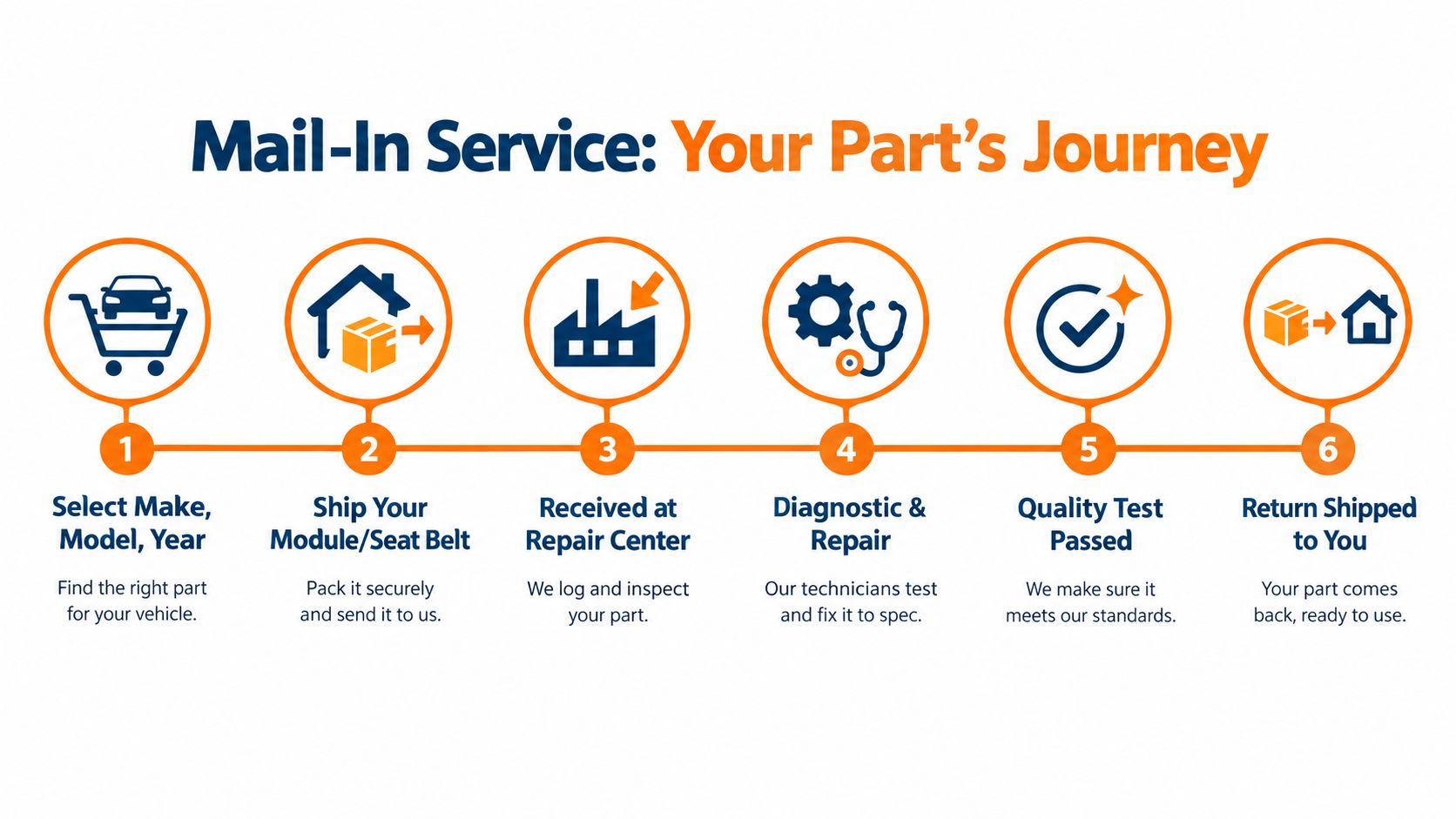
The process generally follows this sequence:
Order the service
Select the vehicle details and the specific part type being sent.Remove and package the part
The module or belt assembly is packed securely for shipment.Bench diagnosis and repair
The technician reads the module memory or services the mechanical internals of the belt assembly.Reset or rebuild
Crash data is cleared from the original module when appropriate, or the seat belt mechanism is repaired.Test and return
The part is shipped back for reinstallation.
When this route makes sense
Mail-in service is practical when the part itself is the bottleneck and the rest of the repair path is already known. It's especially useful after an accident when the vehicle needs its original electronics or original belt assemblies returned to service without replacing more than necessary.
What it does not do is cure a live wiring, sensor, or connector fault somewhere else in the car. If that underlying fault remains, the SRS light will still come back after reinstallation.
Clearing the Light Without Making the Problem Worse
Clearing the SRS light is the last step. Shops get into trouble when they treat it like the first one.
The right sequence
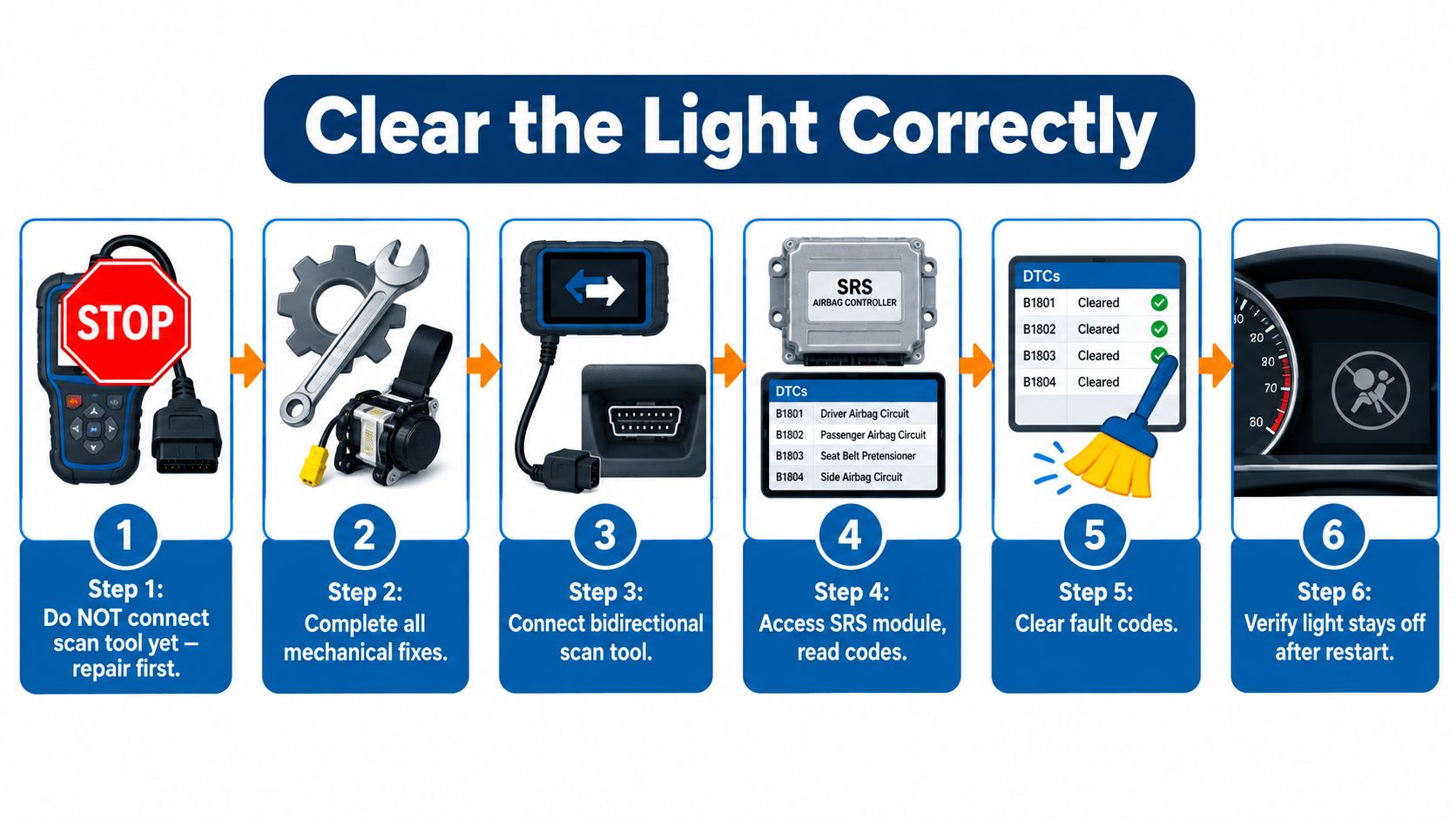
Start with the actual repair. That means the failed pretensioner, damaged connector, bad clock spring, crash-locked module, or wiring issue is already corrected before anyone reaches for the scan tool.
Then follow a clean process:
- Stabilize power first: Weak battery voltage can confuse the result and leave you chasing ghosts.
- Use a scan tool that accesses the SRS controller: A generic reader may not clear anything meaningful.
- Read the codes before clearing: You want a record of what the module was complaining about.
- Clear stored faults only after repair: Otherwise the same light will return and you've lost useful context.
- Cycle the ignition and verify bulb check behavior: The lamp should perform its normal startup routine and then stay off if the repair is complete.
Why blind clearing causes comebacks
When someone clears the code before fixing the cause, one of two things usually happens. The light comes right back immediately because the fault is active, or it stays off briefly until the next self-check catches the same issue again.
That's why “I cleared it and it returned” is valuable information. It tells you the car still sees a live problem or a locked condition, not just an old memory.
Clearing codes prematurely can also muddy the picture. You lose the original fault trail, then spend more time rebuilding the story after the fact.
What verification should look like
After the clear, the job isn't done until the module passes a fresh self-check and the warning lamp stays out under normal use. If the light reappears after seat movement, a bump, wet weather, or a cold start, that points back toward an intermittent connector or harness issue that still hasn't been fully corrected.
A clean repair stays clean. If the light returns, the diagnosis was incomplete.
A Practical SRS Light Decision Checklist
When the SRS light on the dashboard stays on after startup, this is the quickest way to keep the repair on track instead of turning it into a repeat visit.
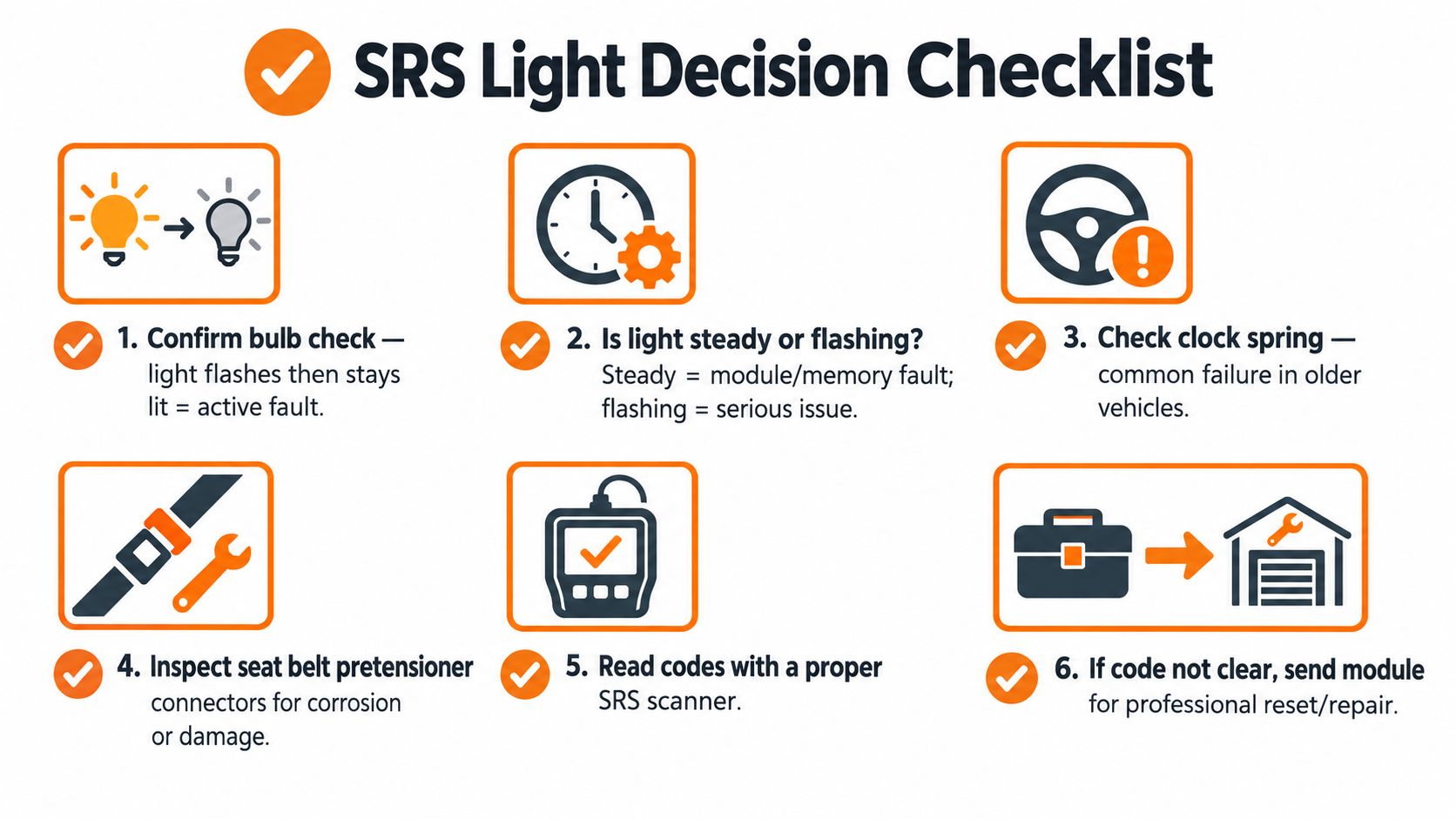
Use this order
- Watch the startup behavior: If the lamp doesn't follow its normal key-on check, treat that as a real fault sign.
- Think about recent events: Battery replacement, seat removal, water intrusion, steering work, and collision repair all matter.
- Separate intermittent from hard failures: A light that changes with bumps or seat movement often points to connection issues.
- Scan the SRS system properly: Don't rely on a generic code pull and call it diagnosed.
- Match the fix to the fault: Connector issue, sensor issue, crash data, and failed pretensioner don't all need the same remedy.
- Clear codes only after the hardware problem is fixed: Otherwise the light is coming back.
The takeaway drivers miss
The SRS lamp isn't just another warning icon you can postpone until the next oil change. It's a safety monitor. The car may still be drivable, but the restraint system may not be ready when you need it.
If you handle it in the right order, the job is manageable. If you skip the diagnosis and go straight to code clearing, you almost guarantee a comeback.
If your SRS light is on after a collision, or your seat belt retractor has locked and the original module or belt assembly needs service, Safety Restore offers mail-in repair for SRS airbag modules and seat belts. That's a practical option when crash data or pretensioner-related issues are the problem, especially if you want to keep the original OEM part and get the vehicle back together without guessing.