
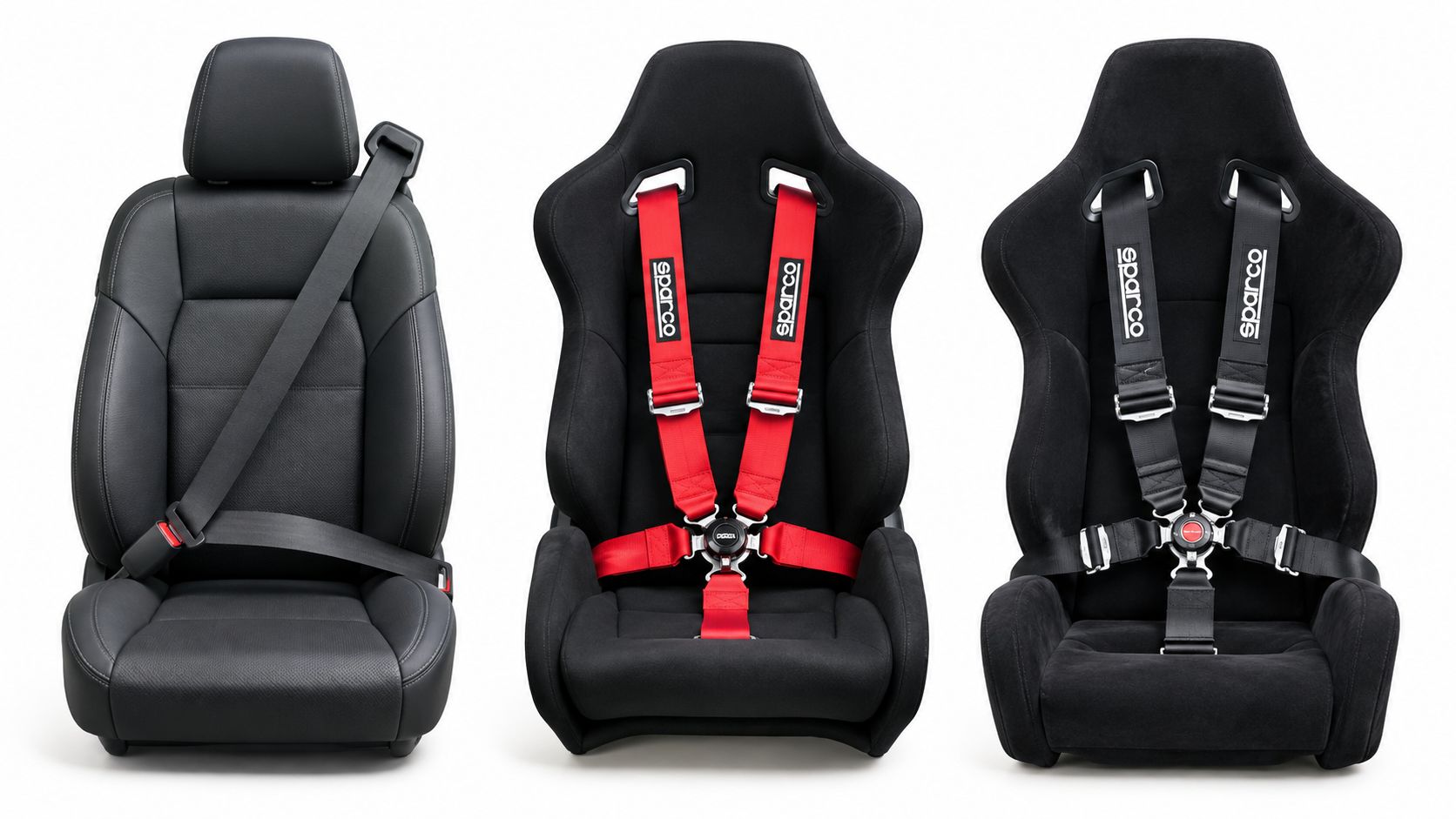
The worst advice in this space is simple: if one restraint strap is good, more straps must be better. That idea sounds logical in a shop bay, but it falls apart in a real crash because a restraint system is not just hardware, it's a matched package of belt geometry, seat design, body structure, and supplemental restraint timing. A four point seat belt can give a driver far better torso control in the right environment, yet the same setup can create legal problems and different injury pathways when it's bolted into the wrong vehicle.
| System Type | Primary Use Case | Street Legality | Seat Requirements |
|---|---|---|---|
| Three-point belt | Everyday road use, factory occupant protection | Built for street driving and standard vehicle compliance | Works with OEM seats and OEM SRS |
| Four-point seat belt | Track, specialty, or controlled high-load use | Often not approved for daily road use in many markets, especially as a standalone retrofit | Usually needs a compatible seat and mounting geometry |
| Five-point harness | Motorsport and other high-control restraint packages | Generally specialized use, not a casual road retrofit | Needs purpose-built racing seats and anti-submarining control |
The practical takeaway is blunt. The right restraint depends on the car's job, not on how aggressive the harness looks. That's why track builders, body shops, and restorers have to think about homologation, seat compatibility, and crash management as one system, not separate upgrades.
Practical rule: If the vehicle still needs to behave like a normal road car after impact, the factory restraint system usually stays the cleanest solution.
Table of Contents
- The Reality of Multi-Point Restraint Systems
- Historical Evolution and Structural Design
- Crash Biomechanics and Load Path Analysis
- Comparing 3-Point 4-Point and 5-Point Systems
- Legality Mounting Rules and Use Cases
- Post-Collision Repair and SRS Integration
- Situational Recommendations for Restraint Selection
The Reality of Multi-Point Restraint Systems
A four point seat belt is not safer just because it adds straps. It changes restraint geometry, so the crash load moves through the body in a different way. Early patent records show the idea is old, including Gustave-Désiré Leveau's four-point safety belt patent, which predates the modern passenger-car belt era [seat belt history and patent record].
Why the use case matters
A road car, a caged track car, and an off-road rig demand different restraint behavior. In a daily driver, the belt has to work with airbags, head restraints, seat cushions, pretensioners, and the seatback. In a track car, the belt may be part of a package that also includes a fixed-back seat and other motorsport-only hardware.
People get into trouble when they treat a harness as a stronger factory belt. They install it in a car that still has an OEM seat, stock airbag timing, and road-use expectations. The belt may feel tight, but that does not mean the whole restraint package matches the crash environment. A tighter hold can also change how the head and upper body accelerate if the seat, anchor points, or belt angle are wrong.
What shop owners should ask first
Before ordering parts or drilling holes, shop owners need to answer a few basic questions.
- Is the car staying on the street? If yes, the factory restraint system usually still has to stay in the conversation.
- Is the seat designed for a harness? If not, belt routing can be wrong even when the install looks clean.
- Are airbags still active? If yes, a harness can change how the occupant moves before the bag deploys.
- Is this for competition use only? That changes the legal and technical decision tree quickly.
A harness can make sense in the right package. It does not earn that status from extra webbing alone. The belt, seat, anchors, and vehicle use all have to match, or one part of restraint improves while another part gets worse.
Historical Evolution and Structural Design
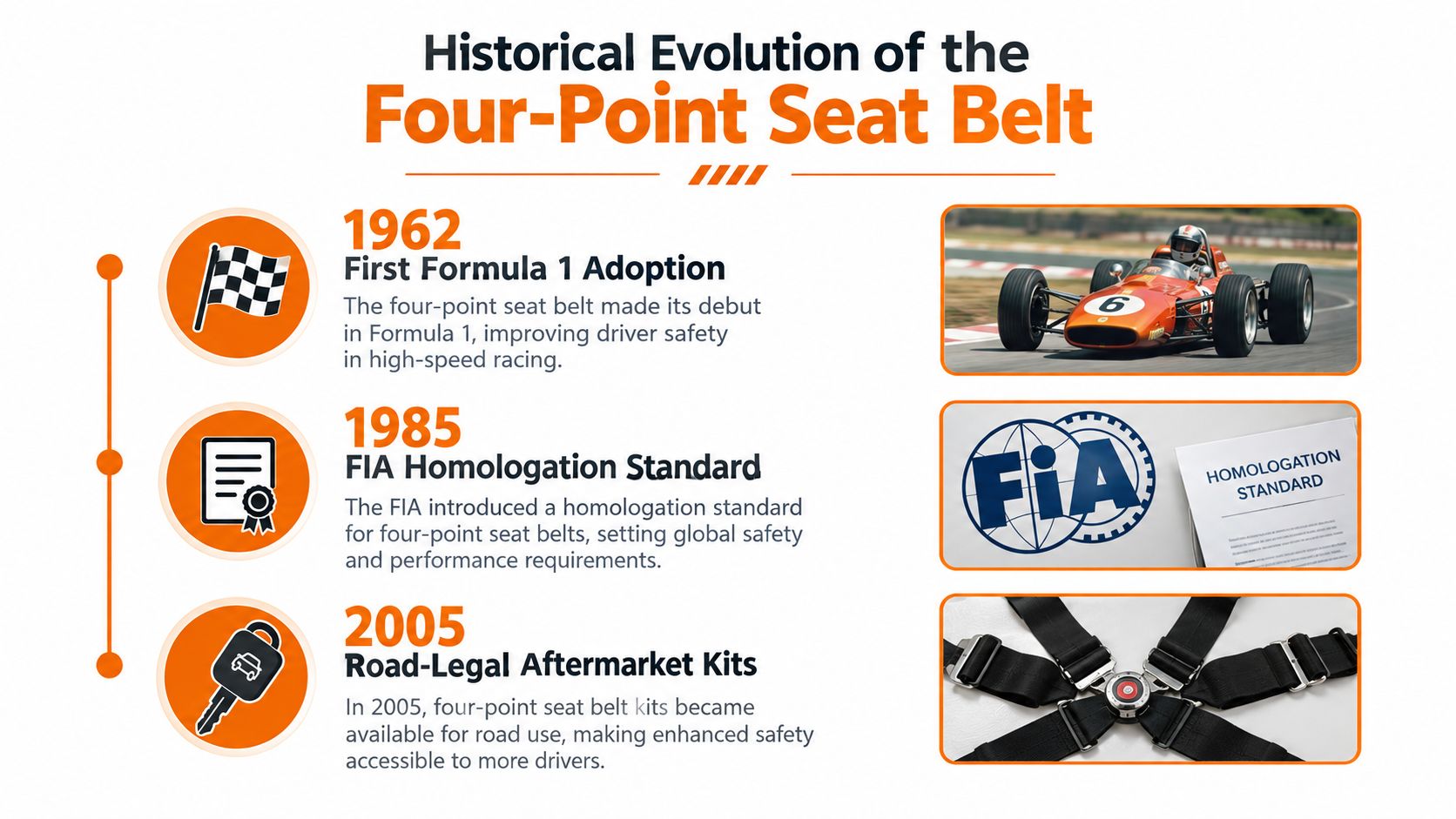
The history matters because it shows that the four point seat belt did not start as a modern convenience. It grew out of early attempts to control occupant motion, then stayed relevant because motorsport kept asking for firmer torso restraint than a simple lap belt could provide. The patent trail also matters, because it places the concept in the first era of automotive safety thinking rather than in a recent aftermarket trend [seat belt history and patent record].
The basic architecture
A four-point harness uses two shoulder straps and two lap attachments. That gives the occupant more symmetrical upper-body restraint than a three-point belt, which uses one diagonal shoulder path and one lap path. In shop terms, the harness is trying to hold the driver more squarely in the seat under braking and cornering load.
That difference is easy to see, and easy to misread. More contact points do not automatically mean more protection. They change the load path through the skeleton, the seat, and the anchor structure.
Four-point versus five-point
The step from four points to five points is not cosmetic. A five-point harness adds a crotch strap for anti-submarining protection. That extra strap helps keep the pelvis from sliding under the lap portion in a hard stop or impact, which is why the five-point layout became the better-known racing configuration for tighter occupant control.
The buckle count is not the point. The question is whether the pelvis stays where the belt expects it to stay.
That distinction matters when builders compare harnesses for a track car and a road car. A four-point configuration can be a first structural answer for restraining a seated occupant, especially where stronger torso control is needed. A five-point system goes further on anti-submarining control, but it assumes the seat and belt package were designed around that extra strap.
For a repair shop, the geometry should be treated as a system decision. A harness is not better because it looks race-ready, and it is not wrong because it predates modern passenger-car belt standards. It solves a different problem.
The mounting details also matter for repair logistics. If the belt mechanism is damaged after a collision, the internal hardware may still be serviceable even when the webbing needs attention. That is why some shops separate mechanical evaluation from trim replacement. For example, seat belt retractor service can fit into a broader restoration workflow when the vehicle-specific assembly is otherwise suitable for reuse.
Crash Biomechanics and Load Path Analysis
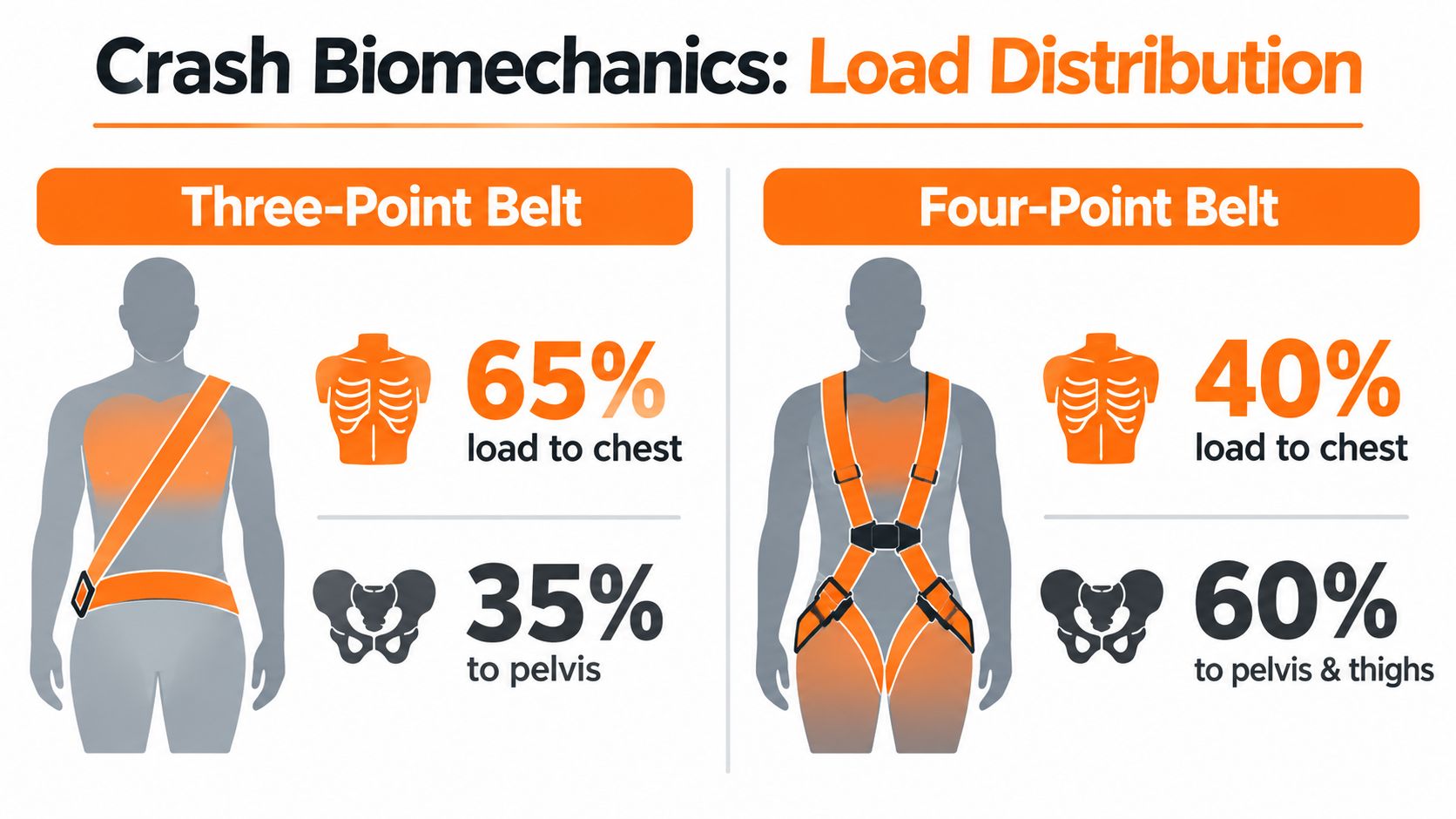
The appeal of a four point seat belt comes from how it routes crash loads. In frontal-impact biomechanics testing, harness-style shoulder belts shifted load toward the clavicles and pelvis, reduced shoulder-belt traction across the chest, and cut chest deflection in the test setup. The same work pointed to a wide reduction in thoracic injury risk, depending on whether the four-point belt was modeled as concentrated or distributed load.
What that means in the cabin
For track builders, the message is straightforward. A four-point harness holds the torso more firmly, so the chest does not pitch forward as freely under hard braking or impact. That is the behavior many drivers want, because it keeps the upper body centered and reduces the slack-and-snap motion that a loose or poorly routed belt can allow.
The trade-off is just as real. A stiffer torso coupling can change head motion. In crash-biomechanics comparisons, four-point belts usually lowered peak webbing stress compared with three-point belts, while also increasing head acceleration because the torso was held more rigidly [finite-element and crash-biomechanics comparison].
Load reduction is not the same as whole-body protection
That is why a harness can look excellent in a sled test and still be a poor retrofit in a street car. The torso may be better controlled, but the head can still carry enough energy to create a different injury pattern. The same comparison found lower four-point webbing stresses than three-point at multiple time points, including 73 MPa vs 84 MPa at 0.025 s and 159 MPa vs 163 MPa at 0.045 s, while noting generally higher head accelerations with the four-point system.
OEM restraint timing is built around the full cabin. Airbags, pretensioners, seat foam, steering column collapse, and belt load limiters are tuned together. An aftermarket harness changes that timing and the motion pattern the rest of the system expects.
Workshop insight: A tighter torso is not automatically a safer occupant if the head, neck, and belt routing are not controlled just as well.
For shops handling post-crash interior damage, the belt system has to be read alongside the buckle, pretensioner, and module condition. In that workflow, buckle pretensioner service belongs in the same conversation as webbing condition and anchor integrity, not as an afterthought.
Comparing 3-Point 4-Point and 5-Point Systems
The cleanest way to compare restraint systems is by job, not by hype. The factory three-point belt remains the most coherent answer for street cars because it integrates with the seat, body structure, and supplemental restraint timing. The four point seat belt narrows torso movement more symmetrically, and the five-point harness adds another level of pelvic control through the crotch strap.
Restraint System Comparison Matrix
| System Type | Primary Use Case | Street Legality | Seat Requirements |
|---|---|---|---|
| Three-point belt | Daily driving, OEM occupant protection | Built into road-legal vehicle systems | Factory seat compatibility |
| Four-point seat belt | Track days, specialty use, controlled installations | Usually not a simple daily-driver retrofit | Needs proper harness routing and compatible seating |
| Five-point harness | Motorsport and high-load restraint packages | Typically competition-focused | Needs fixed-back racing seats and anti-submarining design |
The biggest mistake is assuming that any harness can substitute for a factory belt without changing the rest of the cabin. In a road car, the OEM belt is part of a system that includes airbags, seat sensors, and sometimes pretensioners. In a track car, the harness often belongs with a fixed seat, head-and-neck protection, and a mounting structure that was planned from the start.
Seat compatibility is the hidden divider
Many retrofits fail here. A harness may fit the body, but the seat may not guide the webbing correctly. A factory seat with no proper harness openings can let the shoulder straps slide off angle or the lap belts ride too high, which defeats the purpose of the upgrade.
That's also why comparison tables matter for collision repair shops. They force the decision to stay practical. Is this a road car that still needs OEM compliance, or is it a purpose-built vehicle where a harness package is appropriate from the start?
If you're sorting out a wet-weather incident, a different restraint choice still won't solve the bigger problem of vehicle control. For road safety context, it's useful to also master Oregon wet roads before assuming restraint hardware alone solves the crash-risk equation.
The rule of thumb is simple. The three-point belt wins on integration. The four-point belt wins on torso control in the right environment. The five-point harness wins where anti-submarining and motorsport packaging are part of the build.
Legality Mounting Rules and Use Cases
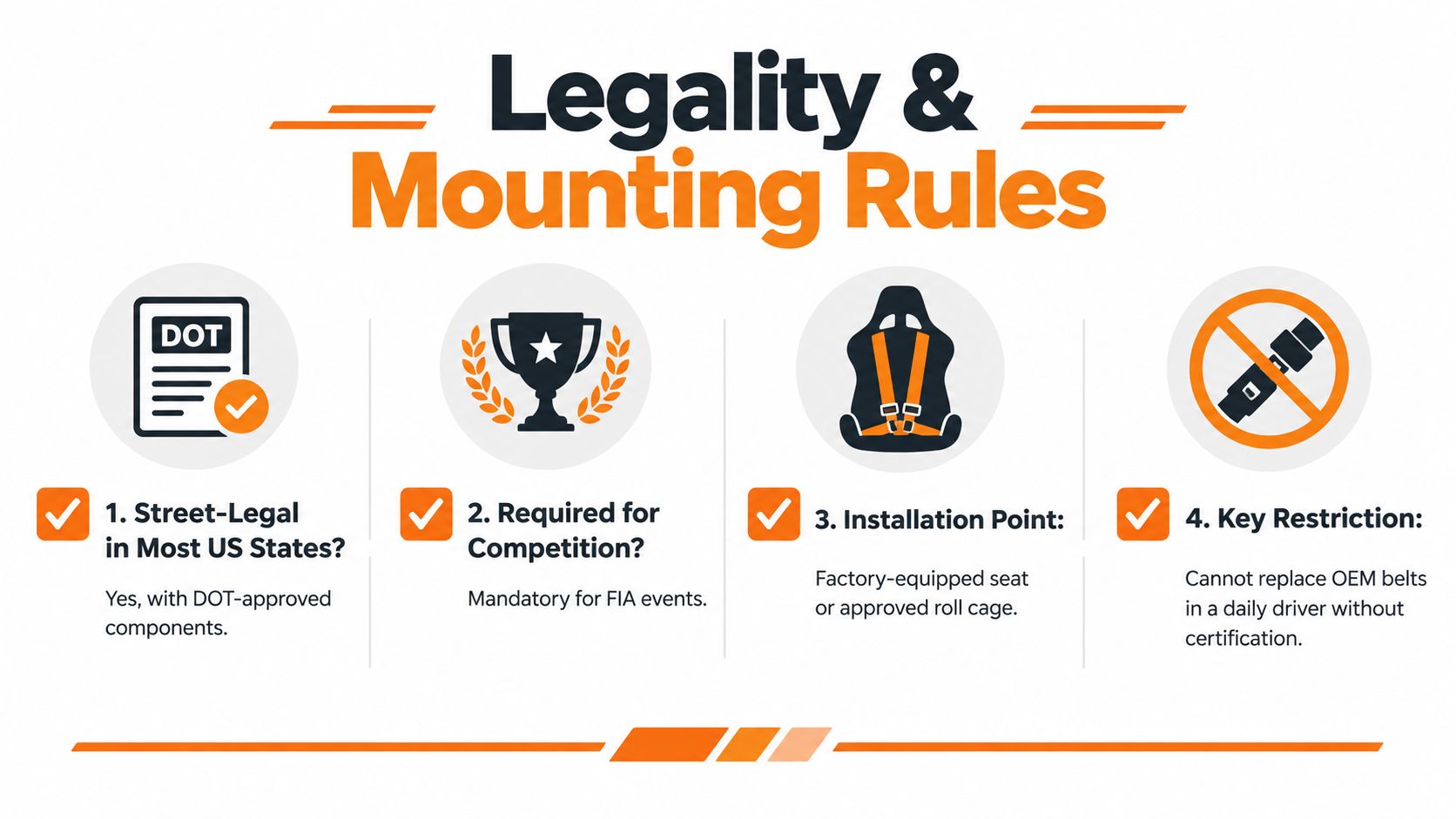
A four point seat belt is where enthusiasm collides with regulation. For everyday driving, the critical issue isn't whether the harness feels secure, it's whether it's allowed for that vehicle and that use case. A 2026 market-focused source states that standalone four-point harnesses are not street legal for daily road use in any U.S. state or major EU country under the relevant restraint standards, though motorsport and specialized OEM-adjacent exceptions can exist [2026 legality overview].
Where the harness makes sense
The appropriate use cases are narrow and deliberate. Dedicated track cars, some off-road rigs, and specialized fleet or competition vehicles can use harnesses when the whole package is engineered around them. That means the seat, mounting points, and other safety equipment all have to match the restraint system, not just the bolt pattern.
A daily driver is a different story. If the car still carries factory airbags, OEM seat sensors, and a three-point belt designed for road approval, a retrofit harness can create compliance headaches and practical safety conflicts. The fact that a belt is popular in motorsport doesn't make it appropriate for commuting.
Mounting rules that actually matter
A proper installation starts with the seat and the anchor points. Racing seats with harness openings help keep the shoulder straps where they belong. Eye-bolt mounts or approved wrap-around bars can be used only when the anchor structure was built for that load path, and the routing angles have to stay within the harness manufacturer's guidance.
Never route a harness by eye and hope the geometry will sort itself out in a crash.
That warning matters because a belt that looks centered in the garage may move into a bad angle once the seat is adjusted, the driver settles in, or the suspension compresses under load. The installation has to be checked in the final driving position, not just at the bench.
For builders who want a visual checklist, the key questions are straightforward:
- Approved seat: Does the seat have proper harness slots and an approved shell?
- Approved anchor: Is the mount designed for restraint loads, not just trim attachment?
- Correct routing: Do the shoulder and lap belts stay aligned with the occupant?
- Road use status: Is the vehicle still expected to pass road inspection as a daily driver?
For readers who deal with inspection failures after a crash, the legal answer usually comes before the repair answer. If the original restraint system no longer meets the use case, it's not a cosmetic issue, it's a compliance problem.
Post-Collision Repair and SRS Integration
After a collision, restraint problems rarely stop at the visible fabric. A belt can look intact while the retractor locks up, the pretensioner deploys, or the SRS module stores crash data that keeps the warning light on. That's why a repair order has to start with diagnosis, not guesswork, and why many shops send out original assemblies for restoration instead of replacing every part blindly.
What actually fails
The common failure points are mechanical and electronic. Webbing can be cut, burned, frayed, or stretched. Retractors can lock hard after impact. Pretensioners can fire and leave the assembly unusable until it's been inspected and serviced. Then the module can hold onto crash information even after the visible damage has been addressed.
A professional repair flow treats those items separately because they're not the same problem. The belt mechanism, the buckle, the pretensioner circuit, and the airbag control module all need their own checks. That's especially true in higher-end vehicles where the restraint system is tightly integrated with seat sensors and other SRS components.
Why repair logistics matter
Collision repair shops don't just need a fix, they need a repeatable process. That's where mail-in restoration becomes useful. One practical path is seat belt webbing replacement when the original assembly is otherwise sound and the job calls for restoring the fabric side of the system.
The same logic applies to larger vehicles. A shop handling collision repair for Class A motorhomes has to treat interior restraint and structural repair as part of the same return-to-service plan, because a crash doesn't politely separate body damage from occupant protection issues.
A repair workflow that holds up
- Document the failure: Photograph the belt, note the part number, and scan the SRS before removal.
- Remove only the needed parts: Keep the vehicle-specific hardware organized and dry.
- Match the service to the fault: Webbing, retractor, pretensioner, and module problems aren't interchangeable.
- Re-scan after installation: Don't assume the warning light tells the full story until the system is checked again.
Safety Restore is one option in this space. It services customer-supplied seat belt mechanisms, pretensioners, and SRS modules through a mail-in process, which can help shops preserve OEM fitment when the original part is worth repairing rather than replacing outright.
The point is not to “clear” a fault code and move on. The point is to return the restraint system to a condition that can be trusted in the next crash.
Situational Recommendations for Restraint Selection
For a collision shop, the safest recommendation is usually boring, and that's a good thing. If the vehicle is a normal road car, the factory three-point belt stays the default unless the manufacturer's repair path says otherwise. If the restraint has deployed, locked, or stored crash data, restore the OEM system first and confirm the SRS is functioning before the car goes back out.
For a track-day builder, the answer is different. A four point seat belt can make sense when the car has been built around it, especially with a fixed-back seat, proper harness openings, and mounting hardware that matches the belt geometry. If the seat is still a stock road seat, the harness may feel snug but still be wrong for the crash environment.
For a classic car restorer, restraint upgrades should be judged by fitment and legality, not nostalgia. A vintage cabin often lacks the seat geometry and anchor reinforcement that modern harnesses expect, so the right move may be restoring the original system or installing a road-legal replacement that preserves the vehicle's intended safety package.
Best-fit rule: Match the belt to the car's real use, not to the most aggressive thing that will bolt in.
There's also a hard line for mixed-use vehicles. If the car has to pass road inspection, carry passengers, and still retain OEM supplemental restraints, a retrofit harness usually creates more problems than it solves. If the vehicle is no longer a road car, then the harness can be part of a properly designed motorsport package rather than an isolated add-on.
For shops trying to keep repair cycles short, the practical path is to separate structural crash repair from restraint restoration, then decide whether the OEM parts are repairable. That approach keeps the decision tied to the vehicle's actual duty cycle, which is the only way to avoid expensive mistakes.
If your shop is dealing with locked retractors, deployed pretensioners, frayed webbing, or post-crash SRS faults, Safety Restore handles mail-in seat belt and airbag module restoration for the original parts you already have. Visit Safety Restore to review the repair options, match the service to the fault, and get the restraint system back into a documented, re-installable condition.