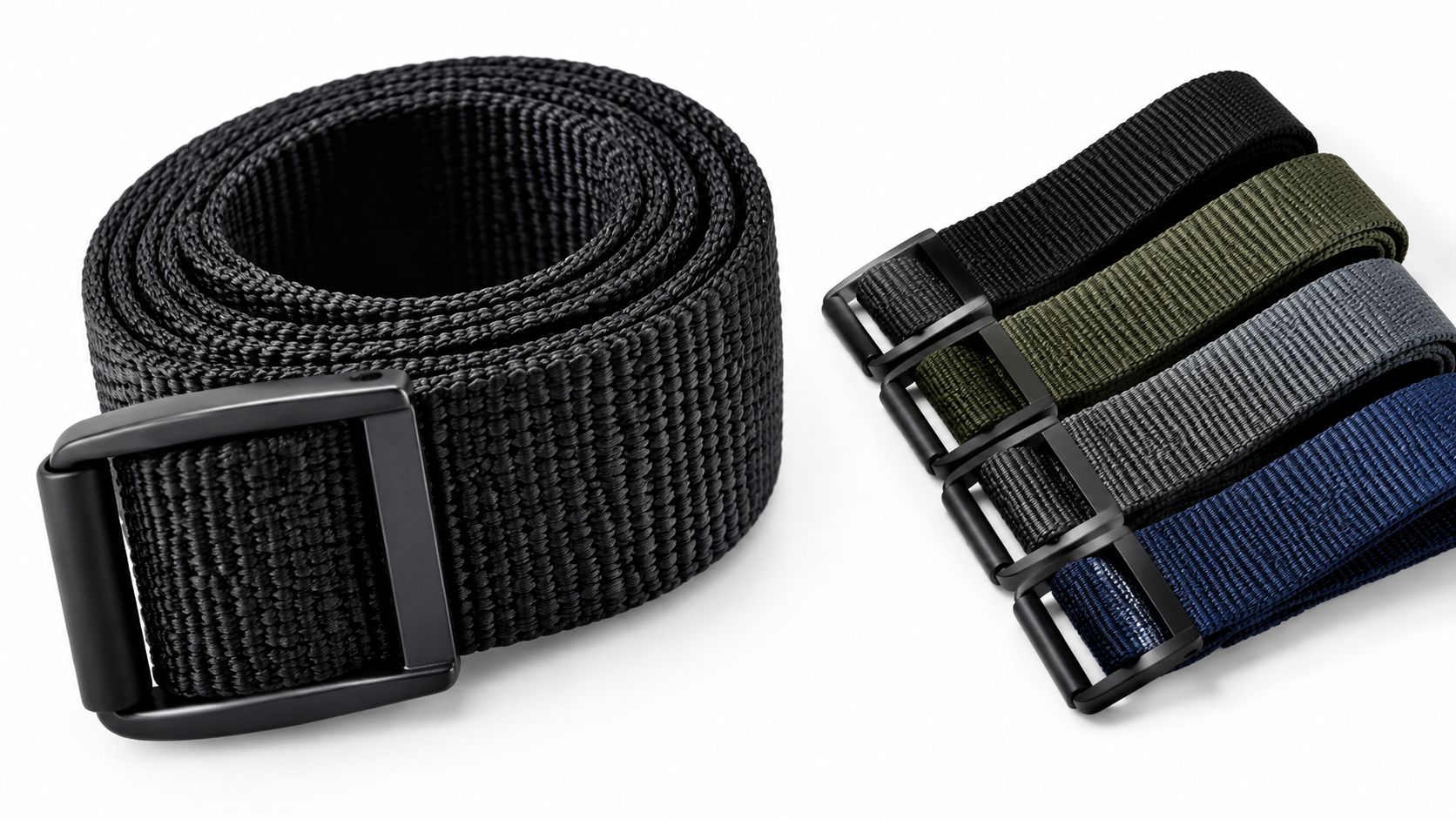
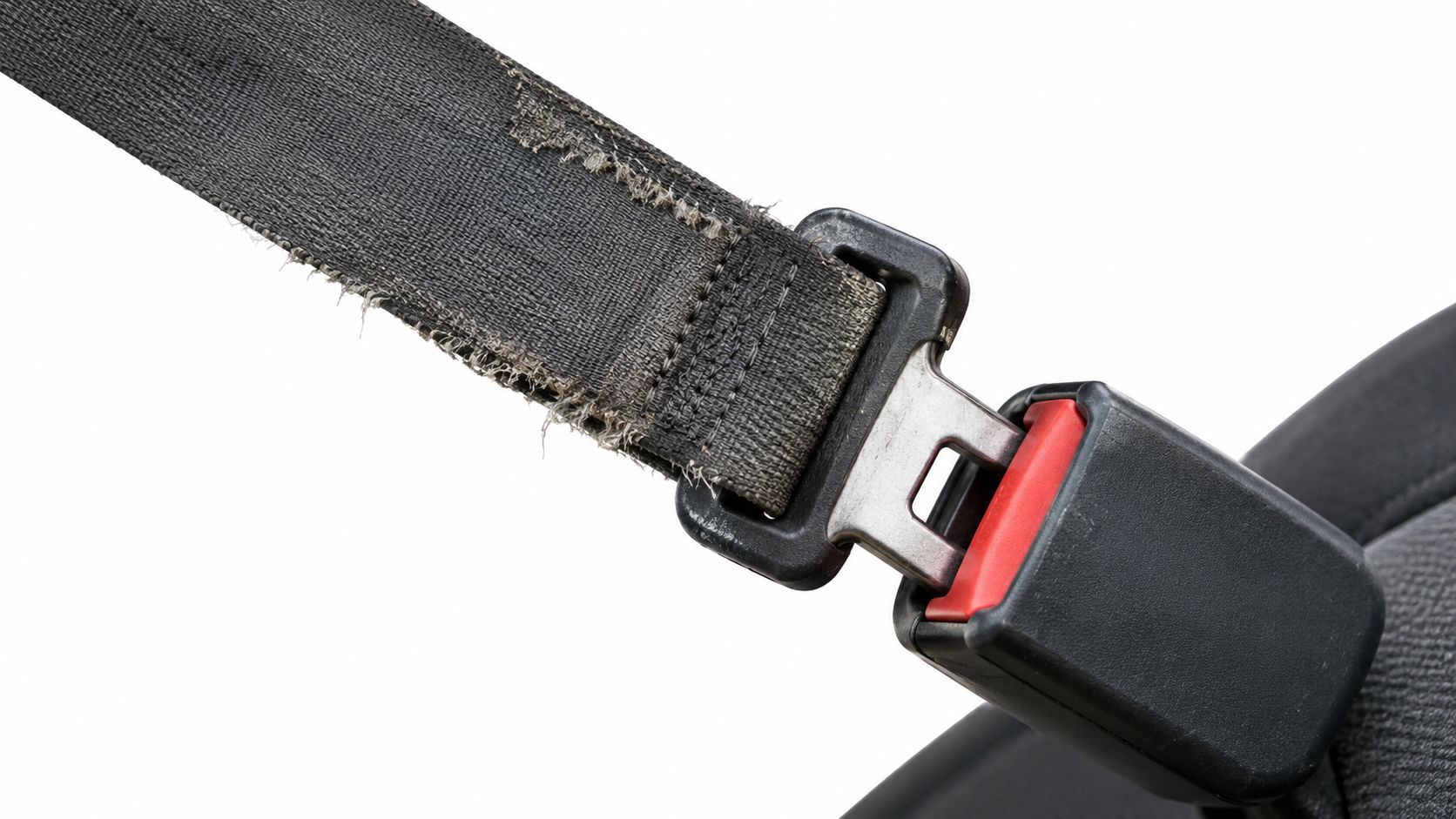
You buckle up for the drive home and notice the belt no longer retracts smoothly. The webbing may be faded, frayed at the edge, stiff from dirt, or marked by a collision. A belt that still latches can look usable, but the webbing is a load-bearing safety component, not ordinary fabric.
That distinction matters because nylon webbing belts combine a synthetic fiber, a carefully engineered weave, stitching, hardware, and compliance requirements. A casual replacement strap may look similar while having the wrong width, stretch behavior, abrasion resistance, or attachment method. The right choice depends on more than a strength number printed on a product page.
By the end, you'll be able to connect lab specifications with practical decisions. You'll understand what breaking load and elongation mean, why abrasion testing matters, where nylon performs well, when another fiber may be safer, and how to approach replacement without treating a restraint system like a craft project.
Table of Contents
- Introduction to Nylon Webbing Belts and Why They Matter
- What Nylon Webbing Is and How It Works
- Strength Standards and Safety Requirements Behind Webbing
- When Nylon Is the Right Choice and When It Is Not
- Colors Replacement Options and Customization Possibilities
- How to Choose Correct Webbing and Handle Installation
- Making Your Nylon Webbing Belt Decision With Confidence
Introduction to Nylon Webbing Belts and Why They Matter
A worn belt often gives you several clues at once. The surface may have fuzzy fibers from repeated rubbing, the color may have lightened near a window, or a dog may have chewed one section. After a collision, the belt can also remain locked or show damage that isn't obvious from the driver's seat.
The webbing carries the occupant load through the belt system. The buckle, retractor, pretensioner, anchor, stitching, and webbing must work together, so replacing only the visible strip without considering the complete assembly can create a mismatch. A belt isn't safe because it looks thick. It must meet the intended construction and performance requirements.
The material has a job beyond holding you in place
Nylon became the standard material for seat belt webbing in the mid-20th century. The U.S. seat belt standard built its light-resistance test around nylon because nylon was the dominant material at the time, as explained in NHTSA's official interpretation of the light-resistance requirement. That history shows why testing methods often reflect the materials and manufacturing practices that regulators were addressing.
The material later began to change. NHTSA noted by 1976 that manufacturers had started shifting toward dacron and polyester, a transition that reflects the continuing need to evaluate webbing by its actual application rather than by tradition alone.
What you should be able to decide
A sensible inspection starts with the belt's condition, then moves to its environment and specification. Ask whether the webbing is frayed, cut, contaminated, faded, locked after a crash, or attached to hardware that has also experienced an impact.
You'll also need to separate appearance customization from structural modification. A different color may be acceptable when the replacement webbing and professional installation preserve the required construction. A decorative strap from a luggage or fashion supplier isn't automatically suitable for occupant restraint.
Practical rule: Treat damaged seat belt webbing as a safety repair, not a sewing alteration.
What Nylon Webbing Is and How It Works
Nylon is a synthetic polyamide fiber. Manufacturers draw the fiber into long strands and weave those strands into a flat tape. The tape form spreads load across its width, making it easier to guide through a retractor, buckle, adjuster, and anchor than a round rope would be.
A useful analogy is a bridge made from many cables. One thin cable has limited capacity, but a well-arranged group distributes force across the structure. Nylon webbing works in a similar way. The fiber supplies tensile performance, while the weave, width, edge construction, and stitching determine how the finished belt behaves.
Fiber becomes a load-bearing tape
Three properties matter immediately:
- Tensile strength describes how much pulling force the webbing can withstand before breaking.
- Elongation describes how much it stretches under a specified load or before failure.
- Abrasion resistance describes how well the surface and internal fibers tolerate repeated rubbing.
These properties interact. A belt that never stretches might transfer crash forces abruptly, while a belt that stretches excessively could allow too much occupant movement. Seat belt webbing therefore needs controlled movement, not maximum rigidity.
Nylon's weave also matters. A wider belt can distribute contact pressure more effectively, while a denser or better-controlled construction may resist damage at edges and folds. That's why two straps made from the same broad fiber family can perform differently.
Manufacturing affects consistency
Historically, seat belt webbing was woven on shuttle looms at about 200 picks per minute. Since 1975, most webbing has been made on needle looms that can reach about 1,000 picks per minute, a fivefold increase in weaving speed, according to Handwoven's overview of seat belt material and loom production. Faster production helped manufacturers scale synthetic webbing for automotive and other safety uses, but speed alone doesn't guarantee a safe product.
The manufacturer still has to control width, weave density, edge quality, finish, and batch consistency. A finished belt also needs suitable stitching and hardware interfaces. If the webbing folds incorrectly, rubs against a sharp edge, or is routed through the buckle incorrectly, the fiber's laboratory rating won't describe the installed system.
Stretch helps manage energy
During a severe deceleration, controlled elongation lets the webbing absorb some energy while limiting how far the occupant moves. The belt must then return to a usable position through the retractor and remain compatible with the pretensioner and locking mechanism.
That relationship explains why a general-purpose nylon strap isn't a substitute for certified restraint webbing. A strap can be strong in a simple pull test and still have unsuitable elongation, edge behavior, coating, or heat performance.
Strength Standards and Safety Requirements Behind Webbing
A specification sheet becomes useful when you know what each test represents. Breaking load is the final-failure threshold, not the force the belt should experience in normal use. Elongation, abrasion retention, width, light resistance, and installation details fill in the rest of the safety picture.
For standard passenger-vehicle use, nylon seat belt webbing is commonly specified with a minimum breaking load of about 26.7 kN, or 6,000 lb. Heavy-duty versions can reach roughly 35.6 kN, or 8,000 lb, as described in seat belt webbing engineering specifications. Those figures describe the webbing under specified test conditions, not a guarantee that every strap with a similar appearance is interchangeable.
Read the numbers as a system
Engineering specifications commonly target controlled elongation of about 8% to 14% at a reference load near 11.1 kN, or 2,500 lb. The purpose is to permit managed stretch while limiting occupant excursion. The same source describes abrasion benchmarks of 2,500 or more cycles without meaningful strength loss.
| Specification | What it tells you |
|---|---|
| Breaking load | The force at which the tested webbing fails |
| Elongation | How much the webbing stretches under a defined load |
| Abrasion result | Whether rubbing causes meaningful strength loss |
| Width | Whether the webbing matches the belt path, hardware, and applicable rule |
| Light resistance | Whether exposure testing causes unacceptable deterioration |
U.S. seat belt rules require at least 46 mm webbing width for occupant-contact portions, a requirement discussed in current compliance guidance for flame-retardant nylon webbing. Width isn't a styling choice on a restraint belt. It affects fit through the hardware and the way load spreads across the occupant.
Test methods protect against misleading labels
For industrial and safety-critical nylon webbing, ASTM D6770 is commonly used for hex-bar abrasion testing, while ASTM D6775 verifies tensile performance. Tensile verification can measure retained break strength after wear, rather than merely counting how many rub cycles occurred, according to the WSTDA webbing standards review.
That distinction matters during buying. A seller who provides only “heavy duty” language hasn't supplied enough information. Look for the intended application, width, construction, breaking load, elongation behavior, test method, and applicable vehicle restraint standard.
For cargo, motorcycle, trailer, or general tie-down work, use products designed for those loads rather than adapting automotive restraint webbing. For example, heavy duty cargo straps 10ft belong to cargo restraint applications, not passenger seat belt replacement.
If the belt was involved in a collision, inspect the complete assembly. A replacement webbing service such as seat belt buckle and pretensioner repair addresses a different component concern than choosing a new roll of webbing.
When Nylon Is the Right Choice and When It Is Not
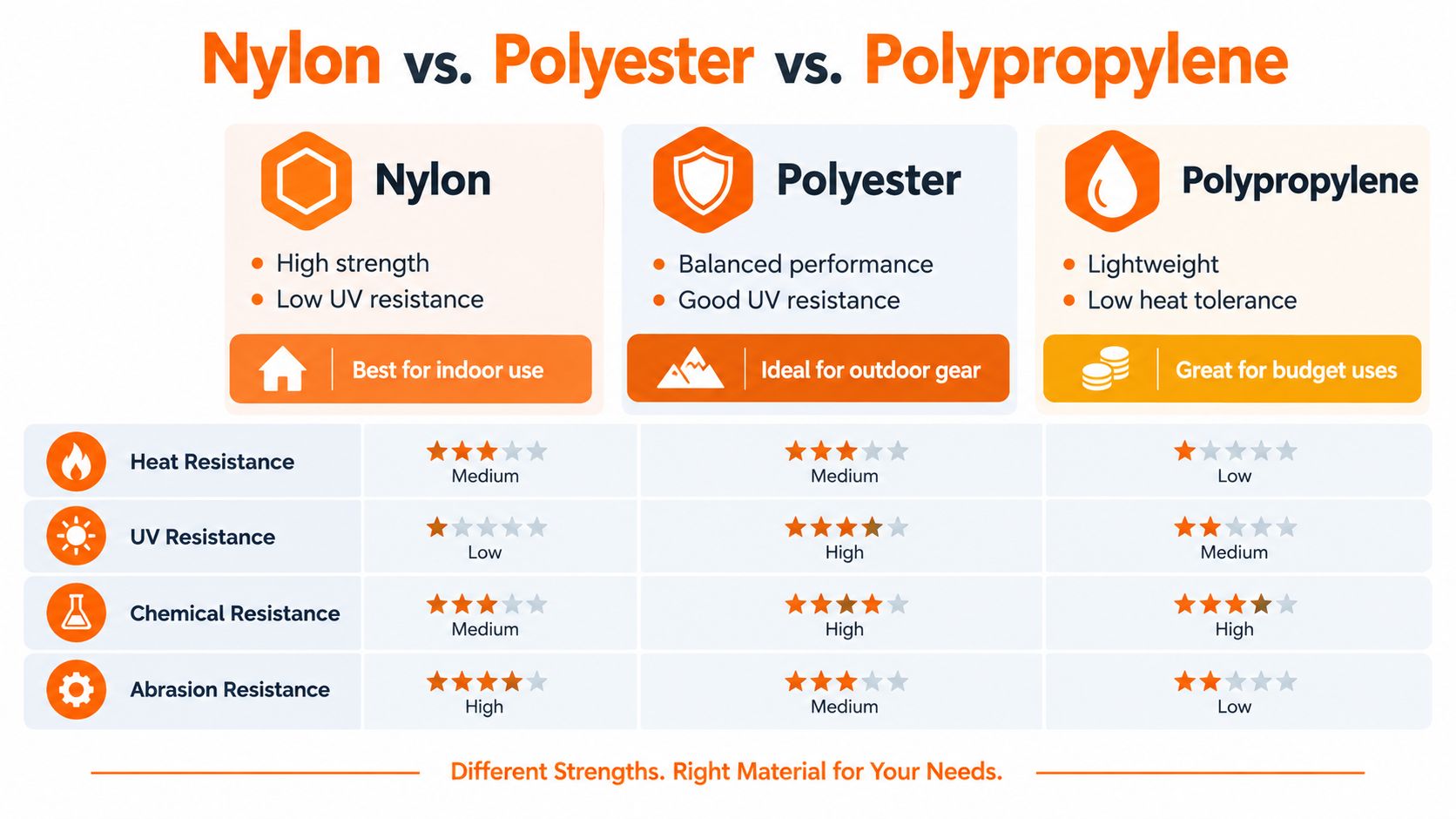
Nylon is useful because it combines high strength, flexibility, and strong abrasion performance. It works well in many interior restraint applications where the belt remains within its intended temperature, chemical, and light-exposure conditions. But nylon isn't automatically the safest fiber for every environment.
Heat is one of the clearest limits. Industrial guidance says nylon slings should be removed from service above 82.2°C, and nylon can soften or melt when exposed to excessive heat. That makes it a poor choice near hot exhaust components, open flame, high-temperature processing, or any location where the belt can contact a heated surface.
Compare the exposure, not just the fiber
| Environment | Nylon concern | Decision direction |
|---|---|---|
| Normal vehicle interior | Generally suitable when correctly specified | Use approved restraint webbing |
| Strong sunlight | UV can reduce tensile strength over time | Inspect often and consider a UV-suitable alternative |
| Acid or phenolic exposure | Nylon may be restricted or damaged | Follow chemical compatibility guidance |
| High heat or flame | Softening, melting, ignition, or dripping can occur | Use a material and construction approved for the hazard |
| Outdoor use | Moisture and sunlight add maintenance demands | Compare nylon with polyester and other alternatives |
Nylon's chemical sensitivity also matters. Industrial guidance specifically warns against using nylon slings around acids and phenolics. A belt used near aggressive chemicals should be selected from a compatibility chart for the actual substance, concentration, temperature, and exposure pattern.
UV aging creates a less visible risk. A technical discussion of harness replacement and aging reports that nylon webbing can lose up to 75% of its tensile strength after 30 months of UV exposure, and it notes that some certified belts use a fixed 2-year replacement cycle. See harness certification and expiration guidance for that specific aging discussion. Those figures don't create a universal expiration date for every vehicle belt, but they show why sun exposure and service history belong in the inspection.
Polyester and polypropylene solve different problems
Polyester often deserves consideration where UV stability and dimensional stability matter, while nylon may offer a useful combination of flexibility and abrasion resistance. Polypropylene is lightweight and can suit less demanding applications, but its heat tolerance is limited. Protective clothing introduces another requirement, because some standards require webbing not to ignite, drip, or sustain afterflame beyond 2 seconds, as summarized in synthetic webbing guidance for nylon, polyester, and polypropylene.
Choose the fiber only after identifying the hazard. For a vehicle seat belt, use webbing intended for that restraint system, not a material selected solely because it resists one environmental condition.
Colors Replacement Options and Customization Possibilities
A replacement belt doesn't have to look out of place. Owners often replace webbing after a pet chews it, a sharp trim edge cuts it, sunlight fades it, or a collision leaves the material visibly damaged. In those situations, restoring the original appearance can matter for inspection, resale, and the overall feel of the interior.
Color, however, should come after function. The replacement must match the required width, construction, stretch behavior, abrasion performance, and attachment method. A bright color or patterned strap may be attractive for a costume, bag, or casual belt, but that doesn't make it suitable for occupant restraint.
Restoration can preserve the assembly
Professional re-webbing typically focuses on replacing the damaged textile while retaining compatible original components where appropriate. Depending on the repair, that may include the retractor, buckle, pretensioner, labels, anchors, and other hardware. The repairer must also reproduce the correct webbing path and secure the new material with an attachment method intended for the load.
Color matching becomes practical when the existing interior has a specific shade. Black, gray, tan, and other standard colors may blend with the original cabin, while custom colors can support restoration projects or deliberate customization. The important question is whether the color option is offered on webbing that remains suitable for the belt's application.
Appearance can help inspection
A clean, correctly colored belt is easier to compare with the other restraints in the vehicle. That visual consistency can help an owner notice a torn edge, an unusual stain, or a belt that no longer retracts correctly. It doesn't replace a functional inspection, but it reduces the chance that obvious damage gets hidden by mismatched replacement material.
Color is a finish choice. The safety specification still controls the decision.
If you're considering a nonstandard interior, review the available custom color seat belt webbing replacement options before ordering. Ask which colors are available for your vehicle's belt, whether the original hardware remains compatible, and whether the service covers only the webbing or the complete affected assembly.
Don't sew a new strip onto a damaged belt as a shortcut. Seat belt stitching carries concentrated load, and an attractive seam can still be structurally wrong. The safest customization preserves the original system's intended geometry and uses webbing selected for the restraint application.
How to Choose Correct Webbing and Handle Installation
Start with identification, not shopping. Record the vehicle, seating position, belt type, visible damage, and whether the belt locked during a collision. The driver belt, passenger belt, rear belt, and buckle assembly may not be interchangeable, even when they look similar.
Build a specification checklist
Use the existing assembly and the supplier's documentation to confirm:
- Width and routing. Measure the webbing and check how it passes through the retractor, guide, buckle, and anchor. A mismatch can cause twisting, binding, or poor retraction.
- Application rating. Confirm that the material is intended for automotive occupant restraint use. Don't substitute cargo, luggage, watch, pet, or fashion webbing.
- Breaking load and elongation. Compare the replacement's documented values with the original requirement, rather than relying on a vague “strong strap” description.
- Condition and exposure. Look for fraying, cuts, melted fibers, chemical stains, stiffness, fading, and damage at folds or contact points.
- Hardware condition. Check whether the retractor, buckle, pretensioner, anchor, and mounting points were involved in a crash or show deformation.
For everyday textile products, practical maintenance advice such as these pro tips for nylon band care can help you recognize dirt, fraying, and surface wear. Safety belts still require vehicle-specific inspection and approved repair methods.
Use a controlled mail-in workflow
A typical mail-in replacement begins with an online order for the correct service. You remove the specified part, package it so the webbing and hardware don't get crushed or contaminated, and ship it to the repair provider. The provider replaces the webbing or services the requested component, then returns it for reinstallation.
Before shipping, photograph the belt path, labels, mounting orientation, and hardware. Keep notes on which position the part came from. Those records reduce installation mistakes when the repaired assembly returns.
A service such as seat belt webbing replacement can be appropriate when the original webbing is cut, frayed, aged, or damaged but the owner needs the assembly prepared for reinstallation. Confirm the provider's scope, return instructions, testing process, warranty terms, and compatibility before sending the part.
After installation, confirm that the webbing isn't twisted, the buckle latches and releases normally, the belt extends and retracts smoothly, and the warning system operates as expected. If any part binds, stays locked, or shows a persistent restraint warning, stop using the vehicle until a qualified technician evaluates it.
Making Your Nylon Webbing Belt Decision With Confidence
The decision becomes clearer when you separate four questions.
First, what happened to the belt? Fraying, cuts, melted fibers, chemical contamination, severe fading, and collision involvement all deserve more than a quick visual wipe-down. A belt that locks after impact may have an internal retractor or pretensioner issue in addition to damaged webbing.
Second, where does it operate? A normal passenger compartment is different from a hot engine-adjacent area, chemical-processing environment, outdoor installation, or flame-exposed workplace. Nylon can be an excellent fit in one setting and an inappropriate choice in another.
Third, what does the specification say? Verify width, construction, breaking load, elongation, abrasion performance, and application certification. For occupant-contact webbing in the U.S., the applicable width requirement is at least 46 mm, as noted in the earlier compliance guidance. Don't treat that number as permission to improvise with a visually similar strap.
Fourth, who will install and verify it? Correct routing, stitching, hardware compatibility, and post-repair function all matter. Professional service is especially sensible after a collision, when the webbing and hidden mechanisms may have experienced loads that aren't visible.
Final inspection before driving
Use this short check:
- The webbing lies flat without twists.
- The belt extends and retracts without sticking.
- The buckle latches securely and releases when pressed.
- The anchor and mounting hardware are tight and undamaged.
- No cut, fray, melt mark, chemical stain, or severe fading remains.
- The vehicle shows no unresolved seat belt or SRS warning.
Nylon webbing belts are engineered systems, not interchangeable ribbons. When you match the material to the environment, verify the specification, and treat replacement as a safety repair, you make a decision based on performance instead of appearance alone.
Safety Restore offers mail-in seat belt webbing replacement for damaged, frayed, cut, aged, or customized automotive belts, with repair services for related seat belt mechanisms and pretensioners. Review the available service options and visit Safety Restore to choose the correct repair path for your vehicle.