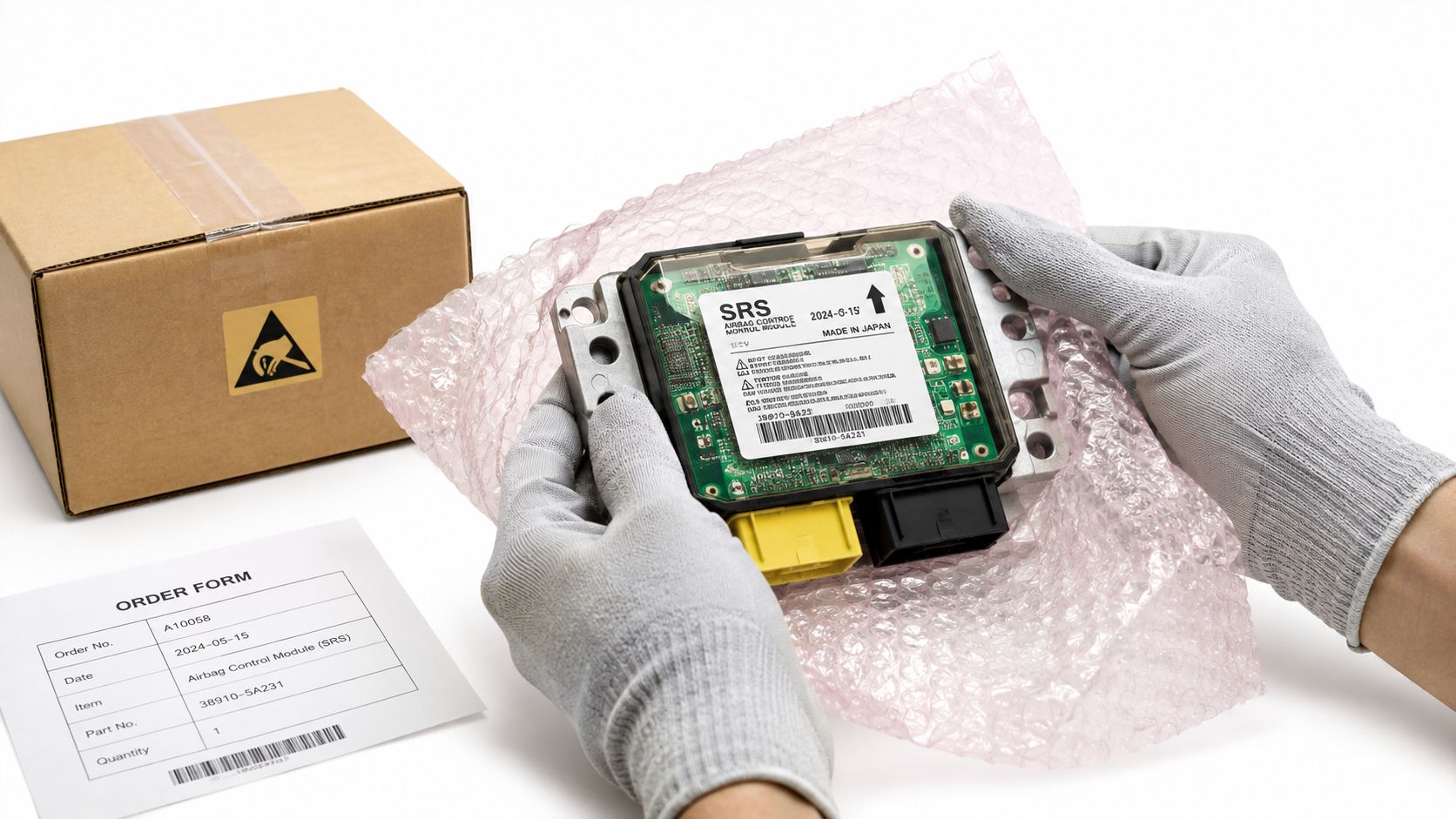
A mail-in airbag computer reset through Safety Restore costs $99 per item and typically takes around 24 hours. That service clears locked crash data from the module, but it doesn't repair deployed airbags, fired pretensioners, damaged sensors, or broken wiring.
You're probably looking at the SRS warning light after an accident, a scan tool report that says crash data is stored, and a repair estimate that makes replacing the entire module sound unavoidable. Before you ship anything, understand what follows the module after it leaves the vehicle. The reset happens on a workbench inside the control unit, not through the diagnostic socket, and the returned part is only one piece of a complete safety-system repair.
Modern airbag control modules preserve crash records in non-volatile memory. The stored information can include impact timing, severity, restraint deployment status, driver inputs, and vehicle movement before and after the collision, as described in NHTSA's Event Data Recorder guidance. Disconnecting the battery won't make that history disappear.
Table of Contents
- What an Airbag Computer Reset Actually Does
- Symptoms That Point to a Locked SRS Module
- What Happens on the Technician's Bench
- Preparing and Shipping Your Module Safely
- Reinstalling the Module and Verifying the System
- Safety Boundaries and Legal Considerations
- Quick Checklist and Common Questions
What an Airbag Computer Reset Actually Does
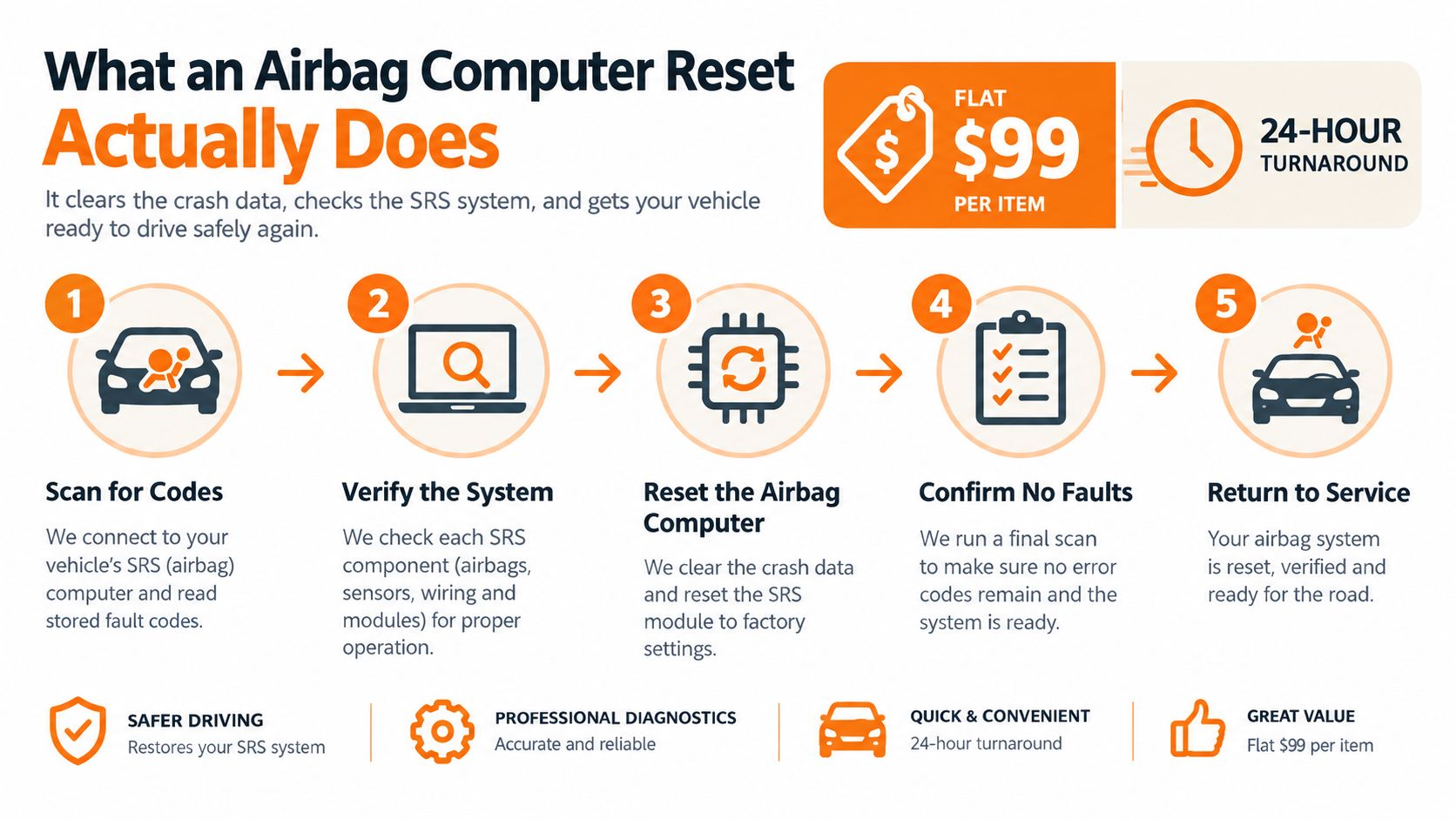
After a collision, a scan may show stored crash data while the repair estimate recommends replacing the entire SRS module. Safety Restore's mail-in service charges $99 per item and usually completes the work in around 24 hours, according to the service information supplied for this guide. That fee covers a component-level reset of the control module, not repair of the vehicle's safety system.
The module is the SRS decision computer. It receives impact-sensor data, monitors restraint circuits, records seatbelt and pretensioner activity, and stores what happened during a qualifying event. After a collision or sufficiently hard impact, it can retain crash information in non-volatile memory. Disconnecting the battery does not erase that record. NHTSA's EDR materials describe crash records as persistent diagnostic information.
What the reset removes
A proper reset clears the stored crash condition inside the controller. The technician removes crash-event hard codes, clears the deployment lock that can keep the SRS warning active, and returns the unit to a state where it can communicate with the vehicle again.
The reset does not repair damaged hardware. It will not replace:
- Deployed airbags: Fired inflators and bags require suitable replacement components.
- Used pretensioners: A fired seatbelt pretensioner needs physical replacement or an appropriate repair service.
- Impact sensors: A sensor damaged or flagged during the collision still requires diagnosis.
- Wiring and connectors: Open circuits, crushed harnesses, corrosion, and loose terminals remain vehicle-side faults.
The recording history explains why this service is more than ordinary code clearing. Updated NHTSA recording and retention standards applied to light vehicles manufactured for model year 2013 and later after September 1, 2012, as discussed in this event-data-recorder history. Deployment events are generally locked, while some near-deployment records may be overwritten by a later event.
Practical rule: A reset gives you a reusable SRS controller. It does not give you a roadworthy car.
Symptoms That Point to a Locked SRS Module
A collision followed by a persistent airbag or SRS light deserves a proper scan, not a guess. If the light returns every time you cycle the ignition, stored crash data is one possibility. The light alone does not prove the controller needs a reset.
Use a capable SRS scan tool to read the airbag controller and record its diagnostic trouble codes. Codes may include B0020, B0028, B0091, or a manufacturer-specific crash-event code. A code beginning with “B” does not automatically mean the module should be shipped. It may identify a sensor, circuit, occupancy system, or connector fault instead.
Separate crash lock from ordinary faults
Sort the scan result before removing anything. A crash-data or deployment-lock message that returns after an attempted clear supports a bench reset. An open firing loop, passenger occupancy mat, seat connection, fuse, or sensor code points first to a vehicle-side repair.
Check these causes while documenting the original condition:
- Under-seat connectors: Inspect loose, damaged, or contaminated terminals. Do not probe firing circuits carelessly.
- Occupancy components: Passenger-seat sensing systems can keep the SRS light on while the module remains healthy.
- Fuses and power: Confirm the controller has correct power and ground.
- Crash hardware: Identify which airbags and pretensioners deployed, then verify that replacements match the vehicle configuration.
- Repeat behavior: Record the codes before clearing them, then check whether the crash condition returns immediately.
A professional module-reset guide explains the distinction. The module stores crash records in EEPROM, so an ordinary OBD2 reader may clear surface fault codes but generally cannot erase locked deployment history.
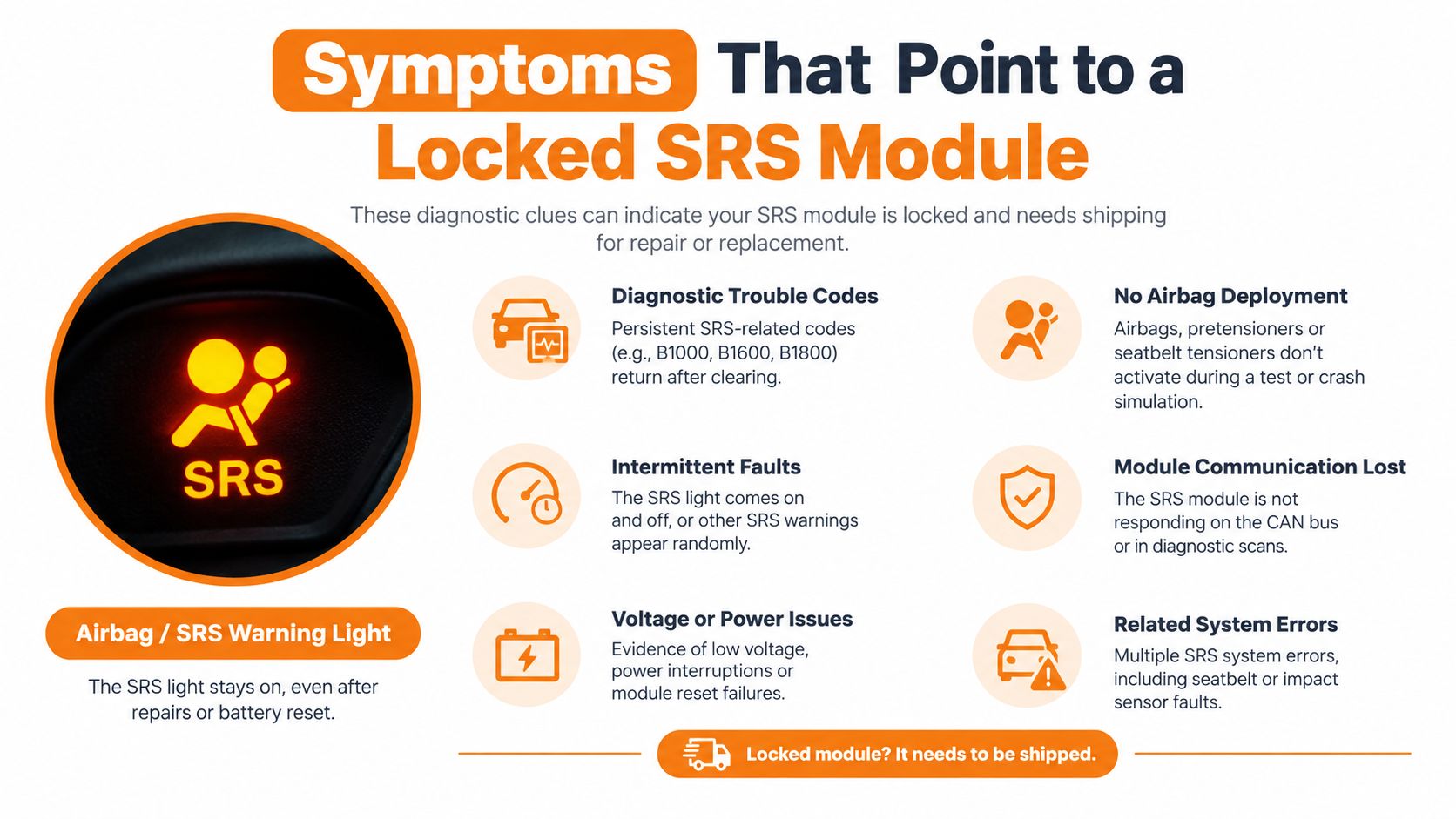
Before shipping, record the exact codes, vehicle mileage, module part number, accident history, and the warning light's behavior during key-on. Photograph the label and connectors. Send that information with the controller so the technician can identify the unit and you can compare the post-reset result after reinstallation. A reset addresses stored module data. It does not replace the diagnosis or repairs that make the SRS safe to return to service.
What Happens on the Technician's Bench
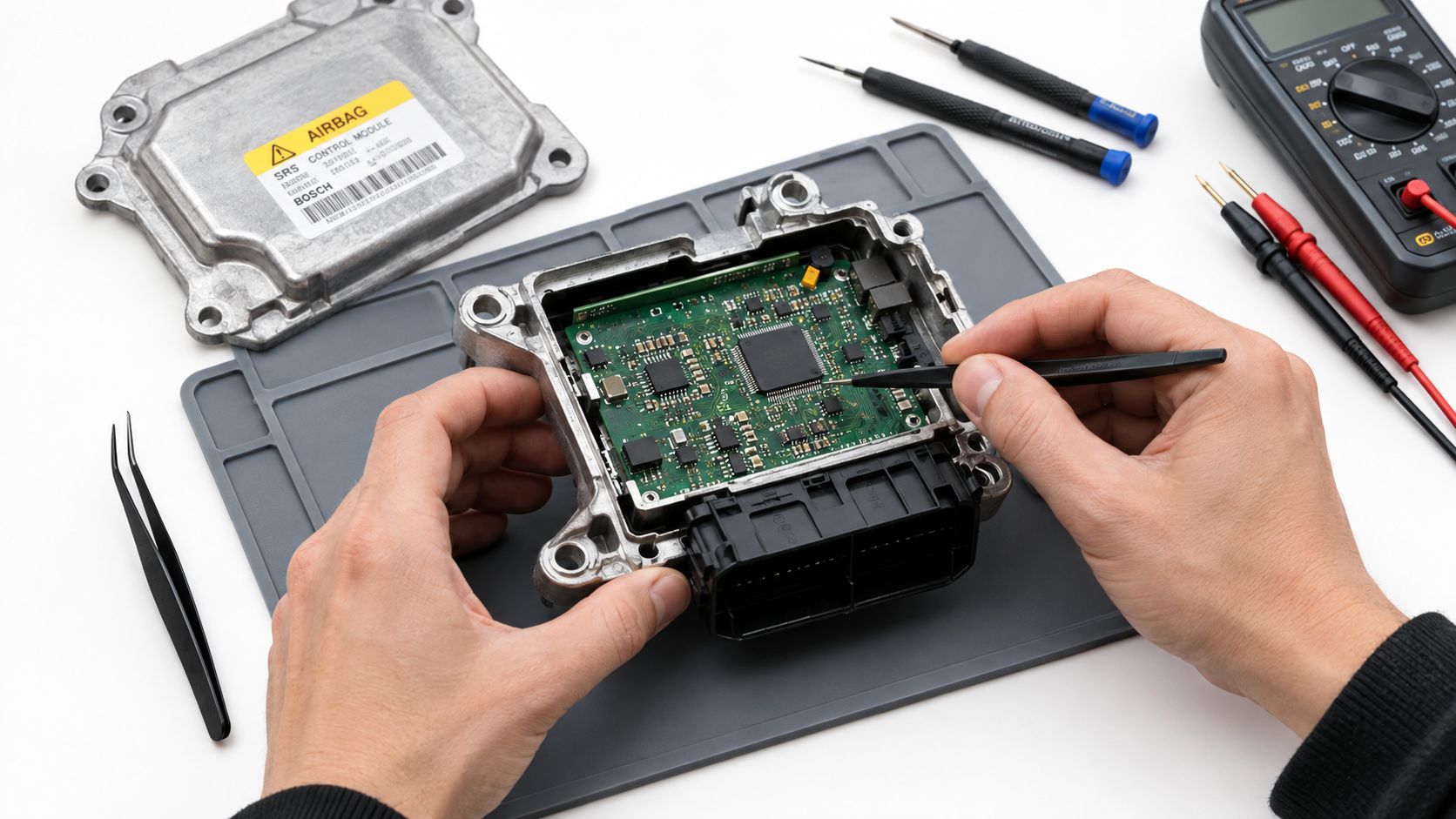
A returned SRS module is an electronics job, not a quick code-clearing visit. The technician first confirms the part number, examines the housing and connector pins, and checks for water intrusion, impact damage, burned components, and corrosion. A damaged board needs repair or replacement, not a reset.
The housing is opened with care. Depending on the design, crash information may be stored in a separate EEPROM or in the microcontroller's memory. The technician connects a module-specific interface or programmer, reads the existing data, and saves the original information before changing anything.
Why the diagnostic port isn't enough
An OBD2 scanner uses approved vehicle diagnostic routines. It can read SRS codes and clear some active faults, but it generally cannot rewrite the protected crash-data area. Non-volatile memory retains that information even without vehicle power, which is why disconnecting the battery or pressing “erase codes” does not remove a locked deployment record.
The bench process involves reading the memory, identifying the crash data, removing or correcting the locked record, rewriting the file, and testing the controller. The technical explanation of airbag control-unit resets describes this direct memory approach. The exact memory location and procedure vary by module.
A careful technician preserves vehicle-specific configuration wherever the design permits. Copying an unverified file or wiping the entire memory can remove configuration data and leave the controller unable to communicate. Background on related vehicle-electronics handling is available in this technical resource on module electronics.
Testing after the memory work
After rewriting, the technician checks whether the controller boots and communicates correctly. Bench testing may include firing-loop resistance checks, squib-circuit verification, connector inspection, checksum validation, and a powered self-test.
The result shows that the returned controller operates and no longer carries the locked crash condition. It does not confirm that replacement airbags, pretensioners, wiring, or sensors are correctly installed in the vehicle. Those repairs and the final SRS scan still belong to the repair shop.
A proper reset service should return a tested, rearmable controller, not a module that was merely wiped and mailed back. If the unit fails communication or shows the crash condition again after installation, stop the vehicle repair process and diagnose the underlying system before driving.
Preparing and Shipping Your Module Safely
Start with the service order, then remove the part only when you know where it is and how the vehicle protects the SRS circuits. The module may sit beneath the center console, near the center tunnel, behind a kick panel, or under the dashboard. Location depends on the vehicle, so use the manufacturer's service information rather than forcing trim panels or pulling on a yellow connector.
Before working near SRS wiring, disconnect the negative battery cable and allow the system's backup energy to discharge. The service instructions in your vehicle repair information take priority. Don't use a test light or improvised meter across an airbag squib, and don't turn the ignition on while an SRS connector is disconnected.
Removal and packing
Remove the mounting hardware with the correct socket and keep the bolts, brackets, and covers together. Don't carry the module by its wiring connector. Inspect the terminals, photograph the label, and record the VIN, mileage, codes, and your contact details.
A safe package has three goals: control static, prevent movement, and protect the connectors. Use anti-static material when available, wrap the module so it can't contact hard packaging, and place it in a rigid box with cushioning on every side. A thin envelope or loose box leaves the circuit board vulnerable to impact damage during transport.
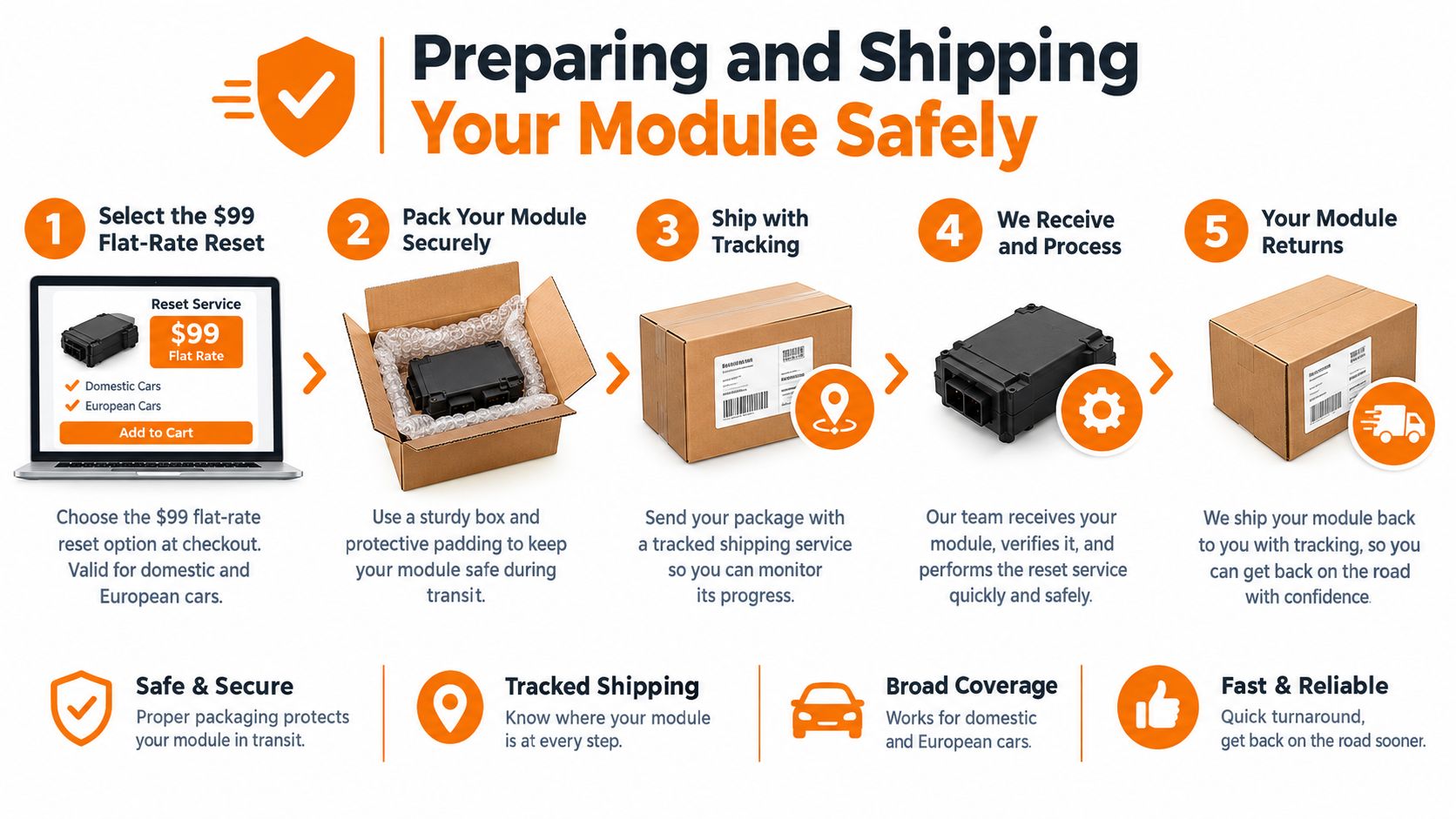
Include the completed order paperwork inside the package, not taped only to the exterior. Add the module part number and a short description of the crash event. Use a carrier service with tracking and keep the receipt until the returned unit is installed and tested.
The ordering process should tell you where to send the component and what information the provider needs. Don't ship an unknown module without an order reference. If the unit is wet, cracked, badly crushed, or missing connectors, report that before sending it because those conditions can change the service decision.
Reinstalling the Module and Verifying the System
When the reset unit comes back, inspect the package before opening it fully. Look for crushed corners, water exposure, broken connectors, or damage to the housing. Compare the part number and label with your photographs, then make sure the mounting bracket and connector area are intact.
Install the module in the original position. Refit the mounting hardware according to the vehicle manufacturer's specification, reconnect the harness, and confirm that the locking mechanism is fully seated. An SRS connector that looks connected but isn't locked can create a new fault immediately.
The first key cycle
Reconnect the negative battery terminal only after the module and all SRS components are installed. Sit outside the deployment path, turn the ignition to the run position without starting the engine, and watch the warning lamp perform its self-check.
A normal system should illuminate the SRS light briefly and then switch it off after the check completes. If it remains on, don't keep cycling the key and hope it clears. Connect an SRS-capable scan tool and read the current faults.
| Result after installation | What it usually means |
|---|---|
| Light completes its check and goes out | The controller communicates and no active SRS fault is being reported. |
| Light stays on with a new component code | An airbag, pretensioner, sensor, occupancy system, or wiring fault remains. |
| Crash data still appears | Confirm the returned unit, part number, and service result with the reset provider. |
| Communication is missing | Check power, ground, connector seating, and network wiring before blaming the reset. |
A standard OBD2 reader may not access the SRS controller at all. Use a scanner that supports the vehicle's airbag system and manufacturer-specific codes. After the warning light behaves normally, carry out a cautious road test and stop immediately if the light returns or another restraint warning appears.
Safety Boundaries and Legal Considerations
An airbag computer reset removes stored crash information from the controller. It doesn't restore protection that the collision physically consumed. If an airbag deployed, the bag and inflator need proper replacement. If a pretensioner fired, the belt assembly needs appropriate repair or replacement. Damaged impact sensors, clock springs, connectors, and harnesses require their own inspection.
That boundary is the most important point in the entire process. Collision-repair guidance on SRS module resets distinguishes memory clearing from repairing deployed restraint hardware. A vehicle can have a clean-looking dashboard after the wrong repair and still lack working crash protection.
What must be repaired separately
Treat the reset as one line on a collision work order, not as the final sign-off:
- Restraint replacement: Replace deployed airbags with components appropriate for the vehicle and configuration.
- Pretensioner service: Address every belt mechanism that fired or locked during the event.
- Sensor inspection: Test impact sensors and replace damaged units.
- Harness assessment: Repair or replace damaged SRS wiring and confirm connector locks.
- Occupant detection checks: Diagnose passenger-seat sensing faults and perform required calibration.
- System verification: Scan the complete SRS after reassembly and document the result.
A reset won't reverse a vehicle's insurance classification, repairability decision, or title history. Insurers may determine that a collision vehicle is a total loss, and clearing the module doesn't change that decision. It also doesn't turn incomplete repairs into an acceptable sale.
Legal requirements vary by location, vehicle type, inspection process, and transaction details. Selling a vehicle while concealing missing or disabled safety equipment can create serious liability, even when the warning light has been made to disappear. Keep invoices, scan reports, parts records, and photos so the repair history is clear.
Read the provider's terms and conditions before sending a component. A responsible shop should also explain what its warranty covers, what it excludes, and what happens if the module has physical damage beyond a memory reset.
A dark SRS light is evidence of a completed diagnostic check, not proof that every restraint component was repaired correctly.
Quick Checklist and Common Questions
Use this checklist before you put the module in a box:
- Confirm the fault: Scan the SRS with a capable tool and record every code.
- Rule out vehicle faults: Check power, grounds, fuses, connectors, sensors, occupancy systems, airbags, and pretensioners.
- Remove carefully: Follow the vehicle's battery-disconnection and SRS handling procedure.
- Protect the part: Use anti-static protection, cushioning, a rigid box, and the completed order information.
- Track the shipment: Keep the carrier receipt and tracking number.
- Review the returned unit: Check the part number, housing, connectors, and packaging.
- Reinstall correctly: Secure the module and lock the harness connector.
- Verify the system: Run the ignition self-check, scan the SRS, and address any remaining fault.
Common questions
Does the lifetime warranty cover the whole SRS system?
No. A warranty on a repaired module applies to the serviced component under the provider's stated terms. It doesn't cover airbags, pretensioners, sensors, wiring, installation mistakes, or a separate vehicle fault.
Are all makes and models compatible?
Safety Restore states that it accepts customer-supplied SRS modules from any year, make, and model. Confirm the exact module before shipping, especially if the housing is damaged or the part number is unreadable.
How long does shipping take?
The bench service is typically completed in around 24 hours. Transit time depends on your carrier, destination, service level, and any delay outside the repair provider's control.
Does the original module need VIN programming after the reset?
A reset of your own module is intended to preserve the vehicle's existing configuration. Ask the provider about your exact part before assuming no additional programming will ever be required.
What if the light comes back?
Scan again. A returning light usually means the vehicle still has an active fault, such as an unrepaired restraint, pretensioner, sensor, connector, or wiring problem. If the scan still reports crash data, contact the reset provider with the new results.
Can multiple modules be sent together?
Each item is handled as its own component. Shops and fleets should confirm quantity pricing, packaging, and return-shipping arrangements before placing a larger order.
Diagnose the car first, then ship the module when the evidence points to locked crash data. That sequence prevents you from paying for a reset while a damaged connector or deployed pretensioner keeps the SRS light on.
Safety Restore offers mail-in SRS airbag module resets for customer-supplied parts, returning the original controller ready for reinstallation after the vehicle's physical repairs are complete. If your scan confirms locked crash data, visit Safety Restore to order the service and follow the shipping instructions.