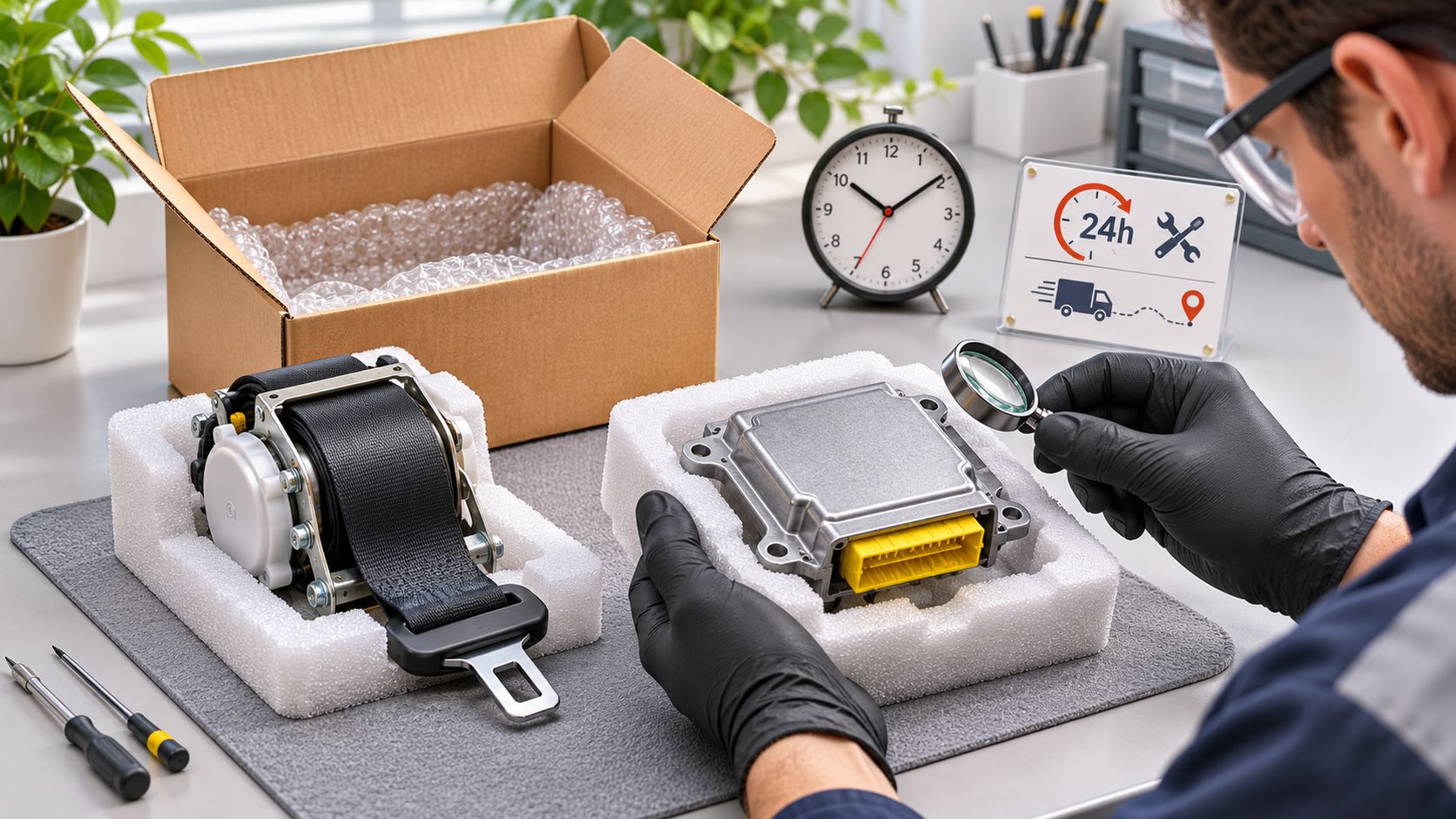
The repair itself is typically completed within 24 hours of the repair center receiving your part. Shipping runs on its own clock, and it's the piece of the schedule most owners and shops forget to plan around.
The usual week looks like this. A parking-lot hit sets the airbag light. The body shop finishes the visible panels, then stops, because the restraint control module still holds crash data and nobody on staff can clear it. The dealer quotes a new module, the car sits in the back lot with a lift bay nobody wants to give up, and the third-party quote is already a week old. Search for a 24 Hour Turnaround Book and you'll find the same promise on a hundred service pages: send the part, get it back in a day. The version worth reading is the one that shows where that day sits inside the rest of the repair.
Table of Contents
- What the 24-Hour Turnaround Covers
- How to Order and Ship Your Part
- What Happens Inside the 24-Hour Repair Window
- Choosing Between Reset, Repair and Replacement
- Send Your Part and Plan Your Reinstall
What the 24-Hour Turnaround Covers
The window belongs to the bench. It opens when your box is signed for and the part is logged in, and it closes when the finished unit goes back out the door with a label on it. Everything before that point and everything after it belongs to someone else.
The order side is short. You pick the service online, choose a quantity and pay. The minimum order quantity for a repair service is one item, so a single retractor or module is a complete order with nothing else to buy. Then you ship the removable part: a seat belt retractor, a pretensioner assembly, an SRS airbag control module, or belts in for webbing replacement. A deployed airbag or inflator never enters this route.
The middle is the promise. Repairs are completed within 24 hours or less of the item arriving. The return leg moves faster than expected: return shipping is free, and repaired parts go back by priority shipping inside the USA in 1 to 3 business days.
| Step | Typical time | Who controls it |
|---|---|---|
| Order and payment online | Before shipping | You |
| Vehicle diagnosis before removal | Not included | Shop |
| Inbound shipping to repair center | 1 to 3 business days | Carrier |
| Component repair at repair center | Within 24 hours of receipt | Repair center |
| Return shipping | Free, 1 to 3 business days | Carrier |
| Insurer authorization and supplements | Not included | Insurer and shop |
| Installation and post-installation SRS scan | Not included | Installer |
Run a Monday shipment through that table. The box leaves Monday, lands Wednesday, the bench finishes inside 24 hours, so it ships Thursday and reaches you somewhere between Friday and Tuesday depending on the carrier. Door to door, that's most of a week of calendar time for a service described as 24 hours. None of those days are wasted, but none of them are free either.
Where the rest of the week goes
The part is one dependency among many. Collision repair cycle data published by Autobody News put U.S. collision-related rental duration at an average of 15.1 days in Q2 2025, with shop backlogs averaging 1.7 weeks. The same reporting found parts delivery times improving by nearly a day, while repairers still juggled inspection, supplements, calibration, parts availability and sequencing.
That's the honest framing. A 24-hour repair removes one bottleneck from the critical path. It does not deliver a 24-hour collision repair, and any page that implies otherwise is selling you a number instead of a schedule. The question worth asking before you box anything up is simpler: how long can this vehicle sit without a working seat belt or airbag system?
How to Order and Ship Your Part
Shipping is the one stage where an owner or a shop can lose a full day for free. Six steps, in this order.
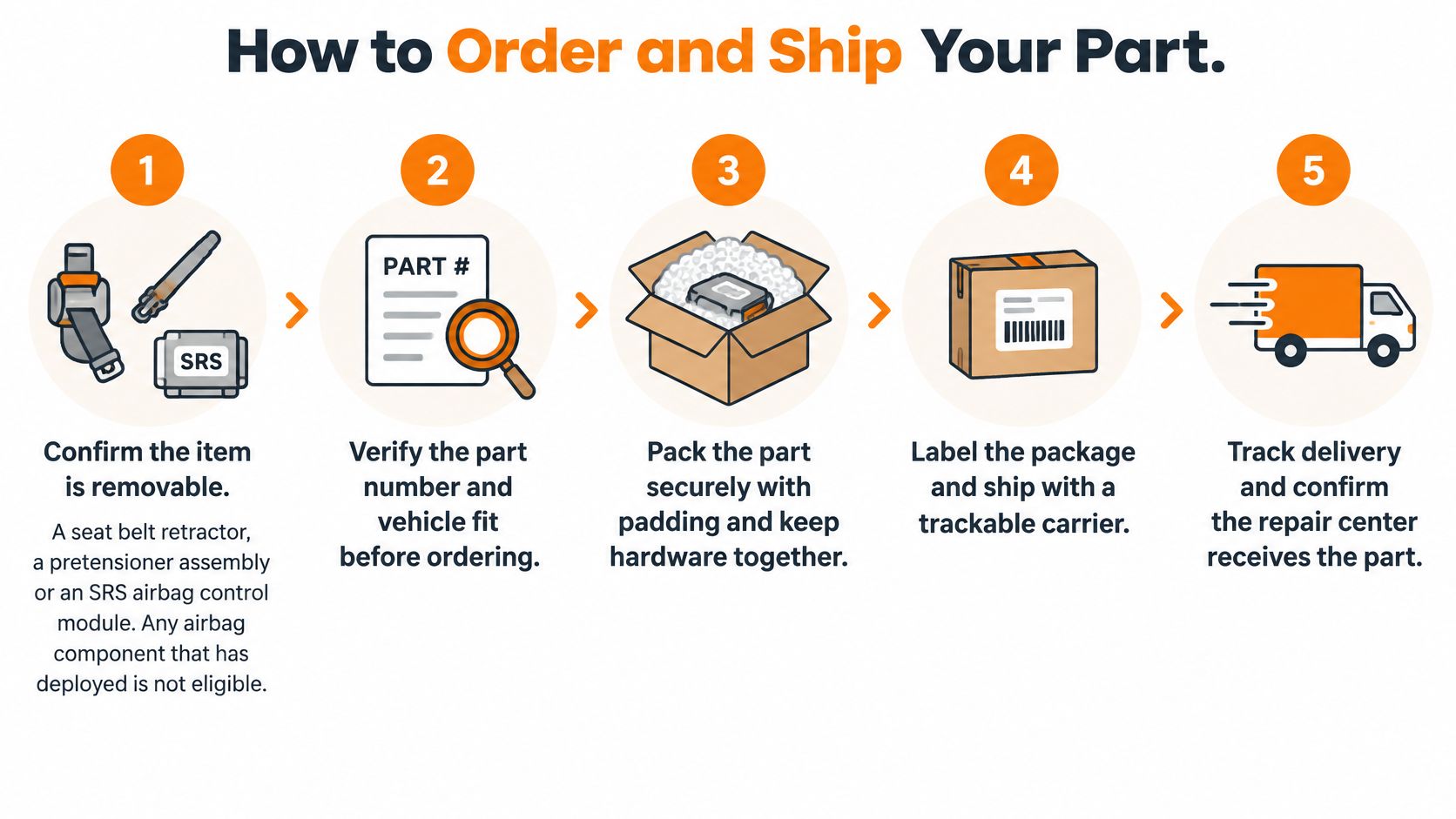
- Confirm the part can come out and can travel. A seat belt retractor, a pretensioner assembly, an SRS airbag control module, or a set of belts for webbing replacement all qualify. Anything that has deployed, meaning an airbag or an inflator, stays out of this route entirely and goes to authorized replacement instead.
- Order online and choose a quantity. One item is the minimum, so a single module is a full order. Pay at checkout, when the price is flat per item regardless of vehicle year, make or model. The repair gets scheduled on arrival, not on a phone call.
- Have a qualified technician pull the part. Follow the service manual for the battery disconnect and the wait time it specifies before any SRS connector is touched. Removing a module with the battery still connected is how a clean fault becomes a stored one.
- Photograph it before you box it. Label, part number, connector face, mounting points. Write the year, make and model on the same note. Matching a box to an order is the very first thing that happens at intake, and a box with no paperwork inside is slower to match.
- Pack it so the housing cannot move. Rigid carton, padding on all six faces, hardware bagged separately. Put your contact details and the order confirmation inside the box, not just on the outside.
- Ship with tracking and keep the receipt. Tracking is your only proof of handoff until the part is logged in at the other end.
Practical rule: put the year, make, model and part number on a note inside the box as well as on the shipping label. The note survives a scuffed or torn label.
After that the sequence runs itself. Tracking updates until the box lands, the repair clock starts, and a return shipment follows with a fresh tracking number. Keep both numbers. Our frequently asked questions page covers what to include and where to send it, and it answers the two questions that cause most of the delay calls.
What Happens Inside the 24-Hour Repair Window
A mail-in repair has two clocks. The repair clock starts when the part is received, and Safety Restore completes repairs within 24 hours or less. The return clock follows, with priority shipping inside the U.S.A. typically taking 1 to 3 business days. That distinction matters because the 24-hour turnaround removes one bottleneck from the post-crash critical path, but it does not erase teardown, shipping, diagnosis, or reinstall time.
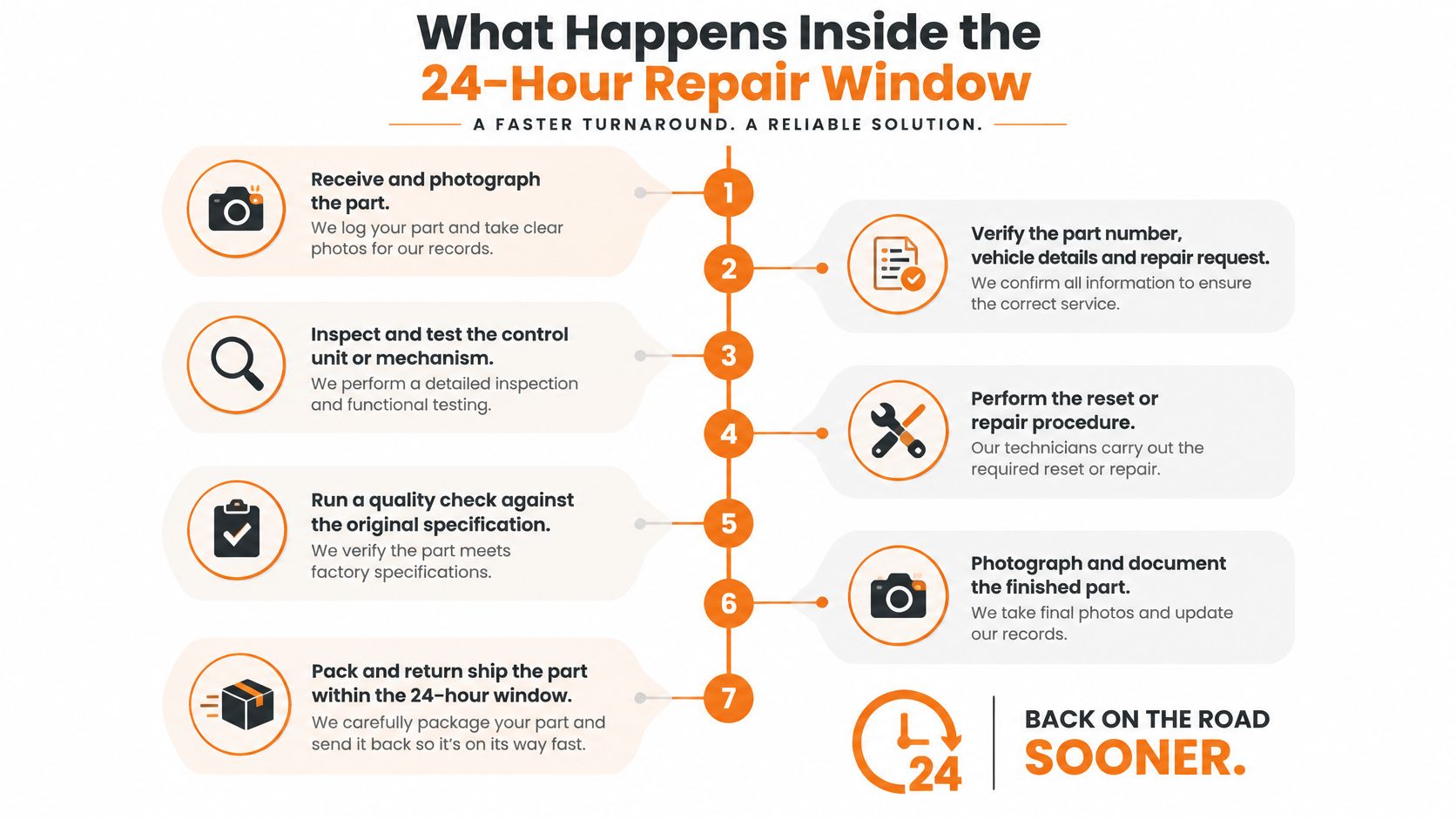
The part is photographed on arrival before anything is opened. That image becomes the condition reference for every later question, including whether a housing crack or connector damage was present before repair. The part number, vehicle application, deployment configuration and reported fault are then checked against the order. A mismatch caught at intake costs an email. Caught after reassembly, it costs another shipping cycle.
Inspection is where a fast reset has to earn its credibility. Connectors, squib circuits, housings and wiring interfaces are checked for heat damage, water intrusion, corrosion and structural damage before the approved restoration is performed. A melted connector or cracked housing changes the job. A reset cannot make that part sound, and shipping it back with fresh documentation would only move the problem into your bay.
The next checks are less obvious from the outside. Electrical continuity and the diagnostic tests appropriate to the component are completed before documentation and packing. The return shipment should carry installation notes and post-install scan requirements, because the final verification happens after reinstall. The bench can return the part within the repair window. The vehicle still has to prove the system is ready.
Why a reset alone is not the finish line
A stored crash event is one cause of a lit airbag lamp. It is not the only cause. NHTSA recall documentation describes pretensioner faults involving high resistance or open circuits at the squib connection, which can set a diagnostic trouble code and light the warning lamp without crash data being involved.
Pretensioners are a primary restraint in frontal and side impacts, so continuity and connector condition belong in the verification step, not in the fine print. A restraint that tests clean is the baseline. The airbag lamp, stored codes and SRS readiness still have to be checked after the part is back in the vehicle and the battery is reconnected according to the service procedure.
Ask for the timestamps: arrival, inspection complete, repair complete, test complete, shipment. Five marks turn a promise into a measurement, and they tell you exactly which stage to question when a part runs late.
Choosing Between Reset, Repair and Replacement
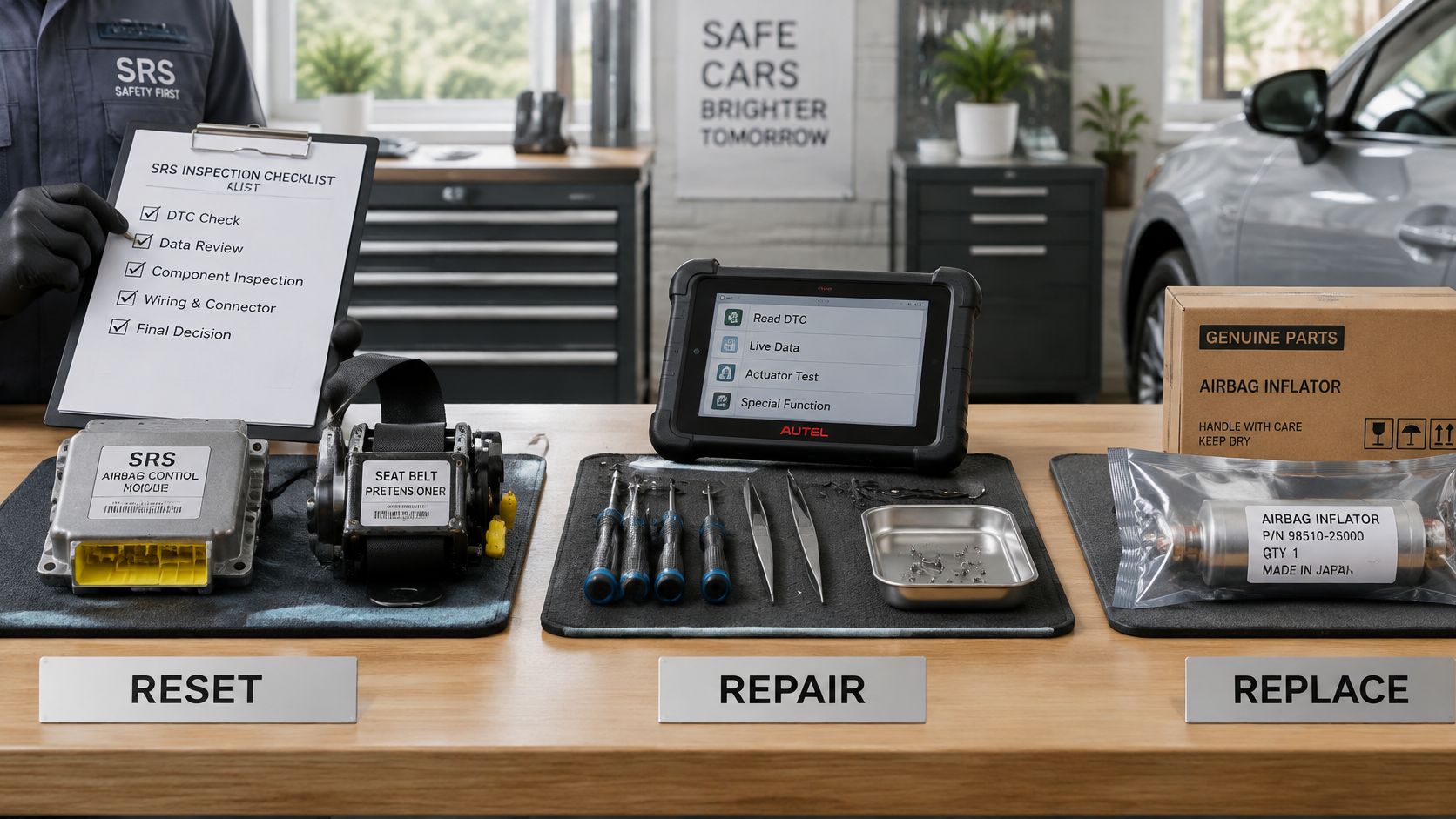
Speed and price are easy to compare. They do not answer the central question: should the original part be restored, or does the job require replacement? A reset has a narrow job. It clears stored crash data from an undamaged control unit. Webbing replacement restores a cut, frayed or chewed belt. A deployed airbag or inflator requires replacement. Physical damage to housing, wiring or mounting points calls for inspection before any bench decision.
| Condition | Usual route | Why |
|---|---|---|
| Crash data or hard fault code with an undamaged module | Module reset | Clears stored crash data so the system can run once repairs are finished |
| Frayed, cut or chewed webbing | Webbing replacement | Restores strength and original fit |
| Deployed airbag or inflator | Authorized replacement | Must be replaced before the vehicle is driven again |
| Visible housing, wiring or mounting damage | Inspect first, then repair or replace | A reset cannot fix physical damage |
The 24-hour window fits this decision in one specific way. It removes bench time from the critical path. It does not erase shipping, inspection at install, or the final scan. Safety Restore completes repairs within 24 hours or less of receiving the item, including all airbag modules once they arrive. That helps when the part is a good reset or repair candidate. It does not turn a deployed inflator into a reusable part, and it does not make a damaged harness safe to reinstall.
That boundary matters more than turnaround time. NHTSA's consumer alert on substandard replacement parts warns that defective replacement airbag inflators have caused deaths and severe injuries in otherwise survivable crashes, tells owners to use reputable providers, verify genuine parts and ask about sourcing, and states plainly that deployed airbags must be replaced before the vehicle is driven again through an authorized repair center.
Clearing crash data cannot compensate for unrepaired structural damage, missing airbags, counterfeit inflators, damaged wiring or an unresolved sensor fault. Some modules also carry recall remedies where the prescribed fix is replacement rather than reset, and no bench service changes that. Ask for four things before accepting any fast fix:
- Part traceability: where the unit came from and what it was matched against.
- Proof of testing: continuity and diagnostic results for the specific component, not a generic clean bill.
- The post-installation scan result: what the full SRS network reported once the part was back in the car.
- Component source: genuine or OEM-equivalent, stated in writing.
The same sourcing discipline applies to any safety component that goes back onto a vehicle. Fitment, traceability and liability questions do not disappear because the part arrived quickly. If the decision is a module reset, keep the scope tied to the service itself. Safety Restore's airbag module reset services are 100% guaranteed, and the SRS module reset service is intended for resettable modules, not deployed components or physical damage. Read the guarantee conditions before ordering, since conditions may apply to the 100% satisfaction guarantee refund policy. If the warning light stays on after any reset, stop and have the system scanned before driving.
For shop planning, treat the decision as a gate. Confirm the fault type, confirm the part can be restored, then use the turnaround window to shorten only the bench stage. The guida Sixrace ai ricambi moto is a useful prompt for asking harder sourcing questions about non-car parts, but the replacement decision here stays with the SRS component in front of you. Fast service helps most when the part choice is already correct.
Send Your Part and Plan Your Reinstall
Get the part on a carrier before you plan anything else. Confirm it's a removable seat belt or SRS module, confirm the vehicle is ready for it to be out of service, then order and ship with tracking. Build the plan around five items:
- Keep the order confirmation. It's the reference for every later question.
- Photograph the part before packing. Label, part number, connector, mounting points.
- Schedule reinstallation for the day after tracking shows delivery. Don't book a bay for the day it lands.
- Book the post-installation scan with the installer. Clearing the light isn't the same as verifying the network.
- Confirm the policy and guarantee conditions before ordering. Read the warranty information so there are no surprises later.
Return shipping is free, which makes transit time the main variable you're planning around. If anything is unclear before the box goes out, call 855-552-7233 Monday through Friday from 9 AM to 8 PM EST, or text (413) 564-1242.
The one-line version: the 24-hour window covers the repair, so plan the rest of the week around shipping, reinstallation and the scan.
And if a warning light stays on after any reset, don't drive it. Stop, have the full system scanned, and find out what the reset couldn't fix.
Safety Restore handles the mail-in side of that timeline every day: you order online, ship the removable seat belt or SRS airbag module, and we repair it within 24 hours of receipt and send it back with free return shipping. That removes the module bottleneck from your week, whether you're a shop with a bay tied up or an owner waiting on a car. Start your order at Safety Restore and put the part on a bench instead of a shelf.