Seat belt module repair is a real safety repair, not a cosmetic shortcut. Because seat belts reduce the risk of fatal injury to front-seat car occupants by 45%, and because services like mail-in OEM seat belt repair are available at a flat $99 per item with a typical 24-hour turnaround, it often makes sense to restore the original assembly correctly instead of treating a locked belt like a minor annoyance.
If you're reading this right after a crash, you probably know the scene. The belt locked hard. The airbag light stayed on. A shop or dealer may have quoted a full belt assembly, maybe more than one, and now you're trying to sort out what needs repair.
People get tripped up here. They hear "seat belt module repair" and assume there's a little computer inside the belt, or they confuse it with the airbag control module under the console or floor. In shop language, the part usually being repaired is the seat belt retractor and pretensioner assembly. That's the hardware inside the pillar, seat base, or body structure that stores the webbing, locks under crash conditions, and may fire a pyrotechnic pretensioner in a collision.
A good repair brings that assembly back to proper mechanical and electrical function. A bad repair just makes the belt move again.
Table of Contents
- What Seat Belt Module Repair Actually Involves
- Anatomy of a Retractor and Pretensioner
- Symptoms That Point to Module Repair
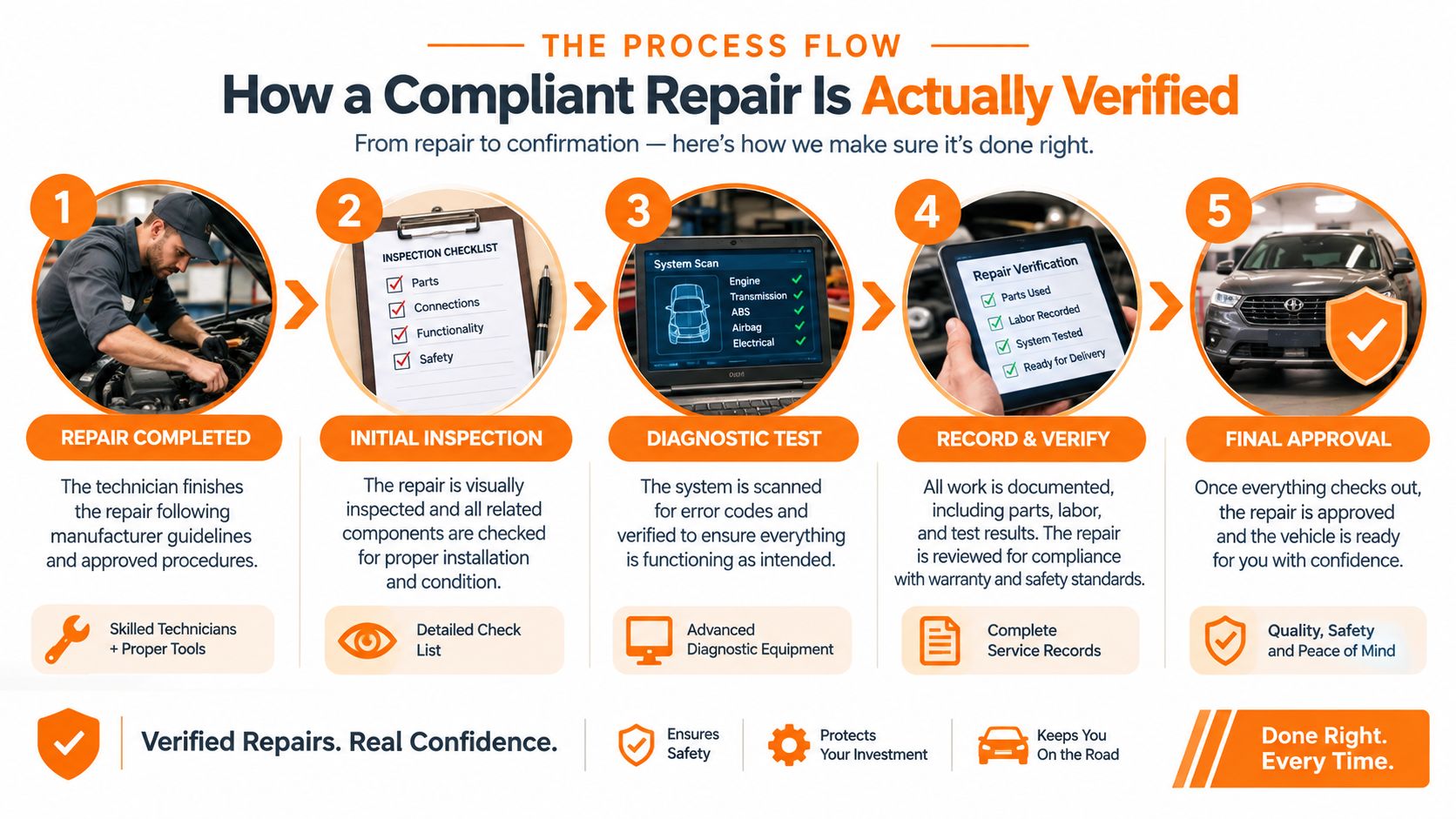
- How a Compliant Repair Is Actually Verified
- The Diagnostic-to-Verification Workflow
- Comparing Dealer Replacement, Local Garage Service, and Mail-In Module Repair
- Why a Cleared Warning Light Is Not the Same as a Safe Restraint System
- Choosing a Provider and Knowing When to Involve a Technician
What Seat Belt Module Repair Actually Involves
The day after a collision, a car can look drivable and still have a restraint problem. I've seen belts that retract halfway, belts that won't feed out at all, and belts that seem normal until you scan the SRS and find a pretensioner fault waiting in memory.
That's why seat belt module repair should be understood as safety restoration. The belt assembly is part of the restraint system, not trim. The Insurance Institute for Highway Safety explains why that matters. IIHS seat belt research notes that lap-and-shoulder belts reduce the risk of fatal injury to front-seat car occupants by 45%, and NHTSA estimated that seat belts saved 20,443 lives in the United States in 2019 and 457,578 lives from 1968 through 2019.
What people mean by the seat belt module
Most owners use the word "module" loosely. In practice, they usually mean the complete belt assembly that includes:
- The retractor: The spool and spring mechanism that winds and rewinds the webbing.
- The locking hardware: The parts that stop belt payout during rapid deceleration or sudden webbing movement.
- The pretensioner: A crash-activated device that removes slack.
- The electrical connector and squib circuit: The part the SRS system monitors for faults.
If that assembly locked during a crash, the problem may be deeper than a jammed reel. A fired pretensioner, damaged internal mechanism, altered load-management parts, or an electrical fault can all leave the belt unsafe even if the webbing still looks clean.
Practical rule: If a belt locked after a crash, treat it like a deployed safety component until proven otherwise.
What a proper repair is trying to restore
A competent repair provider isn't just trying to make the belt slide again. The target is broader:
- Smooth webbing movement
- Correct emergency-lock behavior
- Pretensioner compatibility and status
- Electrical integrity
- Safe reinstall condition
That's also why repair and replacement aren't the only two categories that matter. The key question is whether the original assembly can be returned to correct function and then verified in the vehicle.
For an owner, the useful takeaway is simple. Ask what failed, what inside the assembly is being restored, and how the repaired belt will be verified before the car goes back on the road.
Anatomy of a Retractor and Pretensioner
A seat belt assembly does two jobs at once. It behaves like a spring-loaded convenience device every day, and it becomes a crash-management device in a fraction of a second when the car sees the right kind of impact.
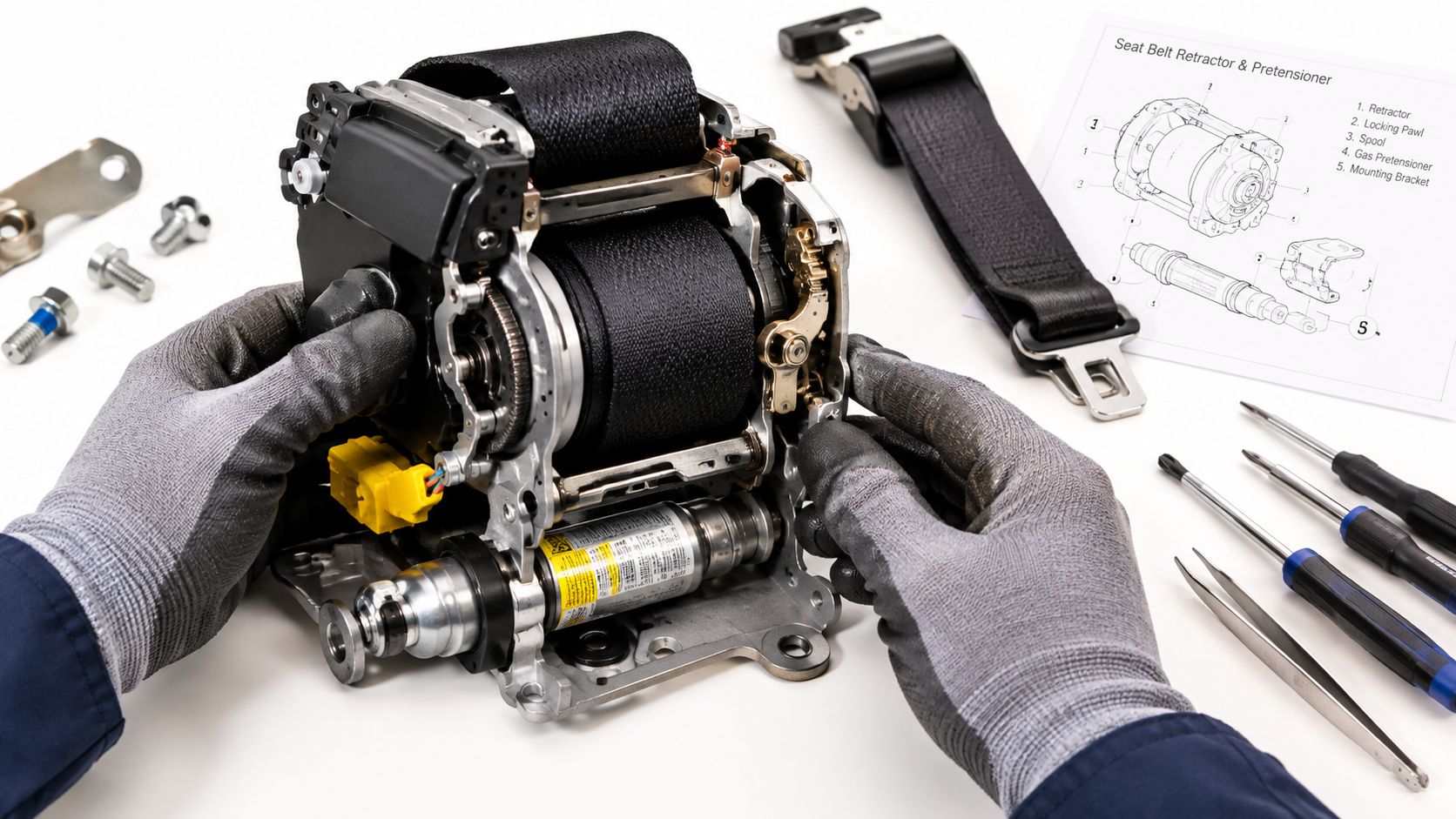
This visual helps make the parts easier to picture:
The mechanical side
Start with the spool. That's the drum the webbing wraps around. A spring keeps tension on the belt so it retracts against the pillar or seat when you unbuckle.
Next is the inertia sensor and locking pawl. Depending on the design, the retractor locks when the vehicle decelerates sharply, when the belt is yanked out too fast, or both. Those parts are why a retractor can feel normal during casual use but still fail under the wrong conditions if internal geometry, mounting angle, or friction is off.
The pyrotechnic side
Now add the pretensioner. Many people underestimate what they're handling here. A pretensioner is a pyrotechnic device that rapidly retracts belt webbing during a qualifying frontal-area impact, removing slack before the occupant loads heavily into the belt. NHTSA found that in passenger cars, crossovers, and minivans, belted drivers and right-front passengers had an estimated 12.8% lower fatality risk when the belt system combined a pretensioner with a load limiter. The reported confidence interval was 2.6% to 23.0%, and the effect was not statistically significant for pickups, truck-based SUVs, or full-size vans, which is one reason repairs need to stay vehicle-specific rather than generic. That analysis is summarized in IIHS research on safety belts.
After the pretensioner takes up slack, the load limiter helps manage belt force as the occupant moves forward. In plain terms, one part pulls you into position early, and another helps avoid excessive chest loading later in the crash pulse.
A locked belt after a collision may contain a spent pyrotechnic device, not just a sticky reel.
A real-world mental picture
Think about a moderate frontal crash. The front structure starts absorbing energy. Before your body fully moves forward, the pretensioner fires and removes slack from the shoulder belt. Then the locking hardware keeps webbing from freely unwinding. After that, the load-management features control how the belt restrains you through the rest of the event.
So when someone says, "The belt just needs to be opened up," that's often too simple. If the pretensioner fired, the repair has to address both the mechanical function and the pyrotechnic and electrical function of that assembly.
Symptoms That Point to Module Repair
The symptoms matter because they tell you where to look first. Some point to a mechanical issue inside the retractor. Others point straight at a fired pretensioner or an SRS fault that won't be solved by freeing up the belt.
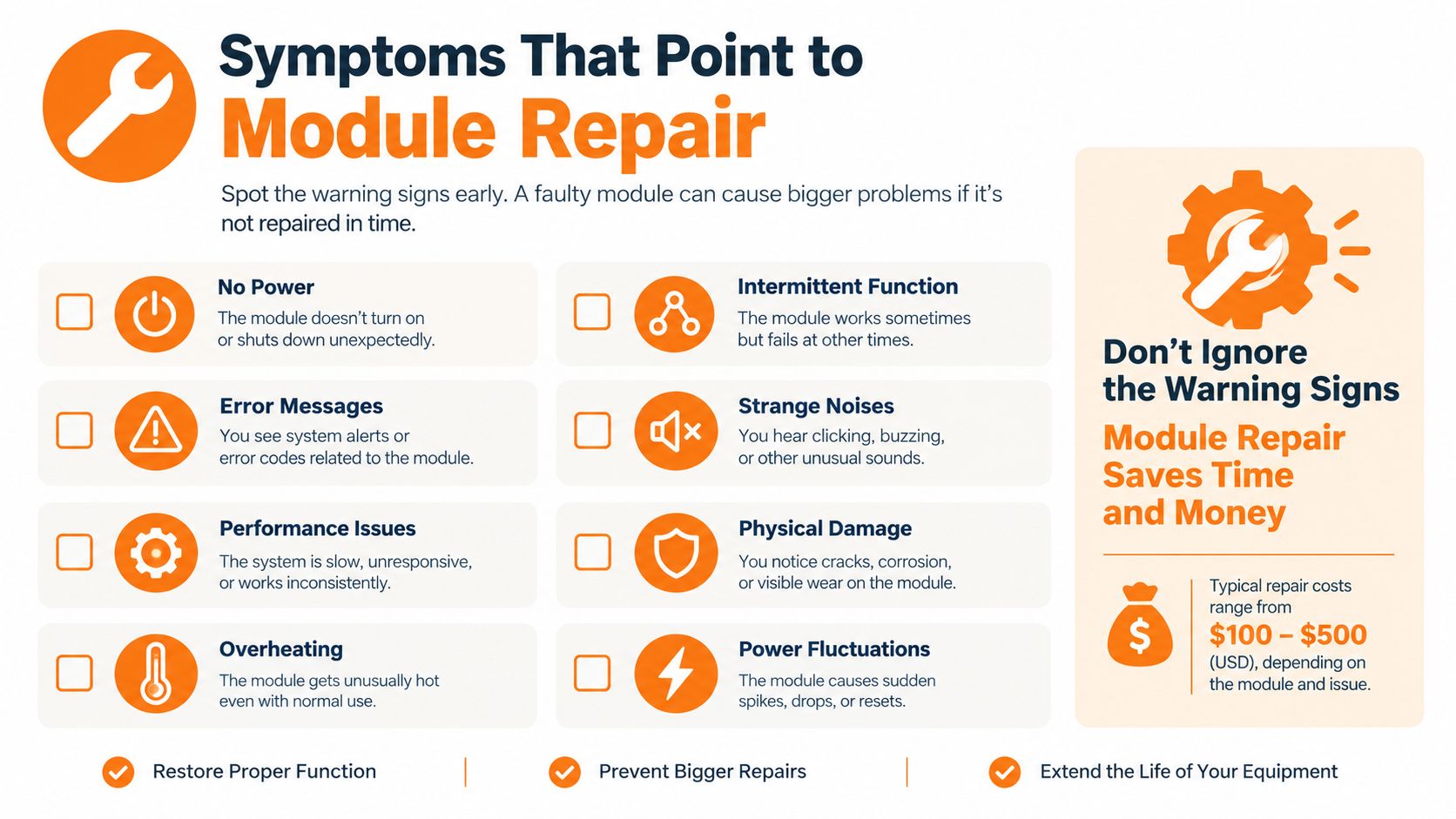
Here is the common symptom list technicians work from:
Mechanical symptoms you can feel
- Belt won't extend: After a collision, this often means the retractor is locked or the pretensioner event changed the internal mechanism's position.
- Belt won't retract fully: The spring may be weak, the spool may be dragging, or the webbing may be twisted, contaminated, or damaged.
- Locks under light tugging: That can point to damaged inertia hardware, incorrect mounting angle, internal friction, or misrouting.
- Webbing is cut, frayed, melted, or chewed: That's not just a cosmetic problem. Damaged webbing changes whether the assembly should be re-webbed, repaired internally, or both.
A lot of owners misread symptom overlap. A belt that feels stuck might have a simple orientation issue during removal, but after a crash it might also be a deployed pyrotechnic unit. Those are very different situations.
Electronic symptoms that change the diagnosis
If the airbag or SRS warning light stays on, the belt assembly may not be the only problem. The airbag control module can retain crash data or hard fault codes after an accident, even after visible components have been replaced. The module also monitors restraint circuits, sensors, power supply, occupant information, and continuity. This overview of airbag warning light behavior is a good reference for why a persistent warning light can mean stored crash data, unresolved hardware faults, or wiring problems.
That's why a belt that "works by hand" can still belong to an unsafe system.
If the SRS light is on, the car is telling you to stop guessing and start diagnosing.
A quick triage map
| Symptom | Likely issue | Usual next move |
|---|---|---|
| Belt locked solid after crash | Fired pretensioner or crash-locked retractor | Remove, identify exact assembly, inspect and repair or replace correctly |
| Belt retracts poorly | Spring, spool drag, webbing routing, contamination | Bench inspection and functional testing |
| Belt looks normal but SRS light stays on | Squib circuit fault, crash data, wiring, unresolved SRS issue | Scan SRS, inspect belt circuit and related components |
| Visible webbing damage | Webbing compromise | Re-webbing or assembly service depending on condition |
When you're trying to sort dashboard warnings, it helps to compare symptoms carefully. Electrical drivability problems can mimic each other too, which is why guides like faulty coil pack warning signs are useful reminders that one warning behavior rarely tells the whole story by itself.
How a Compliant Repair Is Actually Verified
A proper repair has to meet behavior you can define, not just a feeling you can describe. "It seems fine now" isn't a test standard.
For emergency-locking retractors, NHTSA cites FMVSS No. 209 requirements that matter directly to bench and installation checks. NHTSA's interpretation of retractor performance requirements states that an emergency-locking retractor must lock before the webbing extends 1 inch when exposed to 0.7 g acceleration. For webbing-sensitive retractors, it must not lock before 2 inches of extension at 0.3 g or less. Vehicle-sensitive retractors must also avoid locking when tilted up to 15 degrees from the installed orientation.
What those thresholds mean in the shop
Those numbers tell you why a simple hand pull isn't enough. A retractor can pass a casual tug test and still be wrong in ways that matter during a crash.
A repairer needs to think about:
- Spring preload: Too little and the belt hangs loose. Too much and retraction feel can mask drag or routing issues.
- Inertia hardware condition: Bent, worn, or contaminated parts can lock too early, too late, or inconsistently.
- Webbing path and spool alignment: Twists, edge damage, or misrouting can change retraction and locking behavior.
- Installed orientation: Vehicle-sensitive retractors can misbehave if mounted off-angle.
What must also be checked on pretensioner-equipped belts
The pyrotechnic side raises the stakes. NHTSA recall investigation material also describes a failure mode involving corrosion at squib pins and partial separation at a bridge-wire weld, which can create high resistance or an open circuit and may precede inadvertent pretensioner deployment. NHTSA interpretation material on pretensioner-related issues makes the practical point clear. A belt can still appear to lock mechanically while the pretensioner or monitored circuit is unsafe.
Shop check: A belt that passes a pull test still isn't cleared until the matched electrical and pyrotechnic portions are verified.
A responsible provider should be able to document smooth extension and retraction, correct locking behavior, proper connector and squib compatibility, and safe handling steps. One NHTSA service instruction cited there specifies disconnecting the battery and waiting at least one minute before disconnecting the pretensioner.
The Diagnostic-to-Verification Workflow
In a good shop, the process starts before a single bolt comes out. The first job is diagnosis. If the airbag light is on, pull the SRS codes with a scan tool capable of accessing that system. A generic code reader often won't tell you enough to separate a belt fault from a sensor, clock spring, wiring, or module issue.
Step one in the bay
The technician identifies the exact belt configuration first. That means confirming position, connector style, and whether the vehicle uses a retractor pretensioner, buckle pretensioner, or another setup. Mixing similar-looking parts is one of the easiest ways to create repeat faults.
Then the battery is disconnected and the required wait time is observed before touching restraint connectors. On some vehicles, that waiting period is part of published repair procedure, not a suggestion.
What happens once the belt is removed
The assembly comes out carefully so the trim, webbing, connector, and mounting points stay intact. If the webbing is twisted during removal or the unit is allowed to hang awkwardly, you can create new problems while chasing old ones.
On the bench or at a mail-in repair facility, the work usually includes:
- Internal inspection for crash-related lockup, spent pretensioner condition, spring issues, and damaged mechanism parts.
- Webbing inspection for cuts, fraying, contamination, chew damage, or heat marks.
- Restoration of compatible internal components so the original assembly returns to correct function.
- Electrical checks of the monitored circuit, done without applying unauthorized current to the pyrotechnic initiator.
- Functional verification of extension, retraction, and locking behavior.
Reinstall and confirm
After the repaired assembly comes back, reinstall isn't the finish line. The technician routes the webbing correctly, mounts the retractor in its intended orientation, reconnects the restraint connector, and scans the vehicle again.
That final pass matters because the system has to agree with the repair. A properly restored belt won't fix a broken sensor circuit. A reset module won't fix a fired pretensioner. A warning light that stays off only after all hardware faults are corrected means much more than a belt that moves.
Here's the sequence you should expect:
- Diagnose first: Read SRS faults before ordering parts or shipping components.
- Repair physical damage: Belt assembly, pretensioner, webbing, sensors, wiring, airbags, or related items as required.
- Address module-level issues where appropriate: Clear crash data or hard faults only after the hardware side is handled.
- Verify the complete system: Final scan, warning light status, and model-specific confirmation steps.
That workflow exists for one reason. The restraint system is integrated, so each step is meant to catch what the previous one can't.
Comparing Dealer Replacement, Local Garage Service, and Mail-In Module Repair
After a crash, the right repair route depends on what the vehicle actually needs. A dealer may replace the assembly, a local shop may diagnose and install parts, and a mail-in service may restore a repairable original component. These options belong to the same SRS workflow, but they do not perform the same job.
Dealer replacement
Dealer replacement usually fits warranty work, insurer requirements for new OEM parts, or manufacturer procedures that call for replacement and vehicle-specific configuration. Parts are ordered by VIN, then installed using manufacturer information.
The tradeoff is cost and availability. A dealer may need to source several SRS components, and backordered assemblies can keep the vehicle off the road. Replacement also does not remove the need for diagnosis and final system verification. A new part can still be installed into a vehicle with damaged wiring, sensors, or another unresolved fault.
Local garage or collision shop service
A local shop can provide a practical middle ground when its technicians regularly handle restraint systems. Some independent shops are equipped for fault-code diagnosis, wiring checks, scan procedures, component installation, and final confirmation. Others focus on mechanical collision work and limit their SRS service to removal and replacement.
Ask the shop to explain:
- What exact fault is present
- Whether the belt is mechanically locked, electrically faulted, or both
- Who performs the repair
- How final SRS verification will be documented
For example, a technician should be able to separate a locked retractor from a control-module fault before recommending parts. That distinction prevents an owner from paying for a module repair when the belt assembly itself still needs replacement.
Mail-in module repair
Mail-in service fits when the original assembly is repairable and the vehicle needs that component restored rather than replaced with a complete new unit. One provider in this field, Safety Restore, publishes service information that includes flat per-item pricing and a stated turnaround through Safety Restore's service information. Those details give owners criteria to compare with dealer and local-shop quotes, without making mail-in service a substitute for vehicle-level diagnosis.
The assembly must still be removed correctly, shipped with the required precautions, reinstalled in its intended position, and checked as part of the complete SRS. Restoring one component does not confirm that the vehicle has no remaining fault.
| Option | Best for | Main tradeoff |
|---|---|---|
| Dealer replacement | Warranty work, insurer-directed repairs, or OEM-new parts | Higher cost and possible parts delays |
| Local shop service | Diagnosis and installation in one visit | Capability varies by shop |
| Mail-in repair | Restoring a repairable original assembly | Vehicle-level checks remain after reinstallation |
Why a Cleared Warning Light Is Not the Same as a Safe Restraint System
One of the biggest mistakes after a crash is treating the warning light like the problem instead of the symptom. If the light goes out, people assume the restraint system is back. Sometimes it is. Sometimes it absolutely isn't.
The light can go out while the workflow is still incomplete
I-CAR procedure guidance for several Kia models shows how structured post-crash SRS work can be. I-CAR repair procedure guidance notes that manufacturer-specific procedures may require diagnostic trouble code checks before repair, battery disconnection with a waiting period, correction of all DTCs, and final confirmation that the SRS operates correctly. It also highlights that post-crash work can involve the control module, deployed pretensioners, impact sensors, wiring, and sometimes the clock spring.
That's the practical distinction many owners miss. Component repair, crash-data clearing, and full-system validation are not the same thing.
A cleared light only tells you the system isn't asking for attention at that moment. It doesn't tell you which steps were skipped to get there.
Modern collision repair adds another layer
The restraint system also lives in a vehicle that increasingly needs calibration work after collision repair. AutoBodyNews reporting on 2025 collision complexity data stated that calibrations appeared on 35.6% of direct-repair-program estimates in Q3 2025, up from 26.9% a year earlier. The same report cited a separate benchmark estimating that about 61% of vehicles arriving for collision repair require some form of ADAS calibration. It also noted that 33% of repairable DRP appraisals included a calibration in Q2 2025, more than eight percentage points above Q2 2024.
That does not mean every seat belt repair needs camera or radar calibration. It does mean the old habit of thinking in isolated parts is fading fast.
What a real verification map looks like
After a collision, someone has to answer these questions:
- Did the seat belt assembly itself restore correctly
- Did the SRS module retain crash data or hard faults
- Are there unresolved sensor or wiring problems
- Does the vehicle require any occupant-classification, steering-angle, camera, or radar procedures before release
- Who signs off on the final scan results
A mail-in repair can solve the belt assembly problem. A module reset can solve stored crash-data problems where appropriate. But neither one, by itself, certifies the whole vehicle as ready. That final responsibility stays with the installing technician or repair facility using the model-specific procedure set.
Choosing a Provider and Knowing When to Involve a Technician
If you're choosing a provider, keep the checklist practical. Look for transparent flat pricing, a documented turnaround, a clear description of what gets repaired, and a written warranty. For a mail-in service, you also want confidence that the provider handles the exact style of retractor or pretensioner your vehicle uses and returns the original part ready for reinstall.
A technician needs to be involved when the vehicle still has active SRS faults, when the belt damage happened in a collision, when the airbag light remains on, or when the vehicle has post-repair procedures that need a capable scan tool and model-specific information.
Use this short filter:
- Mail-in repair makes sense when the original belt assembly is repairable, you know which unit is affected, and a qualified installer can handle removal, reinstall, and final verification.
- A full shop workflow is the safer choice when multiple restraint components deployed, faults remain in the SRS, wiring or sensors may be damaged, or the vehicle may need calibration-related follow-up.
- Stop and escalate the repair when someone suggests "just clearing the light" without proving the hardware side of the restraint system is correct.
The smart approach isn't replacement at all costs, and it isn't reset at all costs either. It's matching the repair path to the actual fault, then verifying the complete system before the car goes back into service.
If your belt is locked, deployed, or damaged after a crash, Safety Restore offers mail-in repair of original seat belt retractors, pretensioners, and SRS airbag control modules with flat-fee pricing and fast turnaround. If you want to keep the OEM assembly and have it restored for proper reinstallation, visit Safety Restore and match the component service to a complete diagnostic and verification workflow.