
You start the car, see the seat belt pretensioner warning light, and wonder whether a belt that still buckles can really be unsafe. The short answer is yes: the light means the restraint system has detected a fault, and the system's readiness hasn't been confirmed just because the belt latches or the warning disappears after a reset.
A battery disconnect or code clear can silence the dashboard temporarily without repairing a damaged part or circuit. Treat the light as a reason to diagnose the system, not as a verdict about which component failed.
Table of Contents
- What the Pretensioner Warning Light Signals
- Common Causes Behind the Light, from Crash to Fault
- What Post-Collision Faults Mean and Why Reuse Is Risky
- How to Diagnose the Restraint System Step by Step
- Recalls, Used Cars and Lights That Come Back
- Confirm the Restraint System Before You Drive Again
What the Pretensioner Warning Light Signals
The seat belt pretensioner warning light means the restraint control system has detected a fault in a pretensioner circuit, an airbag component, or a related sensor. It's not a cosmetic warning. The pretensioner is a small, charge-driven device built into the belt retractor or the buckle. In a crash, it pulls slack out of the belt so the occupant is held in position as the airbag system responds.
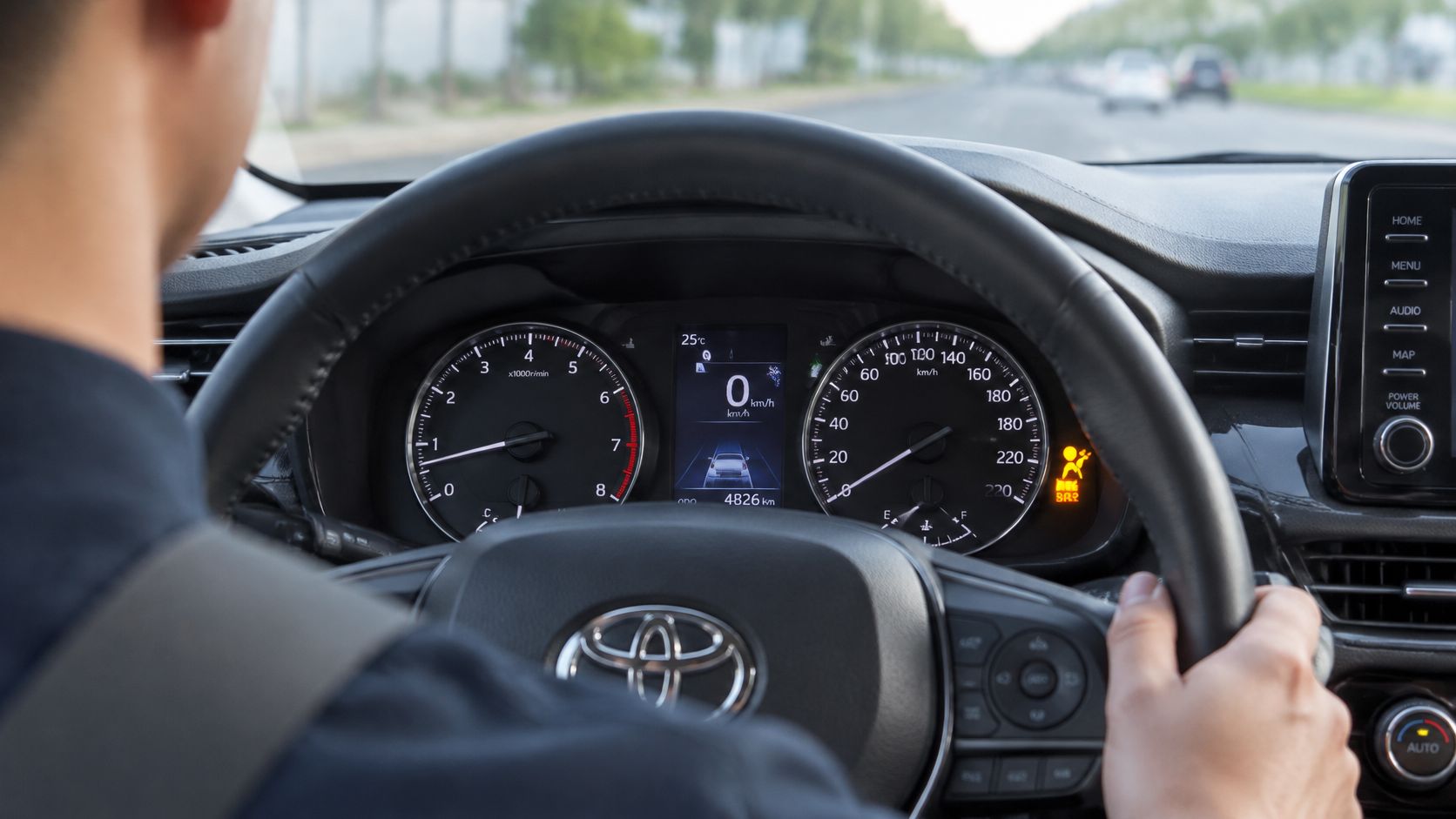
The warning light works like a smoke alarm for the restraint system. It doesn't identify the faulty part; it tells you the system found a condition that may interfere with protection in a crash. The light may come with a chime or dashboard message, and the fault can sit in the pretensioner circuit, the airbag system, or both.
The light is a fault report that starts a diagnosis. It does not name the failed part. A technician reads the stored SRS codes with a compatible scan tool to find where to start.
One thing the light cannot tell you is whether the charge inside a pretensioner is still intact. Each pretensioner carries a single gas charge, and once that charge fires, the unit will not work again. A dashboard that goes dark after a reset only means the code was cleared. It says nothing about whether the charge remains.
A common post-collision scene
Say you've had a minor collision, the belt now feels stiff, and the warning stays on. A stiff belt alongside a lit warning points to hardware that changed state inside the retractor or buckle, with the module logging the event that caused it. A belt that still clicks into place has not proved its internal restraint components are ready to work again.
Practical rule: Don't ignore the light, and don't assume a belt is safe just because it still latches.
Common Causes Behind the Light, from Crash to Fault
A collision is a common trigger, especially if a pretensioner fired or the control module recorded an impact. But the light can also come on without a crash. A buckle switch, seat sensor, disturbed connector, or intermittent wiring fault can all make the restraint system report a problem.
The way the warning behaves can help narrow the possibilities, but it can't confirm a cause. Use the table as a starting point, not as a substitute for reading the stored diagnostic trouble codes.
| Symptom | Likely cause | First action |
|---|---|---|
| Light on after any collision, belts locked | Pretensioner fired or crash sensor recorded impact | Read codes and check whether the module stored crash data |
| Light on, belt will not retract or feels stuck | Retractor locked or pretensioner spent | Inspect the retractor and replace or repair the unit |
| Light on only when the belt is buckled | Buckle switch or buckle sensor fault | Test the buckle and its connector |
| Light on after battery disconnect or interior work | Clock spring or wiring disturbed, stored code remains | Scan codes and inspect connectors near the steering column |
| Light on with no history and no visible damage | Intermittent sensor fault or corroded connector | Scan codes, check wiring and reproduce the fault |
Read the pattern carefully
A warning that appears only when you buckle the belt points toward the buckle or its sensor. If the light stays on whenever the ignition is on, whether or not the belt is buckled, the module or wiring deserves attention. Those patterns are clues, not proof: a stored code and a physical inspection are needed to identify the failed part.
Work near the seats or steering column can disturb restraint-system connectors. If the warning started after interior work or a battery disconnect, tell the technician what was done and when. For a belt that's stuck after an impact, a seat belt retractor repair service is one possible route, but diagnosis should establish whether the retractor itself is the issue.
What Post-Collision Faults Mean and Why Reuse Is Risky
A pretensioner is designed to fire once. When its charge deploys, that charge is spent; disconnecting the battery or clearing a code doesn't reload it. The belt may lock, feel slack, or appear to work normally while the pretensioner can no longer tighten it properly in another crash.
The SRS control module may also record the crash event and retain it after the vehicle is repaired. Depending on the vehicle and the fault, the module may need to be checked and its stored data addressed before the system can return to service. Clearing that record without inspecting the belts and related components can make the warning disappear while leaving a restraint fault unresolved.
| Pretensioner type | Where it sits | Status after deployment |
|---|---|---|
| Single-stage pretensioner | Retractor at the B-pillar or seat base | Gas charge spent, unit must be repaired or replaced |
| Dual-stage pretensioner | Retractor assembly, fires at two force levels | Both stages must be checked; a partial fire can still leave a locked belt |
| Triple-stage pretensioner | Retractor assembly with three force levels | Full inspection of each stage; repair or replacement by a specialist |
| Buckle pretensioner | Female buckle on the seat side | Buckle and pretensioner assessed together; often a separate part number |
Deployment can affect different components
A single-stage unit has one deployment event, but systems with multiple stages need a more careful assessment. A partial activation can leave a belt locked even if the other stage hasn't fired. A buckle pretensioner sits at the seat-side buckle, so the buckle and device should be assessed together. The correct repair depends on the vehicle's design and the diagnostic findings.
A locked seat belt after an accident needs inspection before anyone treats it as reusable. The Seatbelt Buckle Pretensioner Repair After Accident describes a repair option for the buckle-mounted type; the vehicle's specific parts and damage still need to be verified.
A working buckle isn't proof of a working pretensioner
A belt can buckle and retract while its firing mechanism is spent. That normal feel can mislead a driver into thinking the belt will tighten in a second impact, when it may tighten too little or not at all. A reset changes stored electronic information; it doesn't restore a used charge.
Don't reuse a restraint part that has a returning warning light, a recorded crash event, a belt that won't lock or retract smoothly, or visible damage at the buckle or retractor until a qualified technician checks it. Avoid used belts with unknown crash history, damaged connectors, or evidence of a fired pretensioner. Where a belt or retractor is locked after a collision, seat belt repair after an accident should be considered only after the damaged assembly and module have been properly assessed.
How to Diagnose the Restraint System Step by Step
The worst thing you can do with this light is clear it before anyone looks at why it came on. Stored codes, freeze-frame data, and crash records all disappear the moment a reset happens, and a clean dashboard tells you nothing about whether the pretensioner can still do its job. Diagnosis has to run in order: capture the evidence first, inspect second, repair third, verify last.
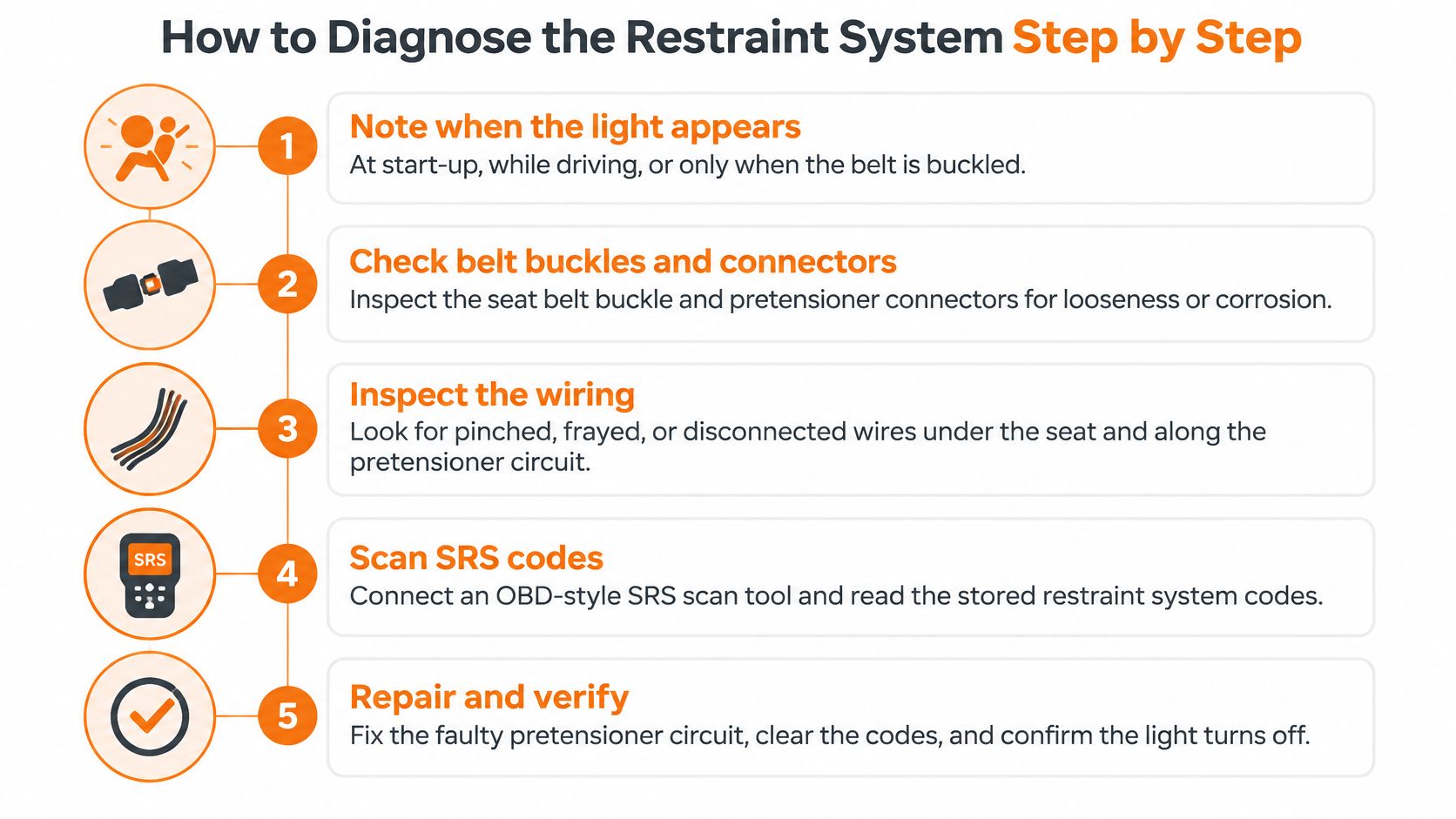
Note when the light appears. Record whether it comes on at start-up, while driving, or only when a belt is buckled. Timing separates a persistent system fault from one tied to a single buckle or seat circuit.
Write down the other symptoms. Note any chime or dashboard message, and whether each belt locks, retracts smoothly, or feels stiff. Tell the technician if the warning started after a collision, battery work, or an interior repair, since a disturbed connector is a frequent trigger.
Use an SRS-capable scan tool. A basic engine-code reader can report no faults because it cannot reach the restraint module. You need a tool that reads the SRS and body modules; a dedicated airbag scan tool costs around $100 and lets you save the codes and freeze-frame data before anything is cleared.
Check for a recorded crash event. Ask the technician whether the module stored crash data and whether an airbag or pretensioner deployed. A fired pretensioner is a single-use device: a locked retractor has spent its one gas charge and cannot fire again, whatever the dashboard shows after a reset.
Inspect belts, buckles, and connectors. Check for locked or poorly retracting belts, frayed webbing, damaged buckles, bent connector pins, or corrosion. SRS connectors under the seats and around the steering column deserve close attention, because a poor connection can mimic a failed component.
Repair the identified fault. Fix or replace the specific component the codes and inspection point to rather than swapping an entire assembly by default. The right repair depends on the vehicle's design and the condition of its restraint parts.
Clear codes and verify the repair. Only after the repair is complete should codes be cleared. Cycle the ignition, let the system run its self-check, and confirm the warning stays off with no new faults stored.
A light that goes out after a reset shows only that the memory was cleared; the hardware may still be spent. If crash data is erased before the deployed parts are inspected, the dashboard can look normal while a fired pretensioner stays in service. Where the module itself holds crash records that need clearing after proper repairs, an airbag module reset service deals with the stored data. The physical parts still have to be repaired or replaced on their own merits.
The sequence matters more than any single step. Clearing codes first and calling the job done is the mistake that sends a vehicle back on the road with the original fault still sitting in the restraint system, waiting to flag itself again on the next self-check.
Recalls, Used Cars and Lights That Come Back
Restraint-system recalls happen, and they can set a pretensioner warning on a car with no crash history. If the light appears without an obvious cause, an open recall belongs on the suspect list alongside connectors and wiring. The dealer can confirm coverage before you pay for anything.
A used car may carry a collision history that was never fully repaired. Before buying, have a technician read the module history and review earlier airbag or pretensioner work. If the module shows an earlier deployment, the technician compares the record against what is fitted: whether crash data was cleared, whether each fired pretensioner was repaired or replaced, and whether the belts match the original stage type. Single-stage, dual-stage, triple-stage, and buckle pretensioners are not interchangeable. A pretensioner carries one gas charge, and once it fires it cannot fire again. A belt that was never rebuilt after deployment stays dead even if the warning never returns.
When the light returns
If the light returns after a reset, the cause is still present or the system has detected another fault. Record when it comes back and have the codes read again rather than clearing them repeatedly. A light that goes out after a reset or a battery disconnect proves only that the memory was cleared. The system runs its self-checks again, and a live fault sets the warning again.
A recorded crash repaired with non-original parts calls for a fitment and function check. The technician should confirm the parts match the vehicle's specification and that the restraint system communicates correctly. A recurring warning is a reason to diagnose again.
Confirm the Restraint System Before You Drive Again
A light that goes out can be the most misleading outcome of all. Clearing the codes or disconnecting the battery silences the lamp on the dashboard, but the hardware underneath stays exactly as it was. A pretensioner that fired in a crash has spent its single gas charge, and it will not protect anyone in a second impact regardless of what the dash shows. Treat the vehicle as ready for everyday use only after a qualified technician has confirmed the fault and verified the completed repair.
What to bring to the shop
A short written summary keeps the technician from repeating work already done and speeds up the diagnosis. Bring:
- When the light appears: at startup, while driving, or only after a bump or hard stop.
- Any message, chime, or flashing pattern the dashboard shows.
- How the belts behave: slow retraction, a belt stuck fully in or out, or a buckle that will not latch.
- Any crash history, including minor impacts and curb strikes.
- Codes already read, with photos or printouts if you have them, plus any repairs or parts replaced so far.
Then let the shop confirm the result instead of assuming it. Ask the technician to verify that the warning stays off through a full key cycle and that no new SRS faults are stored after the work. If the diagnosis points to a deployed belt or a module holding crash data, you have a choice between specialist repair of the original parts and dealership replacement. I lean toward repair of the OEM assembly when the damage is limited to the pretensioner or retractor, because the original housing and webbing already fit the vehicle correctly.
Safety Restore repairs seat belts that are locked, won't retract, or have a blown tensioner, including belts from vehicles involved in accidents where airbags deployed. We also reset SRS modules for an airbag light or crash data after an accident. If those services fit your repair needs, visit Safety Restore to learn how they relate to your vehicle.