
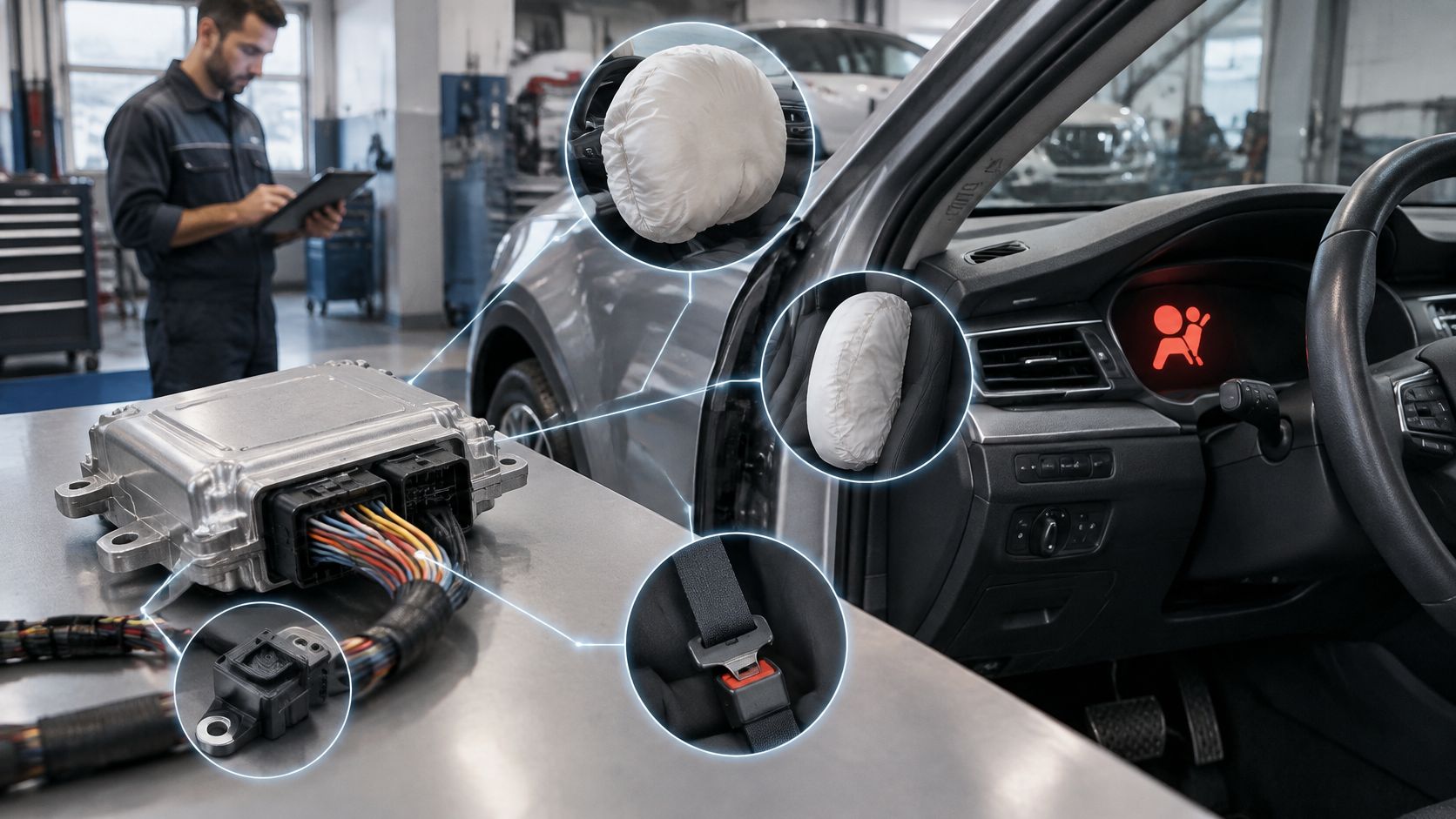
The bodywork is finished, the engine starts, and the car looks like itself again. But the airbag light is still on, the front belt won't pull out, and the estimate includes something called a restraints control module reset. It's reasonable to wonder whether that electronic box is the problem or just reporting damage somewhere else.
That distinction matters. Clearing a crash record is a memory operation, not a complete airbag-system repair. Before you authorize it, you need to know what deployed, what remains faulty, and whether a manufacturer recall calls for a different remedy.
Table of Contents
- How a Restraints Control Module Calls the Crash
- Parts the Module Monitors on Every Drive
- Why Crash Data Survives a Battery Disconnect
- When to Reset, Reflash, or Replace the Module
- A Frontal Crash From Scan to Reinstall
- Faults a Module Reset Cannot Repair
- Confirm the SRS Before the Car Returns to the Road
How a Restraints Control Module Calls the Crash
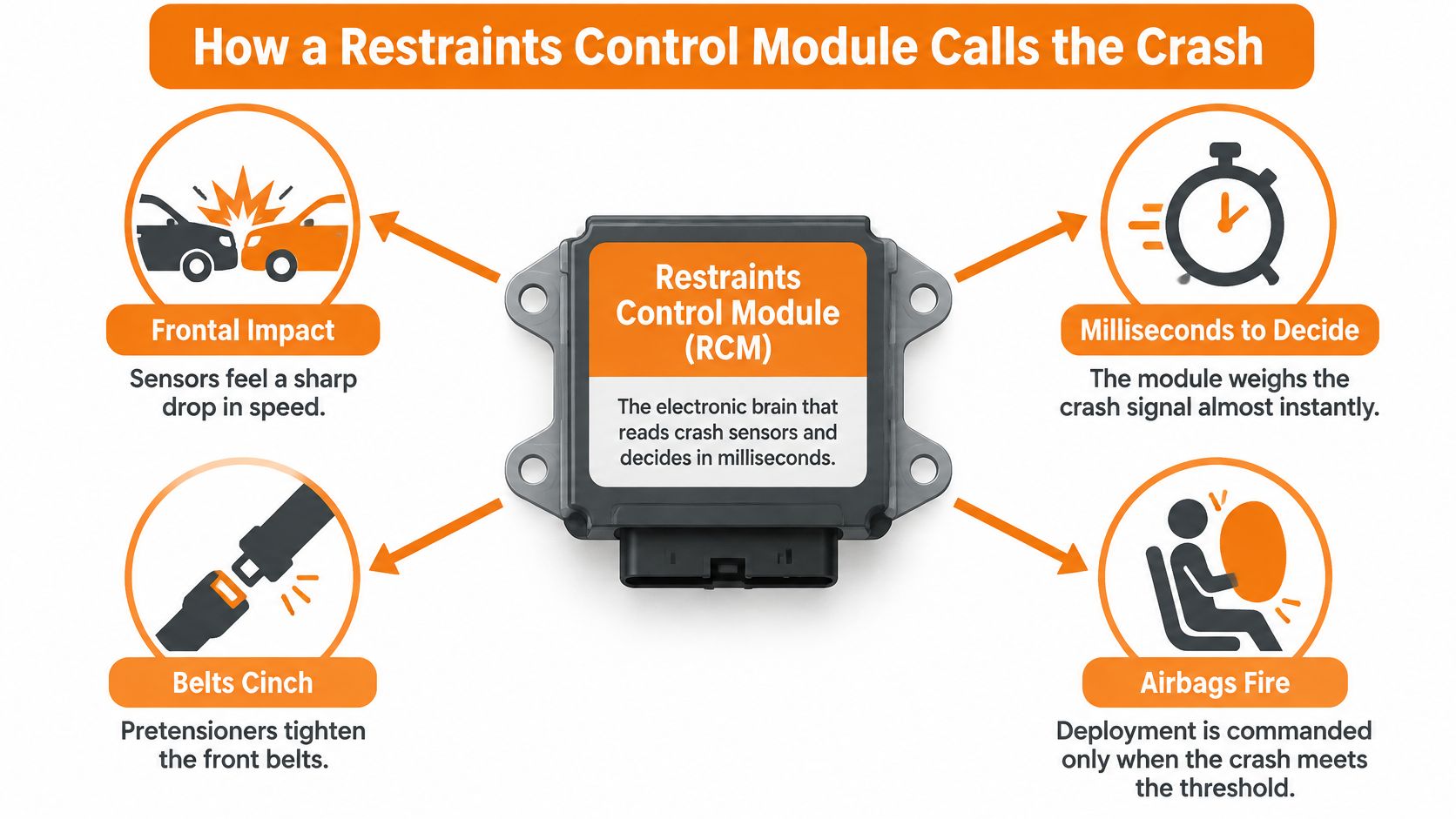
Say a vehicle strikes another car head-on. Its structure slows sharply, crash sensors send acceleration signals, and the restraints control module evaluates whether the impact meets its programmed deployment conditions. If it does, the controller commands the appropriate restraint devices.
The restraints control module, often shortened to RCM, is the electronic decision-making unit in the supplemental restraint system, or SRS. Other manufacturers use names such as sensing and diagnostic module, or SDM, and airbag control module, or ACM. Different labels don't necessarily mean different basic jobs.
Think of the module as a referee. It doesn't manufacture the airbag cushion or weave the seat belt. It interprets incoming signals and calls for action, while many designs also preserve information about the event.
From a sensor signal to a deployment command
The basic sequence is straightforward:
- Sense the impact. Crash sensors transmit acceleration information.
- Evaluate the conditions. The controller compares those signals with its programmed deployment criteria.
- Command the restraints. When the conditions qualify, it sends commands to inflators and applicable belt pretensioners.
A pretensioner removes belt slack during a qualifying crash. An airbag inflator fills the cushion. Those are separate physical devices receiving electrical commands, not parts that a software reset can rebuild.
This diagram shows the relationship between the crash signal and the restraint commands.
Why the controller deserves careful diagnosis
The stakes extend beyond a dashboard warning. NHTSA's lives-saved analysis estimates that vehicle-safety technologies saved 613,501 lives in the United States from 1960 through 2012, including 329,715 attributed to seat belts and 42,856 to frontal airbags.
Those are historical estimates across vehicle-safety technologies, not a performance rating for an individual module. They explain why collision repair must preserve the intended operation of the complete restraint system.
An illuminated airbag warning after a crash means the vehicle needs SRS diagnosis. It doesn't identify the failed part by itself. The controller may be reporting a damaged sensor, a deployment circuit problem, a stored crash condition, or another fault that needs investigation before return to service.
Parts the Module Monitors on Every Drive
| Component | What the module checks | Fault clue |
|---|---|---|
| Frontal impact sensors | Sudden deceleration against deployment thresholds | Front-sensor code after a hit or a sharp acceleration signal |
| Side and curtain sensors | Lateral acceleration used for applicable side-restraint decisions | Side-impact sensor code alongside a curtain or seat-airbag circuit fault |
| Buckle switches | Whether a monitored belt is latched | Belt-status reading that disagrees with the actual buckle position |
| Pretensioners | Squib-circuit integrity for applicable single-stage, dual-stage, triple-stage, and buckle units | Open or deployed pretensioner circuit after a crash |
| Airbag squibs | Electrical integrity of driver, passenger, side, and curtain inflator loops | Resistance out of range or an open squib circuit |
| Power, ground, and network | Supply conditions and communication with the vehicle | Low-voltage fault or lost communication, such as U0151 |
Read this table as a map of circuits to investigate, not a parts-shopping list. A code naming a passenger airbag circuit doesn't automatically condemn the passenger airbag. The connector, harness, terminals, and controller connection belong to that diagnostic path too.
The module performs diagnostic monitoring during normal vehicle operation, not just during a collision. Depending on the vehicle, checks occur at startup and continue while the system is operating. The installed equipment and manufacturer's diagnostic procedure determine exactly which signals and circuits are monitored.
What a circuit description actually tells you
A squib is the electrically initiated element associated with a restraint's pyrotechnic device. A squib fault describes an electrical condition in that deployment circuit. It's not permission to test the inflator with an ordinary electrical probe.
A buckle-related complaint also needs careful identification. A buckle switch reports latch status, while a buckle pretensioner performs a deployment function. The seat belt buckle pretensioner explanation can help an owner distinguish the assembly being discussed from a simple latch-status switch.
Diagnostic rule: Name the failed circuit before anyone clears memory.
For example, a technician may find a pretensioner circuit fault after a frontal collision. The useful next question is whether the unit fired, its wiring was damaged, or a connector was disturbed during seat removal. Erasing a code before recording those findings discards useful diagnostic context.
No deployed airbag doesn't mean no recorded event
NHTSA's event-data-recorder documentation distinguishes deployment events from non-deployment events, which can still wake the sensing algorithm and record information. A minor-looking impact therefore doesn't establish that the warning is a false alarm.
Likewise, U0151 indicates lost communication with the restraints controller, not proof of stored crash data. The technician must establish whether the module has power and ground, whether the network is intact, and whether the controller responds.
Keep the actual scan results, including active squib, sensor, and pretensioner faults. A dashboard photograph documents the complaint, but a manufacturer-capable SRS scan gives the shop a much more useful starting point.
Why Crash Data Survives a Battery Disconnect
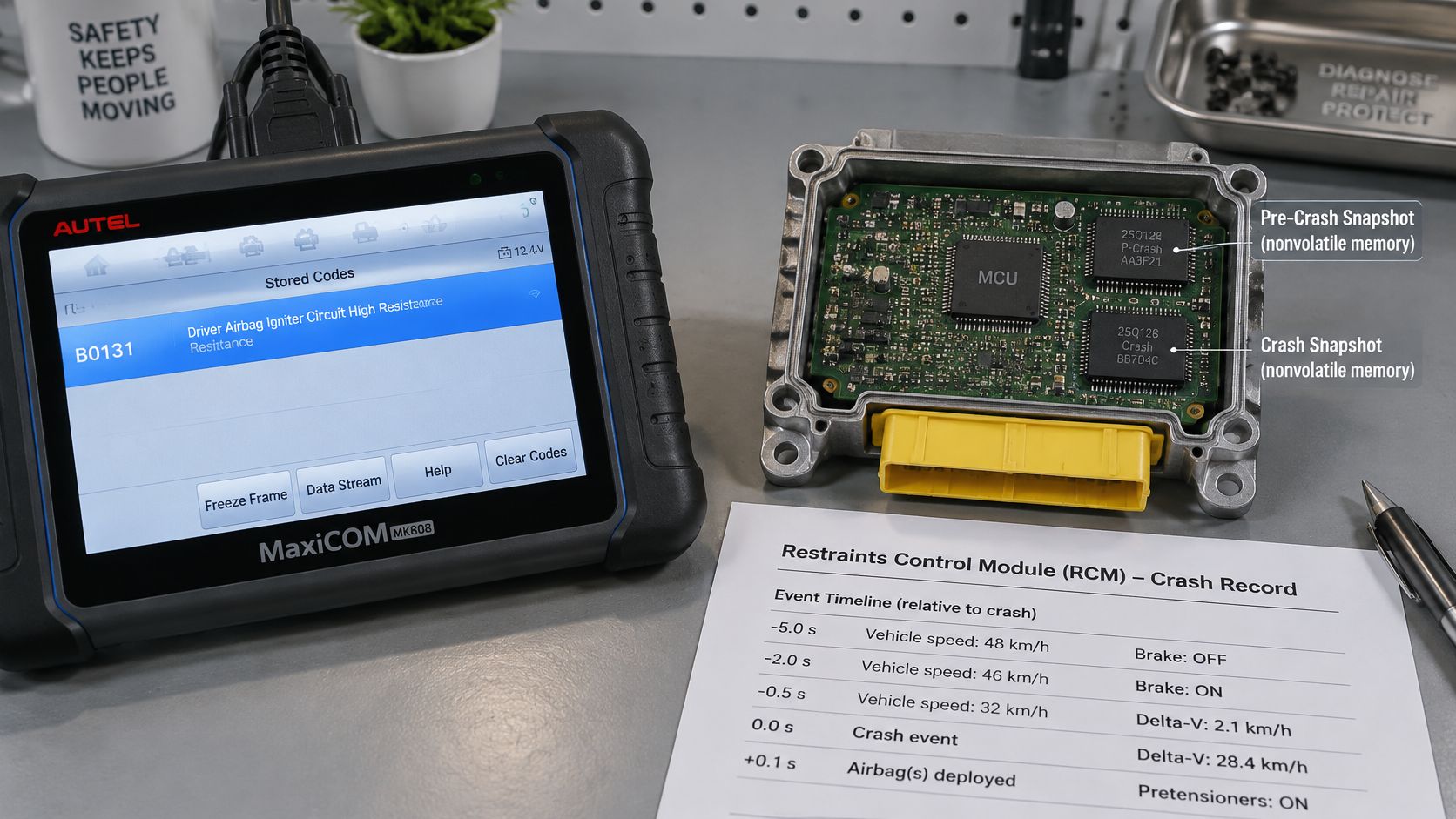
Disconnecting the battery can interrupt power, but it doesn't necessarily erase a crash record. Many restraints controllers incorporate an event data recorder, or EDR, that stores event information in nonvolatile memory. That memory retains information without a continuous electrical supply.
A saved document remains rather than an unsaved screen. Turning the computer off doesn't remove the saved file. Similarly, disconnecting the vehicle battery doesn't turn persistent crash information into an empty record.
A crash record isn't an ordinary trouble code
A diagnostic trouble code identifies a detected fault condition. An event record can preserve a snapshot of vehicle and restraint-system activity around an impact. Depending on the design, that snapshot may include braking, throttle, steering, belt status, pretensioner status, and deployment timing.
The federal EDR rulemaking document describes some systems storing approximately five seconds immediately before algorithm enable, while federally standardized EDR-equipped vehicles manufactured from September 1, 2010 must record at least 15 specified data elements.
Those requirements don't mean every vehicle records identical information or uses the same memory architecture. They also don't mean that every vehicle necessarily has an EDR.
The scanner and controller shown below represent different parts of the diagnostic task.
Why an erase command may not work
A deployment record may become locked after the controller commands restraint activation. Storage capacity can also be limited. The important practical point is that the module's behavior after a crash follows its own design, not the behavior of a routine emissions-code erase.
A scan tool may communicate with the controller, display a deployment-related fault, and still lack the ability to remove the associated persistent record. Communication and memory access are different capabilities.
Before discussing service, the shop should establish:
- Exact identity. Record the controller's part number and vehicle application.
- Event type. Determine whether the finding concerns deployment, non-deployment information, or an unrelated diagnostic fault.
- Manufacturer requirements. Check whether the repair procedure permits reuse or requires replacement.
Preserve relevant event information before authorizing work that could alter it, particularly when an insurer, investigator, or legal representative needs the record. Identifying what the module contains is a different task from deciding what repair the vehicle needs.
When to Reset, Reflash, or Replace the Module
| Scan finding | What it usually means | Next step |
|---|---|---|
| Locked deployment record, restraints replaced, no live circuit faults | Crash data remains stored and the controller may be locked | Consider resetting the original module if manufacturer procedures permit reuse, then verify operation |
| Active squib, sensor, or pretensioner fault | A restraint circuit still has a fault, potentially involving deployment or wiring damage | Repair or replace the affected component or wiring and rescan before memory work |
| Lost communication such as U0151 | The module is unavailable because of a power, ground, network, software, or internal problem | Diagnose communication and electrical supply before considering crash-memory service |
| Open recall for a controller that goes offline while driving | A software condition may prevent intended deployment | Complete the manufacturer remedy; don't substitute a crash-data reset |
| Water damage or internal hardware failure | The controller's hardware is unreliable | Replace the module under the applicable repair procedure; memory clearing won't repair the board |
| History code only, no crash, lamp stays out after repair | A past fault remains recorded | Clear it after correcting the cause and verify that it doesn't return |
Use the matching finding to choose a diagnostic path, but check recall status before authorizing module work. A vehicle may have more than one condition at once. A stored deployment record doesn't cancel an open recall, and a completed recall doesn't repair collision damage.
Reset and reflash solve different problems
A reset addresses stored crash information in an otherwise suitable controller. A reflash changes the controller's operating software. Replacement changes the physical controller and may require vehicle-specific configuration.
The distinction isn't academic. A 2025 FCA recall report in the Department of Transportation recall dataset described occupant restraint controllers entering an offline state that could prevent airbag or pretensioner deployment, with a software flash identified as the planned remedy.
In that situation, clearing collision memory would address the wrong problem. The owner needs the applicable manufacturer remedy, even if the vehicle hasn't crashed.
For a genuine locked-record condition, an airbag module reset is a different service category from recall programming. Its suitability depends on the controller's condition and the vehicle's repair requirements.
Establish the cause before removing the box
The technician should check the VIN for open recalls through the manufacturer or an official recall lookup, save the pre-repair scan, and follow the vehicle-specific diagnostic instructions. If communication is missing, power, ground, connectors, and network integrity need attention before anyone assumes the controller needs erasing.
Safe handling matters throughout. Technicians shouldn't electronically probe or energize airbag terminals because accidental deployment can cause serious injury or death. SRS work requires the manufacturer's disabling procedure and specified precautions, not improvised testing.
Service priority: Correct the condition that prevents intended restraint operation, not merely the condition that is easiest to clear.
If the manufacturer requires controller replacement after deployment, a reset service isn't a substitute for that instruction. Likewise, a replacement controller needs the correct application and configuration. Neither a cleared record nor a newly installed box constitutes a vehicle-level safety certification.
A Frontal Crash From Scan to Reinstall
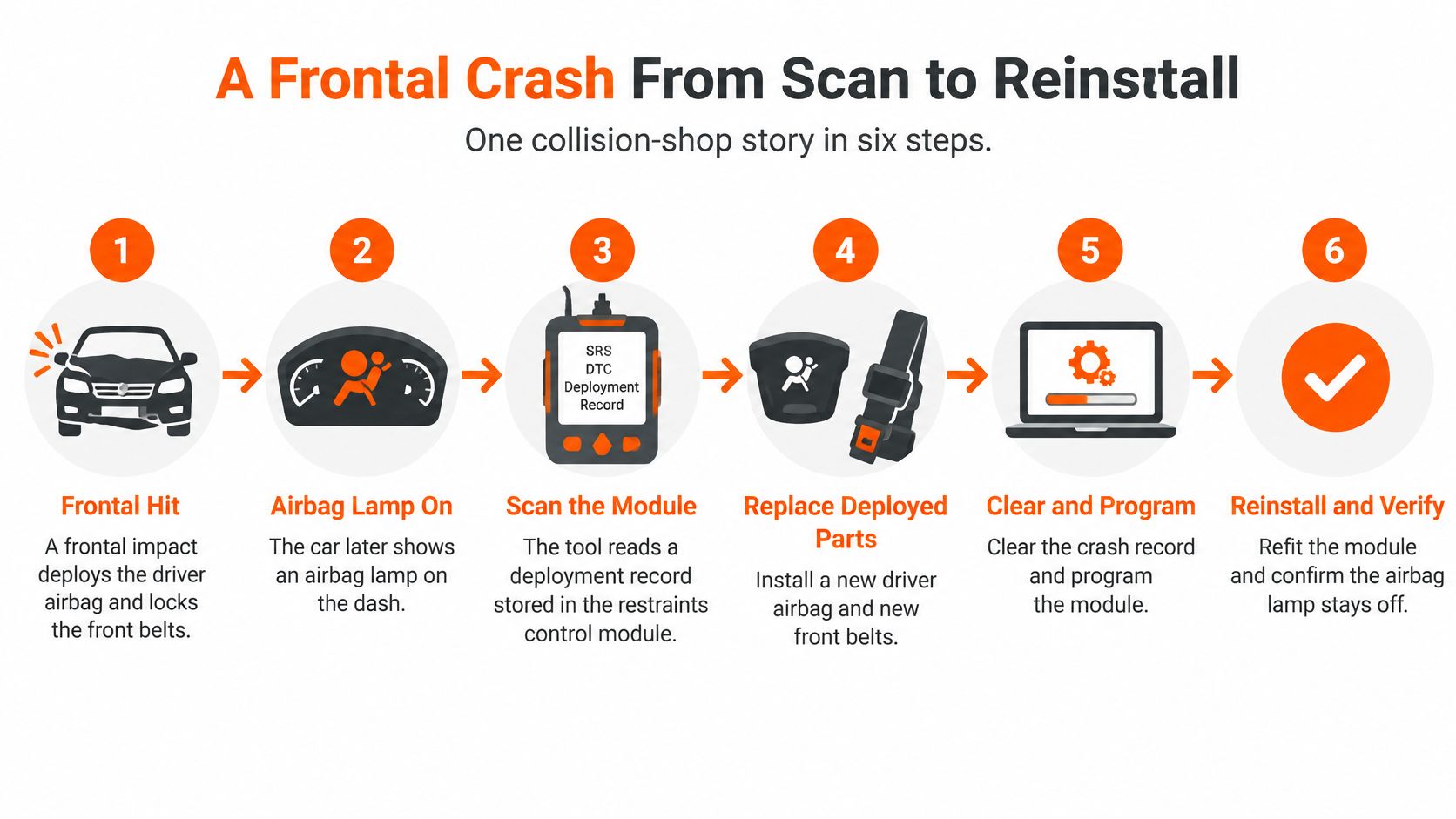
Consider a frontal collision that deploys the driver airbag and activates the front belt pretensioners. After the body repairs, the owner finds that the belts remain locked and the SRS warning stays illuminated. A scan identifies deployment-related information in the restraints control module.
The repair sequence below separates physical restraint work from controller service.
Document, repair, then verify
Save the initial evidence. Photograph the warning lamp and save a complete scan showing active, pending, history, and deployment-related findings available through the diagnostic tool. Record the symptoms before parts are disconnected.
Replace deployed airbags and address fired pretensioners using the manufacturer's repair requirements. Inspect the clock spring, harnesses, connectors, and mounting areas for collision damage. The retractor is where the belt webbing feeds from; a belt that remains locked needs its own assessment, separate from the electronic controller.
Identify the controller and the actual service requirement. Confirm its part number, application, recall status, and recorded condition. Don't send out a water-damaged or noncommunicating controller under the assumption that every post-crash fault is a locked event record.
With the physical circuits repaired, follow the applicable procedure for an eligible original controller or a correctly configured replacement. A used controller from another vehicle isn't a plug-in experiment. Matching connectors alone doesn't establish compatibility.
Reinstall and perform the post-repair checks. Confirm diagnostic communication, complete required setup procedures, and verify the warning lamp's specified startup sequence. Save the post-scan and investigate any returning fault before releasing the vehicle.
The visual's clearing and programming stage is shorthand, not an instruction that every module requires the same operation. The actual controller procedure must match the vehicle.
This video provides additional visual context for the repair discussion.
Keep the collision repair coordinated
For an RV collision involving body or structural damage, Motor Sportsland's Utah RV accident repair help is a useful resource for discussing that portion of the job. Restraint-system diagnosis still needs to follow the applicable vehicle or chassis manufacturer's requirements.
A road test can help identify returning warnings or communication problems, but it cannot prove that airbags will deploy correctly in another crash. The repair file should contain the pre-scan, parts addressed, controller action, required configuration work, and post-scan. That record explains what the shop repaired, rather than stating that the light went out.
Faults a Module Reset Cannot Repair
A dark airbag lamp isn't proof that the entire restraint system is safe. It's an observed warning-system condition, not a physical inspection of every belt, inflator, sensor, and connector.
A memory reset cannot rebuild a fired pretensioner, replace torn webbing, restore a spent load limiter, remove harness corrosion, or correct an unsuitable vehicle configuration. National Collision Authority's restraint-repair guidance describes post-crash work that may require replacement of deployed restraint components and the controller, followed by diagnostic verification.
The reason to keep belts and airbags in the same repair decision is measurable:
Airbags and lap-and-shoulder belts together reduce frontal-crash death risk by 61%, compared with 50% for belts alone and 34% for airbags alone, according to NHTSA research summarized by the Insurance Institute for Highway Safety.
False comforts that leave unanswered questions
A scan-tool screen showing a successful erase can look reassuring. But if an active squib fault immediately returns, the tool hasn't repaired that circuit. The technician needs to resolve the returning condition, not repeat the erase command.
A swapped controller can create a different false comfort. If nobody verifies its application and configuration, an apparently normal dashboard doesn't establish that the vehicle has the correct restraint setup.
A flood or salvage vehicle needs particular care when the repair history is incomplete. Passenger-seat sensing equipment, buckle wiring, and under-seat connectors shouldn't escape inspection because someone previously extinguished the warning.
- Locked belt. Identify whether the retractor, pretensioner, webbing, or another part needs attention. The guidance on a locked seat belt after an accident helps distinguish the mechanical complaint from controller memory.
- Damaged harness. Follow the manufacturer's permitted repair or replacement procedure rather than bypassing the fault.
- Incorrect configuration. Establish the correct vehicle-specific setup instead of treating coding as an optional finishing step.
The stop rule
If a commanded restraint hasn't received the required repair or replacement, stop the return-to-service process. Finishing controller work doesn't resolve that omission.
The useful question isn't whether the module can be cleared. It's whether the shop can document that the physical restraints, controller condition, software requirements, and diagnostic results all agree.
Confirm the SRS Before the Car Returns to the Road
The release decision needs all of these checks, not a choice between them:
- Physical repairs complete. Deployed airbags, activated pretensioners, and damaged belts, sensors, or harnesses have been addressed under the applicable manufacturer procedures.
- Controller condition resolved. Any locked crash condition has been handled through an approved reuse procedure or the required replacement, with applicable configuration completed.
- Verification complete. The post-repair scan shows normal communication and no unresolved active SRS faults, and the warning lamp completes its specified startup check.
These checks belong alongside required calibrations, inspections, and recall work. A reset is the wrong first step when a failed circuit or applicable software remedy remains unresolved.
When mail-in service fits
For an original module that qualifies for reuse after the required vehicle repairs, we offer mail-in service at Safety Restore. Our service covers seat belts and SRS modules of any year, make, and model: select the quantity, place a $99-per-item repair order, ship the removable component, and receive it back after service. Our module reset clears crash data and hard codes, restoring the module to factory condition without additional programming.
That service description doesn't override a manufacturer requirement to replace a controller or complete recall programming. A locked or blown seat belt from the same collision is also a separate item, not something repaired by clearing the module.
Keep the pre-scan, post-scan, parts documentation, and module-service record with the invoice. Give the owner copies rather than leaving the only evidence inside the shop's diagnostic tool. The next technician or inspector should be able to see that both the controller and the restraints received attention.
Safety Restore offers mail-in crash-data clearing for eligible original SRS modules and separate repair of locked or deployed seat belt assemblies. Once your technician has confirmed the required repair path, visit Safety Restore to select the components you need serviced and arrange shipment.

