
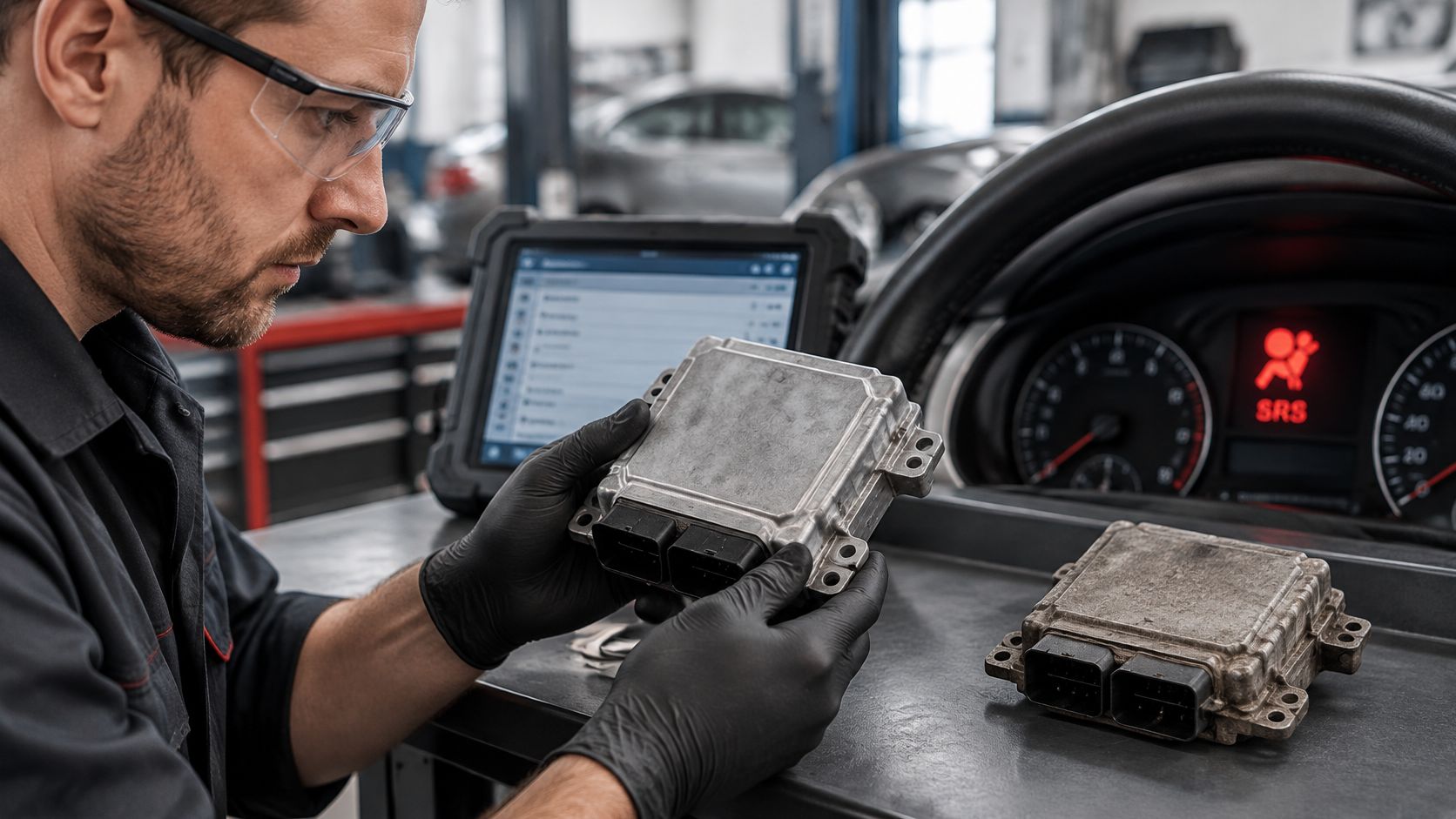
The cheapest used airbag module isn't cheap if it brings another car's crash history into yours. That's the advice worth challenging first. A low purchase price tells you nothing about compatibility, stored data, recall status, or whether the restraint system around it has been repaired.
Table of Contents
- Why a Used Airbag Module Is Not a Plug-In Part
- Comparing Your Three Options
- What the Module Stores and Why It Matters
- How to Verify a Used Module Before Installation
- Recall and Legal Limits Shops Must Know
- Fixing Warning Lights After Installation
- Choose the Right Workflow Before You Order
Why a Used Airbag Module Is Not a Plug-In Part
Say a bumper repair is nearly finished, the panels line up, and the airbag warning light stays on. A salvage yard lists a donor module that looks identical, so swapping it in feels like the fast finish. That assumption is where shops lose time.
The module isn't an ordinary electronic box. It carries vehicle-specific coding, communicates with impact sensors and pretensioners, and may hold data from the donor car's collision. A part that bolts in and powers up can still be wrong for the car in front of you.
NHTSA guidance on salvaged airbag components warns that a salvaged airbag may have been damaged in a low-speed crash even without deployment, or compromised during removal from the donor vehicle. The same guidance notes that repair may require checking or replacing crash sensors, wiring, and other electronic components, not merely installing a replacement.
Three Paths, One Verification Bill
You've got three realistic paths. You can install a used module from a donor vehicle, reset the car's original module, or buy new. Each path still ends with the same questions about sensors, wiring, deployed belts, and final diagnostics.
For example, a deployed belt may need buckle pretensioner repair after an accident before any module decision makes sense. If you skip that repair, a good module will log a fault anyway.
A cleared warning light doesn't independently prove the system is ready. You need compatibility evidence and a complete post-repair scan.
Judge a used unit by the evidence behind it, not its listing photo. If the seller can't document identity, donor history, and diagnostic status, the price advantage is unproven.
Comparing Your Three Options
| Option | Typical cost | Main risk | Best fit |
|---|---|---|---|
| New module from a dealer | Highest | Price, and dealer lead time | Owners who want clean history and factory programming |
| Used module from a donor vehicle | Lower purchase price | Hidden crash damage, open recalls, coding mismatch | Vehicles with verified donor history and documented part number |
| Reset of the original module | Lower to moderate | Unit may be damaged or ineligible for reset | Post-crash cars whose original module is undamaged |
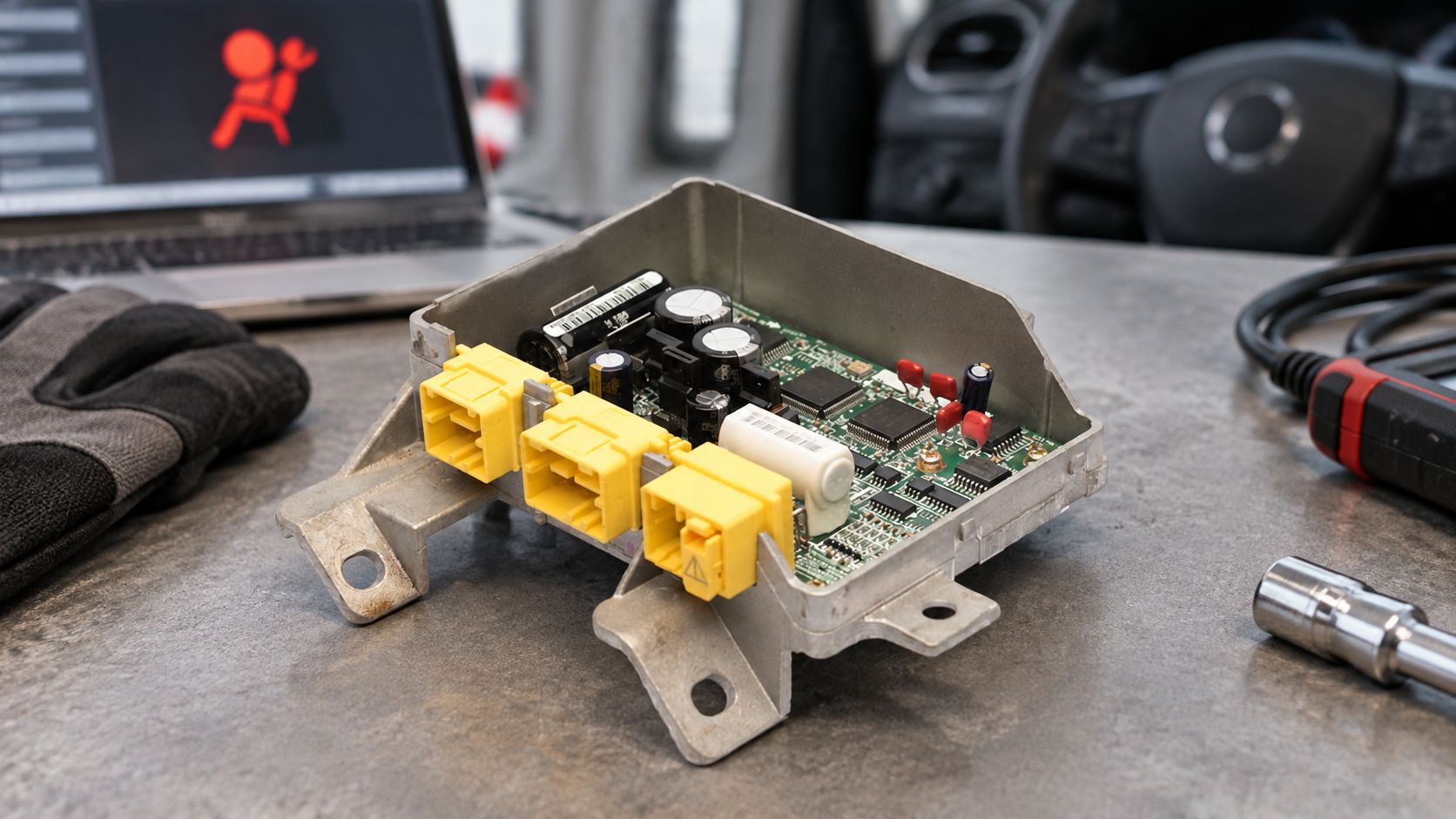
A new module gives you the cleanest paper trail. You know it hasn't lived through another car's crash, flood, or careless removal. The trade-off is straightforward, since you'll usually pay the highest price and may wait for dealer supply and programming.
A donor module reverses that trade-off. The invoice to buy it is lower, but you inherit unknowns about crash history, stored deployment data, software identity, and recall exposure. Two modules can share a housing shape while differing in suffix, hardware revision, or restraint configuration.
Where Reset Fits
Resetting the original unit keeps the module that already matches the vehicle's connectors, mounting, and equipment. SRS Airbag Module Reset is described as a service to reset your airbag light after accident, clearing all crash data and hard codes in your srsmodule. You can review the separate airbag module reset service details when comparing that path with replacement.
Start with a simple rule. First ask whether the original module is physically undamaged and eligible for reset and verification. Then compare a documented used unit against the dealer quote, including programming and diagnostic labor.
Ask every provider two questions before you pay:
- What's the module's history: Can you tie it to a donor VIN, deployment record, and exact part number?
- Who confirms the final scan: Who runs the full SRS self-test after installation and keeps the report?
If either answer is vague, you aren't comparing finished repairs. You're comparing a finished price with an unfinished guess.
What the Module Stores and Why It Matters
The airbag module is both a controller and a record keeper. It reads signals from impact sensors and coordinates the airbag system, including airbags and seat belts. After a qualifying collision, it can also store crash data.
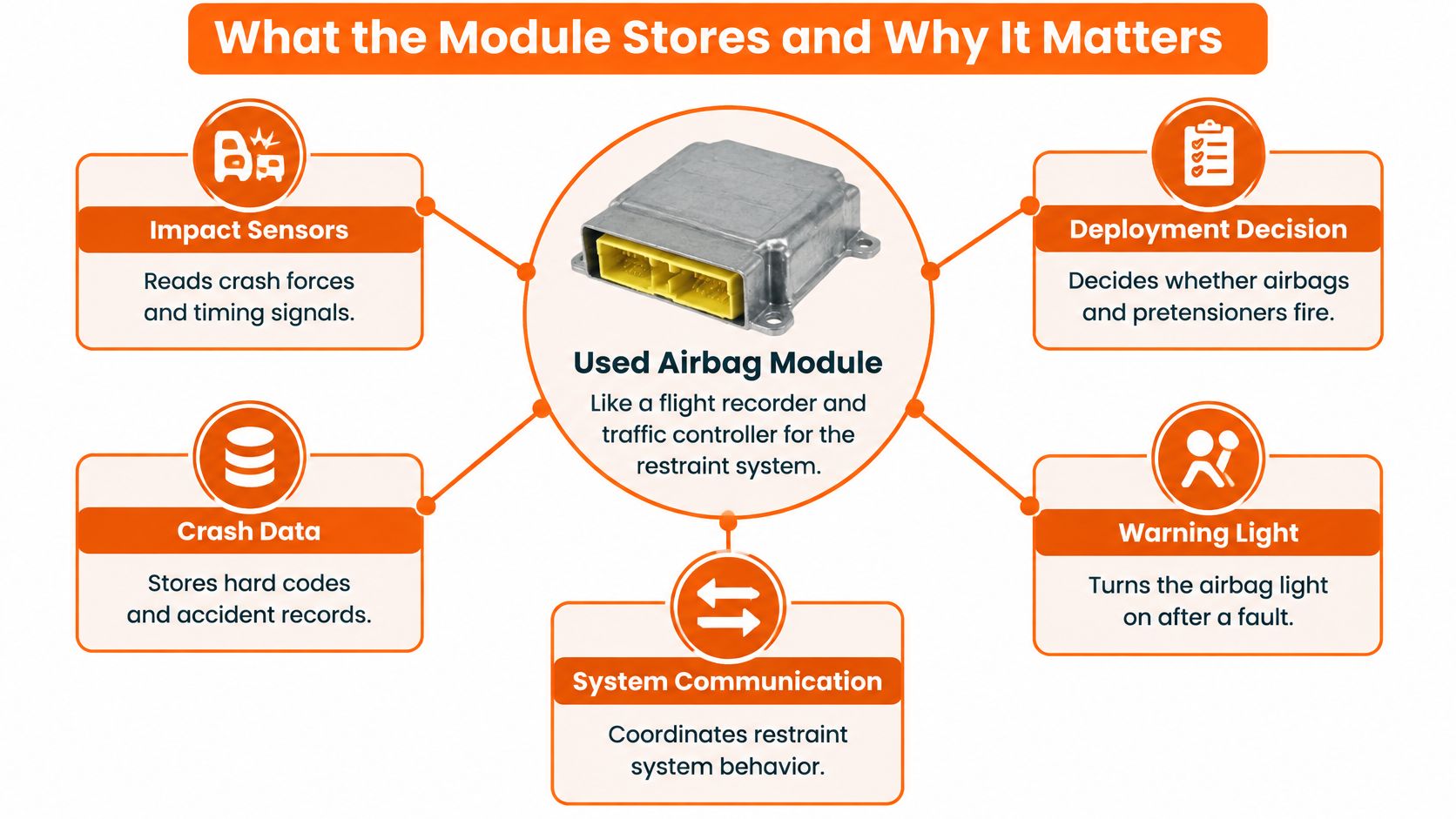
Replacing a deployed airbag or repairing visible damage does not erase the module's memory. The vehicle may look repaired while the controller still retains collision data.
Two Kinds of Memory
Ordinary fault codes point to circuit or component problems, such as an open pretensioner circuit. Once the cause is repaired, a capable scan tool may clear those codes. Deployment data is different: it is recorded during a qualifying collision and may prevent the module from being reused normally.
During an accident, the module stores crash data in its memory chip, and the airbag light comes on. The module is treated as unusable until that stored data is addressed. Disconnecting the battery does not erase it, and clearing codes with a generic reader does not confirm that the deployment data is gone.
NHTSA's history of airbag safety milestones notes that dual airbags became mandatory in U.S. model-year 1999 vehicles. The history also describes how widely airbags had spread by 1999 and records millions of deployments in U.S. crashes by the end of 1998. These milestones reflect the module's role as a safety controller, not just an electronic box.
The System Around the Box
A module depends on the components connected to it. Damaged sensors, cut wiring, a failed clockspring, or an unrepaired pretensioner can cause a functioning controller to report faults. The seat belt buckle pretensioner repair service addresses one component within that larger system.
Working definition: Communication with a scan tool proves the module can respond. It does not confirm that its stored data, coding, or connected circuits are suitable for service.
Treat stored data as evidence, not a nuisance. Distinguish a circuit fault from a deployment event before deciding whether the module should be reset, replaced, or reused.
How to Verify a Used Module Before Installation
A low-priced used airbag module can become an expensive choice if its history, part number, or compatibility is uncertain. Verification starts before removal: disconnect the negative battery terminal, wait at least five minutes, then locate the module, usually under the center console, under the dash, or under a front seat. Unbolt it and disconnect the wire harness without prying on terminals or forcing the connector.
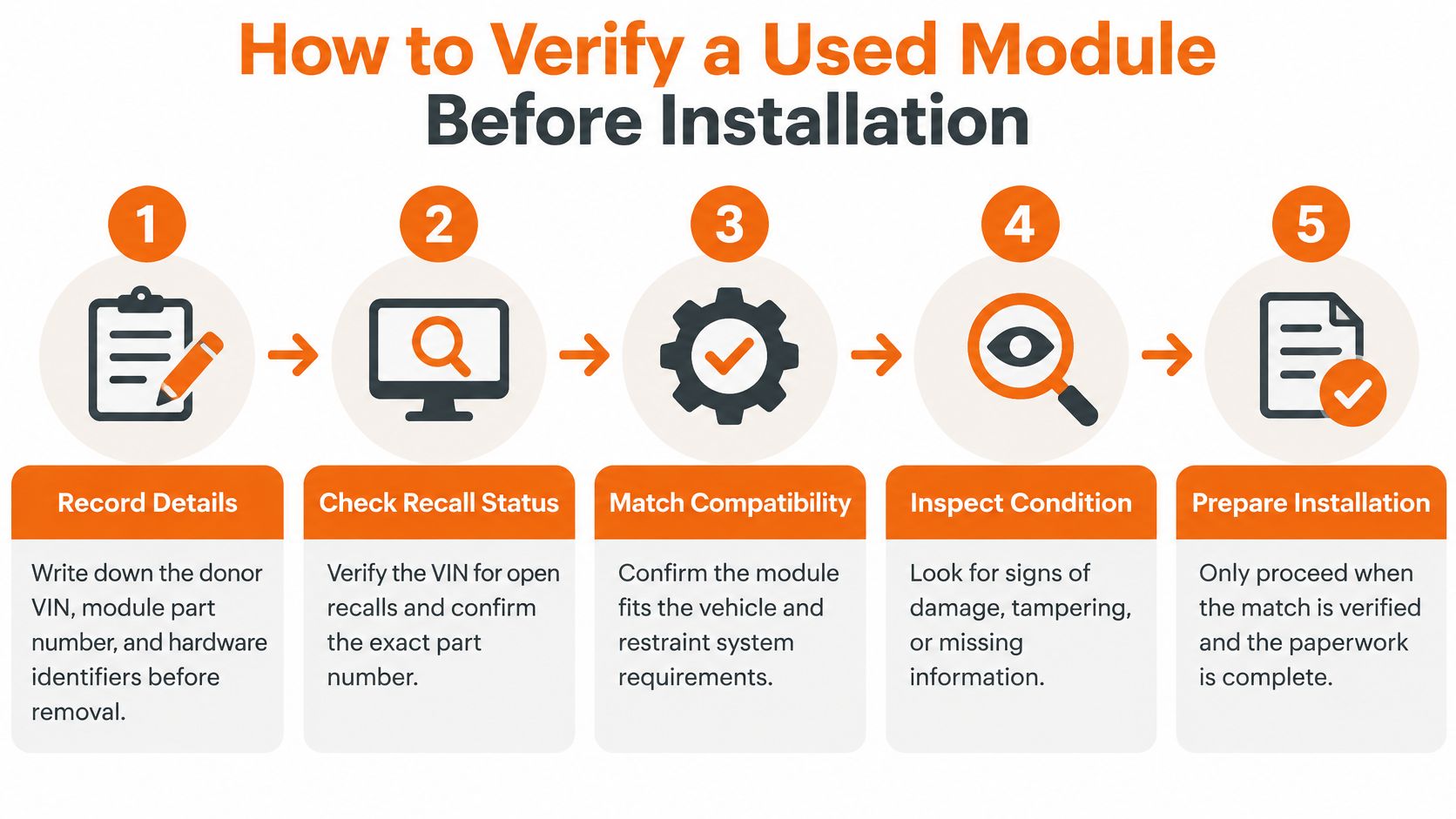
The Seven Checks
Record the donor VIN, module part number, and hardware identifiers. Photograph the label and connector before removal so you can trace the unit later. A model year alone does not establish a match.
Check recalls by VIN and verify the exact part number and inflator identity. Similar-looking modules may belong to different restraint configurations. Confirm the full part number, including its suffix, before assessing compatibility.
Review the donor's history and inspect the housing. Look for cracks, bent pins, corrosion, water marks, melted plastic, or signs of impact. A listing that says “untested but good” does not explain whether the module experienced a collision or water exposure.
Repair the target car's restraint system before fitting a module. Deployed airbags, fired pretensioners, damaged impact sensors, wiring or connectors, and power-supply faults can all affect SRS operation. If a belt remains locked, learn how to fix a locked seat belt after an accident. A controller cannot repair a physical belt fault.
Scan the module and record its DTCs and crash-data status before installation. Manufacturer diagnostic documentation published by NHTSA describes procedures in which a tester identifies “crash data stored” in an airbag control unit. Depending on the procedure, the unit may accept reprogramming or require replacement if programming cannot proceed. A generic OBD scan may not establish whether deployment data has been cleared.
Confirm that the module can be configured for the vehicle's restraint system using the OEM method. Variant programming sets the controller's expected airbags, belts, sensors, and occupant equipment. A coding mismatch can cause faults even when the module connects physically.
Reinstall and confirm SRS operation using the applicable diagnostic procedure. Check that the warning lamp behaves as specified and review the final diagnostic results for unresolved faults.
Record identifiers and fault information before changing the module's state. Once its memory or configuration has been altered, some evidence about its condition may no longer be available.
The Decision Standard
The question is whether this specific unit, with its known history and software identity, is suitable for this vehicle after the crash repairs are complete. If the OEM procedure does not allow the required programming or data clearing, do not force the module into service.
That check may take longer at the parts counter, but it can prevent the cost of buying another unit or repeating diagnostics after installation.
Recall and Legal Limits Shops Must Know
A low-priced donor module can become an expensive choice if the donor vehicle has an open recall or an unclear deployment history. Federal law does not generally require a dealer to replace a deployed airbag in a used vehicle, according to NHTSA's interpretation of deployed airbags in used vehicles. State requirements and dealer obligations can differ, and NHTSA encourages replacement to preserve crash protection.
Why Provenance Matters
A controller scan cannot verify the condition or recall status of the airbag assembly it controls. A module with no active fault may still be paired with a damaged airbag or an inflator that is subject to a recall. Treat the controller and the physical restraint components as separate items to check.
Before installation, document:
- VIN-based recall results: Check the donor and target vehicles where records are available.
- Part and inflator identity: Record complete part numbers rather than relying on shortened listing descriptions.
- Donor and deployment history: Record what is known, and leave gaps unresolved rather than making assumptions.
- Final readiness evidence: Keep the repair documentation and post-install scan.
When reviewing a salvage vehicle's history, you can compare past auction sale prices for additional context about its provenance. Auction information does not establish recall status or confirm that a restraint component is suitable for reuse.
Legal and disclosure requirements vary by location. Confirm applicable state inspection, dealer, and disclosure obligations with a local attorney or licensing authority. If a shop cannot document where a component came from, it cannot reliably assess the risk of reusing it.
Fixing Warning Lights After Installation
A persistent SRS warning light can come from a fault elsewhere in the restraint system, not necessarily the module. An open circuit, loose connector, damaged wiring, or poorly seated terminal can all trigger a fault code. Inspect the harness and connectors before replacing a sensor or controller.
Start with areas exposed to handling or crash forces. Check for backed-out pins, spread terminals, chafed insulation near seat rails, moisture in connectors, and plugs that do not seat fully. A code naming a circuit points to where testing should begin; it does not identify which part to replace.
| Symptom | Likely cause | Fix |
|---|---|---|
| Warning lamp stays on after install | Open circuit or loose connector in the harness | Inspect and reseat connectors before replacing any sensor or module |
| Codes return after a clean scan | Damaged wiring or an unfinished pretensioner or airbag replacement | Complete all repairs, then rescan and run a full SRS self-test |
| Module refuses reprogramming | Stored crash data blocks the OEM procedure | Follow the OEM decision tree and replace the unit if programming cannot proceed |
| Lamp is off but doubt remains | A fault may still be stored or a system check may be incomplete | Check fault memory and confirm the system's diagnostic status |
Reading the Pattern
When the lamp returns at key-on, check for a current circuit fault, incorrect coding, or an airbag or pretensioner that was not replaced. If it returns after a seat moves or the steering wheel turns, inspect for intermittent wiring, connector tension, or a clockspring fault. The timing helps narrow the diagnostic path.
If a code returns after being cleared, stop clearing it and investigate the cause. Recheck deployed airbags and pretensioners, inspect impact-sensor mounting and wiring, and verify power and ground quality under load. A reset or replacement module will continue reporting faults until the underlying repair is complete.
Know when to stop. If the OEM procedure says programming cannot proceed because of stored crash data, replace the unit rather than forcing incompatible software or repeating the attempt. If harness checks are clean, coding is correct, and the same internal fault returns, the evidence points to a module fault.
Choose the Right Workflow Before You Order
The cheapest module can become the costliest choice if it brings a coding mismatch or unresolved fault. Choose a workflow you can document, with each person involved clear about their role.
| Role | Recommended path | First check | Record to keep |
|---|---|---|---|
| Collision shop | Assess the original module for reset eligibility | Physical condition and recall status | Scan reports |
| Independent mechanic | Use a used unit only when OEM procedures are available | Part number and inflator identity | Repair documentation |
| Used car dealer or rebuilder | Disclose deployment history and favor replacement when provenance is unclear | Deployment history and recalls | Repair documentation |
| Vehicle owner | Ask the shop to explain its documented repair path | Module identity and readiness result | Repair documentation |
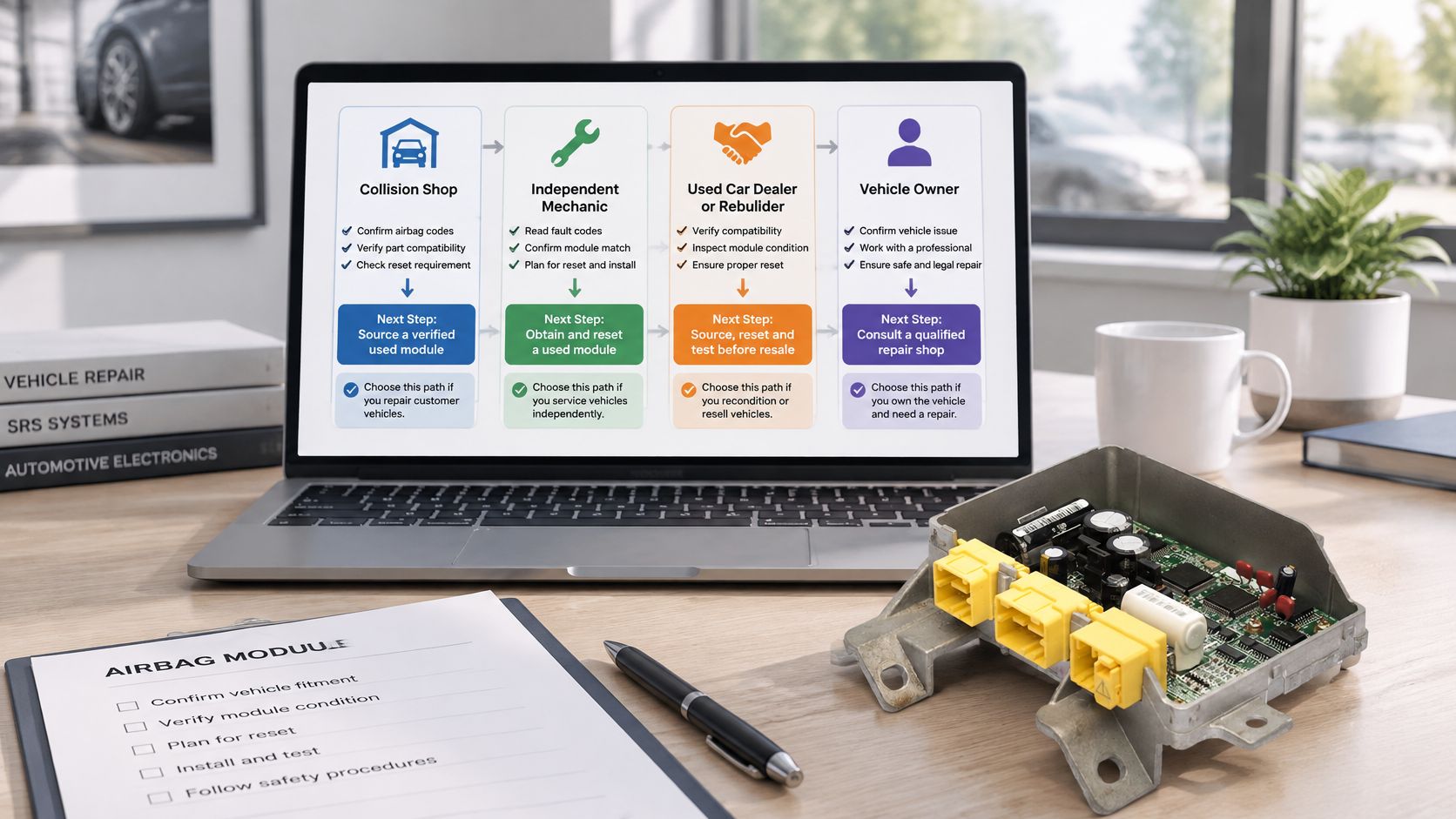
A collision shop can assess whether the original module is suitable for reset. Keeping the original avoids introducing a donor unit with a different identity or coding requirements. Save the scan reports with the repair file.
An independent mechanic needs access to the applicable OEM procedures before considering a used module. If the required information or tools are unavailable, the lower purchase price may be offset by extra diagnostic work.
Dealers, Rebuilders, and Owners
A used car dealer or rebuilder should document deployment history and recall results, and favor replacement when the module's history is unclear. A vehicle owner can ask the repair shop to explain its recommendation and provide the scan reports and final readiness result.
For an eligible original module, Safety Restore offers an SRS reset service for $99.99 per item. Customers mail in their module and receive it back factory reset, ready for installation without additional programming. The service clears crash data and hard codes, but the vehicle's underlying repairs still need to be complete before installation and final checks.
If your original module is undamaged and eligible, our mail-in reset can clear its stored crash data and hard codes while preserving the unit that already fits your vehicle. Visit Safety Restore to start the order, ship the module with your vehicle details, and confirm the finished SRS scan after reinstallation.
