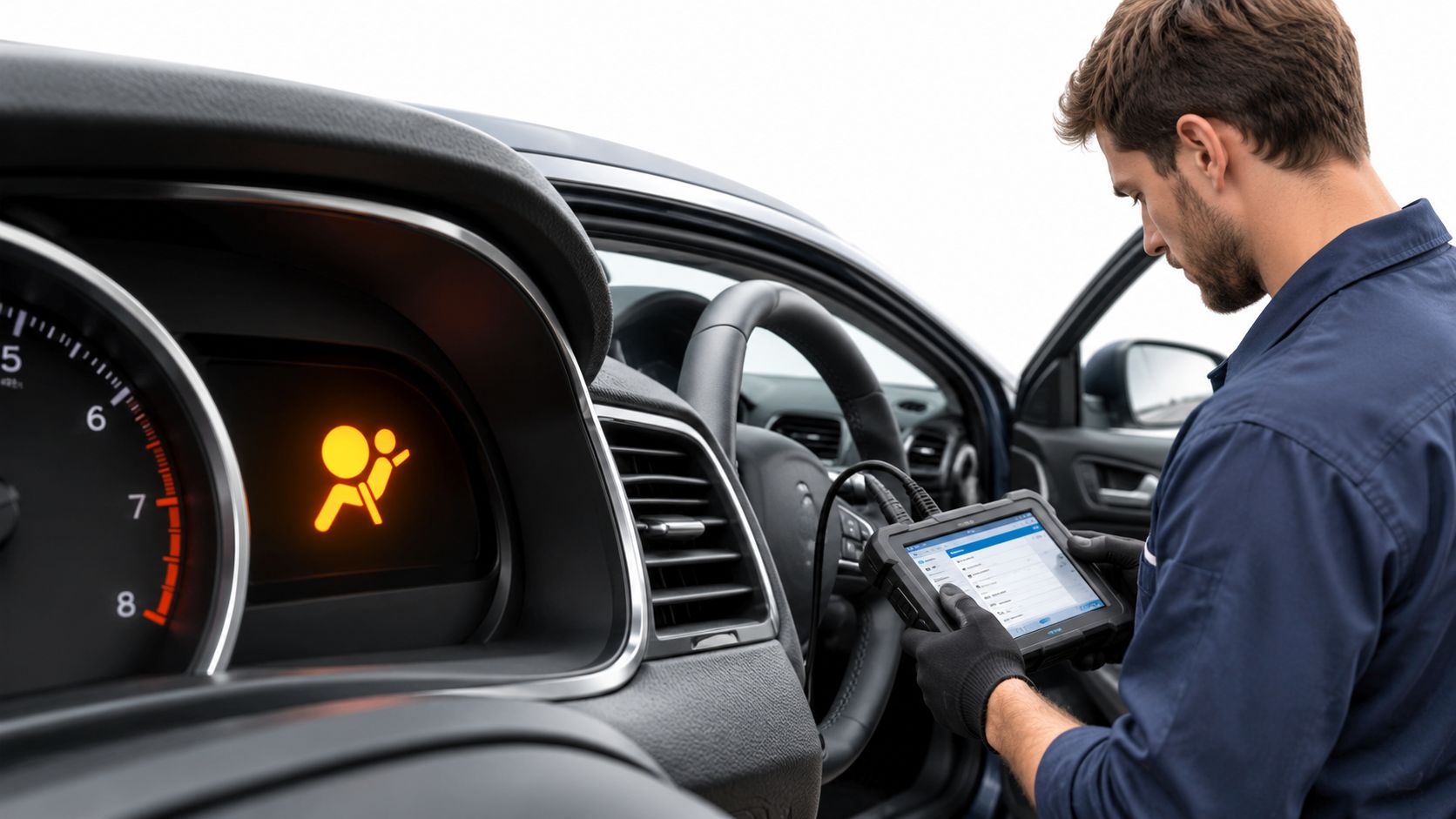
The most popular advice for resetting the airbag light is also the advice most likely to confuse a cleared warning with a repaired safety system. Disconnecting the battery or cycling the ignition might change what the dashboard displays, but neither proves that airbags and seat-belt pretensioners are ready to protect anyone. The right reset follows diagnosis and repair. It's the last part of restoring the Supplemental Restraint System, not a shortcut around it.
Table of Contents
- Why the Airbag Light Is a Safety Problem, Not a Dashboard Nuisance
- How the SRS System Decides to Turn the Light On
- Code Clearing Versus Crash Data Removal
- The Safe Way to Clear an Airbag Light
- Why the Light Comes Right Back After a Reset
- When a Mail-In SRS Reset Makes Sense
- Verifying the Reset and Knowing When to Stop
Why the Airbag Light Is a Safety Problem, Not a Dashboard Nuisance
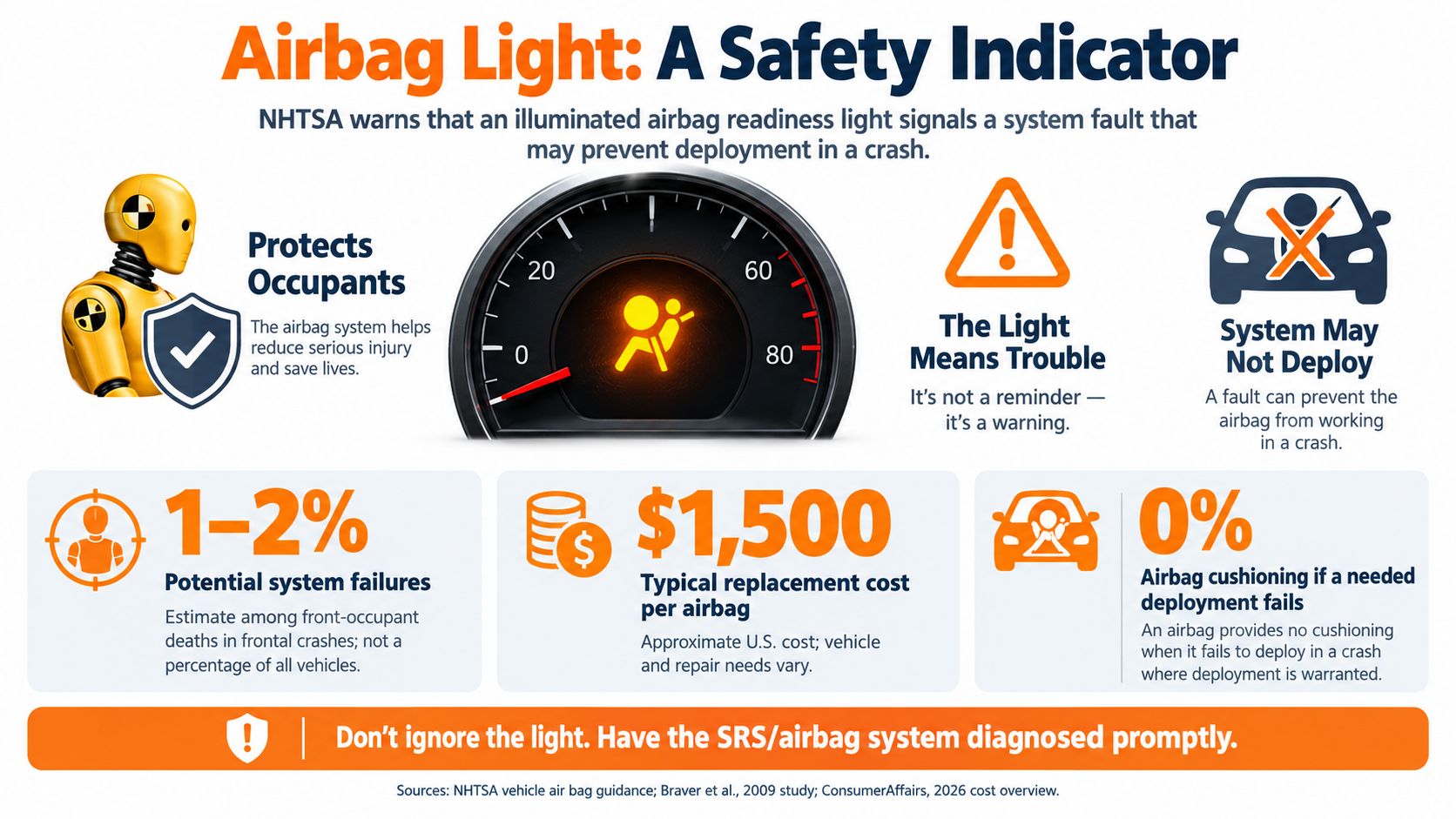
An illuminated airbag light isn't a routine service reminder. It's a warning that the SRS has detected a fault, and depending on the fault, an airbag or seat-belt pretensioner circuit may be disabled. NHTSA recall documents describe cases where an SRS warning light could accompany deactivated airbags or pretensioners. That means a car can start, steer, and brake normally while an important part of its crash protection remains unavailable.
The stakes aren't abstract. NHTSA estimated that frontal airbags saved 42,292 lives in the United States from 1987 through 2014, including approximately 2,396 in 2014 alone. Its analysis also estimated that airbags saved 50,457 lives from 1987 through 2017. Those figures don't tell you what's wrong with a particular car, but they do show why turning off the warning without finding the cause is a poor repair strategy. (NHTSA's airbag fatality analysis; NHTSA airbag safety testimony)
What the warning can indicate
The light may reflect stored crash data, an open or high-resistance circuit, a failed sensor, or a deployed component that hasn't been replaced. A fault involving the passenger seat's occupancy sensor, a connector disturbed during interior work, or a belt pretensioner can all bring the SRS warning on. The lamp identifies a problem in the restraint system, but it doesn't identify the failed part by itself.
After a collision, a reset may be needed to prepare the original airbag control module for reuse. That work doesn't replace deployed airbags or pretensioners, repair damaged wiring, or confirm that impact and occupant sensors are functioning. Those checks and repairs must happen too.
Shop rule: A warning light that goes out is not proof of a working restraint system. Diagnose the fault, restore the required components, then verify readiness.
The distinction matters whether you're a vehicle owner, technician, or collision repairer. Resetting the airbag light should be the final step in a safety-restoration process, after the crash damage and the cause of the stored fault have been addressed.
How the SRS System Decides to Turn the Light On
The airbag lamp is the visible end of a judgment call the control module makes every time you turn the key. While the vehicle runs, the module watches each circuit tied into the restraint system and compares what it sees against expected values. Resistance out of spec, an open line, a short to ground or power, a missing sensor signal: any of these gets logged as a diagnostic trouble code, and the lamp comes on. A stored code is the module's record of why it stopped trusting the system.
Read the system before clearing it
Start with a scan tool that can communicate with the SRS module. A basic engine-code reader often cannot reach it, leaving you with nothing to work from. Pull the current and stored DTCs, check module status, and save freeze-frame data where the vehicle provides it. One thing I tell every junior tech: a DTC identifies a circuit. Finding the failed component is still your job, so confirm the fault before buying parts.
Before you touch an airbag, pretensioner, impact sensor, or column wiring, run the manufacturer's disabling procedure and wait the specified time. These are pyrotechnic devices built to fire fast, and a powered test light across a squib circuit can set one off. Use only the test methods the service manual allows.
Belt faults earn a physical check on top of the scan. When inspection points to a deployed or faulty buckle unit, a seat-belt buckle pretensioner repair service addresses that specific repair. Let the scan data and a hands-on look make that call.
Read the lamp's self-test
At key-on, the lamp should light briefly while the module runs its self-check, then go out. NHTSA-published repair procedures put normal illumination at roughly 4–8 seconds, depending on the vehicle. (NHTSA recall repair procedure)
Two failure patterns matter. A lamp that never lights is not a pass: the bulb, the cluster, or the communication line can all be at fault, and I have seen lamps deliberately disabled to hide a stored code. A lamp that stays on is the module reporting a live problem, or a condition stored at the module level that a simple code clear cannot touch.
The module and the lamp are separate witnesses. One monitors the restraints, the other reports the verdict. Confirm both before you believe either.
Code Clearing Versus Crash Data Removal
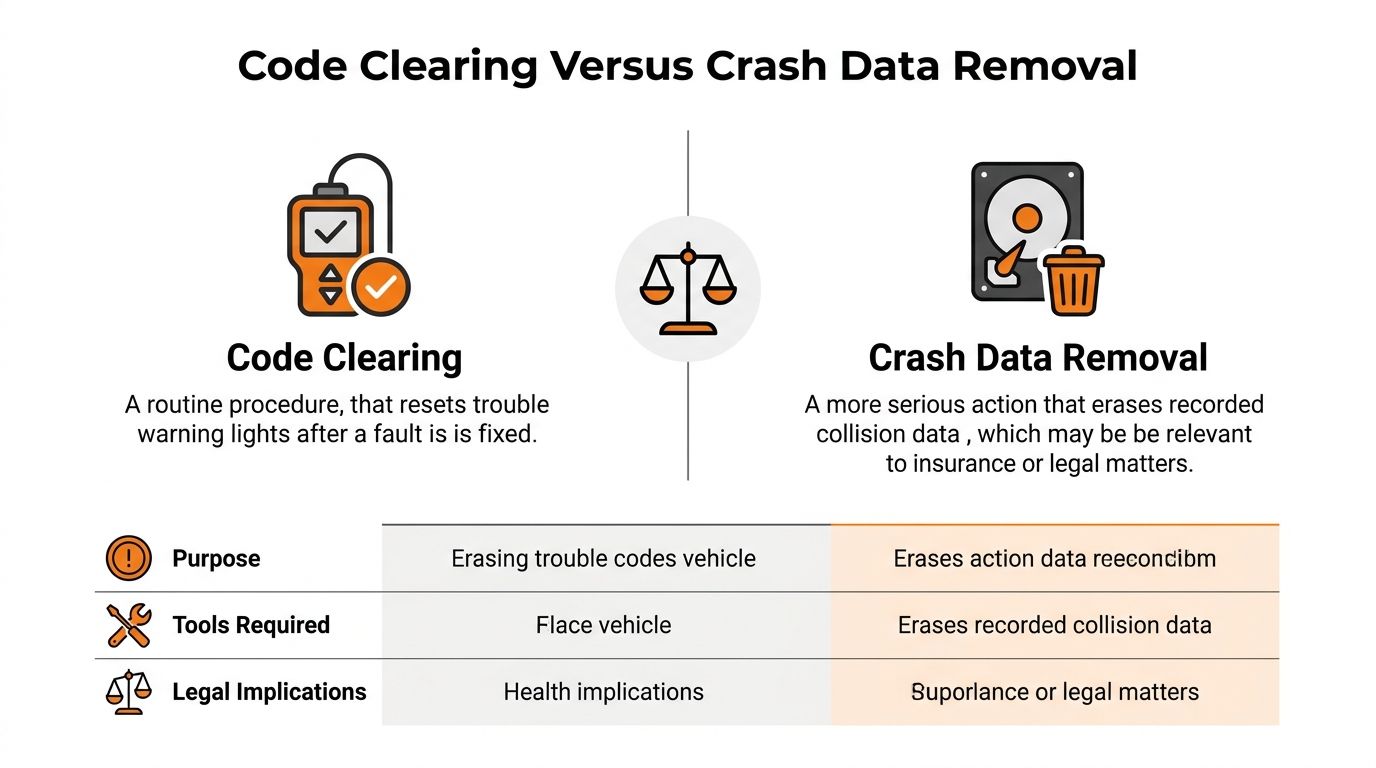
“Reset” can mean different things in a repair conversation. A scan tool may erase a stored DTC after the fault has been fixed. A separate module-level procedure may address crash data stored after a collision. These operations aren't interchangeable, and a tool that clears ordinary SRS codes may not be able to remove crash data.
Routine code clearing
Suppose a technician finds a loose connector, repairs it, and confirms the circuit is sound. An SRS-capable scan tool can then clear the stored code. If the module accepts the command and the fault is gone, the warning should complete its key-on self-test and turn off. A post-clear scan checks whether any current or pending faults remain.
This is not the same as clearing a code while the circuit is still defective. In that case, the module may immediately set the fault again. The light returning is useful diagnostic information, not a reason to keep cycling the ignition.
Crash data in the control module
A collision can leave event data in the airbag control module that a routine code-clear command won't remove. Depending on the vehicle and the condition of the module, the proper route may involve a dedicated reset procedure, reprogramming, or replacement. Even when crash data can be cleared, the physical restraint components and sensors must be inspected and restored before the vehicle is considered ready.
Disconnecting the battery isn't a dependable substitute for either operation. Nonvolatile crash records may remain in the module, and repeated power interruptions can complicate diagnosis without fixing the original fault.
Collision records can also matter outside the workshop. Keep repair records and relevant documentation together, and consult the AskLegally traffic collision report guide if you need help understanding how to obtain a collision report. For a locked belt after an accident, seat belt repair after an accident is a separate issue from clearing module data.
The Safe Way to Clear an Airbag Light
Clearing the lamp is the last step of a repair. What you are restoring is a restraint system that passes its own self-test; a lamp that stays off without that pass can hide airbags that will not fire. Start with the manufacturer's service information for that specific vehicle rather than a generic internet sequence. SRS components can deploy and cause serious injury when handled wrong, and federal recall instructions warn that the system must be disabled before certain work. Follow the vehicle-specific procedure, including any required wait after disconnecting the battery (NHTSA recall safety instructions).
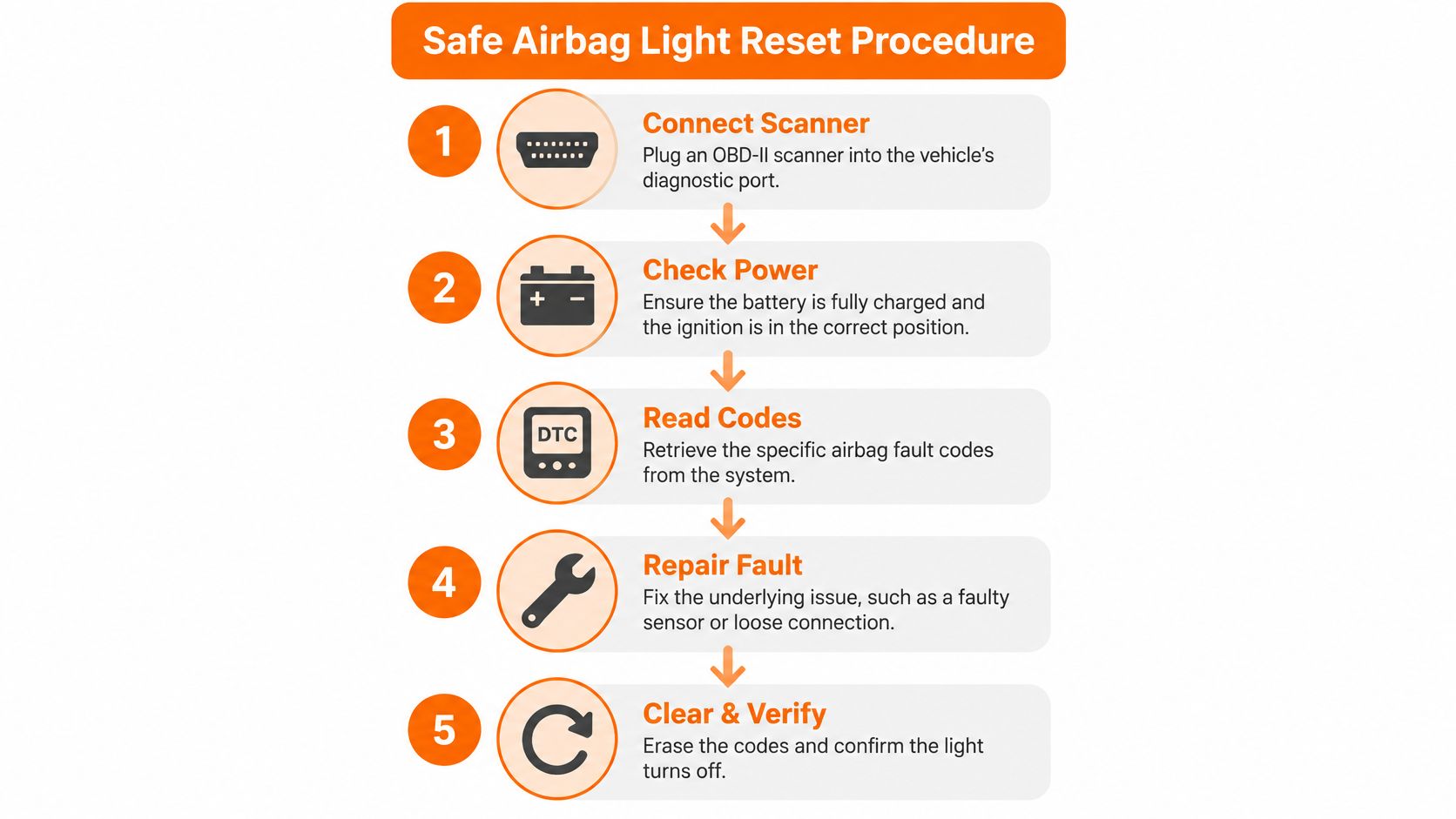
Diagnose, repair, then erase
Connect an SRS-capable scan tool and record every DTC before you clear anything. Note whether each code is current, historical, or pending, and capture freeze-frame data if the tool offers it. Confirm the battery voltage is stable enough to keep module communication reliable for the whole session.
Then disable the system per the service procedure before working near restraint components. Inspect the area the code points to, but never probe airbag connector terminals electrically or hook up test equipment that could energize a deployment circuit. Fix the fault first. That can mean correcting a connector or wiring issue, replacing a damaged sensor, or dealing with a deployed pretensioner or a module holding crash records, which needs a dedicated procedure rather than a routine erase, as covered earlier.
With the repair complete, run the scan tool's dedicated SRS clear function. Ignition cycling is a weaker instrument. It only clears what the module is willing to release, and anything held in nonvolatile memory stays put. After the clear command, turn the ignition off for roughly 15 seconds (the exact wait is vehicle-specific), then switch it back on. The lamp should light for its self-test, then go out and stay out.
Safety boundary: If you don't have the service information, an SRS-capable scan tool, or training to handle restraint components, stop at diagnosis and have a qualified technician perform the repair.
A successful clear is the system verifying itself. If the lamp stays dark through a full key cycle and a short road check, the SRS has passed the same power-up test it ran before the fault. That result is what the warning lamp was asking for all along.
This video provides a visual overview of the reset sequence. Treat any general demonstration as context only, and follow the manufacturer's procedure for the specific vehicle.
Why the Light Comes Right Back After a Reset
A returning lamp usually means the fault survived the erase. Treat it as the SRS running its power-up judgment again and finding the same unsafe circuit, component state, or module condition. Pull the code again, save it, and compare it with the first record before another clear attempt. Repeated clearing only proves the module still has authority to refuse a clean self-test.
Follow the code to the fault
The obvious suspects are still physical: a damaged connector, open circuit, high resistance, sensor fault, or a deployed pretensioner. Under-seat connectors get disturbed during interior work, and a hurried repair can leave resistance just high enough to fail the next check. Clearing first and repairing later also creates a false trail, because the stored history may already be gone while the vehicle-side defect remains.
A reset cannot make a fired restraint device ready again. If the scan and inspection point to the buckle unit, buckle pretensioner repair after an accident is a distinct repair consideration. The module can release a stored command only when the hardware is back in a state it can monitor.
Voltage and communication decide whether the diagnosis is even trustworthy. A weak battery or unstable power supply can corrupt a session, and a module that will not talk needs a different path before anyone condemns it. Verify power, grounds, network communication, and connector seating against the service information before calling the module bad.
Consider module and software conditions
Some modules keep crash data in memory that a routine clear will not touch. Cycling the ignition can clear what the controller is willing to release, but stored crash records are a different memory class and call for a module procedure, not another key-off attempt. There are also documented cases where software logic can generate an erroneous internal-fault code under particular conditions, so the correct fix may be an airbag control unit software update after diagnosis rather than replacement hardware. (NHTSA technical bulletin on SRS fault diagnosis)
A Nissan-style occupant-classification calibration shows why vehicle-specific routines matter. Some systems want set conditions such as an empty passenger seat and a stationary vehicle, then a calibration command, then a DTC check. That sequence restores readiness logic; it is separate from removing crash data.
When a light returns, the code is evidence. Save it, identify the failed circuit or required module procedure, and repair that cause before clearing memory again.
When a Mail-In SRS Reset Makes Sense
A mail-in reset earns its place after the hard part is already done: the crash damage is repaired, the scan record points to stored crash data in the original module, and reuse is allowed for that part. Treat it as a safety-restore step. The module has to be cleared of crash memory so the SRS can run readiness logic again; the dashboard lamp going dark is only the byproduct.
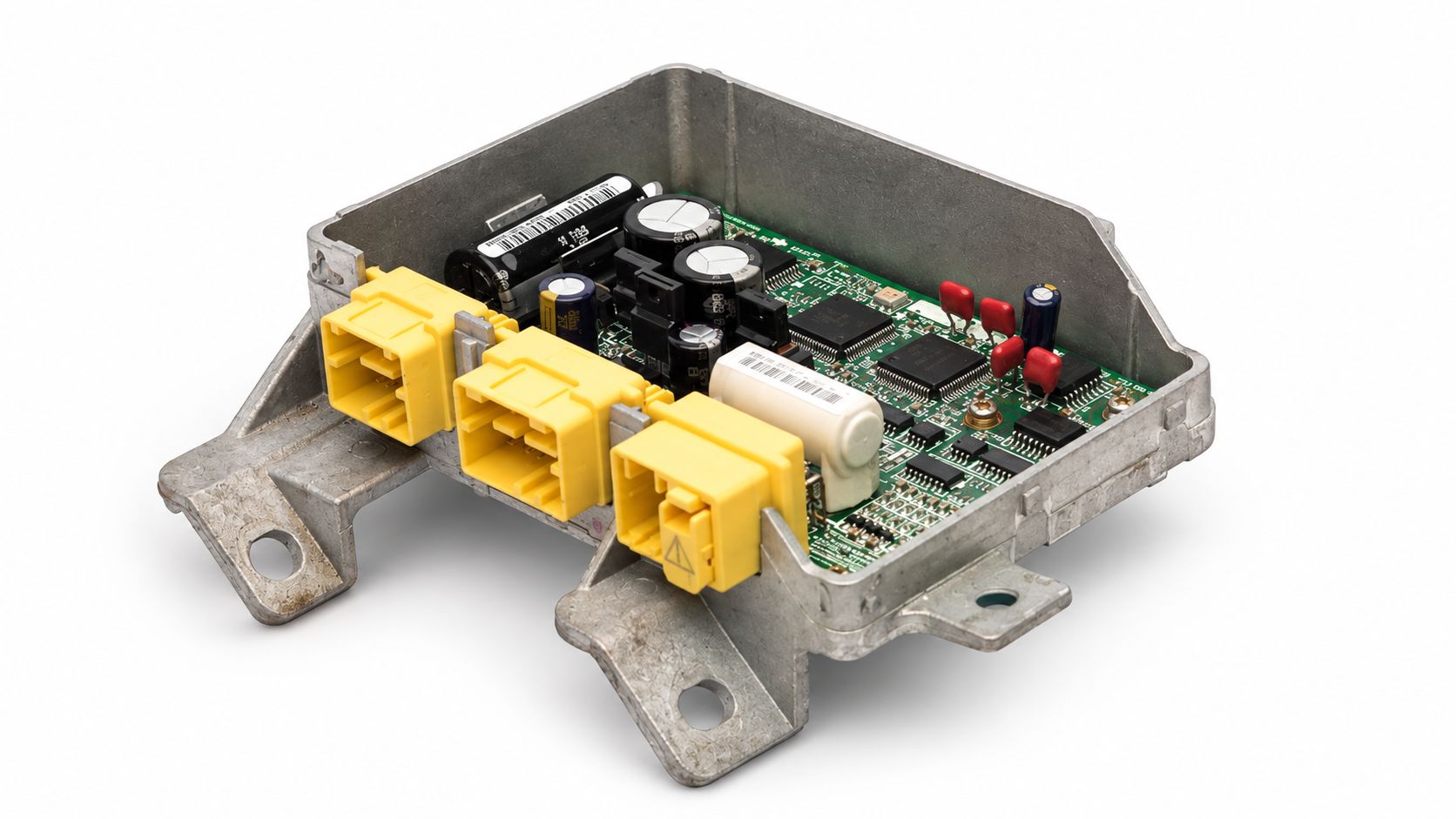
Match the service to the failure mode
Send a module out when the diagnosis says the restraint hardware is sound and the blocker is crash data locked in the controller. Skip it when the scan shows an open squib circuit, a bad weight sensor, an unreplaced pretensioner, corroded connectors, or a module that will not communicate. Boxing up the controller will not repair a vehicle-side fault, and reinstalling a cleared unit can leave the system blind if a deployed component is still in the circuit.
Safety Restore describes its SRS airbag module reset service as removing stored crash data and hard codes after an accident, and lists a flat $99-per-item price, typical 24-hour turnaround, lifetime warranty, and more than 1,000,000 parts serviced nationwide since 2013. Those terms make planning easy for a shop, fleet, or owner. They do not prove a given module is reusable.
Before shipment, confirm the part number, removal steps, handling precautions, and shipping rules in the service information. Keep the original DTC printout with the estimate. When the module returns, the job still ends at the car: install it, complete any required calibrations, scan for current and pending faults, and verify the warning sequence during the self-test. If the same code returns, stop mailing parts and diagnose the circuit that is setting it.
Verifying the Reset and Knowing When to Stop
A reset passes only when the vehicle completes the SRS self-test normally and a follow-up scan shows no active faults. A dark warning lamp by itself isn't enough. The module needs to communicate, perform its check, and report a system state consistent with the repairs that were completed.
Check the system after reassembly
After clearing codes or reinstalling a serviced module, turn the ignition on and watch the lamp. It should illuminate for the self-test, then extinguish. Restart the vehicle and confirm that the warning doesn't return. Scan the SRS again for current and pending codes, and compare the results with the original DTC record.
Also check that the physical repair matches the diagnosis. Confirm that disturbed connectors are seated, the relevant wiring has been inspected, and any required seat-occupancy sensor calibration has been performed according to the manufacturer's procedure. If the battery or module lost communication during the job, verify that the system is now communicating normally.
Know when another reset is the wrong move
Stop clearing codes and escalate the diagnosis if the same fault returns, if the module won't communicate, or if the scan indicates crash data that the tool can't legitimately erase. Don't sign off a collision repair when deployed airbags or pretensioners remain unreplaced, or when damaged sensors, wiring, or structural areas haven't been inspected. A persistent warning is a reason to investigate, not to hide the warning.
The decision rule is simple: repair the identified fault first, then clear the code using the correct vehicle-specific method, and verify the system afterward. If you can't identify the cause or complete the safety checks, hand the job to a qualified SRS technician. A dark airbag light is necessary, but it isn't sufficient. Resetting the airbag light belongs at the end of a safety restoration, not the beginning.
Safety Restore handles mail-in repairs for automotive seat-belt mechanisms and SRS airbag control modules, including modules with stored crash data after an accident. If diagnosis confirms that your original module is a candidate for service, visit Safety Restore to review the module reset process.