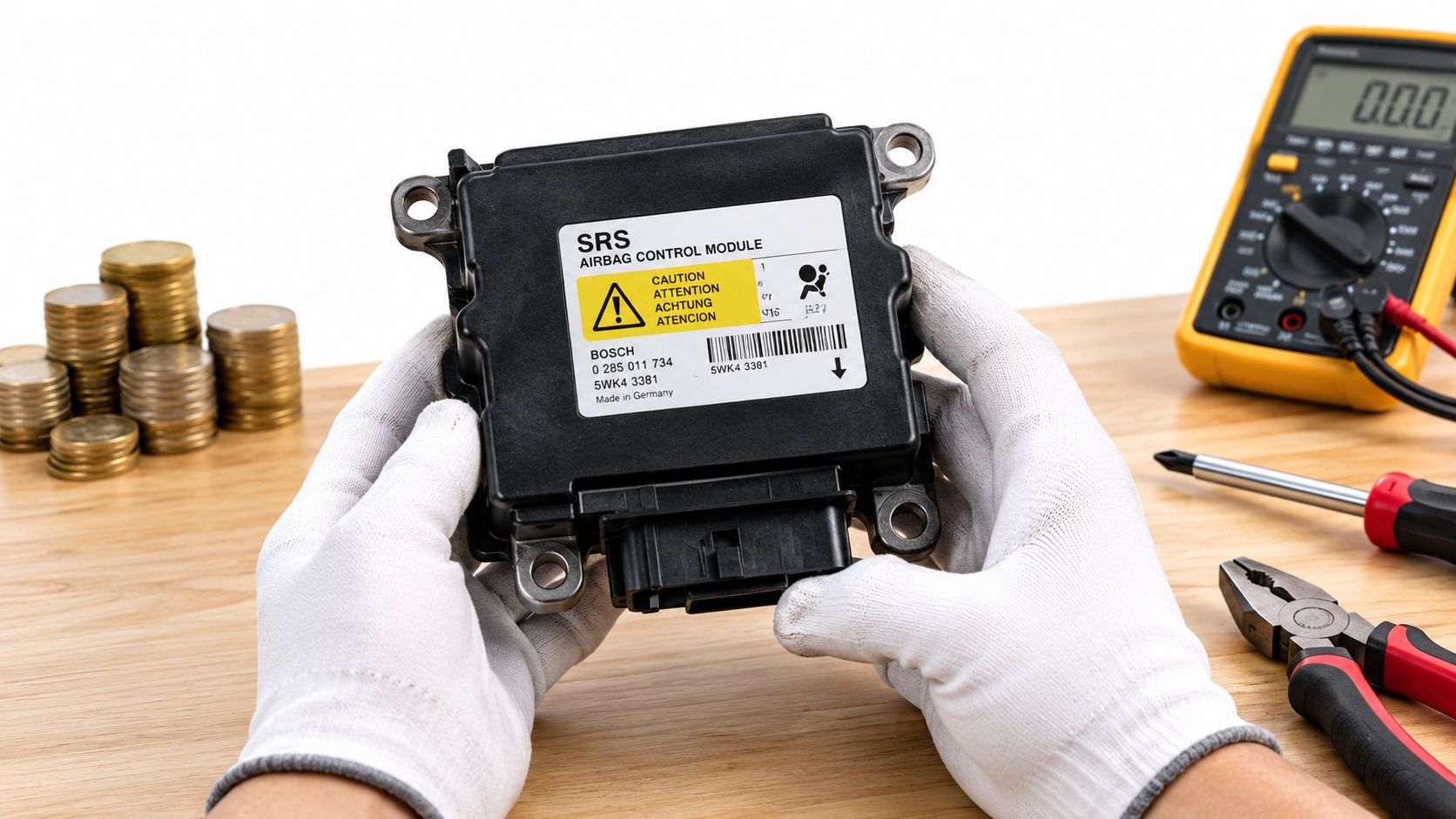
A flat-fee airbag module reset typically runs around $99 per module in 2026, while full dealer replacement commonly lands between $600 and $1,500 once parts, diagnostic time, and programming are included. The right choice depends on whether the original module is intact or physically damaged.
You're standing at the body shop counter after a collision, staring at an estimate that looks larger than the damage on the car. The bumper is repaired, the paint matches, and the airbags may already be replaced. Yet one line remains: SRS module replacement.
That line deserves scrutiny before you approve it. The RepairPal air bag control module estimate places the average U.S. replacement around $865 to $939, including approximately $705 for parts and $160 to $235 for labor, although taxes, fees, and local variation can raise the final bill. Another consumer estimate cited in the same cost discussion puts the average total near $773, with roughly $638 for parts and $134 for labor.
The practical question isn't whether your SRS system needs attention. It does. The question is whether you're paying for a new computer when a professional reset can restore the original one.
Table of Contents
- Why the Airbag Light Stays On After a Collision
- What the Airbag Control Module Does
- What Drives the Cost of an Airbag Module Repair
- Dealer Versus Shop Versus Mail-In Reset Pricing
- How a Mail-In Airbag Module Reset Works
- When to Reset the Module and When to Replace It
- Smart Ways to Lower Your Airbag Module Repair Bill
Why the Airbag Light Stays On After a Collision
The bumper can be repaired and the car can drive normally, yet the red airbag symbol stays on every time the ignition starts. That commonly happens after a low-speed impact, even when no airbag deployed.
The warning usually reflects a stored crash event or another SRS fault. The restraint control module records the incident and places the system in a protective fault state. Until the fault is diagnosed and corrected, the module may prevent the airbags and belt pretensioners from arming normally.
At this point the repair estimate splits into two very different paths. A service advisor may recommend replacing the module, creating a bill in the high hundreds or more. A specialist may inspect the unit, confirm that its housing and electronics remain intact, and recommend clearing the stored crash data instead.
Why a warning light changes the repair decision
The SRS lamp is a diagnostic warning, not a cosmetic dashboard issue. Shops and inspection authorities may treat an illuminated light as a safety defect. In many jurisdictions, a state safety inspection will fail a vehicle with an active SRS lamp, which can block registration renewal as well as signal restricted deployment.
The rest of the restraint system also needs testing. A collision can damage seat belt pretensioners, impact sensors, wiring, or occupant-detection components. A module reset cannot repair a damaged sensor or cut harness. The responsible starting point is a scan of the diagnostic trouble codes, followed by a physical inspection, not an automatic parts order.
Practical rule: Treat the warning light as a request for diagnosis, not automatic proof that the control module is ruined.
The low-speed crash that creates a big quote
A fender bender with no deployed airbag can still store crash information in the module. The owner may then receive a replacement quote for a memory fault rather than failed hardware.
That distinction controls the SRS module line item. A reset makes financial sense only after the module passes physical and electronic assessment. If it does, a flat-fee mail-in reset can remove the replacement assumption from the estimate for any year, make, or model, while the shop still addresses every damaged airbag, belt, sensor, and wire separately. Replacement remains the right call when the housing or electronics are damaged, or when testing shows the original unit cannot be returned to service.
What the Airbag Control Module Does
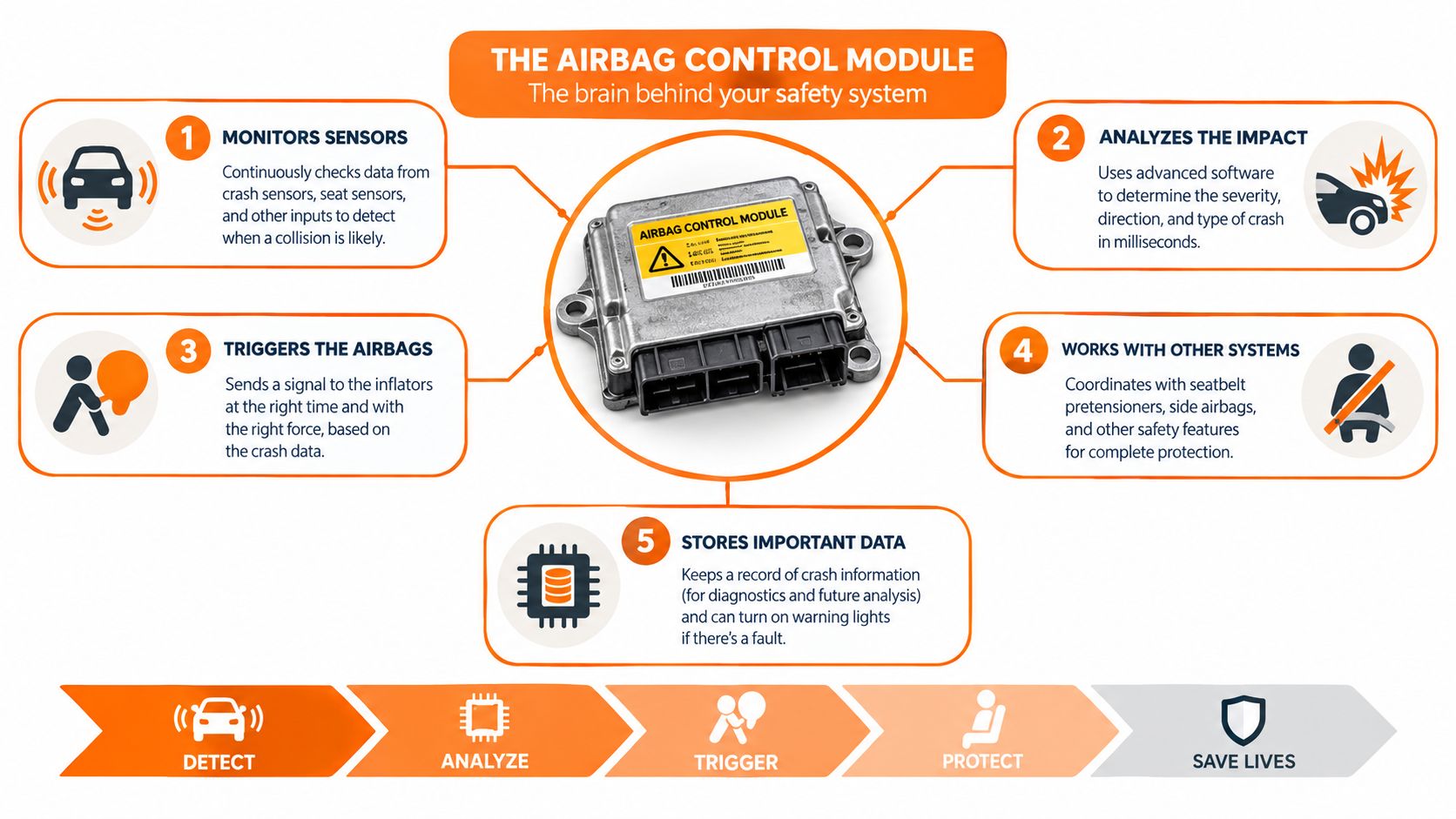
The airbag control module, also called the SRS control unit, is the restraint system's decision-making computer. It receives data from impact sensors, seat belt circuits, occupant-detection systems, and vehicle networks, then uses that information to control deployment.
The module works like a compact flight recorder. It samples sensor data continuously, makes deployment decisions in milliseconds, and records the event in non-volatile memory. A standard scan tool can read the resulting fault codes, but it cannot erase crash data when the module's hardware or stored event record requires specialist service.
Reset and replacement are different jobs
A reset preserves the original module. The service provider assesses the unit, clears the stored crash record when the hardware is suitable, restores the required programming, and tests it before returning it. This approach makes sense when the controller remains serviceable and the damaged airbags, belts, sensors, and wiring are repaired separately.
A replacement removes the original controller and installs another unit. The part may be new, remanufactured, or used. It can still require vehicle-specific coding, initialization, or programming before the SRS communicates correctly.
The distinction is straightforward:
- Reset: Restore a serviceable original module.
- Replacement: Install and configure a different module.
- Diagnosis: Confirm which repair fits the actual fault.
A reset cannot make a cracked housing, flooded circuit board, burned connector, or damaged wiring safe. It also cannot replace a deployed airbag or repair a locked seat belt retractor. The module is one line item within the restraint system, not the entire repair.
Why the price gap exists
Replacement adds the controller, installation, diagnostic work, and often programming. Reset service centers on the existing unit, avoiding the largest parts charge when testing confirms that it is physically sound.
That difference matters when comparing a dealer estimate with a flat-fee mail-in reset for any year, make, or model. Ask the shop to isolate the SRS module cost, then verify whether the unit failed assessment or only contains stored crash data. Choose replacement for damaged or unusable electronics. Choose a reset when the original module passes testing.
What Drives the Cost of an Airbag Module Repair
A post-collision SRS quote can jump quickly when the estimate combines the module with diagnosis, programming, belt work, and other restraint components. The first question is whether the original controller needs replacement or only a reset. That decision changes the largest line item.
The RepairPal cost reference identifies the module as the largest portion of a typical replacement bill, with parts around $705 inside its cited average range. Labor is estimated at about $160 to $235, so replacement can approach or exceed the high hundreds before taxes and unrelated SRS repairs.
The main invoice components
Module price drives much of the total. A new controller costs more than a used or remanufactured unit, and vehicle-specific availability affects sourcing. A discontinued part can force the shop toward a more expensive option.
Diagnostic time covers SRS scanning, trouble-code retrieval, communication checks, and confirmation of the failed component. Skipping this work can lead to replacing the module when the actual fault is a sensor, connector, belt, or wiring problem.
Programming and initialization may follow replacement. The technician can need to configure the controller for the vehicle, clear codes, and confirm communication with the rest of the restraint system.
Crash-data clearing is a separate service when the original module remains physically sound. The Automotive Module Lab guide to clearing crash data explains that reset work clears stored crash information and re-arms a usable controller. It does not supply a replacement unit.
Related SRS components can expand the invoice. Deployed pretensioners, impact sensors, occupant-detection parts, connectors, and wiring may require separate inspection, repair, or replacement. Taxes, shop supplies, shipping, and core charges may sit outside the quoted module price.
Typical Airbag Module Repair Cost Line Items
| Line Item | Typical Range | Notes |
|---|---|---|
| Airbag control module replacement | About $865 to $939 on average | The RepairPal estimate includes approximately $705 for parts and $160 to $235 for labor, excluding taxes and location-specific fees. |
| Control-module reset | About $75 to $150 | Reset work, as described in the crash-data guide cited above, clears stored crash information from an intact unit. |
| Professional repair alternative, European pricing | About €100 to €300, roughly $110 to $330 | The MyAirbags replacement-versus-reset explanation places professional repair in this European range. |
| New control unit, European pricing | About €400 to €1,500, roughly $440 to $1,650 | The same MyAirbags comparison notes that brand and model affect the price. |
| Related belt, sensor, or wiring work | Vehicle-dependent | These components require their own inspection and are not covered by a module reset. |
For a clean comparison, ask the shop to isolate the SRS module line item from the rest of the collision repair. The estimate should show diagnostic codes, the module part number, programming charges, and related restraint components. If testing finds a sound original unit with stored crash data, compare its reset fee with the replacement quote before approving a new controller.
Dealer Versus Shop Versus Mail-In Reset Pricing
A dealer estimate can turn a manageable SRS repair into a large invoice because the pricing model often starts with replacement. Independent shops may source a remanufactured controller or send the original unit to a specialist. A mail-in provider charges for the module service itself, while removal and reinstallation remain separate costs.
The MyAirbags cost comparison reports reset or crash-data clearing services around $50 to $150. As the earlier table showed, European pricing runs €100 to €300 for professional repair and €400 to €1,500 for a new unit. Those figures show why the SRS module line deserves separate attention instead of being buried inside a collision estimate.
Three ways the same job gets priced
Dealers commonly quote a new module with diagnostics, labor, and programming. Their workflow may not include restoring the original controller, even when its housing appears undamaged. That approach makes financial sense when testing shows failed hardware, but it is expensive when the unit only contains stored crash data.
An independent shop can reduce the bill by using a remanufactured controller or outsourcing the reset. Ask whether the estimate includes programming, code clearing, installation, return shipping, and any required scan after installation. A low parts price is not a low finished-job price if those charges appear later.
A mail-in reset separates the module service from vehicle labor. It suits an intact, removable module that has been confirmed eligible for reset. The flat service price stays easier to compare across any year, make, or model because dealer labor rates and local programming charges do not change the module fee itself.
Airbag Module Reset vs Replacement Cost by Source
| Cost Component | Dealer | Independent Shop | Mail-In Reset |
|---|---|---|---|
| Module solution | Usually a new replacement unit | Remanufactured, replacement, or outsourced reset | Reset of the customer's original unit |
| Diagnostic work | Usually billed by the dealer | Billed by the shop or included in the estimate | Vehicle diagnosis remains separate |
| Programming | Often added after installation | May be included or charged separately | Depends on the module and service process |
| Reset service | Not usually the default workflow | May be available through a specialist | Flat-fee model can be about $99 per module, as noted in the cost comparison cited above |
| Best financial fit | Damaged or non-repairable module | Owners wanting local installation | Intact module with stored crash data |
For one module, a flat $99 service can cost far less than replacement. For two modules, the service portion becomes approximately $198, before removal, shipping, and local scan work. The Automotive Module Lab benchmark places full replacement around $600 to $1,500 once the part, diagnostic time, and programming are included.
Safety Restore also presents a flat-fee reset model through its service overview. Treat that fee as one line of the repair, not the complete SRS job. The vehicle still needs proper diagnosis, safe removal, and correct reinstallation.
Ask the estimator to separate the module from every related SRS component. A combined collision estimate can hide the line that is actually negotiable.
How a Mail-In Airbag Module Reset Works
After a collision, the SRS light can remain on even when the vehicle looks repaired. A mail-in reset addresses the module, not the entire restraint system. The vehicle still needs a scan, safe module removal, repairs to other SRS components, and a final system check before driving.
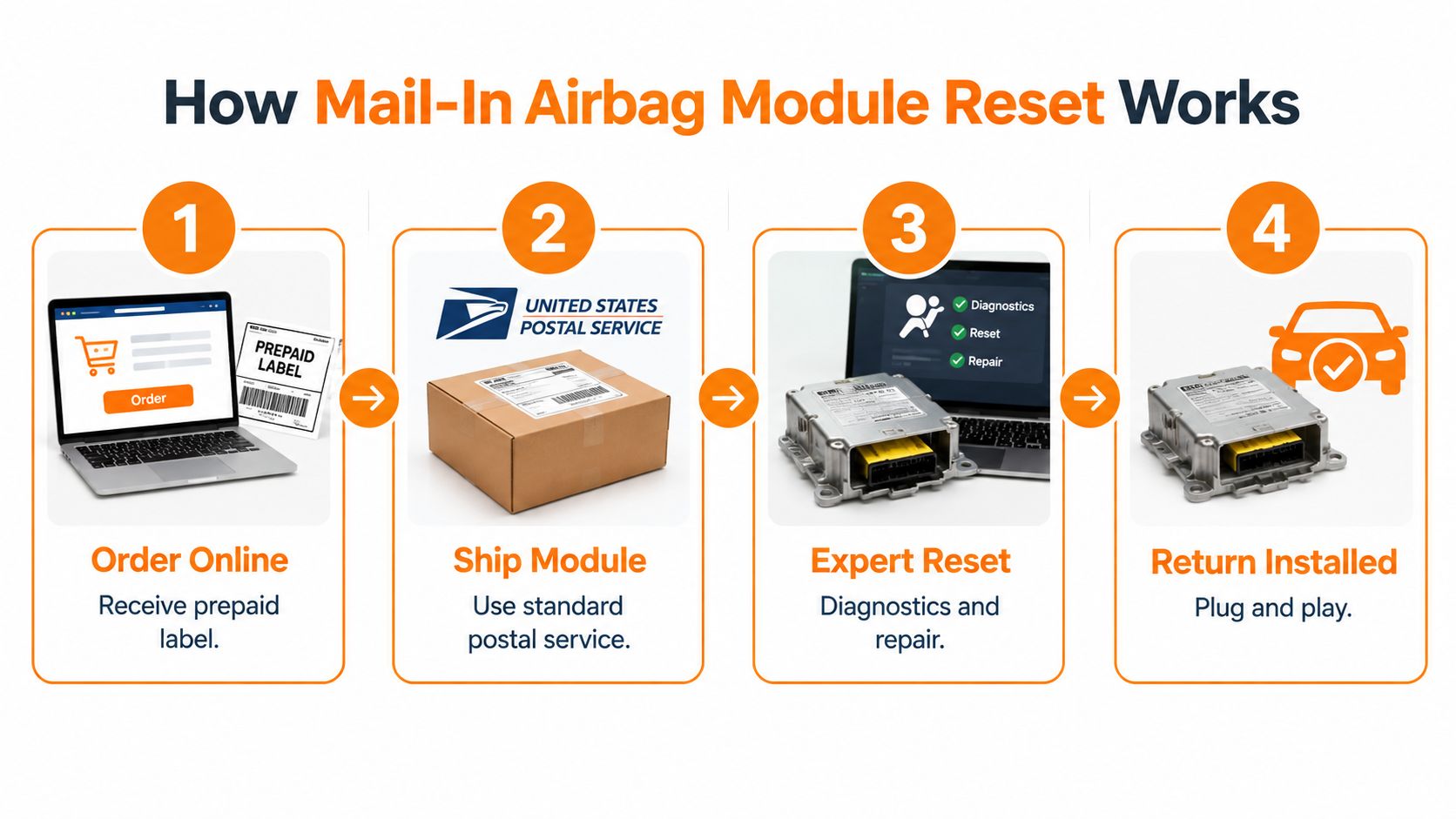
The process from order to reinstallation
Order the service. Give the provider the vehicle and module details requested. Confirm the flat fee, shipping instructions, warranty terms, testing requirements, and what happens if the unit fails inspection.
Remove the module. Depending on the vehicle, the controller may be under a center console, beneath a seat, or behind dashboard trim. Follow the manufacturer's SRS procedure when disconnecting components. Improper handling can create new faults or injury risk.
Ship the original unit. Use protective packaging that prevents connector damage and limits movement inside the box. Include the order information and vehicle details so the provider can identify the module correctly.
Bench testing and reset. The provider reads the module memory, checks the hardware, clears eligible crash data, and verifies operation. A reputable service explains its policy for modules with physical damage instead of claiming that every unit qualifies.
Return and reinstall. Reinstall the module only after deployed airbags, pretensioners, sensors, and damaged wiring have been addressed. Scan the complete SRS system again. The warning light should be considered resolved only when the underlying faults are gone.
What the customer should receive
The returned module should be clearly identified, protected for reinstallation, and accompanied by useful service records. A typical return packet includes a bench test report listing the codes found and cleared, the module part number, and the warranty terms. If the provider cannot describe these items before shipment, treat that as a warning sign.
As described earlier, reset work clears stored crash information while a replacement supplies a different controller. The practical value of the mail-in option is that it preserves the customer's original unit when that unit passes inspection, isolating the SRS module cost from the larger dealer replacement estimate.
Turnaround and shipping remain separate from the electronic service. Ask when processing begins, whether the clock starts at receipt, and how the provider handles physical damage or an ineligible module. Compare the complete job, including diagnosis, removal, shipping, reinstallation, and final scanning, rather than comparing one reset fee with a dealer's all-in estimate.
When to Reset the Module and When to Replace It
Reset the module when it is physically intact, communicates with the vehicle, and the diagnosis points to stored crash data. Replace it when testing finds damage or an internal fault that a reset cannot correct. That is the decision rule I use before approving an SRS quote.
A reset candidate should have an undamaged housing, usable connectors, no signs of water intrusion, and electronics that respond to bench testing. A crash can leave a permanent event record without destroying the controller. The stored record explains the warning light, but it does not automatically make the module unusable.
Replacement makes more sense when the housing is cracked, the circuit board is burned, the unit has been flooded, or damaged wiring has affected the controller. A technician may also recommend replacement when the module's history is unknown and testing cannot establish reliable operation. A difficult scan result alone is not proof that a new module is required.
Three common scenarios
A minor impact with a persistent SRS light deserves diagnosis before replacement. Undeployed airbags do not prove the module is healthy, but they make stored crash data or a related sensor fault worth checking before ordering a controller.
A collision with multiple deployments requires inspection of the complete restraint system. The module may be reusable, yet deployed airbags, belt pretensioners, impact sensors, and wiring can each keep the warning light on. Resetting the controller alone does not make the vehicle safe.
A vehicle with interior water damage calls for a replacement-first approach unless testing clearly proves the module is sound. Moisture can corrode connectors and damage electronics beneath a clean exterior. A housing that looks fine does not confirm a reliable circuit board.
The economics of the decision
As the earlier cost table showed, an SRS reset runs about $75 to $150, while full replacement lands between $600 and $1,500 after parts, diagnostic time, and programming. The Automotive Module Lab guide also explains why clearing eligible crash data differs from replacing the controller. That price gap makes a proper inspection the most important part of the decision.
A bench test showing that the module still communicates on the vehicle bus and reports no internal hardware faults is the strongest evidence that reset is the right call. A reset is a poor bargain for a water-damaged unit or a vehicle with another unresolved SRS fault. Replacement is equally poor advice when the original module passes testing and only contains eligible crash data.
The right question isn't “Can I avoid a new part?” It's “What evidence shows that the original part is unusable?”
Smart Ways to Lower Your Airbag Module Repair Bill
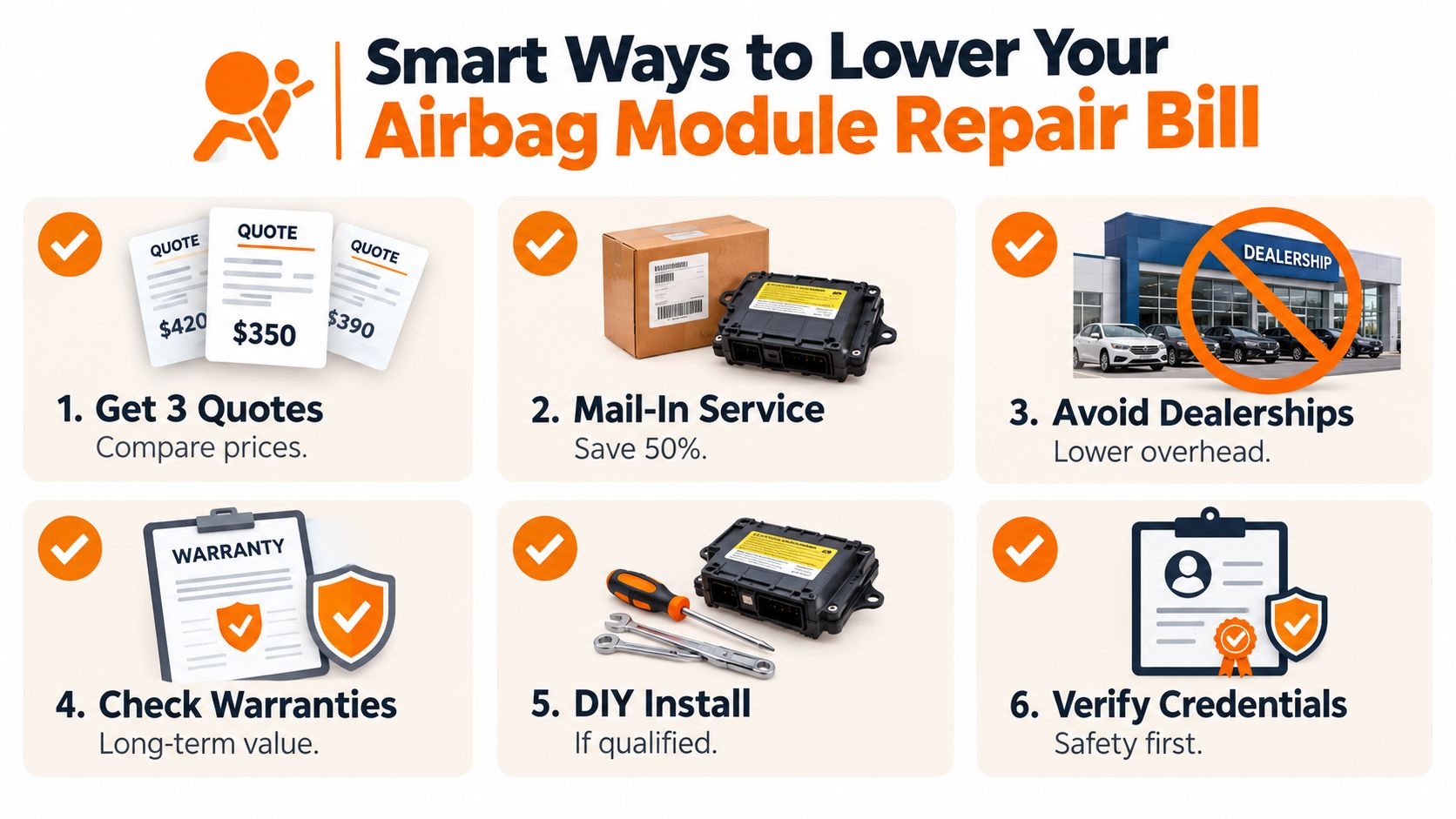
A dealer quote can make a complete SRS repair look like one unavoidable expense. Separate the airbag control module line item from airbags, belts, sensors, wiring, diagnostics, programming, taxes, and shipping. That breakdown shows whether the module itself requires service or whether another SRS fault is keeping the warning light on.
Request the exact diagnostic trouble codes and ask the shop to identify the component associated with each code. Have them state whether the controller has physical damage and whether it communicates with the vehicle. A stored crash event does not automatically mean the controller needs replacement.
Control the parts and service decisions
- Demand an itemized estimate: Get separate prices for diagnosis, module work, programming, belt repair, sensors, wiring, taxes, and shipping.
- Compare reset with replacement: If the controller passes inspection, compare a flat-fee mail-in reset with the complete replacement quote, including programming.
- Ask about combined shipping: If a pretensioner and module need outside service, confirm whether both can travel in one shipment.
- Verify the actual fault: Wiring, impact sensors, occupant detection equipment, and pretensioners can all trigger an SRS warning.
- Reject automatic OEM replacement: A new controller makes financial sense when the original is physically damaged or fails testing. Stored crash data alone does not justify the higher parts and programming bill.
- Use trained help: SRS circuits can deploy airbags and contain safety-critical components. Pay a qualified technician to remove and reinstall the unit if you lack the proper training.
As noted earlier, clearing eligible crash data is functionally different from installing a new virgin controller. Make sure the estimate identifies which service the shop is proposing. That distinction often determines whether you are paying for a reset or an entirely new module.
Pull the codes, confirm the module's condition, and require a written reset-versus-replacement recommendation. Safety Restore offers a mail-in SRS module reset at a flat $99 per module, returning the original unit for reinstallation when it qualifies for service. Review the airbag module service page alongside the shop's quote before approving a replacement.