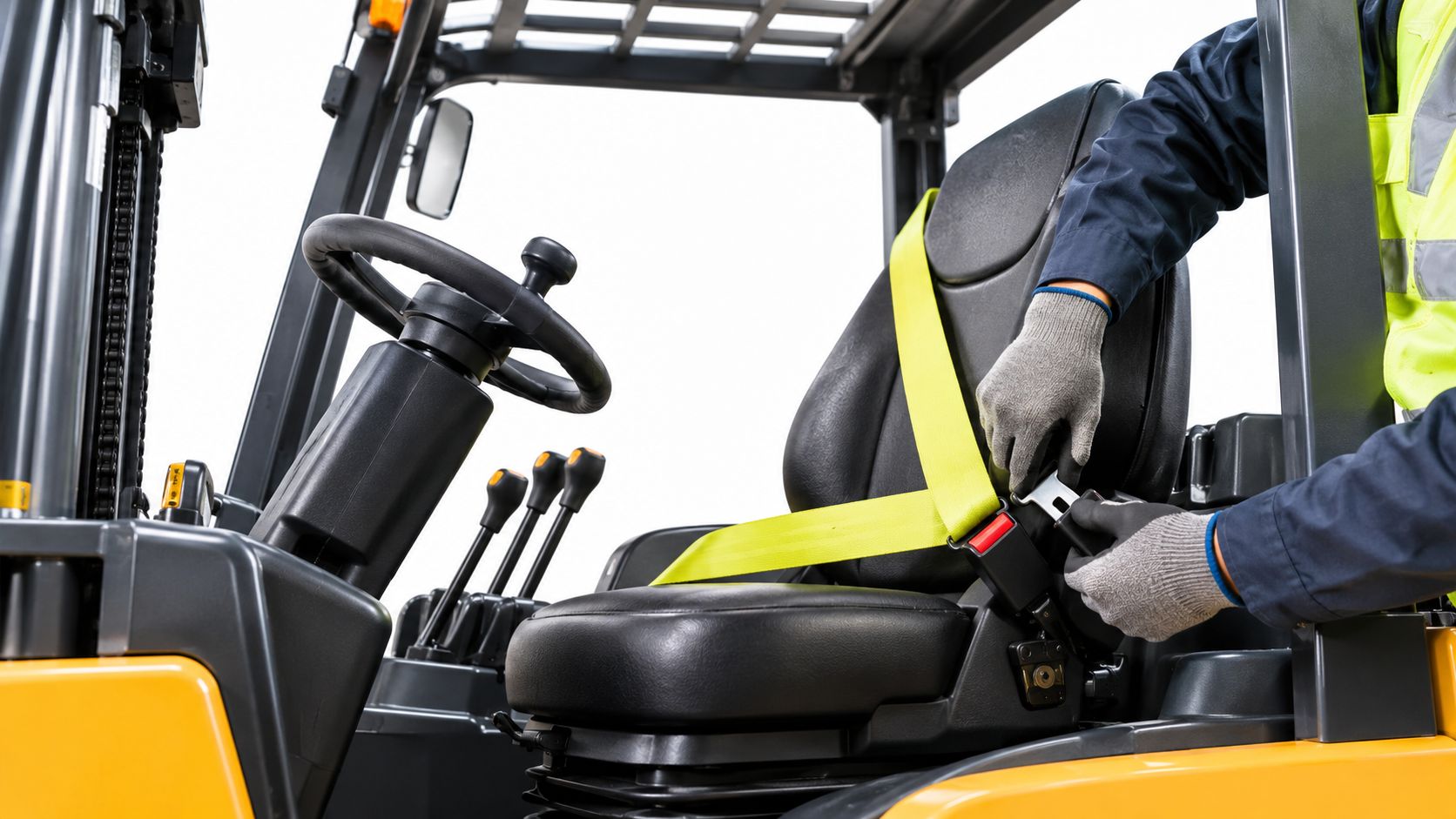
A forklift can tip laterally in seconds, and the operator’s safest action is usually the opposite of the instinct to jump. OSHA-backed materials estimate 35,000 serious forklift injuries and 62,000 non-serious injuries each year in the United States, while the Bureau of Labor Statistics recorded 96 worker deaths in forklift incidents in 2015. Research cited in an occupational safety case record found that approximately 25% of forklift-related fatalities and serious injuries resulted from lateral tip-overs. (Oregon OSHA safety resource)
A seat belt for forklift operation isn’t a comfort accessory or a box to tick on a checklist. It’s part of the restraint system that helps keep the operator inside the truck’s protective zone when the machine overturns. This guide explains what the belt does, how OSHA’s requirements work in practice, how to inspect it, and how to choose between repair, retrofit, replacement, and lockout.
Table of Contents
- Why Forklift Seat Belts Matter More Than You Think
- What a Forklift Seat Belt Actually Does
- OSHA Requirements for Forklift Seat Belts
- Seat Belt Types and Mounting Considerations
- Inspecting, Maintaining, and Replacing Forklift Seat Belts
- Choosing a Compliant Seat Belt Solution for Your Fleet
- Key Takeaways for Forklift Operators and Fleet Managers
Why Forklift Seat Belts Matter More Than You Think
A loaded forklift can tip laterally in seconds. One wheel lifts, the mast shifts sideways, and the operator may instinctively try to jump. During that movement, the truck can rotate into the operator’s path, creating a crush zone between the machine and the floor.
The scale of forklift risk explains why a seat belt deserves more than a checklist tick. OSHA-backed materials report 35,000 serious injuries and 62,000 non-serious injuries involving forklifts each year in the United States. The Bureau of Labor Statistics reported 96 worker deaths in forklift incidents in 2015. These figures cover forklift incidents broadly, yet they show why the restraint inside the operator compartment needs active fleet management.
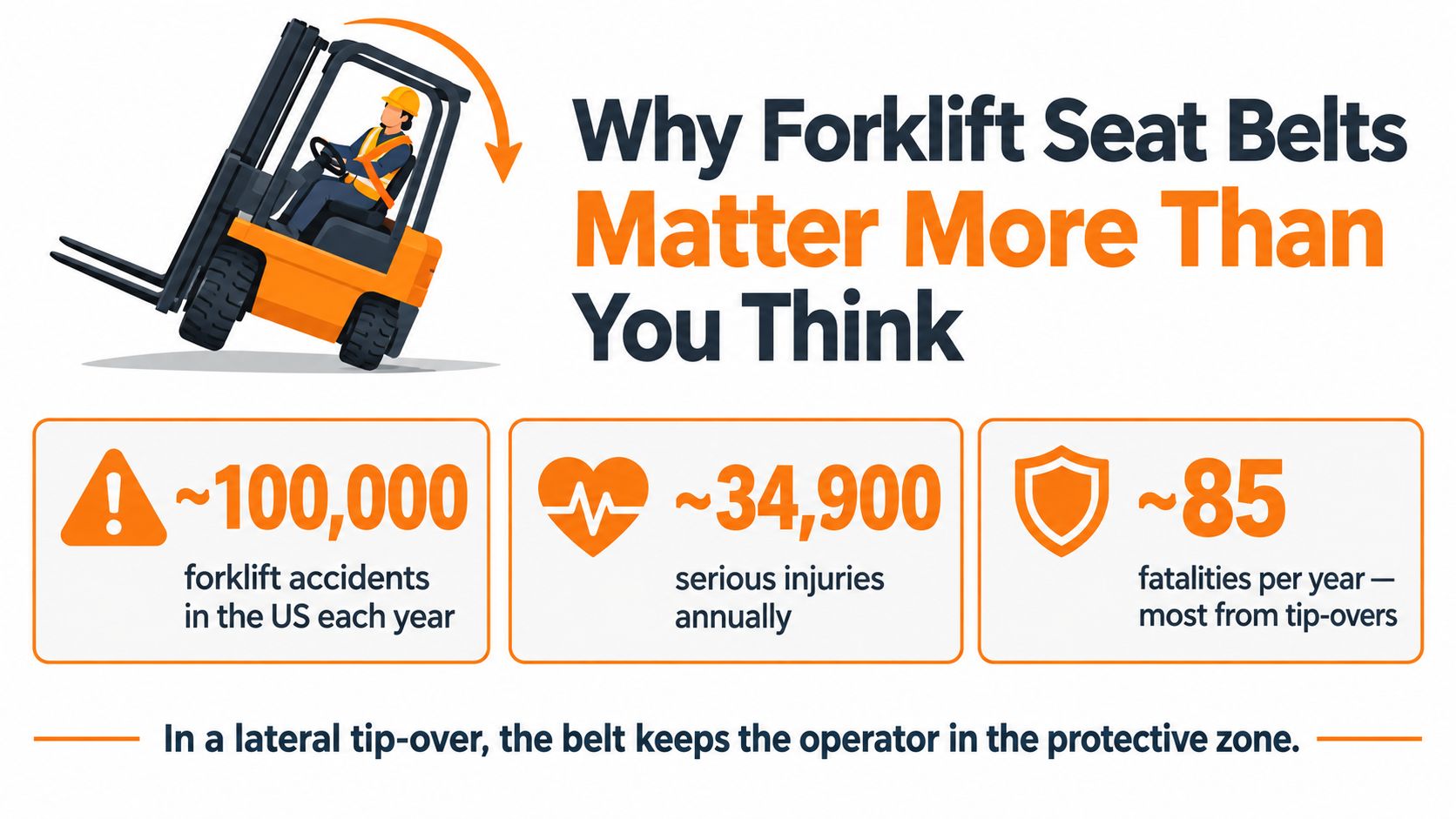
The danger is ejection
An occupational safety record cited by Oregon OSHA found that approximately 25% of forklift-related fatalities and serious injuries resulted from lateral tip-overs. Among 77 incidents involving forklifts equipped with operator restraint devices, 50 were lateral tip-overs and 27 were off-dock incidents. The same record noted that about 53% of operators in trucks without protective devices were killed or seriously injured when they jumped or were thrown from the truck. (Oregon OSHA safety resource)
A belt does not prevent every injury. It addresses a specific failure point: the operator leaving the protective compartment during an overturn. Outside that zone, the operator may be struck, crushed, or trapped by the truck.
Personal rule: Buckle the belt before the forks move, even for a short trip across the warehouse.
For supervisors, a worn belt can become a compliance event, not merely a maintenance note. A restraint that will not latch, retract, or hold the operator requires the truck to be removed from service until the fleet decides whether repair, retrofit, or replacement fits the truck’s configuration and incident history. A compliant program therefore connects four actions: correct fitment, operator use, supervisor enforcement, and immediate lockout of defective equipment.
What a Forklift Seat Belt Actually Does
A forklift seat belt has a different job from a passenger-car belt. A car’s restraint works with the vehicle body and crash structure to manage movement during a collision. A forklift belt is designed mainly to keep the operator inside the protective zone during a tip-over.
The overhead guard, operator compartment, and truck frame form that zone. During an overturn, the restraint helps the operator stay within it instead of being thrown clear. OSHA describes powered industrial truck seat belts as part of an operator restraint system intended to reduce injury severity in tip-over accidents. (OSHA enforcement guidance)
Why staying inside matters
During a lateral tip-over, the truck can seem to move away from the operator. Jumping may feel like the fastest escape, but the machine can rotate before the operator clears it. A person who leaves the compartment may fall beneath the overhead guard, frame, or counterweight.
The belt helps limit that ejection path. It also reduces the chance that the operator’s head or torso will be caught between the truck and the ground. The protective-zone principle is why the restraint must match the truck and keep the operator positioned correctly. (Oregon OSHA workshop materials)
Fit determines whether the belt can work
A buckle that clicks is not enough. The webbing should lie across the operator’s lap as designed, the latch should close completely, and the anchors should remain firmly attached to the manufacturer-approved mounting points. The belt must also allow normal entry and exit without being routed around a seat component or other obstruction.
Use a short operating check before the truck moves. Pull the belt across the lap, confirm that it latches, inspect the webbing and buckle, and verify that the belt retracts or stays secured as designed. A worn belt that will not latch, hold, or retract is no longer an ordinary housekeeping issue. Tag the truck out of service and choose repair, an approved retrofit, or replacement based on the truck’s configuration and any relevant incident history.
A replacement that merely fits the bolt holes may alter the operator’s position or fail during an overturn. Comfort supports consistent use, but restraint performance is the standard. Evaluate the belt as part of the forklift’s protective system, not as a generic strap or a car-style collision device.
OSHA Requirements for Forklift Seat Belts
OSHA’s position is not a simple rule requiring a seat belt on every forklift. Compliance depends on the truck’s configuration, its operator restraint system, the hazards of the work, and the employer’s duty to protect workers from recognized hazards.
In its December 1996 powered industrial truck policy clarification, OSHA stated that no specific standard explicitly required seat belts on every powered industrial truck. The agency also relied on Section 5(a)(1) of the OSH Act, the general duty clause, which requires employers to protect workers from recognized hazards. OSHA later clarified that operators must use an operator restraint system when the truck is equipped with one. (OSHA’s 1996 policy clarification)
What supervisors must enforce
The working rule is easier to apply than the legal wording:
- If installed, require its use. Operators exposed to overturn or ejection hazards must use an installed restraint.
- Do not remove it. OSHA enforcement guidance treats removing a seat belt as prohibited under 29 CFR 1910.178(q)(6). (OSHA powered industrial truck enforcement directive)
- Act on defects. A missing, cut, unusable, or incorrectly mounted belt becomes a safety and compliance issue when the truck’s restraint system is needed for the job.
- Keep the solution matched to the truck. The approved belt arrangement and truck design matter, particularly when an older unit needs a retrofit.
A supervisor should treat a defective restraint like a failed brake light before a road vehicle leaves the yard. Tag the forklift out of service when the belt cannot latch, hold, retract, or remain securely mounted. Then decide whether the correct response is an approved repair, a manufacturer-compatible retrofit, or complete replacement. Incident history matters too. A truck involved in an overturn or ejection event deserves a closer review of the seat, anchors, and surrounding mounting structure rather than a belt-only swap.
Inspectors may examine more than the written policy. They can assess whether the restraint is installed, whether operators use it, whether supervisors enforce that use, and whether the employer responds to inspection findings. A rule that says “wear your belt” has little value if damaged or removed restraints remain in service.
For facility planning, OSHA guidelines from Material Handling USA can help connect forklift controls with warehouse layout and traffic hazards.
The practical test is straightforward: confirm that the truck has the required restraint, the work presents relevant overturn or ejection hazards, and the complete system functions and is enforced.
Seat Belt Types and Mounting Considerations
A forklift restraint works as a system. The belt, buckle, retractor, anchors, brackets, and seat structure must match the truck’s design. Mounting geometry is the practical detail behind that rule. A belt attached to the wrong location may look secure while failing to hold the operator in the intended protective zone during a tip or sudden shift.
Common restraint configurations
A fixed lap belt uses webbing connected to fixed anchor points across the operator’s lap. It is a straightforward arrangement for trucks built around established anchor locations. A retractable belt stores extra webbing and can make entry and exit easier. Its retractor still needs the correct orientation, pull path, and approved mounting position.
Some forklifts use an integrated restraint system. The seat, belt, buckle, switches, and related components are designed to function together. Replacing one part without checking the others can change belt fit, seat movement, or operator-presence functions. Before ordering parts, record the truck make, model, serial information, seat configuration, and existing mounting points.
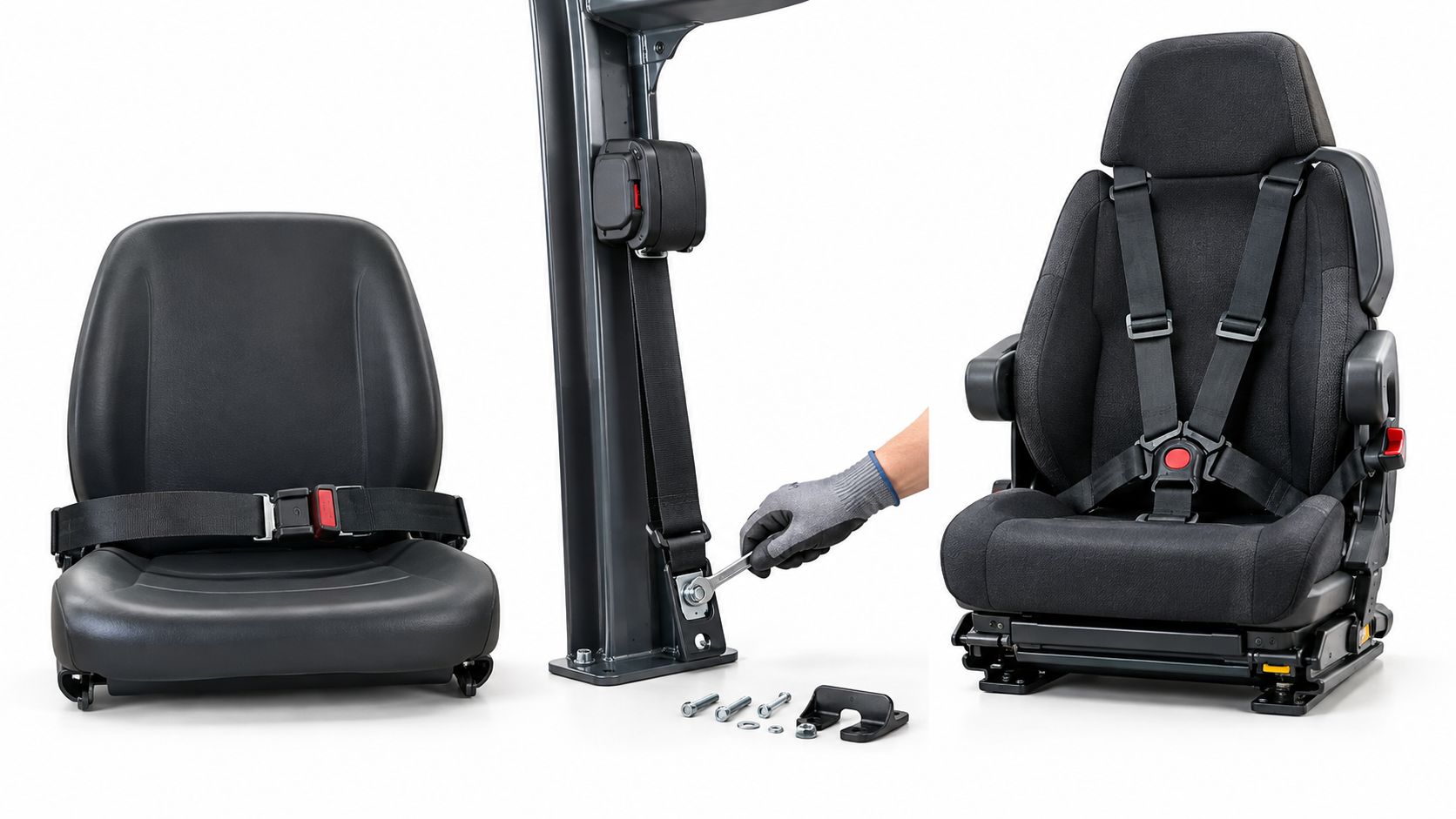
Compare the options
| Belt Type | How It Works | Best Suited For | Retrofit Notes |
|---|---|---|---|
| Fixed lap belt | Webbing connects fixed anchors across the operator’s lap | Trucks with established fixed-anchor layouts | Confirm anchor spacing, bracket design, and buckle compatibility |
| Retractable belt | A retractor manages excess webbing during entry and operation | Applications where controlled webbing movement supports regular use | Check retractor orientation, pull path, and approved mounting points |
| Integrated restraint system | Belt works with the seat and related operator components | Trucks designed around a complete restraint arrangement | Replace or retrofit according to the manufacturer’s approved configuration |
For older units, the manufacturer should identify an approved conversion kit. A suitable kit addresses mounting hardware and geometry, rather than supplying webbing alone. Oregon OSHA workshop materials discuss this type of approved retrofit consideration.
A universal belt can appear convenient in a parts catalogue, but bolt-on fit does not establish a safe installation. Confirm anchor strength, bracket compatibility, buckle placement, retractor direction, seat travel, and clearance from controls. A supplier that cannot identify the truck application or provide fitment documentation should not be treated as having established compatibility. Pause the installation and involve the manufacturer or a qualified service provider.
Inspecting, Maintaining, and Replacing Forklift Seat Belts
A pre-shift belt check should take more than a glance. The operator needs to test the parts that hold, release, retract, and connect the restraint to the truck. A belt can look clean while a buckle, anchor, or retractor has already become unreliable.
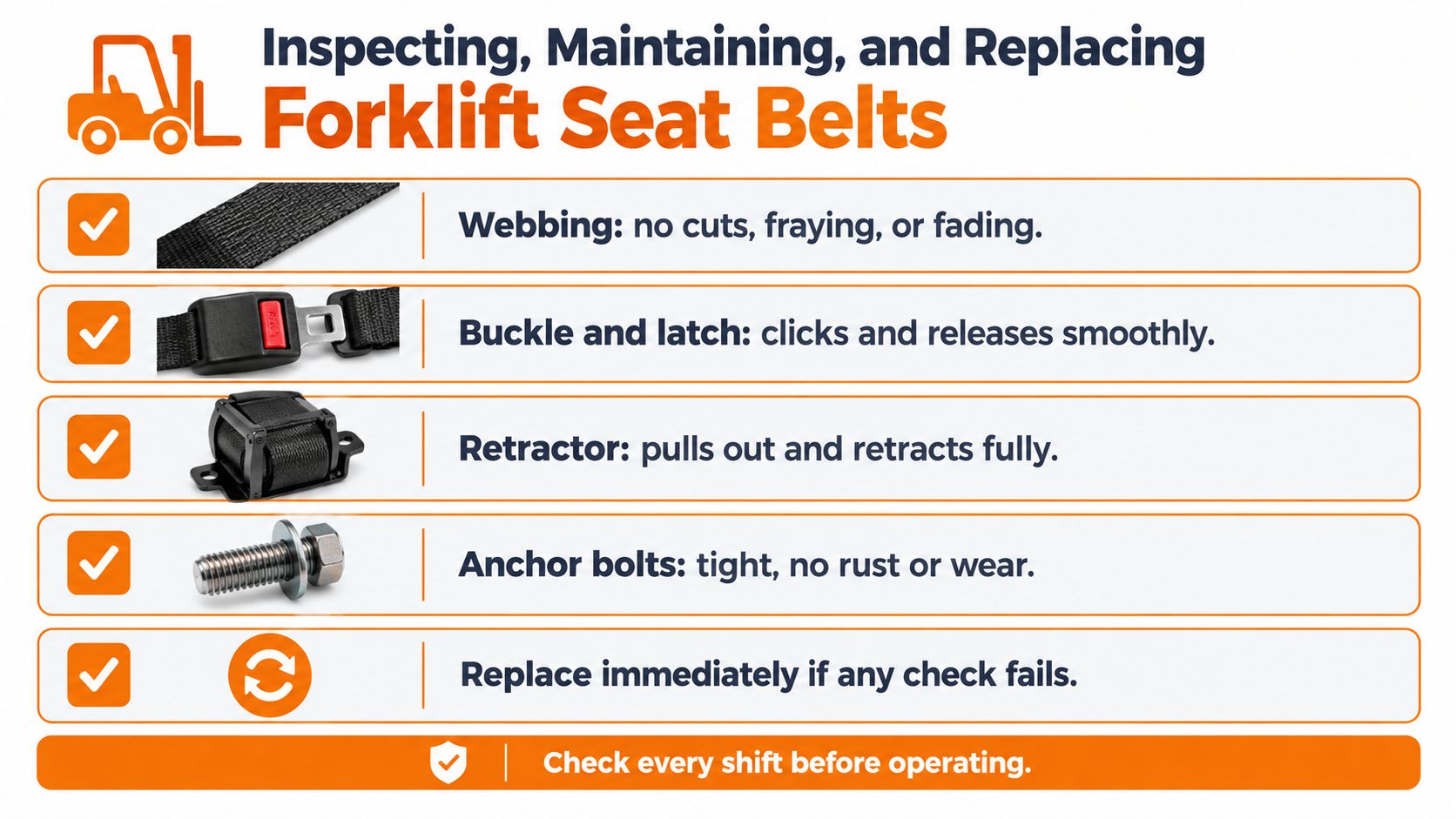
Use a functional pre-shift check
Run the inspection before operating, not after the truck is already in a busy aisle:
- Inspect the webbing. Look for cuts, fraying, melted areas, pulled stitching, severe fading, or contamination that could affect the material.
- Test the buckle. Insert the latch until it clicks, then confirm it releases smoothly without sticking or remaining partially engaged.
- Check the retractor. Pull the belt out steadily and allow it to retract. It shouldn’t remain loose, jam, or retract only intermittently.
- Examine the anchors. Look for loose fasteners, bent brackets, damaged mounting points, corrosion, or movement where the belt connects to the truck or seat.
- Confirm the belt’s path. Make sure it isn’t trapped under the seat, twisted around a control, or routed in a way that prevents proper use.
Surface dirt or minor cosmetic wear doesn’t automatically mean the truck must be locked out. The decision changes when the webbing is cut or frayed, the buckle won’t latch, the retractor is slow or frozen, or an anchor is deformed or loose.
Lockout trigger: If the restraint can’t reliably hold, latch, retract, or remain attached, stop using the truck until the defect is evaluated and corrected.
Inspect after incidents
Replacement decisions shouldn’t rely only on visible webbing damage. Practical maintenance guidance recommends replacing the belt after a tip-over or significant impact and checking the anchors, retractors, and latch hardware for deformation or corrosion. Chemical exposure, intense heat, an overload event, or other severe operating conditions can also compromise residual strength even when the belt looks intact. (Forklift seat belt inspection guide)
Document the event, identify the truck and restraint components, and keep the unit out of service until a qualified person determines whether repair or replacement is appropriate. Digital pre-shift logs can record the defect, operator, truck, corrective action, and return-to-service decision. A functional check, rather than a visual tick box alone, gives the supervisor stronger evidence that the restraint works as intended.
Choosing a Compliant Seat Belt Solution for Your Fleet
The right purchase starts with the truck, not the online product listing. Before ordering a seat belt for forklift use, identify whether the unit already has an installed restraint, where the anchors are located, and whether the manufacturer offers an approved replacement or conversion kit.
The operating environment matters too. A truck used around dock edges, ramps, uneven surfaces, or loads that affect stability may expose the operator to overturn or ejection hazards that make restraint use especially important. OSHA’s policy framework connects the employer’s responsibility to recognized hazards and the truck’s installed restraint system, so the purchasing decision should be reviewed by maintenance and safety staff together.
A practical buying checklist
- Record the truck identity. Capture the make, model, serial information, seat type, and existing belt arrangement.
- Describe the defect. Separate dirty or worn webbing from a failed buckle, damaged retractor, loose anchor, bent bracket, or post-incident concern.
- Confirm the solution. Ask whether the part is an approved replacement, an approved conversion kit, a repairable original assembly, or a generic component requiring additional engineering review.
- Verify mounting. Confirm anchor locations, bracket geometry, buckle position, seat travel, retractor orientation, and clearance from controls.
- Request documentation. Keep the purchase record, fitment information, inspection result, repair notes, and return-to-service approval with the truck’s maintenance file.
- Set the service decision. If the restraint is missing or defective and the truck is exposed to the relevant hazard, lock out the unit while the team arranges correction.
Used equipment deserves the same scrutiny as a new acquisition. A truck that arrives without its original belt, with a belt tucked behind the seat, or with an assembly that doesn’t match the seat and anchor points shouldn’t enter production until the restraint configuration has been verified.
Repair may be appropriate when the original assembly is serviceable and the repair provider can restore the required function. Replacement is more suitable when hardware is deformed, corrosion is significant, fitment can’t be verified, or the belt has been involved in a serious event. Retrofit is the route for older trucks when the manufacturer provides an approved kit and the installation can be documented.
A worn belt becomes a compliance event when operators remain exposed while the installed restraint is unavailable or defective. At that point, don’t leave the decision to the next shift. Lock out the truck, record the condition, order the approved solution, and document the inspection that authorizes its return.
Key Takeaways for Forklift Operators and Fleet Managers
A forklift seat belt is a hazard-control device. It helps keep the operator inside the protective zone during a tip-over, where remaining in the compartment can reduce the risk of ejection, entrapment, and crushing.
Operators and supervisors can apply the essential rules immediately:
- Verify the truck’s restraint status. Know whether the forklift has a belt or integrated restraint system, and don’t treat a missing belt as an optional equipment choice.
- Enforce use whenever it is installed. OSHA’s practical enforcement position requires employers to require use of an installed operator restraint when workers face overturn or ejection hazards.
- Inspect function, not appearance alone. Test the buckle, retractor, webbing, anchors, and mounting points before operation.
- Replace after serious events. A belt may require replacement after a tip-over, impact, overload, chemical exposure, or heat exposure even if the webbing still looks usable.
- Use the approved fitment. Match the belt and mounting hardware to the truck’s design, especially during a retrofit or used-equipment inspection.
- Document the decision. Record defects, lockouts, repairs, replacements, and return-to-service checks in the fleet maintenance system.
Operator rule: Belt on before the forks move.
Manager rule: No functional belt, no truck in service.
A strong program doesn’t depend on an operator remembering a visual checklist or a supervisor noticing a missing buckle from across the floor. It combines correct equipment, clear enforcement, functional inspections, incident-based replacement, and records that show what happened after a defect was found. That approach turns the restraint from a neglected consumable into a managed part of the truck’s safety system.
For damaged or locked seat belt mechanisms, Safety Restore offers mail-in repair for customer-supplied seat belt retractors, pretensioners, and webbing, subject to evaluation of the specific assembly. Visit the service site to review the repair process and decide whether restoring an original component fits your fleet’s documented replacement and compliance plan.