
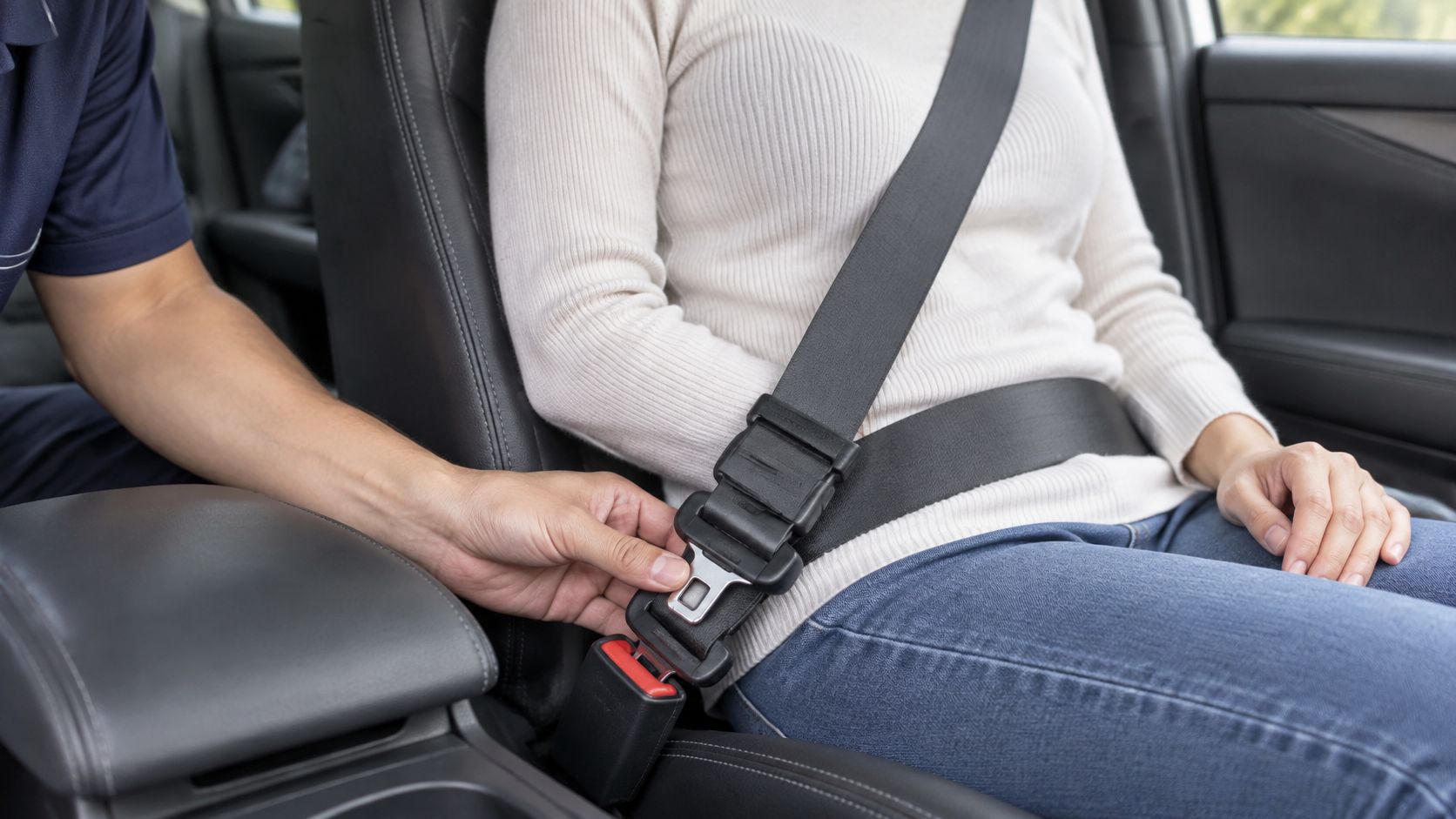
An extender is acceptable only for an adult who can't fasten an otherwise working belt, and only with the manufacturer-approved part for that vehicle and seat. Never use one with a child restraint or as a repair for a locked or damaged belt.
You're seated, pulling the belt across your body, and the tongue stops short of the buckle. A small extension looks like an easy fix, but the right decision starts with finding out whether you're dealing with insufficient length, poor positioning, or a restraint-system fault.
Table of Contents
- What an Extended Seat Belt Is and Why It Matters
- When an Extender Is Allowed and When to Avoid It
- How Extenders Affect Airbags and Occupant Sensing
- Crash Protection Data and Regulatory Standards
- Fitment Checks Before You Fit an Extender
- How Shops Choose Between Repair and Extension
- Confirm the Right Fix Before Driving Again
What an Extended Seat Belt Is and Why It Matters
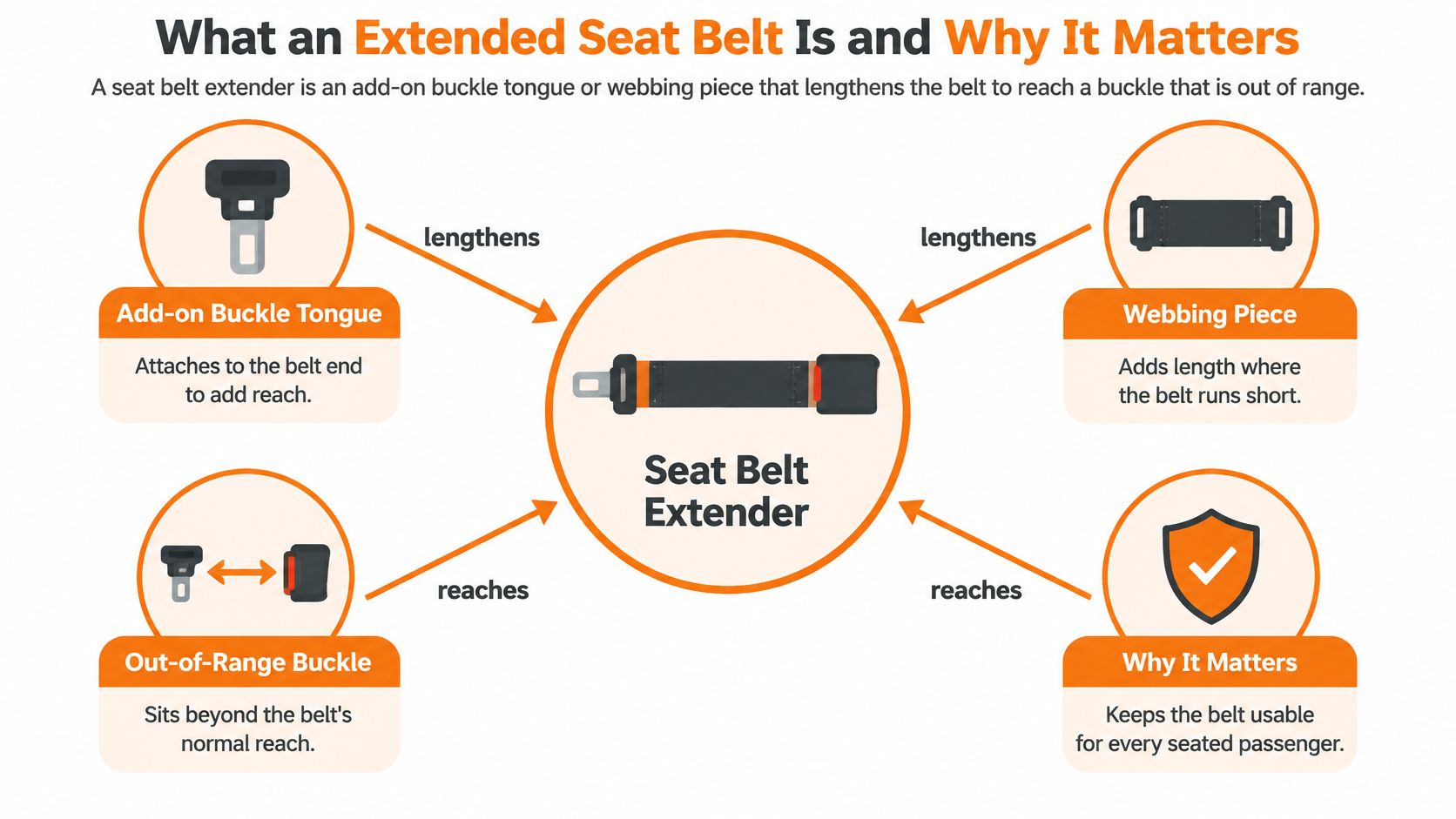
Say the driver's belt pulls out smoothly but won't reach the buckle when the driver sits fully back. An extended seat belt, usually called a seat belt extender, is an add-on buckle tongue or webbing piece that adds usable reach. It isn't a replacement retractor, a buckle repair, or permission to change the belt's routing.
Think of the factory belt as a custom-fitted garment. An extender is a hem alteration that changes how the whole garment sits, not a generic strip of fabric added to the end. The anchor points, retractor, buckle position, and belt path work together, so added length can change where the lap and shoulder portions contact the body.
The distinction between added reach and correct fit matters when reviewing an extender's basic layout.
Start with the reason the belt feels short
Owners search for an extended seat belt for cars for several different reasons:
- Body size: The available belt length may be insufficient for the seated adult.
- Bulky clothing: A heavy coat can make fastening awkward and obscure the belt's actual fit.
- Seat adjustment: A changed driving position can affect reach and access to the buckle.
- Buckle position: A buckle pushed into the cushion can look like a length problem when access is the underlying issue.
Don't treat those situations as interchangeable. First remove unnecessary bulk, sit normally, and check whether the buckle is accessible without pulling on its wiring or mounting stalk.
The stakes aren't cosmetic: in 2024, 9,758 passenger-vehicle occupants killed in U.S. traffic crashes were not wearing seat belts, according to NHTSA's Traffic Safety Marketing office. That figure supports making the restraint usable, not improvising a connection.
If a collision prompted the inspection, address the person as well as the hardware. MedAmerica Rehab Center's hidden injury guide offers a separate resource for recognizing symptoms after an accident; it doesn't replace medical assessment or restraint-system diagnosis.
When an Extender Is Allowed and When to Avoid It
An approved extender answers a narrow problem: an adult cannot fasten a functioning belt because it lacks sufficient reach. It doesn't answer every complaint about comfort, accessibility, or a warning light.
General Motors' technical guidance describes an extender as a “custom fit” and warns that using it in another vehicle or for another person can lessen or nullify restraint protection. That's why a part that clicks into a buckle isn't automatically suitable for the occupant sitting above it.
When an extender is allowed
| Situation | Extender Allowed? | Why | Correct Action |
|---|---|---|---|
| Adult, belt cannot reach buckle, manufacturer-approved extender for this seat | Yes, with conditions | Approved for the specified application and fit | Sit fully, latch, confirm click and retraction |
| Child in a car seat or booster | No | Extender can compromise restraint protection | Route the belt as the child seat instructs, with no extender |
| Extender latched before the occupant sits down | No | Occupant sensing can read the seat as empty | Sit first, then latch; unlatch before exiting |
| Extender moved between passengers or vehicles | No | Custom fit for a specified vehicle and occupant | Obtain the approved part and fit assessment for each application |
| Universal clip-on or generic extension | Avoid | Compatibility with buckle and restraint geometry isn't established | Use only manufacturer or authorized channels |
| Belt locked, frayed, cut or dog-chewed | No, not a fix | Fault is in the mechanism or webbing, not length | Inspect, then repair or replace the assembly |
| Belt only hard to buckle, no reach problem | No | Extenders are for belts that cannot fasten | Adjust seat position or get a fitment assessment |
| Airbag or SRS warning after a collision | No, not a fix | Restraint-system fault needs diagnosis | Read fault codes and repair before use |
Convenience isn't a fitment requirement
A buried buckle can be frustrating, especially when the seat cushion closes around it. The correct response is to inspect its position and mounting, not automatically add another latch above the cushion. Don't stretch a buckle stalk, reroute it around trim, or use an extender to hold it upright.
Likewise, easier buckling doesn't establish a need for added length. An extension can move the buckle toward the abdomen or alter the lap-belt path even though the original belt already fastens.
Child restraints need a different response altogether. If the belt won't route or fasten as the child-seat instructions require, check the installation method and vehicle compatibility rather than inserting an extender.
Practical rule: If the proposed extender solves anything other than a verified reach problem, stop and reassess the complaint.
The trade-off is straightforward. An approved part may make a correctly fitted adult restraint usable, but an unnecessary extension adds another connection and changes fit without a valid reason. If any applicable row returns a no, have the belt inspected before driving with that arrangement.
How Extenders Affect Airbags and Occupant Sensing
The buckle isn't just a mechanical latch. Its switch reports to the restraint control module whether the belt is in use, and an occupant-classification system supplies information about the passenger seat. Those inputs shape how the supplemental restraints respond in a collision.
That makes an extender an electrical component as much as a length of webbing. A latched extender can generate a buckle signal while changing nothing about whether a person is held correctly. The module reads the switch state, not the occupant.
A click can send the wrong message
Volvo service guidance warns that inserting either the extender tab or the belt into the buckle may make the SRS interpret the belt as being used; if the occupant isn't restrained, the related frontal airbag may not deploy or may not deploy with appropriate force. A mechanically secure connection therefore doesn't establish correct electronic operation.
Toyota's technical bulletin identifies another failure path: on vehicles with occupant classification, leaving the extender latched before the occupant sits can make the system interpret the seat as unoccupied and place the airbag in an airbag-off or disarmed state. Manufacturer instructions also prohibit extender use with child restraints.
These warnings are application-specific, and vehicle responses differ. The correct procedure is to follow the exact vehicle instructions rather than treating the buckle sequence as optional.
Verify the sequence and the warning indicators
For an approved installation, the owner and the technician carry different checks:
- Owner: Sit fully in position, latch in the specified sequence, and pull firmly to confirm engagement.
- Indicator check: Compare the passenger-airbag indicator with the owner's manual. An airbag-off indication isn't automatically a fault in every seating condition.
- Technician: Scan SRS and occupant-classification systems after installation and investigate unexpected status changes or codes.
- Crash inspection: Examine buckle and pretensioner connectors and harnesses using the manufacturer's electrical safety procedure.
Recall status is a separate check. Owners can check the 2026 airbag recalls list for orientation, then verify applicability through the vehicle manufacturer using the VIN.
Damaged buckle hardware is a different job entirely. Seatbelt Buckle Pretensioner Repair After Accident addresses the buckle pretensioner itself, not added belt length. An extender cannot repair a damaged retractor or a deployed pretensioner, whatever the dashboard indicator shows.
Crash Protection Data and Regulatory Standards
The strongest published numbers describe belts that fit and function as the vehicle maker intended. They say nothing about an assembly lengthened with an aftermarket part, because an extender changes both the belt geometry and, on many vehicles, the buckle-side wiring the restraint system monitors. Keep that gap in mind when reading the figures.
Seat-belt effectiveness and regulatory figures
| Measure | Estimate | Source |
|---|---|---|
| Three-point belt, driver seat, passenger car, fatal injury | 48% effective | NHTSA analysis |
| Three-point belt, front-right occupant aged 5 and older, fatal injury | 37% effective | NHTSA analysis |
| Front-seat occupant, fatal injury risk | About 45% to 50% lower | UN/WHO account of seat-belt standards |
| Rear-seat occupant, death and serious injury risk | About 25% lower | UN/WHO account of seat-belt standards |
| Front-seat occupant, serious injury | About 20% to 45% lower | UN/WHO account of seat-belt standards |
| UN Regulation No. 16 | In force since December 1, 1970, with 52 contracting parties applying it as national legislation by 2023 | UN/WHO account of seat-belt standards |
What these estimates mean for an extender
The measures aren't interchangeable. They describe different seating positions, populations, and injury outcomes, so don't add them together or treat them as a prediction for an individual collision. None establishes a crash-protection percentage for a generic extender, and none covers a belt whose latch point, retractor angle, or buckle wiring has been altered.
Regulation addresses belt design, installation, and certification as a complete assembly. A seller's mention of a seat-belt standard does not make an accessory interchangeable with the certified part, and it says nothing about how an added buckle stalk interacts with the pretensioner connector or occupant-classification wiring in that specific seat.
The published protection estimates support preserving the intended restraint system. They don't validate an unapproved alteration.
Local wearing requirements are another separate issue. Drivers reviewing state obligations can consult Georgia seat belt requirements for 2026, while using vehicle-specific guidance for hardware selection.
The practical conclusion is to preserve the approved configuration. You can't assume the published benefits remain unchanged when an unapproved extension alters the assembly's geometry or its sensing circuits.
Fitment Checks Before You Fit an Extender
Confirm the part through the vehicle manufacturer or an authorized parts channel, using the vehicle identity, seating position, and buckle application. A seller's photograph or a matching-looking tongue isn't enough.
Have the intended occupant present for the assessment. An empty-seat trial can establish that a latch engages, but it can't establish where the lap belt sits on that person or whether the shoulder belt remains correctly positioned.
Use this checklist before ordering or fitting a part.
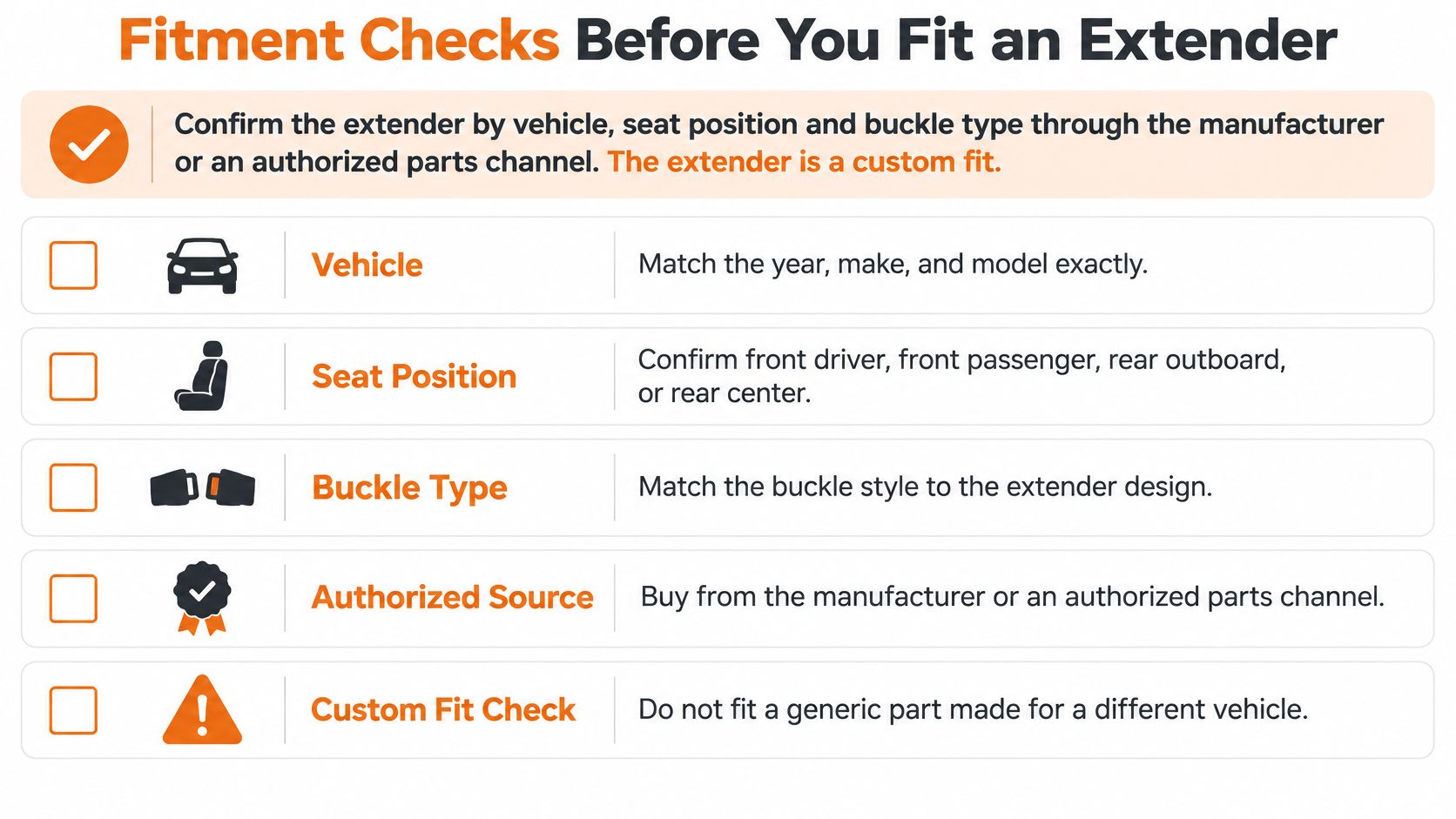
Fitment checks before installing an extender
| Check | What to Verify | Red Flag |
|---|---|---|
| Part source | Manufacturer or authorized parts channel | Universal or unlabeled clip-on |
| Vehicle match | Year, make, model and seat position match the listing | Part sold for a different model or seat |
| Buckle and latch | Latch engages with a firm click and holds under pull | Loose, sliding or sticking latch |
| Length need | Assessed with the occupant seated in position | Length chosen by estimate |
| Occupant | Adult only, used by the person it was fitted to | Child use, or part moved between people |
| Crash history | Belt and buckle checked for deployment or damage | Any deployed or locked pretensioner |
| SRS and occupancy codes | Scanned before and after fitting | New code appears after installation |
| Pretensioner wiring | Connectors and harness free of crash damage | Chafed, pinched or unplugged wiring |
Check the belt path, not just the part number
With the occupant seated upright, inspect the lap portion across the pelvis and upper thighs. It shouldn't ride across the soft abdomen, twist around the extender, or hang loose because extra length has been added unnecessarily. The shoulder portion should cross the chest and shoulder without being routed behind the back or under the arm.
Test access to the release button as well. The occupant must be able to release the belt without the buckle being trapped against trim or buried beneath another component.
A firm pull is a useful engagement check, not a substitute for approval or a crash-strength test. Don't file the tongue, lubricate the latch to make an incompatible part fit, or stack extenders.
For shops, use a scan tool that can access the vehicle's restraint and occupant-classification modules. A basic engine-code reader may not provide those functions. Don't probe pyrotechnic pretensioner circuits with general-purpose test equipment; follow the manufacturer's depowering and diagnostic procedures.
A single failed check means no installation. Resolve the mismatch or fault rather than accepting it because the other checks passed.
How Shops Choose Between Repair and Extension
Classify the complaint before choosing a part: is it about length or function? Only a pure length complaint can lead to an approved extender, and normal retraction alone doesn't establish that the entire assembly is serviceable.
Record the symptom precisely. “Belt too short” might mean the webbing reaches its normal limit, stops partway out, catches behind trim, or reaches the buckle but won't latch. Those descriptions lead to different inspections.
The decision starts with that distinction.
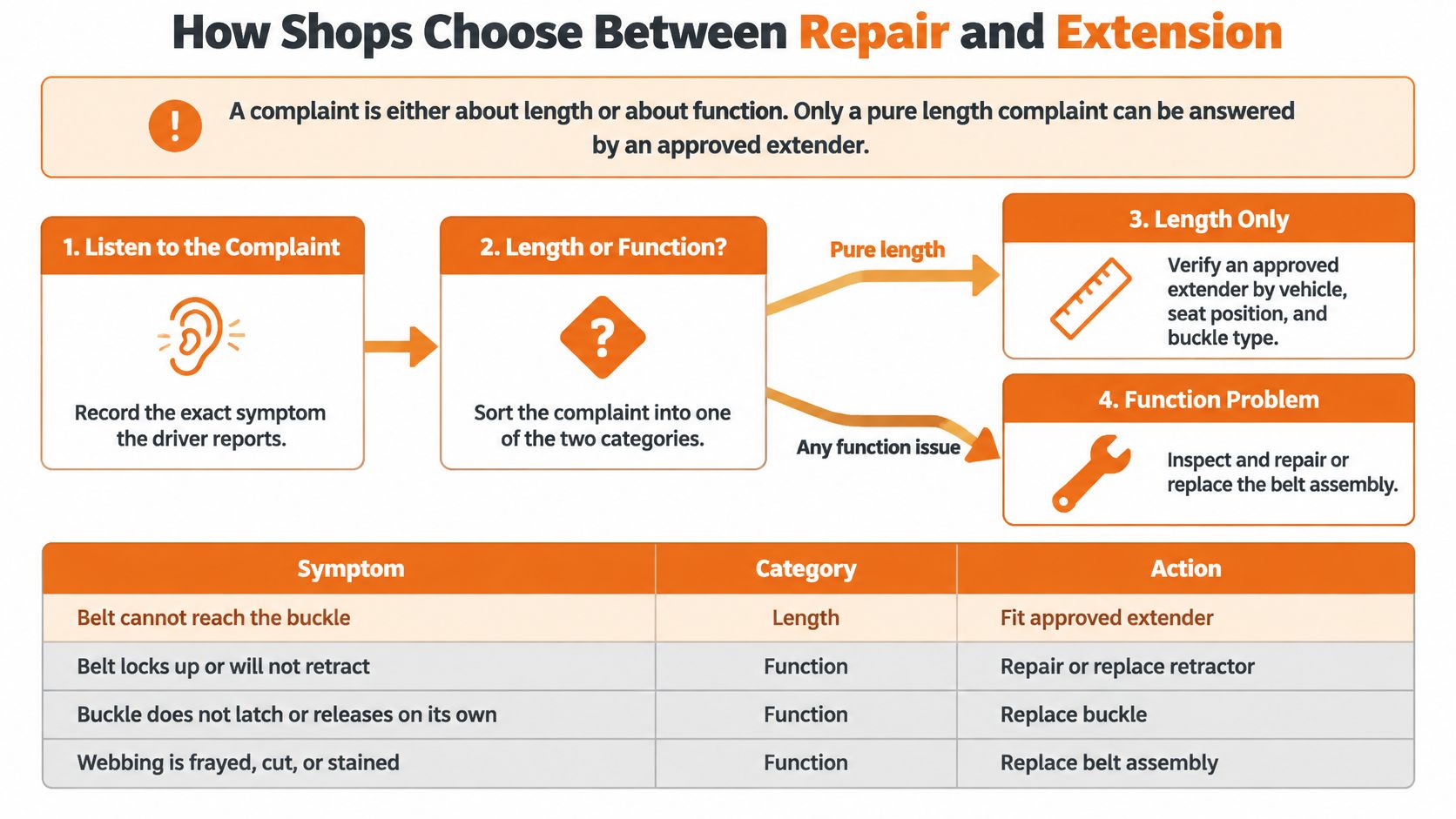
Belt symptoms, causes and right actions
| Symptom | Likely Cause | Right Action |
|---|---|---|
| Belt locked or will not retract | Retractor lock, routing fault, or deployed pretensioner | Diagnose, then repair or replace the retractor or pretensioner assembly as permitted |
| Belt will not reach buckle but retracts normally | Available length, seat position, or buckle geometry | Approved extender after a fitment assessment |
| Frayed, cut or dog-chewed webbing | Webbing damage | Replace with specification-compatible webbing, matching original color and pattern where appropriate |
| SRS light after a collision | Stored crash data or restraint-component fault | Read codes, repair restraint faults, then perform the permitted module reset or replacement |
| Buckle fails to latch or sticks | Obstruction, wear, or buckle damage | Inspect for obstruction; replace a faulty buckle assembly |
| Airbag-off warning with extender latched | Possible occupancy-sensing interaction | Remove extender, follow the specified latch sequence, and rescan if the indication remains incorrect |
Diagnose before clearing anything
A locked retractor isn't proof of deployment by itself. Vehicle angle, installation position, and belt routing can affect its behavior, so inspect it in the specified position before condemning the mechanism. Conversely, don't force a crash-locked belt out and assume that movement proves it's safe.
For damaged fabric, seat belt webbing replacement is a separate repair category. Color and weave appearance don't establish strength or compatibility; the replacement must suit the original assembly and permitted repair method.
Workshop boundary: Clearing a warning light is not the same as repairing the restraint system.
Use the following procedure to keep diagnosis separate from parts selection:
- Read and save stored codes. Access SRS and occupant-classification modules before disconnecting components. Preserve the diagnostic record rather than erasing the evidence.
- Separate reach from malfunction. Check normal seating position and available belt travel. A jammed mechanism belongs on the repair route.
- Inspect the complete connection. Follow depowering instructions before examining the buckle, pretensioner, connectors, and crash-damaged harness sections.
- Choose the permitted remedy. Use the symptom table to select repair, replacement, or manufacturer-approved extension. Follow vehicle-specific replacement requirements.
- Validate the completed work. Confirm retraction, latching, release, and the specified locking checks, then verify module status and relevant indicators.
The video below provides additional visual context for the repair discussion; vehicle service information remains the controlling procedure.
Document the final result on the repair order. Include the affected seating position, the remedy performed, and the post-repair scan result so the next technician doesn't have to guess what changed.
Confirm the Right Fix Before Driving Again
Owners with a reach problem: Match the vehicle and seating position to the situation table, then complete the fitment checks before buying anything. Bring the intended occupant to the assessment and obtain the approved application rather than selecting an extension by appearance.
Owners with damaged hardware or webbing: Stop using the affected seating position until it's inspected and corrected. If the driver's belt is affected, don't drive the vehicle; arrange transport for diagnosis instead.
Treat warning lights as unresolved work
An SRS warning needs fault-code diagnosis, not a buckle accessory or an erased code. A passenger-airbag status indicator also needs interpretation against the vehicle instructions, especially if its behavior changed after an extender was fitted.
Shops should start with the symptom table and diagnostic procedure, then refer specialist component work without bypassing manufacturer replacement requirements. Keep the original fault record with the removed assembly.
For a collision-damaged belt, our seat belt repair after accident service provides pretensioner repair and replacement for any make or model. We repair belts that are locked, won't retract, or have a blown tensioner, including belts from vehicles where airbags deployed; damaged webbing can also be replaced while retaining suitable existing hardware. All seat belt repairs include a lifetime warranty.
Before release, verify the complete installed system:
- Mechanical operation: The belt retracts, latches, releases, and passes the specified locking checks.
- Electronic status: Required diagnostics are complete, faults are corrected, and no relevant active SRS code remains.
- Final indicators: The SRS warning completes its normal self-check, and passenger-airbag status matches the occupied-seat condition.
Don't accept a cleared dashboard as the only sign-off. The occupant needs both a working restraint and the correct fit.
Safety Restore offers seat belt pretensioner repair and replacement, along with webbing replacement for damaged belts. If your search for an extender started because a belt is locked, won't retract, or has damaged fabric, visit Safety Restore to review the appropriate repair route before adding length to a faulty restraint.
