
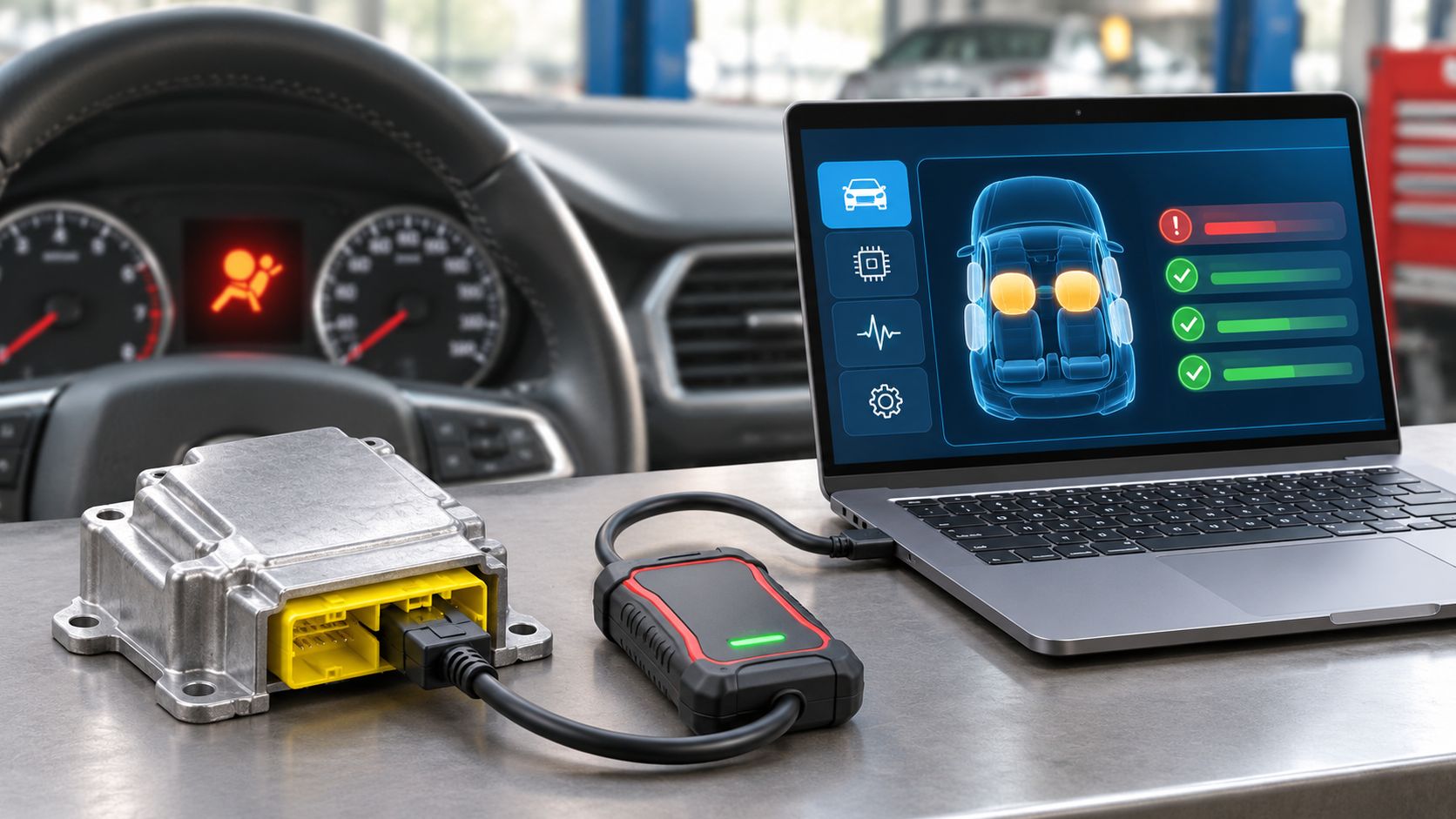
Reset software can clear some stored SRS fault codes and switch off the airbag warning light, but it usually can't erase the full crash record or repair a hardware fault inside the module. Whether a clear works depends on the tool, the vehicle, and what caused the warning.
If the light goes out, does that prove the restraints are ready to protect you? No. A successful clear only shows that the module accepted a command; the important distinction is whether the tool cleared an eligible fault or whether the crash record and the cause of the warning were dealt with.
Table of Contents
- Can SRS Reset Software Clear an Airbag Light?
- How the Module Records a Crash and Why the Record Survives
- Where Reset Software Stops
- When a Professional Module Service Is Appropriate
- How Professional Module Service Works
- Confirm Module Status Before You Reinstall
Can SRS Reset Software Clear an Airbag Light?
The right tool can clear some stored faults and turn off the airbag light, but consumer software usually can't erase crash data or fix a damaged component. The table separates what a scan tool may do from the work that calls for direct module service.
What each option can clear after a collision
| Task | Reset or scan software | Professional module service |
|---|---|---|
| Turn off airbag warning light from stored fault codes | Sometimes, if the fault isn't hardware-related | Yes, after full diagnosis |
| Erase stored crash data and hard codes | Usually no | Yes, through direct access to the module memory (EEPROM) |
| Repair an internal module fault | No | Limited; many internal faults require replacement |
| Restore a module to factory condition for reuse | No | Yes, where the module is reusable |
| Check sensor and wiring circuits | Partially, by reading codes | Yes, with complete circuit diagnosis |
A generic OBD-II reader often reads engine codes but can't access the SRS controller. An enhanced scan tool may read and clear eligible restraint-system codes, show available circuit information, and confirm whether the module communicates. Dealer equipment can access more manufacturer-specific functions, but it still can't necessarily erase a protected crash record or repair a physical fault. Match the tool to the vehicle and the operation you need, not just a product label that says “SRS.”
If the warning returns after a clear, treat that as evidence of an active or intermittent fault. A loose connector, damaged wire, failed sensor, or deployed component can keep triggering the warning; repeatedly clearing it doesn't correct the cause. Before changing anything, record the codes and identify which module reported them.
Practical rule: A tool that can read an SRS code hasn't necessarily got permission or capability to erase crash data.
Software treats the symptom, while module service addresses the stored record and the hardware behind it. Even a successful module reset doesn't replace deployed parts or repair faults elsewhere in the restraint system.
How the Module Records a Crash and Why the Record Survives
Why can the crash still be recorded after the car is repaired? Because bodywork repairs the vehicle's structure, but the SRS module keeps its event data in memory. The module is an onboard computer that senses, decides, records, and reports. It receives signals from impact sensors and connects with components such as the clockspring in the steering column, seat belt pretensioners, airbag igniters, and warning-light circuit.
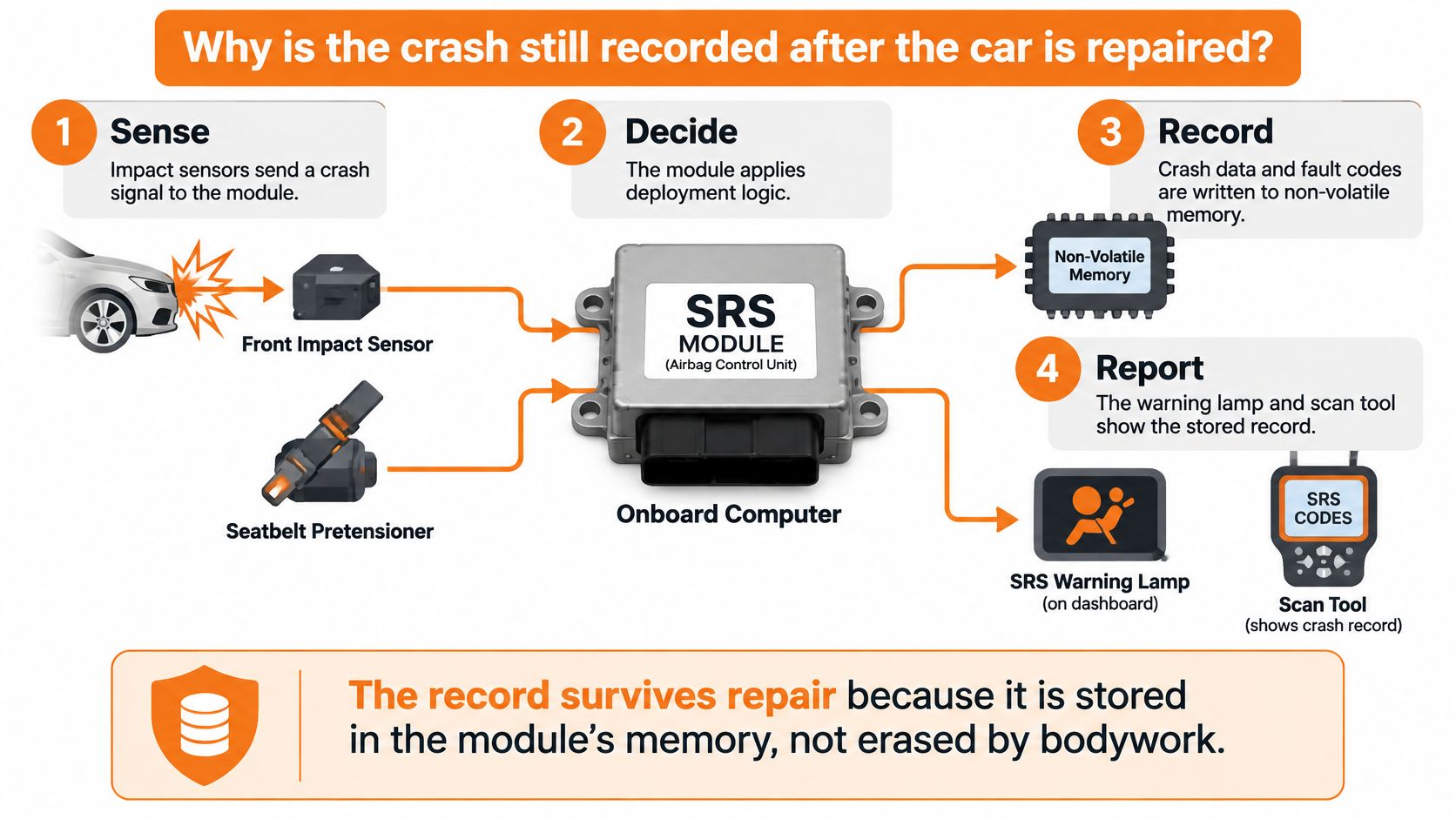
A collision sets off a chain of events:
- Impact sensors send the module a signal associated with rapid deceleration.
- The module evaluates that signal against the vehicle's deployment logic.
- If the conditions call for deployment, the module activates the relevant igniters and pretensioners.
- The module records the event and reports system status through its warning lamp and diagnostic data.
The module also runs self-checks when the ignition is switched on. The warning lamp is part of that status report: if the system detects a problem or has a condition it can't clear, the lamp can stay on. That's why a lamp that remains lit needs diagnosis rather than a guess based on visible damage.
Why unplugging the battery doesn't erase the event
Crash information is stored in non-volatile memory, commonly an EEPROM. Unlike data held only while a device has power, this record is designed to survive the loss of power, including a disconnected battery. Depending on the vehicle, an event record can include deployment status and information about the crash and restraint-system conditions.
After a deployment or a serious fault, the module may keep the SRS disabled until the underlying issue is corrected and the stored faults or event record are addressed using a method supported for that vehicle. Replacing the bumper or installing a new airbag doesn't make that memory forget the event.
Consider a low-speed rear-end collision with no airbag deployment. The module may still store a non-deployment event; replacing the bumper doesn't remove it, so the warning can remain on. In a more severe collision, a car may receive replacement front airbags while the module still holds a deployment record and keeps the system from returning to normal operation.
The same separation applies to belts. If a pretensioner has fired or a buckle mechanism has been affected, clearing module memory won't restore the belt. The seat belt buckle pretensioner repair service addresses the belt component, not the stored event in the module. Mechanical repair never clears the record on its own.
Where Reset Software Stops
Reset software can help with diagnosis and with some eligible stored codes. It can read SRS faults, show supported circuit status, and confirm that the module is communicating. Those functions are useful, but they don't turn a clear command into a repair.
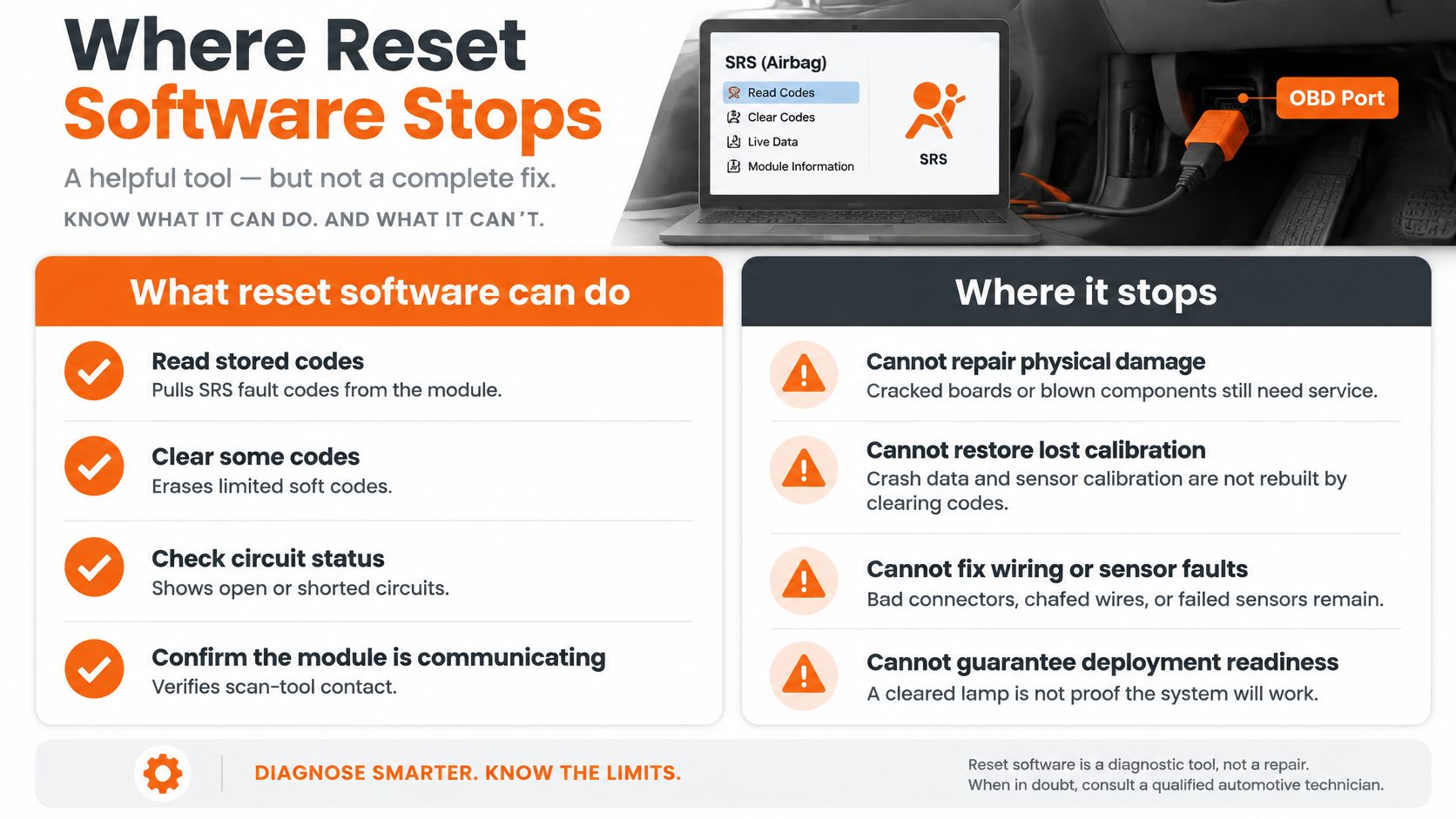
- Deployed components remain deployed. Airbag igniters and fired seat belt pretensioners are single-use parts. They must be replaced as required, or the system may not have working restraints when another collision occurs.
- Physical damage needs a hardware decision. A cracked circuit board, corrosion from water exposure, or heat damage from a fire won't be repaired by clearing codes. A damaged module may need hardware repair or replacement.
- A circuit code needs circuit diagnosis. Broken wiring, a damaged connector, or a clockspring fault can keep the warning on after the code is cleared. Find and repair the circuit problem before clearing again.
- A replacement module may need vehicle-specific setup. A unit from another car isn't automatically compatible. If configuration or programming is required, a code clear won't make the module match the vehicle.
Generic readers may not access the SRS controller at all, and even capable dealer or aftermarket scan tools can be unable to erase certain crash data and hard codes. Safety Restore's airbag module reset service erases crash data and hard codes that dealers and OBD airbag scan tools can't reset. That's a distinct operation from reading codes or clearing eligible faults through the diagnostic connector. The airbag module reset service is a service for the stored module data, not a substitute for repairing damaged parts or wiring.
If you clear the light without correcting the fault, the warning may return while the safety problem remains. Scan again after every clear, and don't treat an extinguished lamp as proof that the system can deploy correctly.
When a Professional Module Service Is Appropriate
If a collision deployed a restraint, or the codes return after a software clear, use professional module service or replace the module as appropriate. Software alone is a reasonable possibility only when the fault is eligible to clear and stays clear after the cause has been checked.
Software reset or professional service by situation
| Situation | Software alone likely enough? | Recommended path |
|---|---|---|
| Light on, no deployment, no collision | Possibly | Diagnose the stored codes first |
| Minor impact, no airbag deployed, codes stored | Possibly, if codes clear and stay clear | Professional service if codes return |
| Airbags or seat belt pretensioners deployed | No | Professional module reset plus replacement of deployed parts |
| Used car bought with deployed airbags or locked belts | No | Professional module reset and full system inspection |
| Module with water, fire, or board damage | No | Replacement or hardware repair |
| Light returns after a software clear | No | Professional diagnosis of the underlying fault |
For example, a parked car gets bumped at low speed, no airbag deploys, and the light comes on. If diagnosis finds an eligible fault, the fault is corrected, and the light stays off through a road test and a follow-up scan, a software clear may have been enough. If the same code returns, stop clearing and investigate the circuit or component that set it.
Now consider a salvage vehicle with deployed airbags and locked seat belts. A scan tool can help identify faults, but it can't restore the deployed parts. The module may need a professional reset if it's reusable, the airbags and affected belt components need replacement or repair, and the full SRS needs inspection before the car goes back on the road. Safety Restore's reset service is intended for vehicles that have been in a crash or were bought from a salvage yard with deployed airbags or locked belts. It covers SRS modules across vehicle years, makes, and models.
Compare a professional reset with module replacement, including the work needed to remove and reinstall the unit. The less expensive route makes sense only if the original module is reusable; physical damage or an internal fault can make replacement the right repair. Body shops, independent mechanics, rebuilders, and owners repairing an accident-damaged vehicle can use that distinction to choose the next diagnostic step. See the SRS airbag module reset service for a professional service option.
How Professional Module Service Works
Professional service begins with diagnosis, not with erasing memory. The technician needs to know whether the module is the source of the problem and whether other SRS faults would keep the warning on after the module returns.
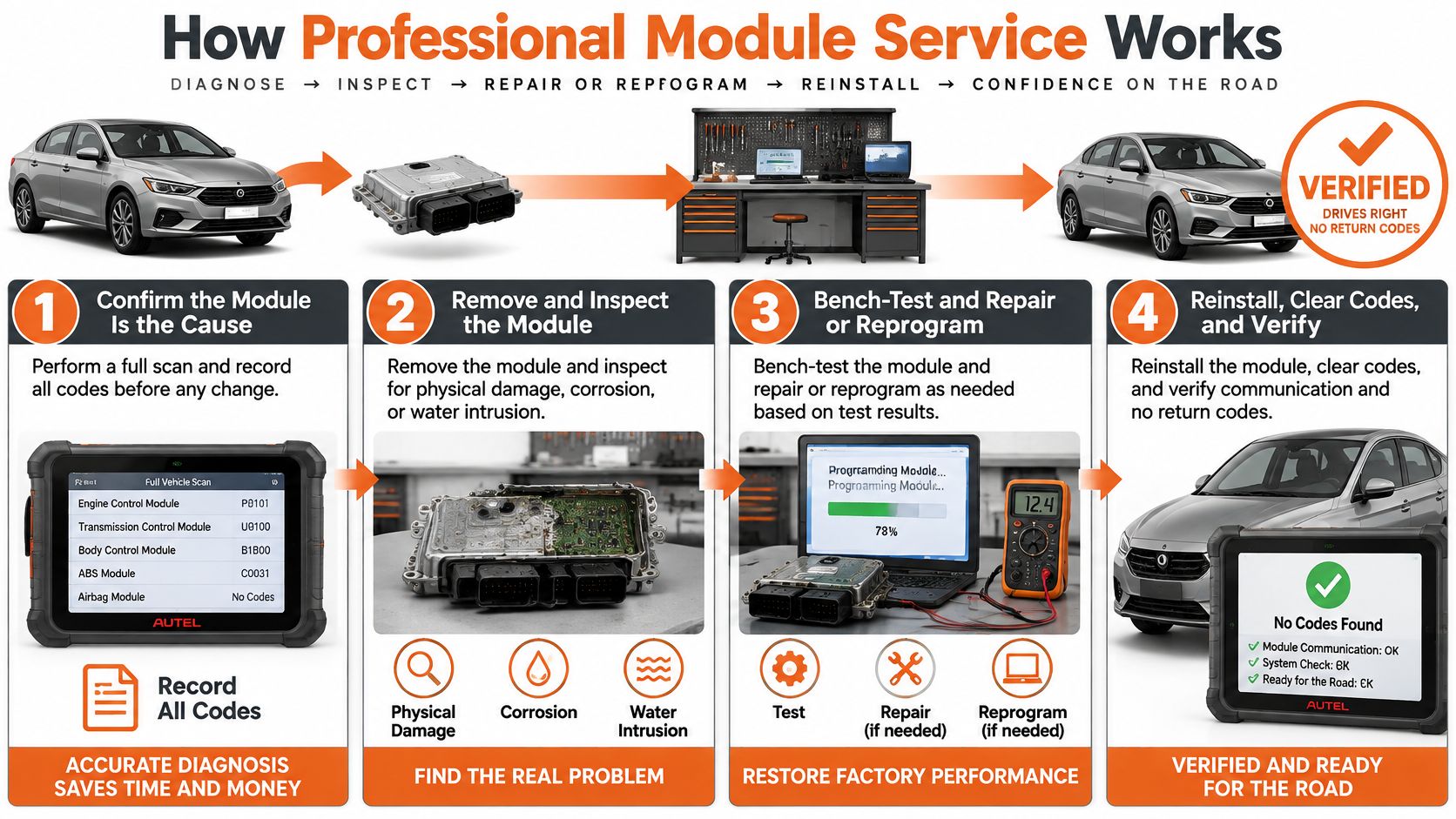
A careful workflow looks like this:
- Scan and record. Run a full SRS scan, confirm that the module communicates, and save every code before making changes. This record helps separate a stored event from a fault that's still active; clearing first can erase useful diagnostic information.
- Disable the system and remove the module. Follow the vehicle manufacturer's procedure, including its specified wait after disconnecting the battery so stored electrical energy can dissipate. Skipping the wait or pulling the module before the system is safe to handle creates avoidable risk.
- Protect the unit. Remove the module without forcing its connector, then inspect it for obvious damage and package it securely for hand-off or shipment. A bent pin or damaged connector can create a new communication fault after the original issue is addressed.
Before any stored event is erased, confirm whether the vehicle is tied to an insurance claim, legal case, or accident investigation. The crash record may need to be preserved; get agreement from the owner or insurer before proceeding.
- Access the module memory. A specialist connects directly to the module's EEPROM to erase crash data and hard codes. Safety Restore uses this direct-memory approach and flashes the stored data with an OEM factory-installed program; that work addresses the module's data, not a damaged sensor or harness elsewhere in the car.
- Test the module. Bench testing checks whether the unit can communicate and report its status after service. If an internal hardware fault remains, a reset alone may not make the module suitable for reuse.
- Reinstall and verify. Seat the connector fully, reinstall the module, reconnect the battery according to the vehicle procedure, and confirm the warning lamp completes its self-test. Check clockspring wiring and other repaired circuits before calling the job complete; a loose connector can produce a new fault.
The service restores the module when it's serviceable. It doesn't repair a damaged airbag, pretensioner, sensor, or wiring elsewhere in the vehicle. A completed reset is one part of a safe repair, followed by a full-system check.
The video below shows additional context for the module service process.
Confirm Module Status Before You Reinstall
Reinstall the module only when the system is verified. A quiet warning lamp by itself isn't enough; confirm communication and check for returning faults before the vehicle is released.
- Scan with the module connected. Confirm the SRS controller communicates and review active and stored codes. Save the result so you can compare it with the original scan.
- Watch the ignition self-test. The warning lamp should follow the vehicle's normal startup check and turn off if no fault is present.
- Confirm the replacement parts. Verify that any replaced igniters, pretensioners, and clockspring components are correct for the vehicle and properly installed.
- Check the event status. Confirm that no unresolved deployment record or hard code remains where the repair procedure requires it to be cleared.
After the stationary checks, road-test the vehicle only when it's safe to do so, then run a follow-up scan. Intermittent wiring or connector faults may not appear during the first check, so a fresh scan can catch a problem that returns after the vehicle has been driven.
If codes return, stop and arrange professional diagnosis rather than repeating the clear command. If the vehicle has a salvage history or deployed components, don't drive it until the required module service, component repairs, and system checks are complete. Don't treat the light going off as proof of repair. Verify the system with a scan, and let the scan decide.
Safety Restore provides mail-in SRS module reset service that clears stored crash data and hard codes from serviceable modules, along with repair services for seat belt components. If your diagnosis points to a module with stored crash data, visit Safety Restore to review the service and arrange the next step.


