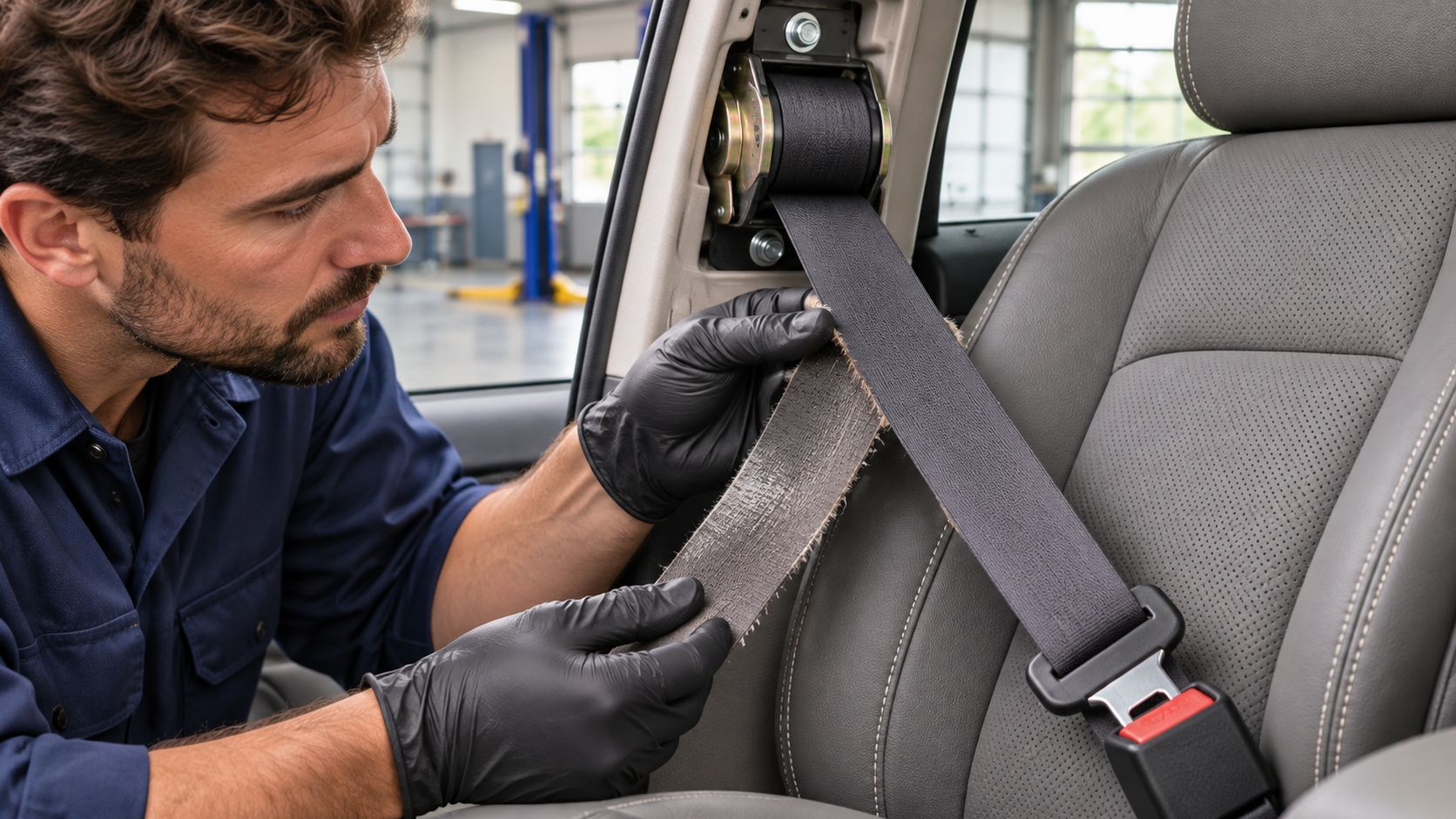
A collision can leave you with a seat belt that won't retract, an airbag warning light, or webbing that looks fine but doesn't feel right. Before ordering a replacement or mailing anything away, identify what part failed and check what the vehicle manufacturer permits. A belt's appearance alone can't tell you whether it's safe to reuse.
Table of Contents
- Repair or Replace a Locked, Deployed or Damaged Seat Belt
- Why Locked and Deployed Belts Behave This Way
- How to Mail In a Seat Belt for Repair
- What Repair Costs and How Long It Takes
- Georgia Rules, Insurance and Title Paperwork
- Safety Checks Before Reinstalling a Repaired Belt
- Choose the Repair Path and Ship With Confidence
Repair or Replace a Locked, Deployed or Damaged Seat Belt
A seat belt that locks after a crash may be repairable, but a fired pretensioner or cracked buckle or anchor can rule out restoring the original assembly. The deciding factors are what failed, whether a one-use device activated, and what the manufacturer's service procedure allows. Looks alone won't settle it.
Repair or replace by seat belt condition
| Condition | Usually repairable? | Typical action | Key condition |
|---|---|---|---|
| Locked retractor after a moderate crash | Often yes | Release the lock, clean and rebuild mechanism | Webbing undamaged and no housing cracks |
| Single-stage pretensioner fired | Sometimes | Replace pyrotechnic charge or full assembly, per OEM procedure | Check OEM service information first |
| Dual-stage pretensioner deployed | Sometimes | Replace charges or assembly, per OEM procedure | Both stages must be serviced to spec |
| Frayed, cut or dog-chewed webbing | Yes | Replace webbing and re-stitch tags and latch | Hardware intact and tested after repair |
| Cracked buckle or latch housing | Rarely | Replace buckle assembly | Structural damage is not reliably repairable |
| Bent or damaged anchor bolt or mount | No | Replace hardware and torque to OEM spec | Anchor is a structural component |
| Belt with SRS airbag light on | Module reset possible | Reset airbag control module after repairs | Stored crash data cleared before testing |
This table is a starting point; the verdict on a specific car still depends on its service information. For webbing damage, seat belt webbing replacement is a distinct repair from rebuilding a locked retractor. Neither repair should be assumed suitable until the vehicle-specific procedure and the condition of the entire assembly have been checked.
Ask these questions in order
- What does the OEM service information require? Look up the procedure for the vehicle's year, make, model and belt position. If it calls for replacement of the assembly or a component, don't substitute a repair without qualified confirmation.
- Did a pretensioner fire? A fired pyrotechnic device is a one-time component. Don't try to reset or bypass it; follow the manufacturer's specified replacement or repair procedure.
- What else is damaged? Check the webbing, retractor housing, buckle and electrical connections. A repair to one part won't make a cracked or compromised neighboring part safe.
- Is the anchor sound? A bent bolt, torn mounting point or cracked floor or pillar needs professional assessment. The anchor carries restraint loads.
- How does the quote compare with a new OEM assembly? Include labor, fitting and any related SRS work, rather than comparing the repair charge in isolation.
- Can the work be documented? Keep the written scope, invoice and any repair or testing records.
A compact car with pet-frayed webbing may be a straightforward candidate for webbing replacement if the hardware is intact and the repair process preserves the belt's required construction. The same car with a deployed pretensioner needs the OEM procedure checked before repair is even considered.
A locked lap-shoulder belt after a low-speed rear impact might need retractor service, but the impact description alone can't establish that. If the front pretensioner fired and the buckle is cracked, the affected assembly will generally need replacement under the applicable service procedure. Avoid used belts from crash-damaged vehicles unless a qualified professional can confirm their history and suitability.
Before deciding, record the belt position, vehicle year, make and model, and whether a warning light is on. That information drives the correct service path and saves a wasted shipment.
Why Locked and Deployed Belts Behave This Way
A pretensioner is like a sprinkler head: once its one-shot mechanism activates, it needs service or replacement rather than a reset. The retractor stores webbing on a spool; a locking pawl engages when a sensor detects a sudden deceleration or a fast pull. In a crash, the pretensioner uses a small pyrotechnic charge or gas generator to pull the belt tight.
A belt locking during a collision is often the restraint system doing its job, not proof that every part has failed. But a belt that stays locked afterward needs inspection because the cause could be the retractor, a deployed pretensioner or damage elsewhere in the assembly.
Single-stage systems use one charge. Dual-stage systems can activate two charges in stages, while some systems have a third stage. The correct service depends on the specific design and the manufacturer's procedure; treating a multistage unit as a simple rewind can leave part of the system unserviced.
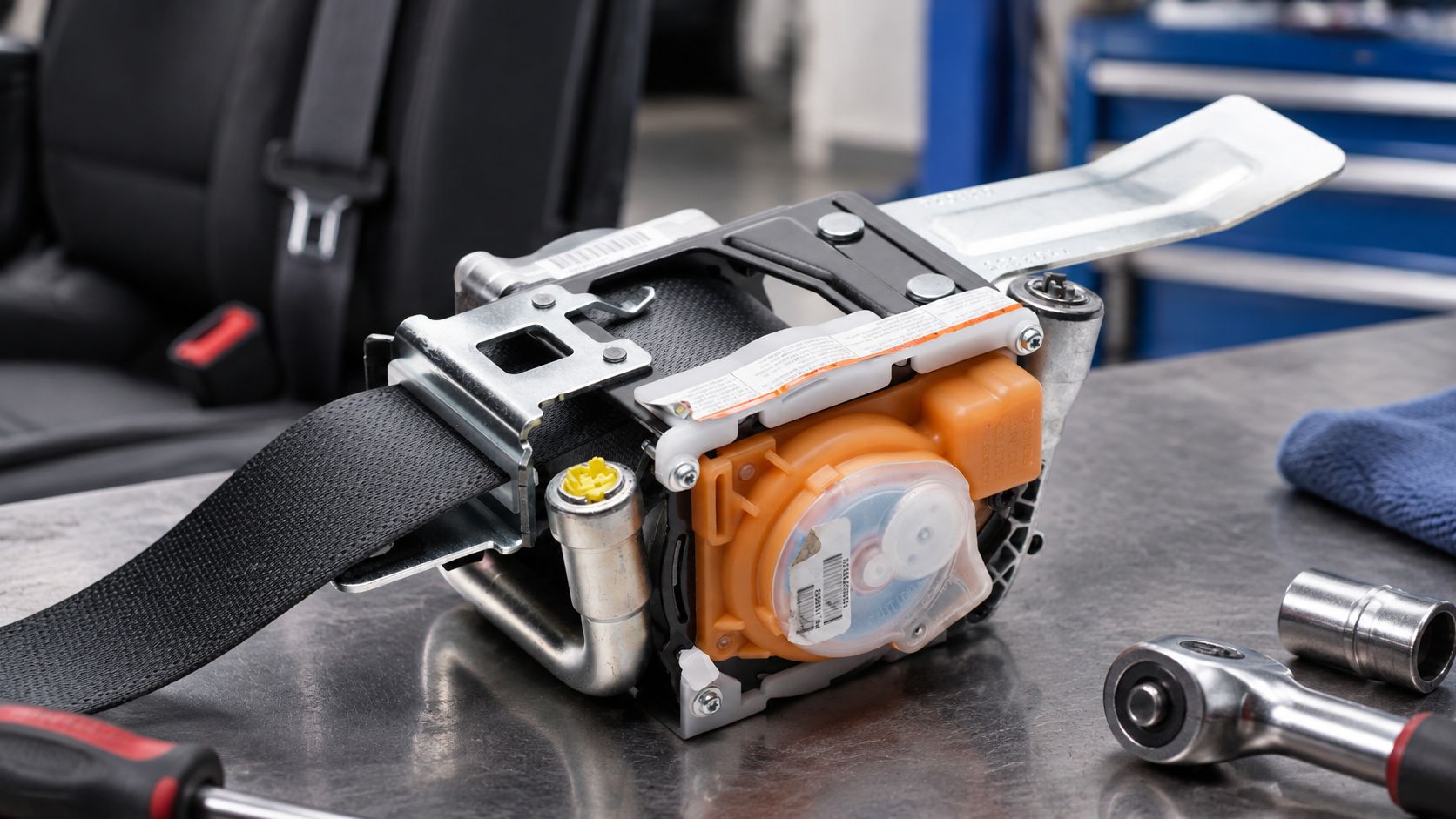
Crash sensors and the SRS control module also affect what happens after an impact. The module may store crash data or a fault code, leaving the airbag light on until the underlying issue is repaired and the module is addressed. A locked belt and an illuminated light indicate the system needs diagnosis; they don't prove that every component is beyond repair. If the vehicle-specific procedure permits it, airbag module reset service may address stored crash data after the required repairs.
How to Mail In a Seat Belt for Repair
Mail-in service can work for a removable belt or module. It won't fix a cracked pillar, floor mount or other damage that remains attached to the vehicle.
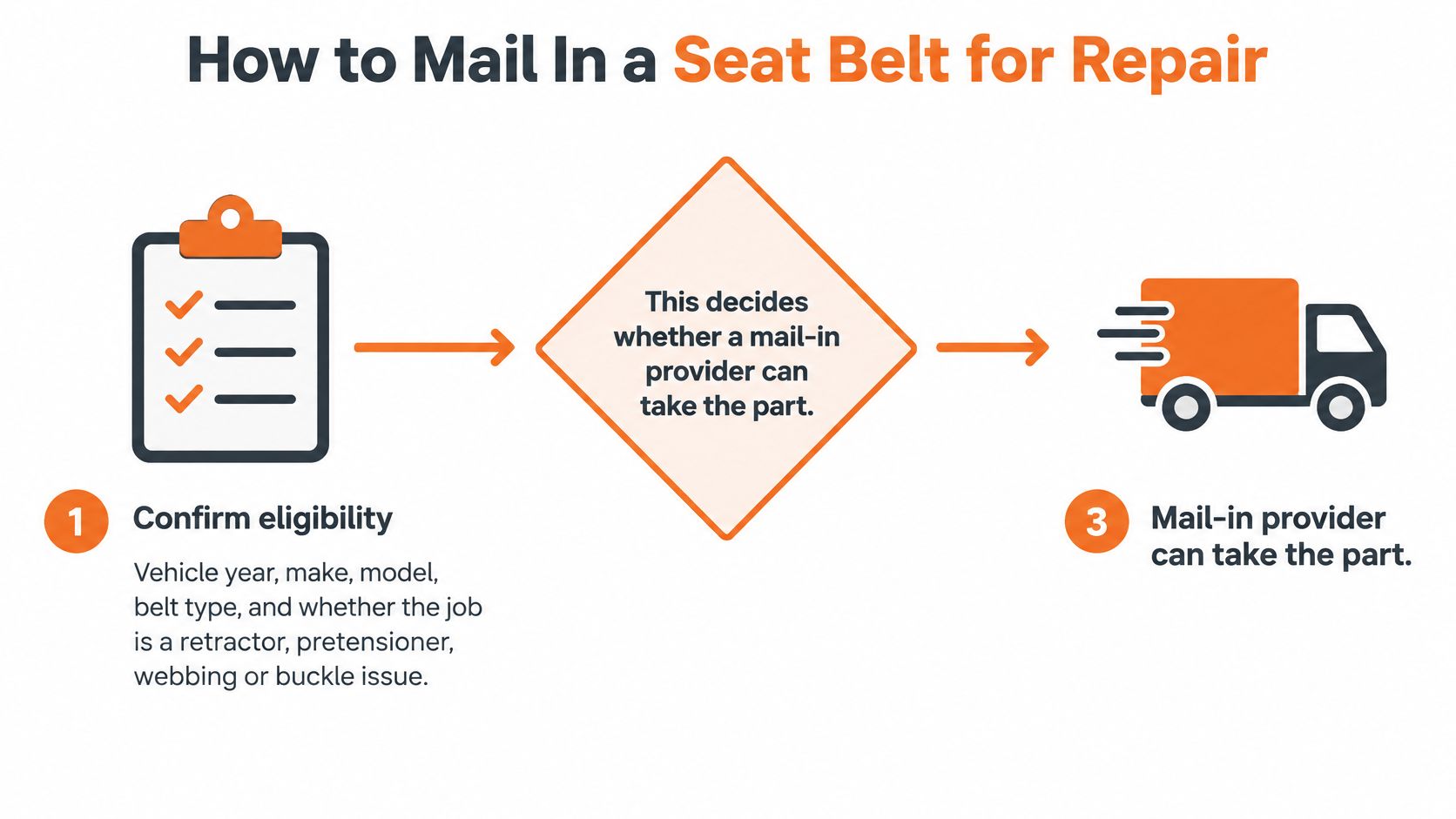
- Confirm eligibility. Provide the vehicle's year, make and model, the belt type and the problem, such as a locked retractor, deployed pretensioner, damaged webbing or buckle fault. This helps establish whether a mail-in provider can accept the part.
- Remove the assembly using the vehicle service guide. Disconnect the battery and wait for the specified time before working near pretensioner connectors; an energized restraint component can deploy. If you can't follow the service procedure confidently, have a qualified shop remove it.
- Document the part. Photograph the connectors, labels, mounting points and damage, and note the seat position. These records can help with diagnosis and an insurance file.
- Place the order and keep the receipt. Follow the provider's ordering instructions and save the order number with your vehicle records.
- Pack only the removable parts. Include the order details inside and use tracked shipping, so you can confirm delivery.
- Get timing in writing. Confirm the repair window and return transit time rather than treating a processing estimate as the total time without the belt. For harness repair, customers pay online, mail in the belt with the receipt, and the belt is repaired within 24 hours of receipt and shipped back.
The Seat Belt Repair After Accident service is described as an OEM seat belt repair service for locked or blown pretensioners after an accident. Check that any service you choose matches the fault and the OEM procedure for your vehicle.
What Repair Costs and How Long It Takes
The main cost drivers are the number of belts, the fault on each one, pretensioner design, any required module work and the availability of parts. A dealer quote typically includes an OEM replacement part, labor and tax; waiting for a part to arrive can add days or weeks. Independent-shop quotes depend on sourcing and labor, while mail-in service is commonly charged per item with shipping in each direction handled separately.
Typical cost driver and turnaround by repair path
| Repair path | Main cost driver | Typical turnaround | Main trade-off |
|---|---|---|---|
| Dealer full replacement | OEM part plus labor and tax | Parts ordering can take days to weeks | Highest cost, simplest documentation |
| Independent shop replacement | Part sourcing and labor hours | Shop schedule and parts lead time | Quality depends on part source |
| Mail-in repair service | Per-item fee plus return shipping | Repair window plus transit both ways | Requires removal and shipping; compare written quotes |
| DIY removal and reinstall | Your time and tools | Hours to a weekend | Errors can leave the belt untested |
| Insurance-claim replacement | Deductible may apply | Set by the claim adjuster | Coverage depends on the policy wording |
A mail-in option avoids fitting labor at the provider, but you still need to remove and reinstall the part correctly. DIY may look cheaper, yet a mistake with an anchor, connector or retractor can leave the belt unsafe. A classic car can also require more effort to source a suitable replacement.
For instance, a sedan with two retractor-locked belts and two belts needing only webbing work shouldn't be quoted as though all four have the same fault. Ask for an itemized quote and confirm what each line includes: webbing, tag and latch re-stitching, module reset and warranty. A custom-color option is listed as Custom Color Seat Belt Webbing Replacement, with color-match webbing and shipping and returns terms shown on its listing.
Before choosing a provider, confirm the following in writing:
- Per-item scope: List each belt and its fault so you can compare like with like.
- Shipping: Ask whether outbound and return shipping are charged separately.
- Included work: Confirm webbing, tags, latch re-stitching and any module reset.
- Timing: Get the repair window and return transit estimate.
- Warranty: Clarify what it covers and how long it lasts.
Georgia Rules, Insurance and Title Paperwork
A repaired belt usually doesn't require a separate state sign-off, but don't assume every vehicle or title situation follows the same path. Georgia requirements can depend on the vehicle and circumstances, so verify current rules with the Georgia Department of Revenue, your county tag office and your insurer.
Ask the adjuster to itemize seat belt repair and airbag module work separately, and clarify whether the vehicle is being treated as repairable or as a total loss. If it's declared a total loss, Georgia title requirements apply; a vehicle with a salvage history may need an inspection before it can be retitled. Confirm the steps for that specific vehicle before paying for repairs or planning to put it back on the road.
Insurance paperwork can be confusing if the claim includes a filing requirement unrelated to the belt repair. For context on a separate Georgia insurance filing, see this guide to how SR-22 certificates work in Georgia. It isn't a seat belt repair requirement; your insurer can explain whether it applies to your situation.
Keep the repair invoice, provider warranty, before-and-after photos, insurer's estimate, order receipt and service records together. That file supports claim discussions and gives a future buyer a clearer account of the work.
Safety Checks Before Reinstalling a Repaired Belt
Reinstall the assembly with the original or OEM hardware, then torque the anchor bolts to the manufacturer's specified value using a calibrated torque wrench. Don't guess at the torque or reuse damaged hardware.
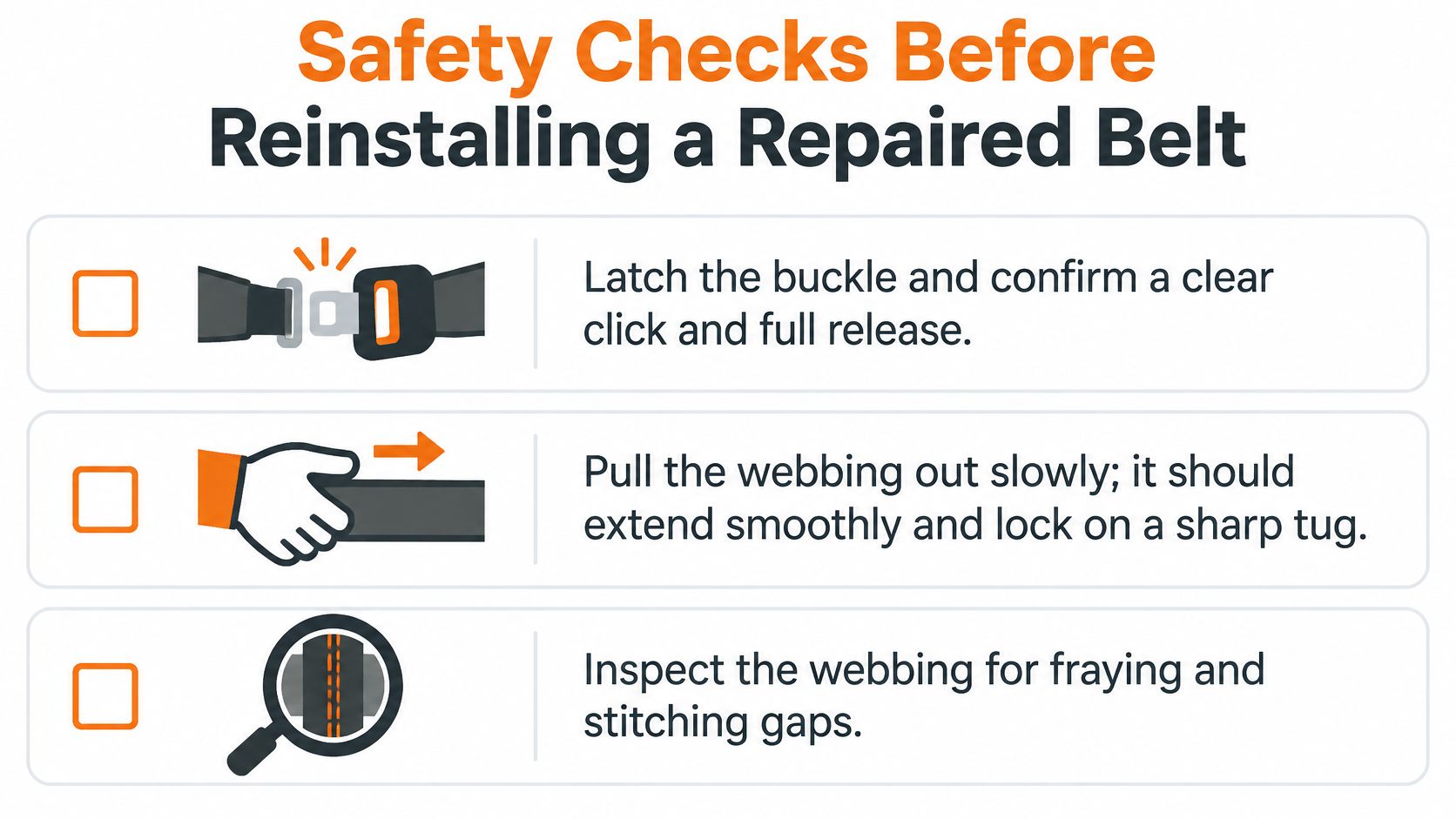
Run these checks in order:
- Latch and release the buckle. It should click securely and release fully, which checks that the latch is operating.
- Test the belt's movement and lock. Pull the webbing out slowly; it should extend smoothly and lock on a sharp tug.
- Inspect the webbing and stitching. Look for fraying, gaps, twists or damage, and check that tags and the latch are attached correctly.
- Check retraction. Let the belt retract; it should move smoothly without binding on the spool.
- Inspect the pretensioner connection. Make sure the connector is fully seated and latched, with no exposed wires.
- Check the SRS warning light. On startup, it should illuminate briefly and then go out. A light that stays on means the fault must be scanned and addressed before driving.
- Record the work. Save the repair date, provider, part numbers and before-and-after photos with the vehicle records.
A belt that fails a movement or locking check isn't ready for use. Stop and have the assembly and SRS system assessed rather than trying to compensate with adjustments.
Choose the Repair Path and Ship With Confidence
If the vehicle is otherwise sound and the fault is a locked, frayed or dog-chewed belt, mail-in repair can be a practical option when the OEM procedure allows it. If a pretensioner fired and the procedure calls for assembly replacement, or the housing or anchor is cracked, replace the affected part instead.
Before shipping, work through this checklist:
- Record the damage, belt position and warning-light status.
- Check the service information for the vehicle's year, make and model.
- Get a written repair quote, including shipping, and compare it with a dealer quote.
- Confirm the repair scope and warranty terms.
- Ship the removable part with tracking.
Safety Restore offers seat belt harness repair that replaces shoulder-belt webbing with OEM webbing and restitches it using an automated sewing machine. Check the supported vehicle makes list before sending a part, and keep the receipt, warranty terms and checklist with the vehicle records.
Safety Restore repairs customer-supplied seat belt components and SRS airbag control modules through a mail-in service. If your belt's condition and the manufacturer's procedure point to repair, visit Safety Restore to review the relevant service and ordering steps.