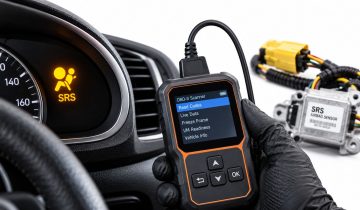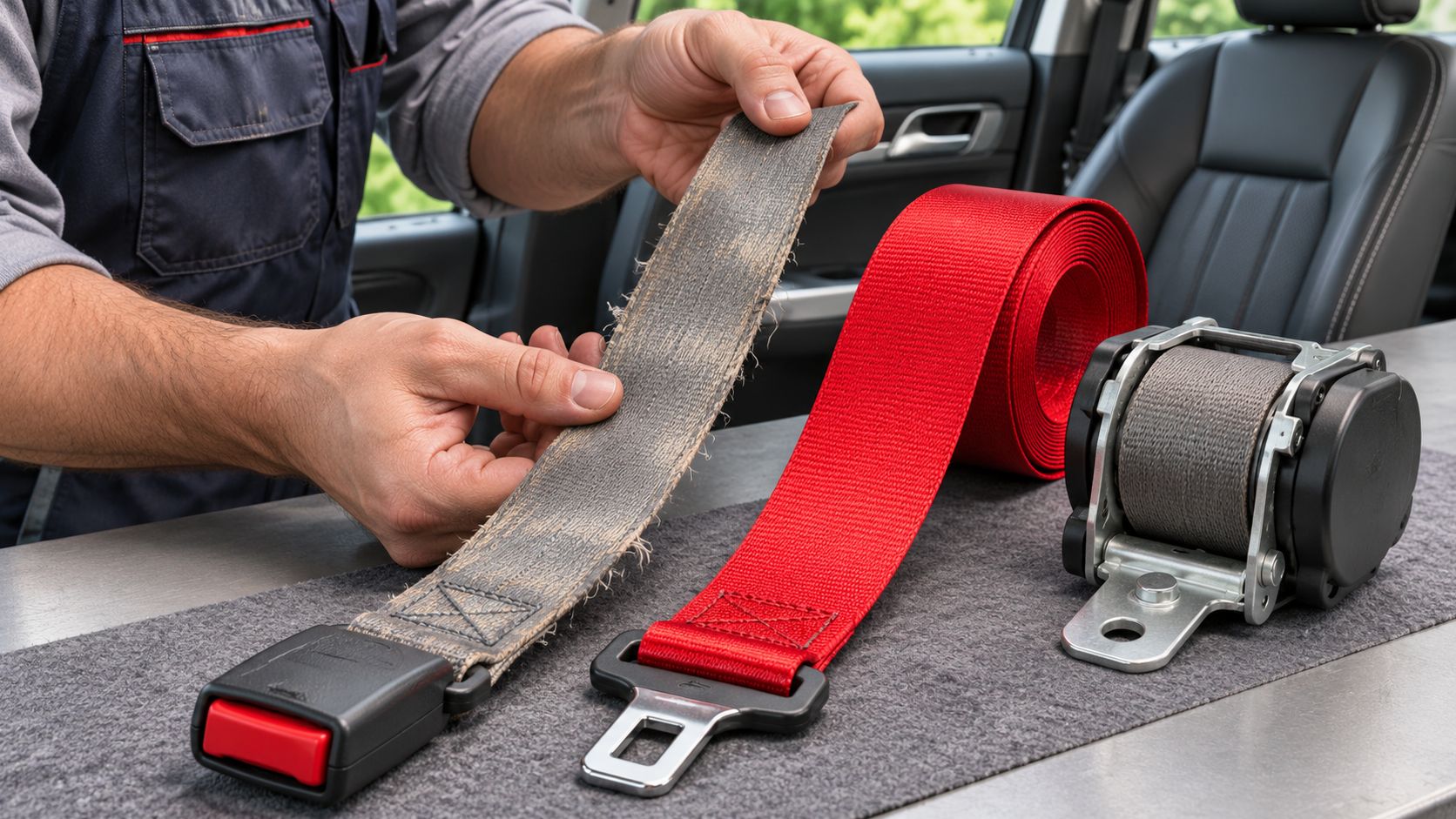
You open the car door and notice the belt before anything else. It still clicks into place, but the shoulder strap looks faded, the edge feels fuzzy, or the dog has chewed the section beside the rear seat. Maybe nothing is damaged at all. You've finished the upholstery, and the old belt color no longer suits the cabin.
Table of Contents
- Why Drivers Look for Custom Seat Belt Belts
- Webbing Colors and Patterns You Can Order
- When Webbing Replacement Is the Right Fix
- Safety Rules That Still Apply After a Color Change
- How a Mail-In Webbing Replacement Works
- Choose a Color and Send the Original Belt
Why Drivers Look for Custom Seat Belt Belts
Custom seat belt belts usually means replacing the woven strap on an existing seat belt assembly. It doesn't mean fitting a racing harness, redesigning the anchors, or buying an unrelated belt that happens to look right.
The webbing is the visible fabric that crosses your body. The retractor is the spring-loaded machine behind the pillar or trim panel that stores the strap and controls its movement. During suitable re-webbing work, the original retractor, latch plate, stop button, and manufacturer tags remain with the assembly.
What's driving the change
Owners generally arrive at this decision for a practical reason:
- Appearance: A different color or pattern will suit new seats, restored trim, or an accent theme.
- Damaged fabric: Fraying, cuts, stains, or chewing make the strap unsuitable or visibly worn.
- Hard-to-find hardware: A classic vehicle still has its correct fittings, but the original fabric needs replacement.
The important distinction is between replacing fabric and correcting a mechanical fault. A strap can look tired while the mechanism works normally. Conversely, a clean-looking strap can belong to a failed or crash-loaded assembly.
If the spool stays locked or won't take up slack, the relevant starting point is seat belt retractor service, not a color selection.
Shop-floor rule: Choose the repair for the failed component first. Color never overrides fit, retraction, or crash-hardware condition.
Webbing Colors and Patterns You Can Order
Custom seat belt webbing colors and best uses
| Color or pattern | Look | Best used for |
|---|---|---|
| Black | Solid dark neutral | Daily drivers and factory look |
| Gray | Solid cool neutral | Modern interiors |
| Tan | Solid warm neutral | Trucks and older cabins |
| Beige | Solid light neutral | Light leather and cloth |
| White | Solid bright | Show cars and marine-style interiors |
| Ferrari red | Solid vivid red | Sports and performance cabins |
| Elegant red | Solid deeper red | Luxury sport interiors |
| Burgundy | Solid dark red | Classic and luxury cabins |
| Yellow | Solid bright | Show and accent builds |
| Orange | Solid bright | Off-road and custom builds |
| Purple | Solid accent | Custom show interiors |
| Cobalt blue | Solid deep blue | Sport cabins |
| Navy blue | Solid dark blue | Understated custom look |
| Royal blue | Solid rich blue | Classic custom interiors |
| Baby blue | Solid pale blue | Light custom interiors |
| Turquoise | Solid blue-green | Show and retro cabins |
| Light pink | Solid pale accent | Custom show interiors |
| Neon green | Solid high-visibility green | Show cars |
| Green | Solid standard green | Subtle custom cabins |
| Camo green | Patterned green | Off-road and themed builds |
| Red trim black | Black with red edge | Contrast without a full red belt |
| Yellow trim black | Black with yellow edge | High-contrast custom builds |
| Orange trim black | Black with orange edge | Off-road contrast builds |
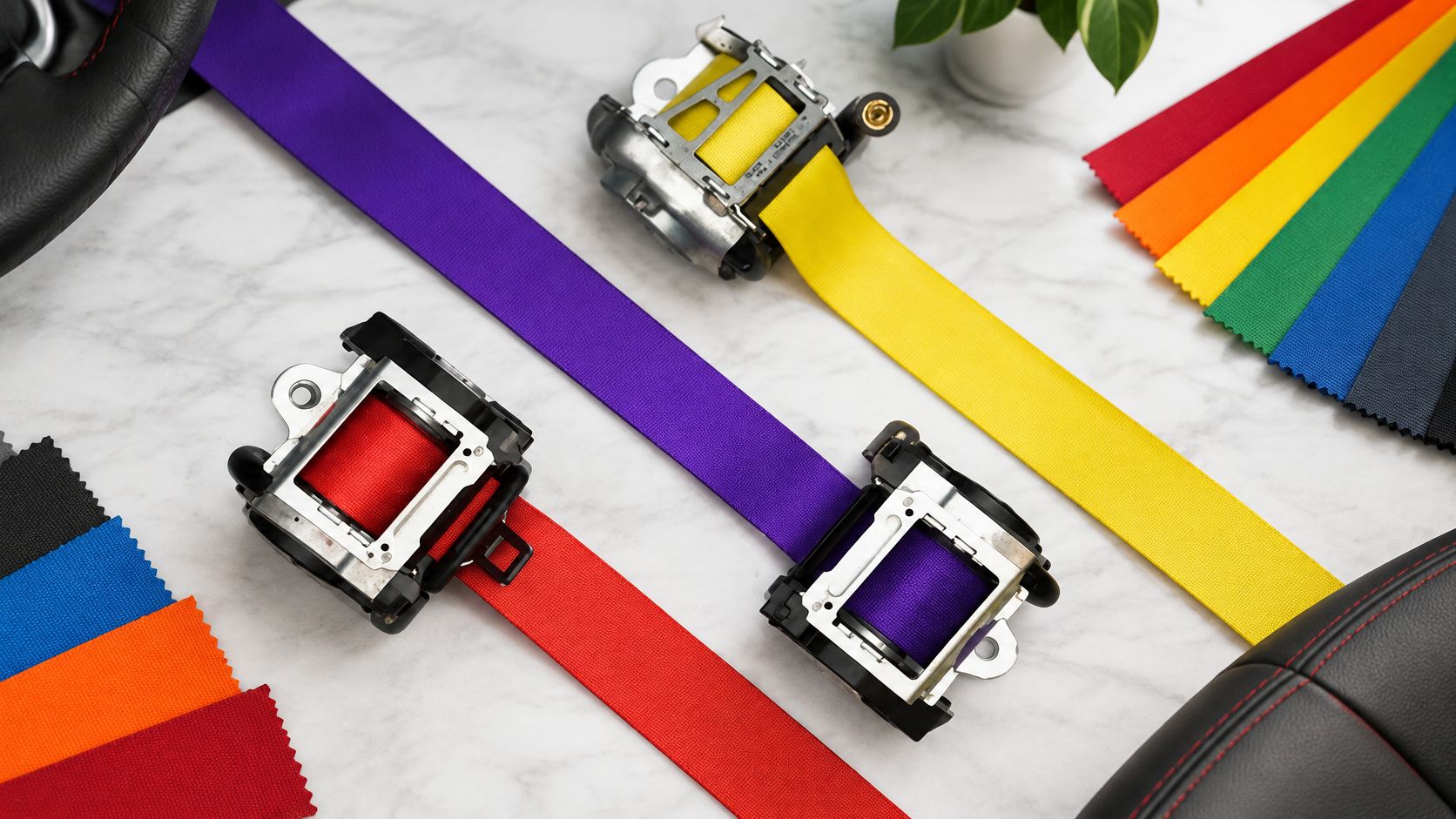
Keep this table handy before ordering. Cabin colors such as gray, tan, and beige are usually chosen to disappear into the interior; accent colors and contrast edges are chosen to show.
Choose whether the belt should blend in
Black and the other neutrals suit daily drivers and restorations that should look factory-finished. Gray, tan, and beige are common factory-match requests, but those names describe color families rather than an exact match to every interior. Compare the existing strap, not just the seat leather, when an invisible repair is the goal.
For example, a warm beige belt can look out of place against cool gray upholstery even though both colors seem neutral. Check the belt beside the seat, pillar trim, and carpet in daylight. A screen image is useful for narrowing the choice, but lighting and display settings can change how a shade appears.
Reds create different effects. Ferrari red is vivid, elegant red is deeper, and burgundy works well when a classic or luxury cabin needs a darker accent. Blue choices run from pale baby blue and turquoise to cobalt, royal, and understated navy.
Choose how much contrast you want
Neon green makes a deliberate statement, standard green is quieter, and camo green adds a pattern rather than a single-color accent. Yellow, orange, purple, white, and light pink suit builds where the belt is meant to become part of the interior design. Light colors also make everyday handling marks easier to notice.
Red trim black, yellow trim black, and orange trim black mean a black strap with a colored edge. They aren't solid red, yellow, or orange belts. That distinction matters when you're trying to echo piping on a seat without adding a broad band of bright color across it.
Decide on solid color, contrast trim, or a factory-style match before removal. The replacement webbing will be cut and stitched for that choice.
Color selection is a service option on the original assembly, not a universal parts-counter belt that fits every vehicle. Confirm the intended shade and seating position together so a styling decision doesn't become a fitment assumption.
When Webbing Replacement Is the Right Fix
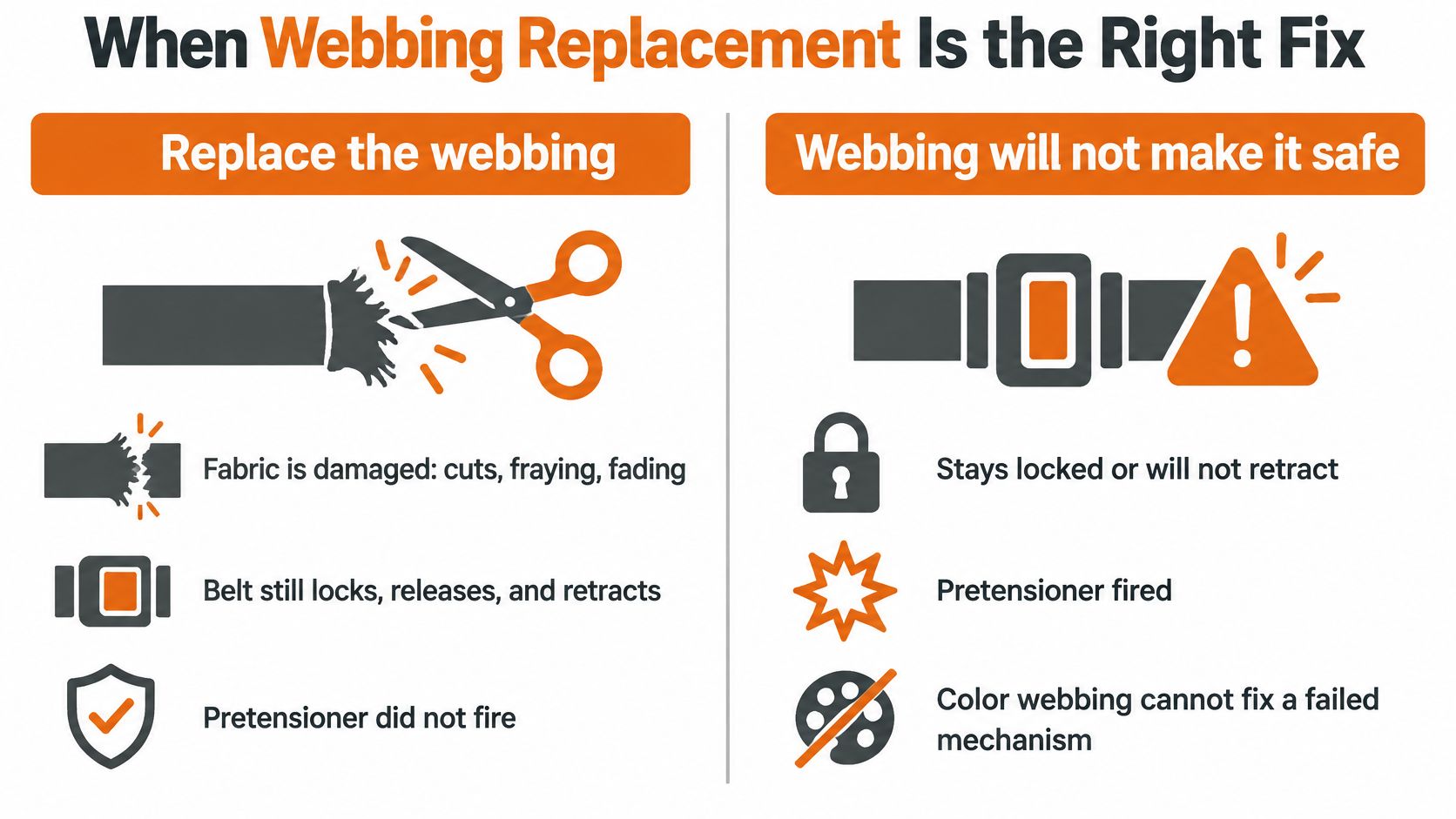
Use visible damage to identify what needs inspection, not to declare the entire assembly safe. Normal pulling, latching, and retraction are useful checks, but they don't rule out hidden crash damage. Collision history and the vehicle manufacturer's replacement instructions still matter.
Webbing replacement versus mechanism repair
| What you see | What failed | Right service |
|---|---|---|
| Frayed, faded, or sun-rotted strap | Webbing condition needs assessment; fading alone doesn't prove strength loss | Webbing replacement, color match or custom, when deterioration is confirmed |
| Cut, torn, or ripped strap | Webbing | Webbing replacement after hardware assessment |
| Dog-chewed holes or shredded edges | Webbing; retraction must also be checked | Webbing replacement in the chosen color if hardware remains serviceable |
| Belt will not pull out or stays locked | Possible retractor fault; mounting angle or routing can also affect operation | Retractor diagnosis and appropriate service, plus webbing if damaged |
| Pretensioner fired or belt locked after a crash | Pretensioner or retractor assembly needs crash assessment | Correct single-stage, dual-stage, or triple-stage service, or assembly replacement as required |
| Wired pretensioner connector and gas-charge hardware | Pretensioner-equipped assembly; connector appearance alone doesn't establish stage type | Identify the exact assembly before selecting mechanism service |
| Classic or antique belt, strap tired but hardware sound | Webbing on original assembly | Re-web in the requested color if the hardware passes assessment |
The fabric-versus-mechanism distinction is useful for describing the fault accurately.
A chewed daily-driver belt
Say a dog has shredded the rear shoulder strap, but the retractor moves normally and there's no collision history. The damaged woven structure needs replacement, not a patch. If inspection confirms that the original hardware remains suitable, re-webbing can avoid replacing an otherwise usable assembly.
Keep the original latch plate and identification tags with the unit. If the chewed section also jams at the guide or won't retract, describe both symptoms on the order. Don't assume that fresh fabric will correct an internal fault.
A locked belt after a collision
Suppose the belt locked during a crash and broken glass cut the exposed strap. That job involves both the restraint mechanism and the fabric. Sending it as a color-only order leaves the more important fault unaddressed.
A belt that looks untouched but remains locked after a wreck also needs assessment. Our seat belt repair after an accident information addresses that separate repair category. A fired pretensioner must never be treated as serviceable merely because someone can make the spool move again.
A classic cabin with tired straps
An older car may have correct chrome fittings and anchors that are difficult to replace. Where those components remain sound and the assembly is suitable for re-webbing, fresh burgundy or royal blue fabric can complement restored upholstery without substituting mismatched hardware.
Sun fading needs a careful distinction: a color change alone is cosmetic, while brittleness, roughness, separated edges, or damaged yarns indicate deterioration. Don't classify every pale strap as rotten, and don't dismiss a cut as cosmetic because the buckle still clicks.
A look-alike assembly with different anchors or pretensioner plugs isn't a shortcut. Serviceable original hardware is valuable because it belongs to that seating position, not because old hardware is automatically safe.
Safety Rules That Still Apply After a Color Change
Strong-looking fabric and a home sewing machine aren't enough to rebuild an occupant restraint. Seat belt webbing is a load-bearing textile, commonly made from tightly woven polyester yarns, with controlled strength, stretch, and abrasion behavior. Its flexibility also has to suit the guides and retractor.
The attachment stitching is part of that load path. Thread specification, stitch pattern, folded material, and placement matter more than whether the thread matches the upholstery. A neat-looking seam doesn't establish that the assembly can perform its intended job.
New color is cosmetic; new strength has to be engineered.
Preserve the restraint system
Replacement material must be appropriate for the assembly and its applicable Federal Motor Vehicle Safety Standards requirements. Suitable webbing alone doesn't establish that the completed belt is compliant; assembly methods, hardware condition, and functional checks matter too.
Our certified technicians use OEM-quality webbing that meets or exceeds FMVSS standards and a professional automated sewing machine for clean stitching. Automation helps control construction, but it isn't permission to alter the belt's routing, length, anchor arrangement, or locking behavior.
The system-level checks remain essential after cosmetic work.
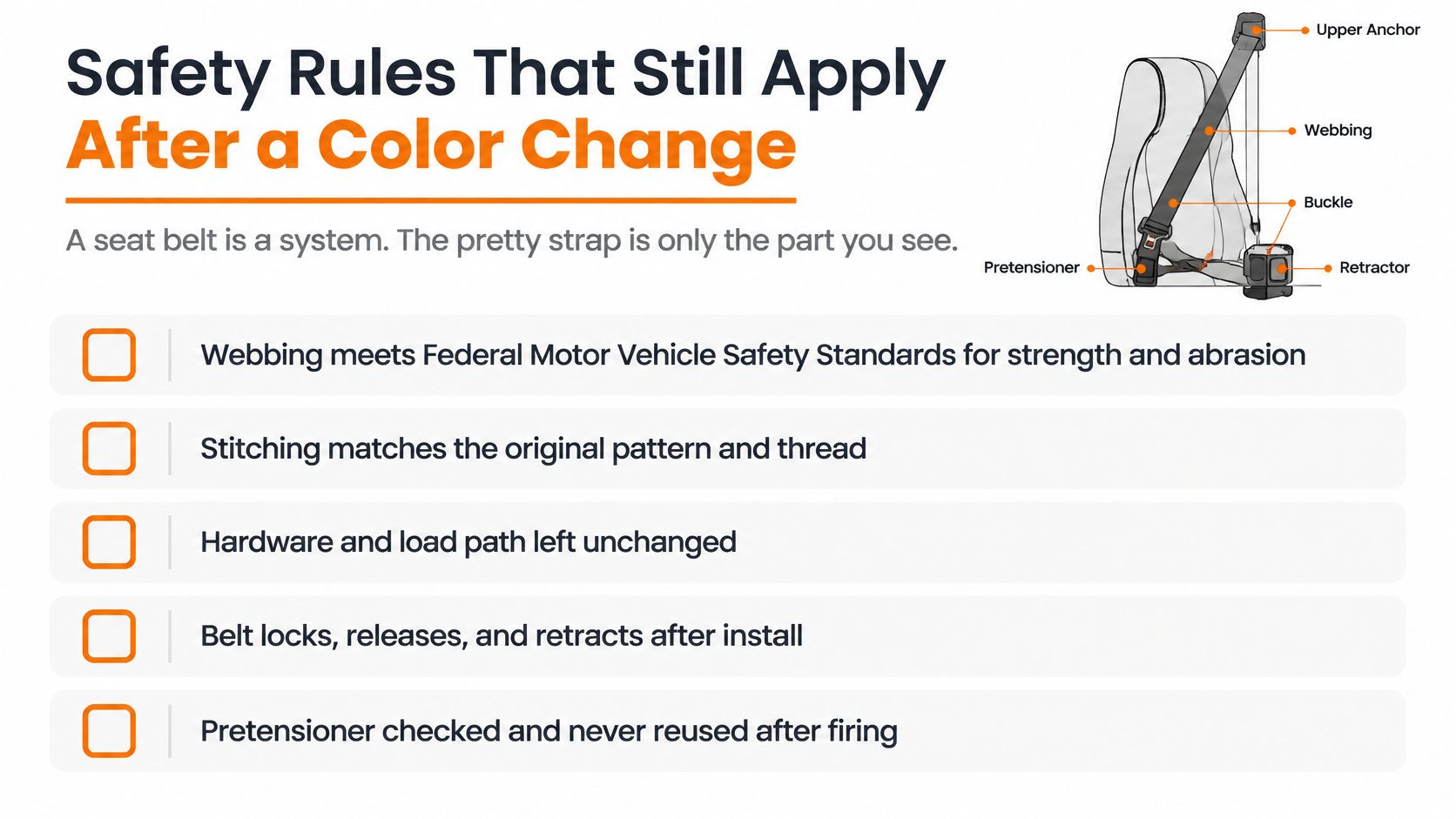
Don't glue a cover over a chew hole, knot a torn strap, or substitute an unknown used assembly from another car. Those shortcuts can conceal damage or change fit and operation. A separate buckle pretensioner assessment is needed when the buckle-mounted mechanism is affected.
Check the returned assembly
Plug-N-Play describes reinstalling the original assembly, not skipping the vehicle's repair procedure. Anchors and electrical connectors should correspond to the original positions, and a dark warning light doesn't excuse visible webbing damage.
- Pull and retract: The strap should move smoothly and take up slack completely.
- Lock and latch: Check locking as specified for the vehicle and confirm secure buckle engagement.
- Inspect construction: Look for twists, catching edges, and loose thread near tags or the stop button.
- Confirm system status: Have unresolved restraint warnings diagnosed before returning the seating position to use.
A firm tug is only a basic functional check. It isn't a crash-performance test or a substitute for the required post-repair inspection.
How a Mail-In Webbing Replacement Works
Prepare the order around the complete removable assembly, not a loose piece of fabric. This overview shows the path from identifying the fault to reinstalling the returned belt.
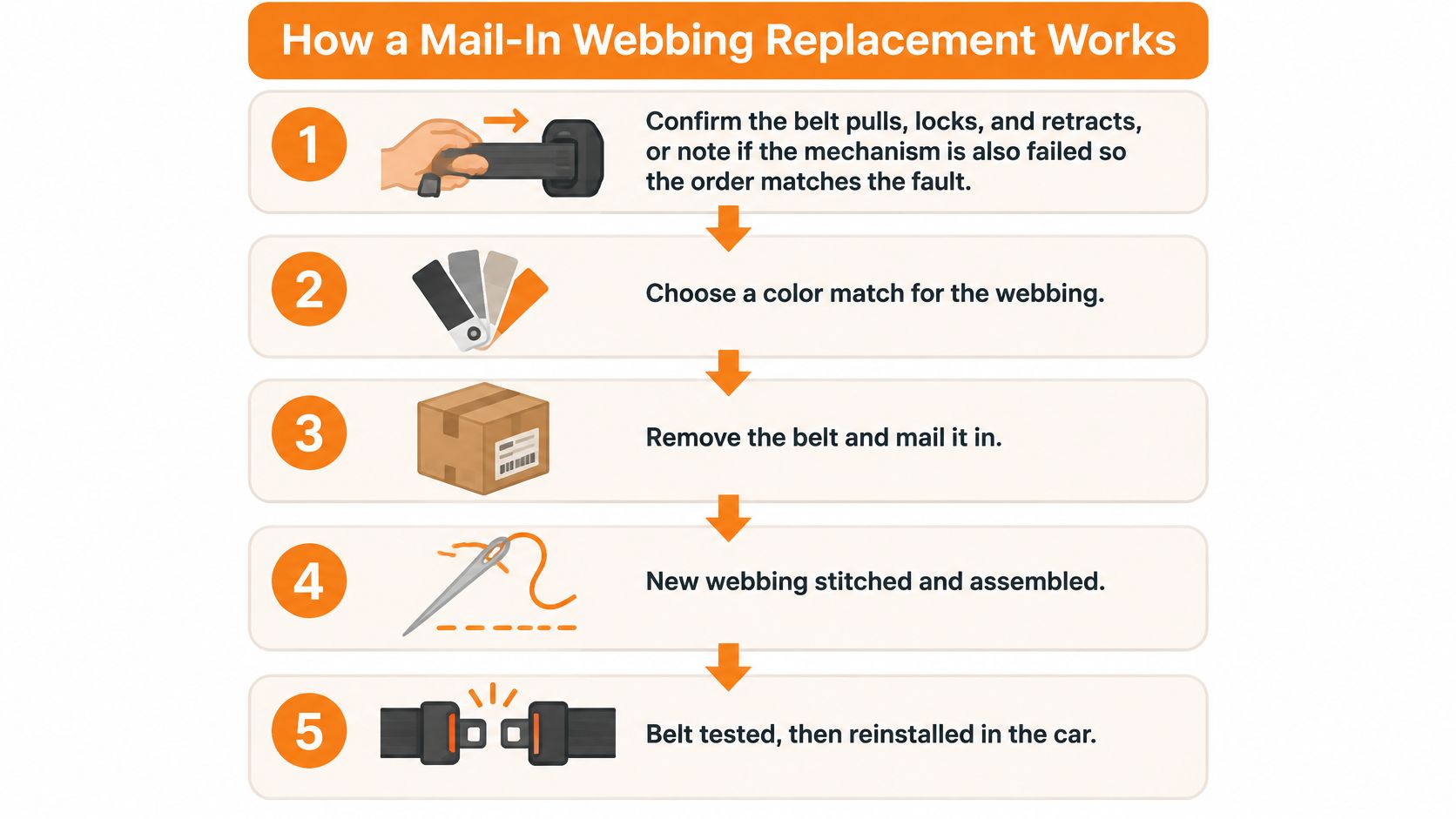
Prepare and send the assembly
- Record the symptoms. Note damaged areas, pulling or retraction problems, collision history, and any restraint warning. This lets the order describe more than the desired appearance.
- Choose the color before checkout. Include the quantity and identify each belt separately so the order matches the carton.
- Pay online and retain the receipt. We use the receipt accompanying the shipment to connect the parts with the service order.
- Have the assembly removed using the vehicle's repair procedure. Trim tools and the correct socket protect surrounding panels, but pretensioner-equipped belts also require the prescribed electrical isolation procedure. Don't probe pretensioner connectors or attempt removal without the necessary knowledge.
- Label and pack. Mark driver, passenger, or the specific rear position. Keep the latch plate, tags, and associated components attached; don't send only a cut sample. Cushion the hardware so it can't strike other parts in transit.
Bench work and return
Our harness-repair process includes disassembling and cleaning the retractor mechanism and fitting replacement webbing with the original manufacturer tags and components re-stitched into place. Mechanism faults must be identified as part of the required work rather than assumed to be included in a cosmetic request.
Confirm current processing and shipping arrangements before taking the vehicle out of service. Transit time is separate from bench work, and the vehicle shouldn't be used with an occupied seating position missing its restraint.
The accompanying video provides another view of the service process.
Reinstall in the original locations using the prescribed fasteners, tightening procedure, and connector routing. Finish with the pull, lock, latch, and full-retraction checks, including checking that the strap clears the closed door.
Choose a Color and Send the Original Belt
A useful order tells the technician what happened, which seating position the belt came from, and what finish you want. “Rear passenger belt, dog-chewed shoulder section, no known collision, replace with black webbing” is clearer than “custom belt repair.”
For a style-only change, specify the actual finish rather than a general theme. “Black with orange edge trim” describes something different from “orange.” For an unobtrusive repair, identify the existing strap color and make clear that matching it is more important than adding contrast.
Put the repair decision in writing
Keep the fault description separate from the color request. If the belt stays locked, has a deployed pretensioner, or was loaded in a collision, include that information even when the strap looks presentable. The technician needs that history to evaluate the assembly appropriately.
We service customer-supplied original assemblies rather than asking you to adapt unfamiliar hardware. Our seat belt repairs include a lifetime warranty, but a warranty doesn't remove the need for correct installation or future inspection. Continued abrasion against damaged trim or a rough guide also needs correction so it doesn't damage the replacement strap.
Make the carton match the order
Before sealing the box, check that each labeled assembly has a corresponding order entry. Include contact details and the receipt, and keep your own record of the seating positions. For a body shop sending several similar units, clear labels prevent uncertainty when the parts return.
You're choosing a finished restraint component, not fabric by the roll. An intentional color, suitable original hardware, documented repair scope, and correct reinstallation matter more than how closely a swatch matches a dashboard accent.
Safety Restore offers mail-in webbing replacement, custom colors, and repair for affected seat belt mechanisms. Visit Safety Restore to choose the service that matches the fault, specify your finish, and prepare the original assembly for shipment.