Seatbelt strap covers can improve shoulder comfort, but they aren't crash-tested safety devices: observed 2025 use was 92% for drivers and 90% for right-front passengers, and they should never replace repaired or replaced seat belt webbing, retractors, or pretensioners. If your belt is frayed, locked, deployed, or slow to retract, a cover is the wrong fix.
You notice the problem on an ordinary drive. The shoulder belt rubs your neck, your passenger keeps pulling it away from their skin, or a child complains that the strap feels rough. Then you see a soft padded cover online and assume the discomfort is the whole problem.
Sometimes it is. A correctly fitted cover can make an undamaged belt more comfortable. But comfort and restraint performance are separate jobs. A sleeve can't repair webbing damaged in a collision, free a jammed retractor, reset a deployed pretensioner, or restore a belt that no longer moves and locks as designed.
NHTSA's seat-belt guidance makes the priority clear. Nearly 50% of people killed in crashes where belt use was known were not buckled, so an accessory must never make correct belt use more difficult (NHTSA seat-belt guidance). Treat a seatbelt strap cover as a comfort layer placed over a critical restraint, not as a safety upgrade.
Table of Contents
- Seatbelt Strap Cover Basics and Why Comfort Options Matter
- What Seatbelt Strap Covers Actually Are and How They Work
- Comparing Seatbelt Strap Cover Materials and Designs
- Safety Risks of Seatbelt Strap Covers and Hidden Trade-offs
- When a Seatbelt Strap Cover Makes Sense and When It Does Not
- Seatbelt Strap Covers vs Professional Seat Belt Repair and Webbing Replacement
- How to Choose the Right Solution for Your Vehicle and Safety Needs
- FAQ About Seatbelt Strap Covers and Belt Restoration Choices
Seatbelt Strap Cover Basics and Why Comfort Options Matter
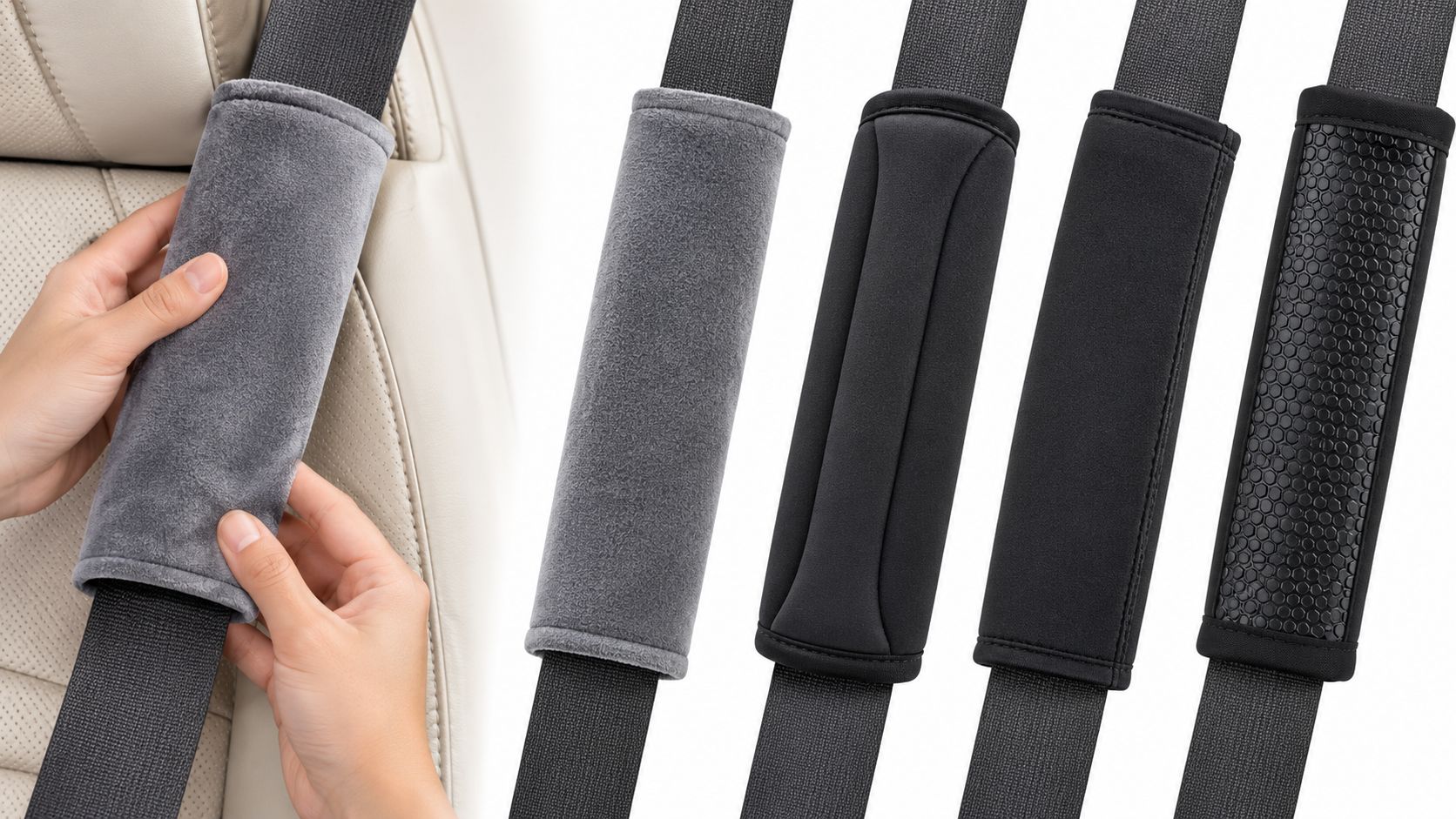
A seatbelt strap cover is usually a fabric sleeve, padded wrap, or slip-on cushion that surrounds the shoulder portion of the belt. It spreads contact over a wider area and can reduce irritation where the webbing crosses the neck or collarbone. Most attach with hook-and-loop fasteners, snaps, or a simple wrap that stays closed around the belt.
Consider two drivers with similar complaints. The first has a clean belt that retracts smoothly, locks when pulled sharply, and lies across the chest correctly. For that driver, a thin, secure cover may be a reasonable comfort adjustment. The second driver has a belt that stayed locked after a crash. A cover might hide the ugly webbing or make the belt look tidier, but it leaves the failed mechanism untouched.
Safety rule: If the belt has a mechanical fault, repair the belt before adding anything around it.
A proper inspection comes before shopping. Pull the belt slowly, check the webbing for cuts, fraying, melted areas, stiffness, stains that may conceal damage, and signs of chewing, then test whether it retracts without hesitation. The belt should also lock during a controlled sharp pull. Don't perform aggressive testing while driving, and don't keep using a belt that behaves abnormally.
The accessory belongs only on a belt that already functions correctly. The underlying restraint still needs full movement, reliable locking, and proper positioning across the occupant. A cover can address rubbing. It can't correct poor belt geometry, accident damage, or a recall-related defect.
What Seatbelt Strap Covers Actually Are and How They Work
The cover changes the surface that touches the occupant. It doesn't change the belt's retractor, latch, pretensioner, anchor, or webbing strength. A fabric sleeve generally adds the least structure, while foam and neoprene designs create a thicker cushion between the webbing and the body.
That added layer creates the central fit question: can the belt still travel freely through its normal path? The cover shouldn't bunch at the anchor, catch on trim, prevent the shoulder belt from returning to the pillar, or make the belt sit away from the chest. It also shouldn't cover labels required on the original webbing.
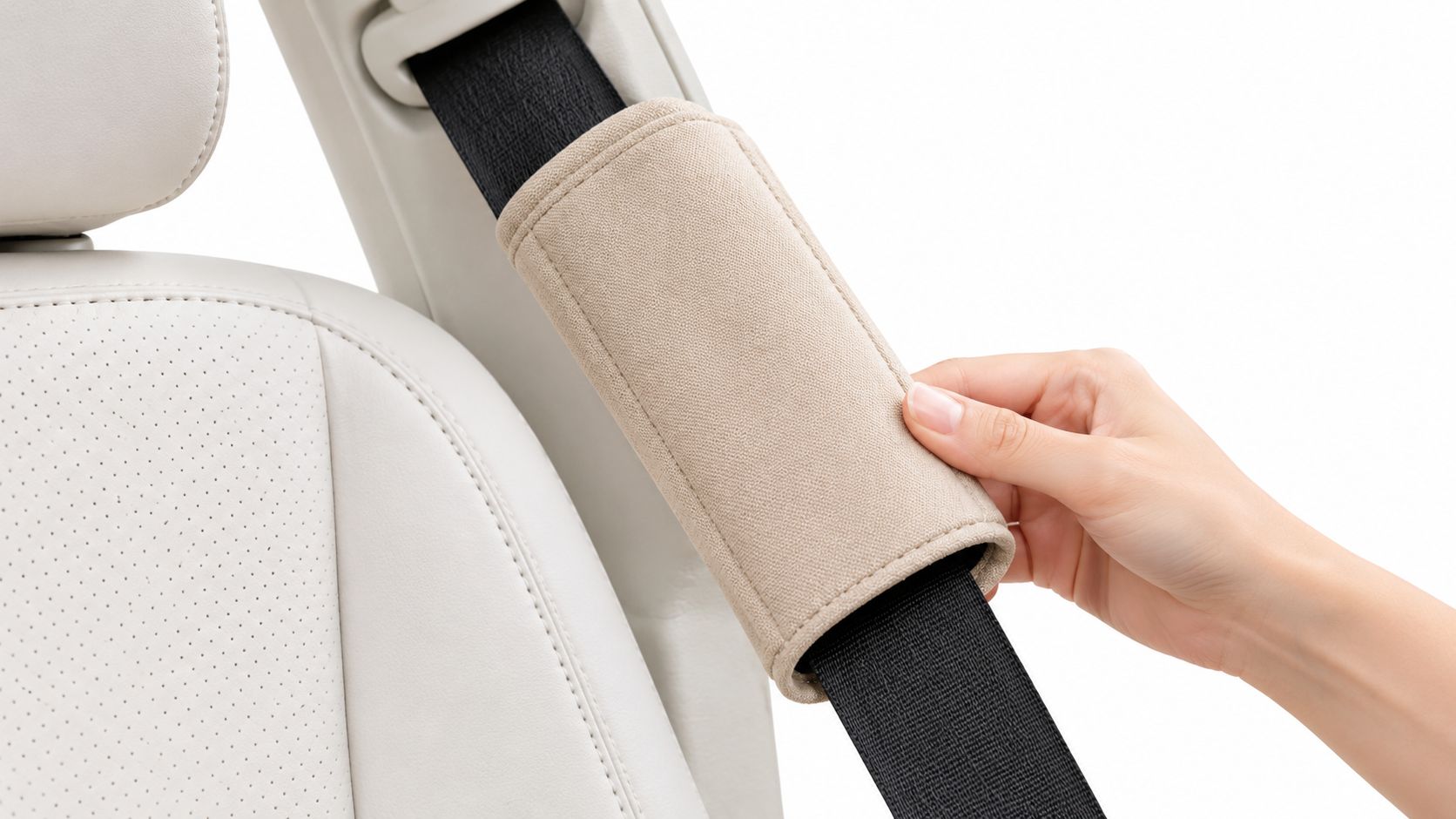
NHTSA doesn't treat an automotive seat belt strap cover as a separate safety-critical part. That doesn't give manufacturers permission to ignore the restraint system. NHTSA's interpretation says an attached accessory must not interfere with belt retraction, damage the webbing through adhesive or contact materials, or obscure required FMVSS 209 webbing labels (NHTSA's seat-belt accessory interpretation).
Original equipment installations face a broader requirement. With the pad in place, the complete system must still satisfy the applicable occupant protection, seat-belt assembly, and flammability requirements associated with FMVSS 208, FMVSS 209, and FMVSS 302. That is why “made from premium material” tells you far less than whether the installed cover preserves original belt movement.
How the cover stays in place
A cover that slides along the belt may end up at the neck, shoulder, or lower anchor instead of staying at the intended contact point. Hook-and-loop closures can hold well, but exposed edges may irritate skin or catch on clothing. Silicone-backed designs may resist movement, yet their extra grip can increase friction where the belt needs to pass smoothly.
Before accepting the product, buckle the belt, sit in your normal driving position, and observe the entire path. The belt should remain flat, the latch should be accessible, and the retractor should pull the cover back without hesitation when you lean forward and return upright.
Comparing Seatbelt Strap Cover Materials and Designs
Material choice matters, but no material earns a safety pass by itself. The best option is the one that solves a minor comfort problem without creating bulk, drag, or movement at the wrong point.
| Material | Comfort Level | Durability | Fit Reliability | Safety Interference Risk |
|---|---|---|---|---|
| Soft fabric sleeve | Good for light rubbing and daily use | Moderate, depending on stitching and washing | Usually good when thin and correctly sized | Low when it stays flat and clear of the retractor |
| Memory-foam pad | High cushioning for a sensitive shoulder or neck | Moderate, foam may compress or retain shape changes | Variable because thickness can shift belt position | Moderate if the pad creates slack or bunches |
| Neoprene wrap | Soft, grippy, and resistant to small spills | Good for frequent use, though it can retain heat | Moderate, depends on closure and thickness | Moderate if its grip slows belt travel |
| Silicone-backed design | Stable placement and easy cleaning | Good against surface wear | Variable across belt widths and trim layouts | Moderate when friction affects retraction or routing |
A thin fabric sleeve is my first choice for an adult commuter with an undamaged belt. It offers a modest comfort change without adding much structure. Look for flat seams, a secure closure, and an opening that matches the belt width rather than forcing the webbing to fold.
A foam pad makes sense only when the extra cushioning solves a genuine pressure point and the belt still lies firmly across the chest. Thick foam is where buyers get into trouble. It can feel comfortable while sitting still, yet create a different belt position once the occupant leans forward or the vehicle brakes.
Neoprene handles dirt and repeated handling well, but it can feel warm against the body. A grippy interior may stop sliding, though that same grip deserves a careful retraction test. Silicone-backed products are similar. Stability is useful only if the product doesn't add resistance to the belt's normal movement.
For a family using child restraints, don't choose from this table on comfort alone. Use the cover supplied or approved by the restraint manufacturer, and follow the child-seat instructions for every strap and contact point. The adult belt and the child harness have different fit requirements, so a product that feels harmless in an adult seating position may be unsuitable around a child restraint.
Safety Risks of Seatbelt Strap Covers and Hidden Trade-offs
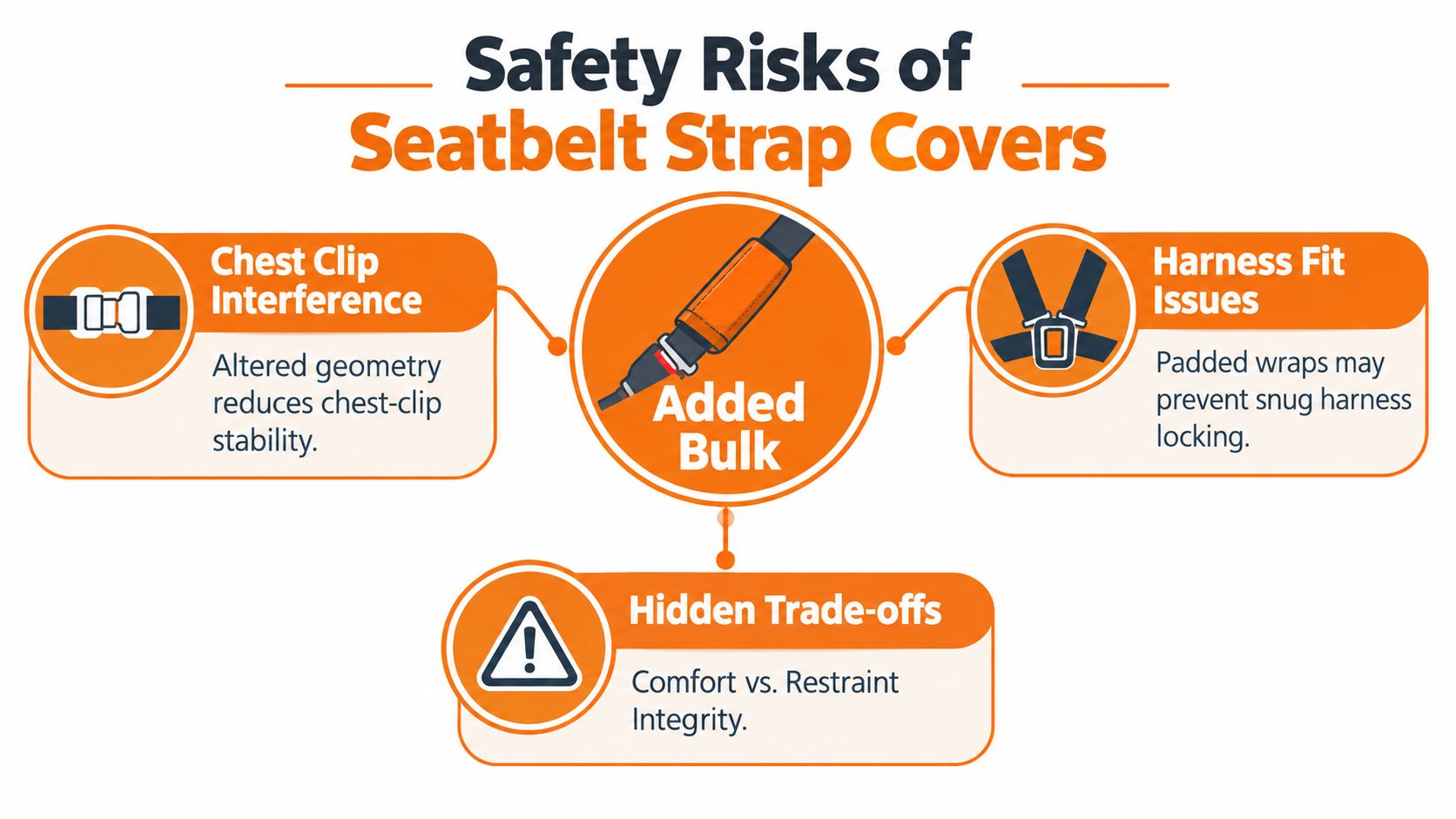
The most overlooked risk is not the cover falling off. It's the cover changing the relationship between the belt and the occupant.
Added bulk can move the shoulder portion away from the body, increase friction, or make the belt less willing to retract. A wrap can also gather at an anchor or create a small amount of slack. Those changes may be subtle during a normal drive and still matter in a crash, when the restraint must load the occupant in a controlled way.
Child restraints require even more discipline. Independent child-restraint safety guidance warns that aftermarket pads and covers can interfere with harness tightening and chest-clip placement. The same guidance notes that there is no federal crash-test benchmark validating aftermarket strap pads across different seats, so packaging claims can't establish crash performance (child-restraint guidance on non-regulated products).
The fit checks buyers skip
- Watch the belt return: Lean forward and sit back. The belt should retract without dragging, folding, or leaving a loop.
- Check the shoulder line: The belt must remain across the shoulder and chest, not move toward the neck, face, or edge of the shoulder.
- Inspect the closure: No flap, fastener, or strap should obstruct the latch, anchor, trim, or webbing labels.
- Remove it for child-seat work: Use only covers supplied or tested by the child-restraint manufacturer when a harness or child-seat belt is involved.
Added comfort is acceptable only when the belt still fits, moves, and locks exactly as intended.
A cover isn't automatically dangerous. It becomes a poor choice when comfort depends on changing belt placement or increasing resistance. If you need to pull the belt into position, force it through the cover, or accept visible slack, remove the accessory.
When a Seatbelt Strap Cover Makes Sense and When It Does Not
Use a seatbelt strap cover when the complaint is minor and the belt itself passes inspection. The webbing should be intact, the retractor should operate normally, the latch should engage securely, and the belt should sit correctly without the cover. In that situation, choose the thinnest design that solves the irritation and test it in every seating position where it will be used.
Don't use a cover to deal with any of these conditions:
- Frayed, cut, torn, melted, aged, or chewed webbing: The strap needs replacement or professional assessment. Covering damage removes visibility without restoring strength.
- A locked retractor: If the belt won't pull out or retract normally, the mechanism needs repair or replacement.
- A deployed pretensioner: A crash-activated pretensioner is not made functional by adding a sleeve.
- An airbag or SRS warning: The warning needs diagnosis and correction. A comfort accessory has no role in clearing a restraint-system fault.
- A child-seat fit problem: Follow the child-seat manufacturer's instructions instead of improvising with aftermarket padding.
- A belt that rubs because of poor routing: Adjust the seat or anchor position if the vehicle allows it. Don't use thickness to force a bad route into a comfortable one.
Cleanliness can also solve some irritation. Remove loose debris, follow the vehicle manufacturer's cleaning instructions, and use a careful interior-care process such as the SwiftJet car upholstery tips before deciding the belt needs an accessory. Never soak a retractor or saturate the webbing with a product that could alter its texture.
The decision is simple. Comfort on a healthy belt can justify a cover. Damage or malfunction requires restraint repair. If the cover is hiding a defect, skip the purchase and address the belt.
Seatbelt Strap Covers vs Professional Seat Belt Repair and Webbing Replacement
A strap cover changes appearance and contact comfort. Professional repair addresses the component that failed. Those outcomes aren't interchangeable.
A damaged belt may need new webbing. A locked unit may need retractor service. A deployed unit may need pretensioner work. If the belt suffered collision loading, the correct answer depends on the condition of the original assembly and the vehicle's repair requirements, not on whether a padded sleeve can conceal the damage.
What a restoration service should resolve
A proper repair path should identify the affected part, preserve compatible original hardware where appropriate, and return the assembly ready for correct installation. For webbing, that means dealing with cut, torn, ripped, frayed, aged, or dog-chewed material rather than wrapping it. For mechanisms, it means addressing locked retractors and deployed pretensioners rather than forcing the belt to move.
Safety Restore offers mail-in repair for seat belt retractors, pretensioners, and webbing replacement. Its published service model lists $99 per item, a typical 24-hour turnaround, and a lifetime warranty, with service for vehicles across the United States. The company also lists standard and colored webbing options, which can solve a cosmetic preference through replacement material instead of adding a sleeve over the original strap.
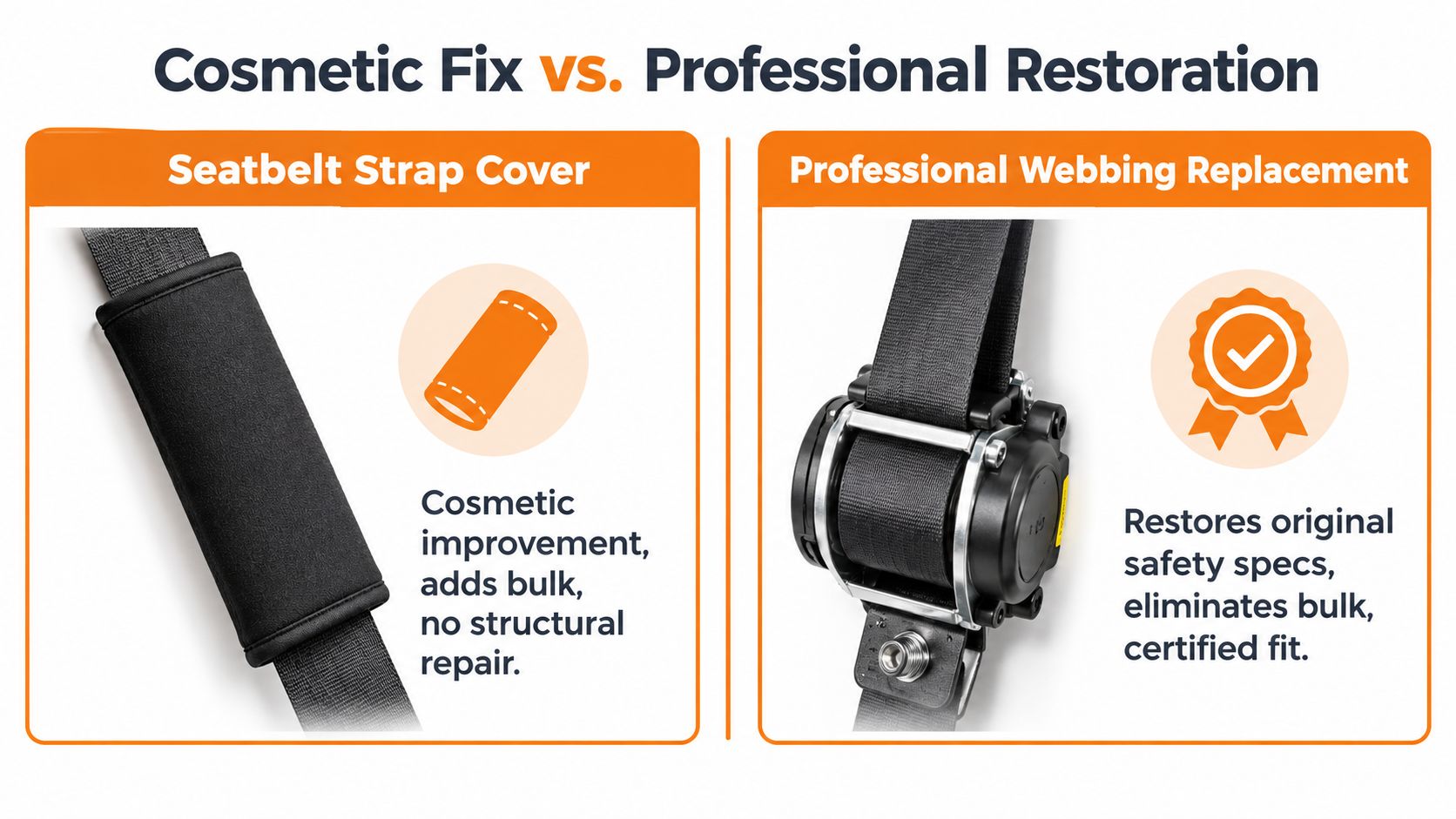
The cost comparison is not just the purchase price. A cheap cover may be a sensible comfort item, but it has no structural repair value. A restoration service costs more than a basic sleeve, yet it targets the failed webbing or mechanism and removes the need to add bulk over a damaged strap.
Before shipping any component, confirm which part the service accepts, remove it according to the vehicle's repair procedure, and follow the return-installation instructions. A repaired component still needs correct installation and a complete vehicle safety check.
For owners maintaining the interior after the repair, a practical ultimate car seat care routine can help keep surrounding upholstery clean without treating the belt itself like ordinary trim. The belt remains a restraint component. Don't apply cleaners, dyes, adhesives, or decorative products without confirming they won't affect the webbing.
How to Choose the Right Solution for Your Vehicle and Safety Needs
Start with the symptom, not the product category.
If you drive daily and the belt merely rubs your shoulder, inspect the belt, choose a thin cover, and verify retraction before keeping it installed. If you drive a tall vehicle or share the car with different occupants, test the accessory in each normal seating position because shoulder geometry changes with seat height and posture.
Parents need a stricter rule. A cover should never interfere with a child-seat harness, chest clip, belt path, or tightening process. If the child-restraint manufacturer doesn't supply or approve the product, leave it off the restraint.
Collision shops and independent mechanics should separate cosmetic complaints from post-crash restraint work during intake. A belt that looks acceptable may still have a locked retractor or deployed pretensioner. Diagnose the assembly before recommending trim accessories, and document the condition of the webbing and mechanism.
Used-car rebuilders and fleet managers should prioritize repeatable fit and reliable downtime planning. Replacing compromised webbing or restoring the original mechanism is the appropriate route when the belt has sustained damage. A sleeve is useful only after the underlying assembly passes inspection and the vehicle's restraint system operates normally.
A practical choice matrix
- Irritation only: Consider a thin, secure cover after checking belt movement.
- Visible webbing damage: Stop using the belt and arrange webbing replacement or qualified repair.
- Locked or deployed hardware: Send the affected mechanism for appropriate restoration or replace it through the correct repair channel.
- Child restraint involvement: Follow the specific seat manufacturer's instructions, not general accessory advice.
- Persistent warning light: Diagnose the SRS fault before addressing comfort.
My verdict is firm. Buy a cover for comfort, not for safety performance. When the belt itself is compromised, spend the repair money on the restraint, where it can restore function instead of masking a defect.
FAQ About Seatbelt Strap Covers and Belt Restoration Choices
Can a seatbelt strap cover void my vehicle warranty?
It may create a warranty dispute if it damages the webbing, interferes with operation, or conflicts with the vehicle manufacturer's instructions. Check the owner's manual and remove any accessory before dealer inspection.
How should I inspect the webbing?
Look along the entire visible strap for fraying, cuts, melted fibers, stiffness, discoloration, or chewing. Pull it out slowly, confirm smooth retraction, and stop using it if the belt locks unexpectedly or fails to lock during a controlled test.
Is colored replacement webbing safer than a colored sleeve?
Color doesn't determine safety. Properly specified replacement webbing installed as part of a compatible repair is fundamentally different from placing a colored sleeve over the original strap. Confirm that the repair preserves the assembly's intended fit and operation.
How do I verify repair quality?
Ask what component was repaired, whether the original hardware was retained where appropriate, how the returned part should be installed, and what warranty applies. After installation, confirm correct routing, latch engagement, retraction, locking, and the absence of warning faults.
A comfort accessory belongs only on a belt that's already intact, correctly fitted, and fully functional. If you're covering damage, you're delaying the repair that matters.
Safety Restore repairs locked retractors, deployed pretensioners, and damaged seat belt webbing through its mail-in service, with a published flat price, typical 24-hour turnaround, and lifetime warranty. If your belt is frayed, chewed, cut, or no longer operates correctly, visit Safety Restore to start the repair process instead of hiding the problem under a cover.