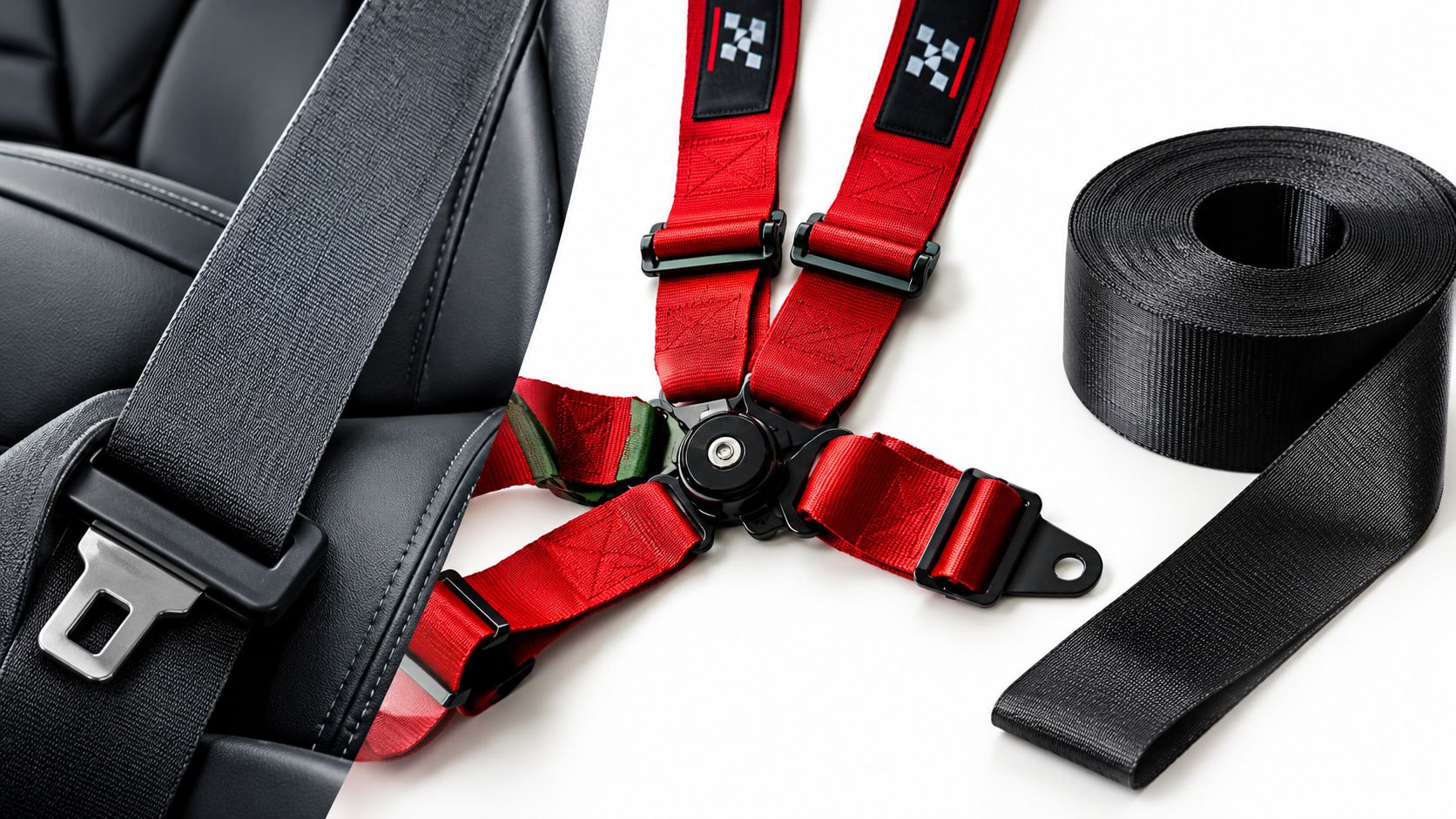
3 inch wide belts are safety webbing and restraint assemblies built around a formal width specification, not oversized fashion belts or generic straps. Whether 3 inches is the right choice depends on the job, because an OEM seat belt, racing harness, cargo strap, industrial restraint, and lifting belt follow different design and safety rules.
The popular advice that “wider is always safer” causes plenty of bad repairs and uncomfortable gear choices. Width only works when it matches the load path, hardware, body geometry, certification, and intended environment. A decorative waist belt can't replace automotive restraint webbing, a cargo strap isn't a seat belt, and a racing harness shouldn't be installed as though it were factory equipment.
Table of Contents
- What 3 Inch Wide Belts Actually Are
- Safety Standards and the History Behind 3 Inch Webbing
- OEM Seat Belt Webbing Versus Racing Harness Use
- When 3 Inch Is Required and When It Is Not the Best Fit
- Replacing and Restoring Seat Belt Webbing Safely
- How to Choose the Right 3 Inch Belt Path
What 3 Inch Wide Belts Actually Are
The measurement is easy. The application is where the trouble starts.
A 3 inch wide belt may refer to automotive restraint webbing, a competition harness, a heavy-duty cargo strap, a lifting belt, or a fashion accessory. Those products can share a width while having completely different fibers, stitching patterns, buckles, anchor points, elongation behavior, and inspection requirements. Treating them as interchangeable is how a replacement belt ends up looking correct but performing wrong.
Match the webbing to the job
For an automotive seat belt, the webbing is part of a restraint system. The belt works with a retractor, buckle, anchor, stitching, load limiter, and sometimes a pretensioner or supplemental restraint system. The webbing must manage occupant movement during a crash while remaining compatible with the original hardware and vehicle design.
A racing harness also restrains a person, but its geometry is different. A multi-point harness depends on shoulder belts, lap belts, submarine protection, anchor locations, adjustment hardware, and competition rules. A harness may be perfectly appropriate for a track car and completely wrong for a road vehicle if it lacks the equipment integration and certification required for normal passenger use.
Cargo webbing has another job. It holds a load in place rather than positioning a person inside a crash-tested passenger compartment. Its rated capacity, edge protection, attachment angle, tensioning method, and working load limit matter more than buckle comfort or occupant geometry. A lifting belt is different again. It gives a lifter a firm surface for bracing, but it isn't designed to arrest a vehicle occupant or secure freight.
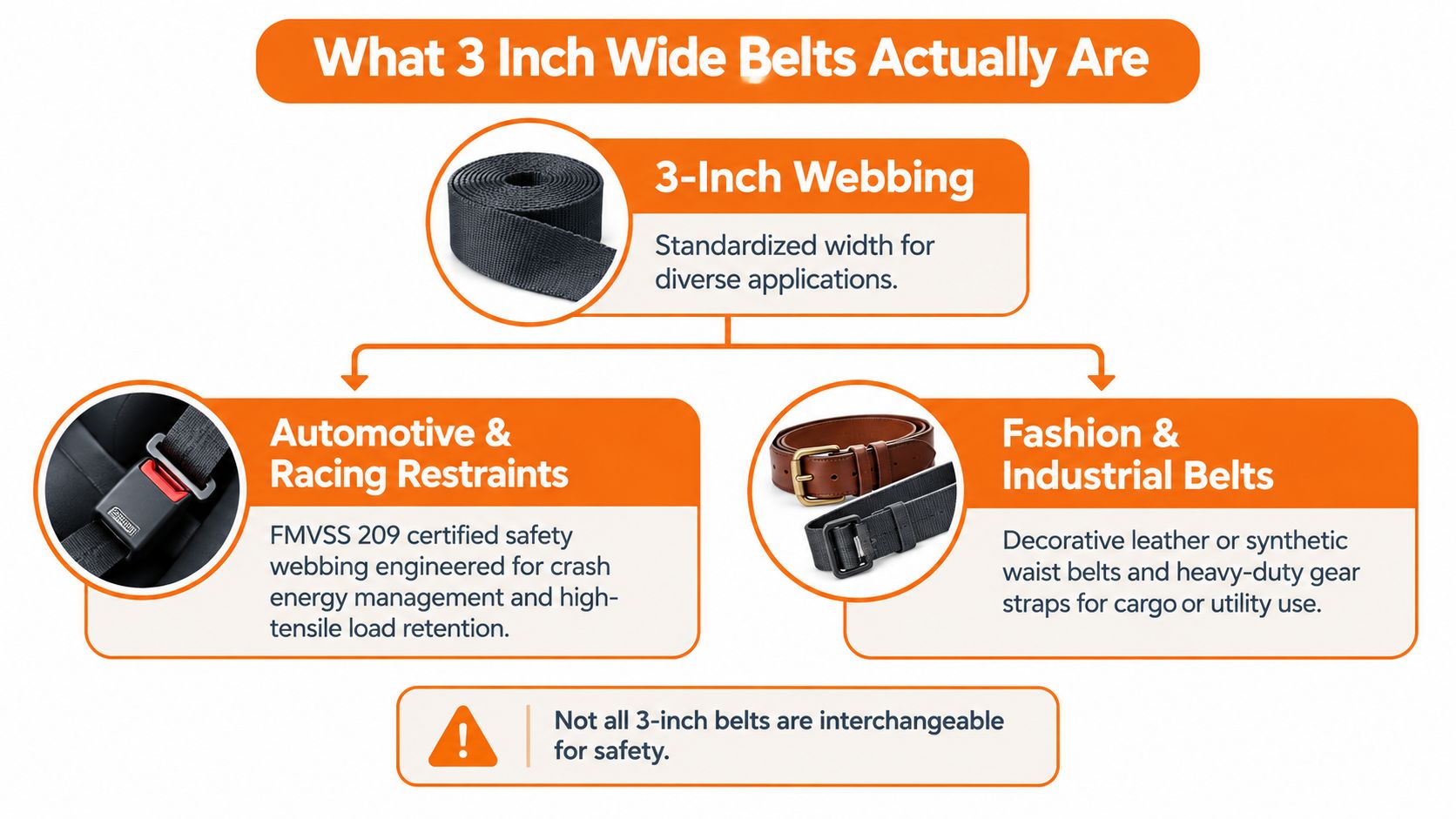
Practical rule: Measure the width only after identifying the system. “Three inches” tells you the size, not whether the belt is safe for your application.
Fashion history helps explain why the phrase creates confusion. Wide waist belts have appeared in mainstream clothing, while military equipment and restraint systems also used broad webbing. But appearance and width don't establish load rating, regulatory compliance, or compatibility. The right question is always, what is this belt expected to do when something goes wrong?
Safety Standards and the History Behind 3 Inch Webbing
In passenger vehicles, width isn't merely a styling decision. FMVSS 209 applies to seat belt assemblies used in passenger cars, multipurpose passenger vehicles, trucks, and buses. The regulation covers performance requirements including strength, elongation, webbing width, durability, and related assembly characteristics, as documented in the U.S. seat belt assembly requirements under FMVSS 209.
That distinction matters during a repair. A roll of attractive synthetic webbing may be wide enough to fit through a buckle, yet still be unsuitable for a certified restraint assembly. Seat belt webbing must work with the original stitching, retractor behavior, hardware, and force-management design. A repair that preserves the appearance but changes the performance characteristics isn't a proper restoration.
Why the width has staying power
Three-inch webbing also has a long history outside modern passenger vehicles. A U.S. Army 1908 web equipment pattern described a waist belt as 3 inches wide, with standardized sizes introduced in 1909 and revised in 1915, according to the historical material summarized in the history of belts from the 1920s through the 1960s. That continuity shows that broad webbing has long been treated as a practical load-bearing dimension rather than a niche aftermarket measurement.
Fashion followed a similar path. Sources covering women's belts describe widths from 3 to 5 inches across parts of the 1920s through the 1960s, while menswear belts in the 1940s commonly ranged from 1.5 to 3 inches. Those examples don't make fashion belts safety equipment. They show why the same measurement appears across clothing, military gear, and automotive-adjacent products.
A standards mindset is useful even when you're evaluating equipment outside a vehicle. The broader safety management context covered by 45001 ISO standard Australia reinforces a basic workplace principle, identify the governing requirements before choosing equipment. For a vehicle, that may mean federal restraint rules and manufacturer specifications. For machinery, it may mean an occupational safety directive or equipment-specific rule.
OEM Seat Belt Webbing Versus Racing Harness Use
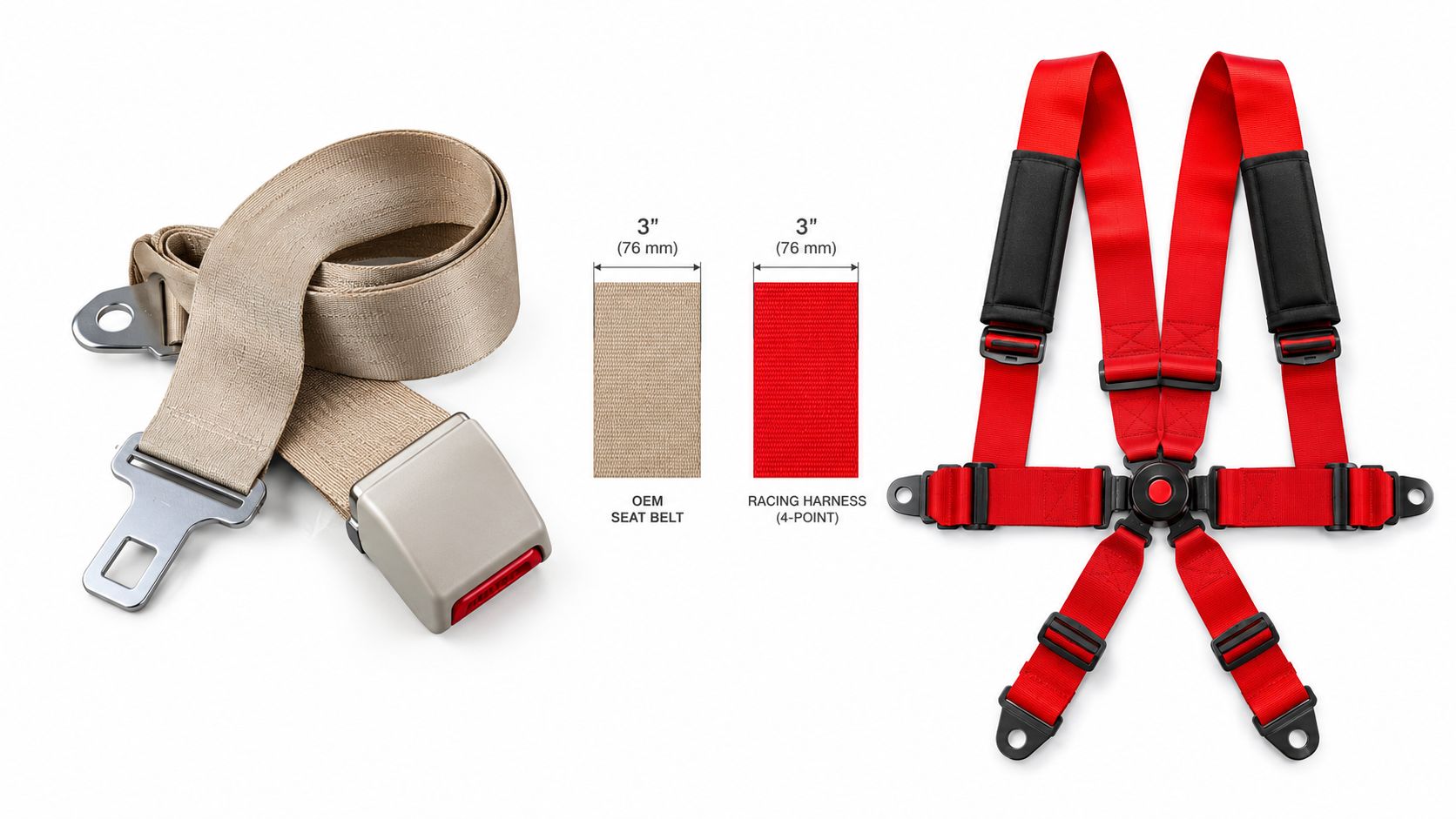
The same three-inch width can support two very different restraint philosophies. OEM seat belts are designed around the vehicle's original crash system, while racing harnesses are designed around controlled installation in a competition vehicle. Width doesn't bridge that gap.
OEM restraint priorities
A factory seat belt usually has a retractor that controls spool-out, a buckle designed for that vehicle, an anchor arrangement engineered into the body, and possible integration with pretensioners or load limiters. The belt's behavior is part of the vehicle's occupant protection strategy. Change the webbing, stitching, or hardware without accounting for the complete system, and you may change how the restraint behaves in a collision.
For a damaged factory belt, preserving the original hardware is often the sensible path when the hardware remains serviceable. A replacement should match the assembly's intended construction and retain the correct routing, buckle engagement, anchor position, and retractor operation. Fraying, cuts, heat damage, contamination, or a belt that no longer retracts smoothly are reasons to stop treating the part as cosmetic trim.
Racing harness priorities
A racing harness uses multiple belts to control the torso and pelvis. The installation depends on correct shoulder-belt height, lap-belt angle, anchor strength, anti-submarine geometry, and adjustment. The seat, roll cage or mounting structure, harness bar, and driver position all affect the result.
A 2024 racing industry article states that the majority of racing harness belts come in a 3 inch width, with the size common in sport compacts, hobby stocks, modifieds, and sprint cars. That makes three inches familiar in competition, but it doesn't make every three-inch harness legal or suitable for every event.
The failure I see most often in mixed-up installations isn't the belt width. It's the system mismatch.
- Road car with racing harness: The harness may lack the factory retractor and integration required by the road vehicle's restraint design.
- Track car with factory belt: The original belt may not provide the geometry, adjustment, or containment required for the driver's competition setup.
- Replacement with generic webbing: The material may fit the slot but lack the verified construction and stitching required for occupant restraint.
Use the belt type approved for the vehicle and environment. If the vehicle returns to public roads, retain a compliant OEM restraint system unless the relevant authority and manufacturer documentation clearly support another arrangement.
When 3 Inch Is Required and When It Is Not the Best Fit
Three inches isn't automatically the strongest, safest, or most comfortable choice. In cargo securement, commercial 3 inch polyester webbing is commonly engineered around working load limits near 5,400 to 6,000 pounds, with published break strengths often around 18,000 pounds. Some nylon versions are listed at 21,000 pounds tensile strength, as shown in Kinedyne's bulk 3 inch Rhino polyester webbing specifications.
Those figures describe different things. Break strength is the point at which the material fails under the stated test conditions. Working load limit is the usable rating, and the accepted engineering rule is that it shouldn't exceed one-third of rated capacity. A crooked pull, edge contact, damaged stitching, or poor anchor angle can reduce the effective working load limit further.
Compare the application, not the width
| Application | Typical Working Load Limit | Break Strength Reference | Compliance Note |
|---|---|---|---|
| Commercial cargo securement | Near 5,400 to 6,000 lb | Often around 18,000 lb | Use the manufacturer's rating, correct tensioning method, and suitable load direction |
| Heavy-duty nylon cargo webbing | Product-specific | Some versions list 21,000 lb tensile strength | Tensile strength isn't the same as working load limit |
| Industrial or off-road restraint | Governed by the equipment and rule | Don't substitute cargo ratings | Some applications specify a minimum strap width of no less than 3 inches |
| Lifting belt | Not a cargo restraint rating | Not selected by break strength alone | Choose based on torso clearance, construction, and training use |
The OSHA directive on powered industrial truck operator restraints shows why industrial restraint decisions require more than a wider-is-better assumption. Some machine and work-vehicle applications use 2 or 3 inch belts, and California off-road equipment rules referenced in technical coverage specify a minimum strap width of no less than 3 inches for certain operator restraint systems. In those cases, three inches may be required for compliance, not selected because it feels more substantial.
Fit decides lifting-belt width
A lifting belt has a different constraint: your body. Independent lifting guidance notes that 3 inch lifting belts are mainly useful for shorter torsos or smaller frames, while 4 inch belts remain the standard for average-to-tall lifters. The practical measurement is the space between the top of the pelvic bone and the bottom of the ribs, not height alone, as explained in this lifting belt sizing guide.
A 4 inch belt that bites into the ribs or hip crest has failed the fit test, even if it offers more contact area. Choose three inches when a narrower profile lets you hinge, squat, or brace without fighting the belt. Choose wider only when your anatomy and movement pattern provide enough clearance.
Replacing and Restoring Seat Belt Webbing Safely
A chewed or frayed seat belt doesn't always mean the entire assembly belongs in the scrap bin. The repair decision starts with inspection. Check the webbing for cuts, torn stitching, heat damage, chemical contamination, pulled fibers, and signs that the retractor or pretensioner has deployed. A belt that locked during a collision may have an internal problem even if the visible fabric looks acceptable.
Preserve the factory system
The safest restoration path keeps the original hardware when it remains serviceable and replaces the damaged webbing with material intended for automotive restraint use. That preserves the fit through the pillar, the buckle relationship, the stop button position, and the retractor interface. It also avoids the common mistake of forcing generic strap material through hardware that was designed for a specific restraint assembly.
Before removal, document the routing and mounting points. Protect the original manufacturer tags and labels, because they can help identify the assembly and support inspection readiness. After reinstallation, confirm that the belt extends smoothly, retracts without binding, locks when tested as intended, and latches securely.
Know what a webbing repair can't fix
Webbing replacement won't correct a deployed pretensioner, a locked retractor, damaged anchor hardware, or an SRS fault. Those components need separate diagnosis and proper repair. Cosmetic color matching is useful for a clean interior, but it comes after the restraint's mechanical and structural condition.
A do-it-yourself sewing job is a poor gamble here. Ordinary upholstery thread, improvised stitching, and a household sewing machine don't reproduce certified restraint construction. The belt can look neatly repaired and still fail at the seam or transfer load incorrectly.
For owners and repair shops that want to retain original components, Safety Restore offers mail-in seat belt webbing replacement and repair services for customer-supplied automotive restraint parts. The practical workflow is to remove the relevant component, provide accurate vehicle and part information, send it for service, and reinstall it only after checking the returned assembly and vehicle system. Regardless of who performs the work, don't return a vehicle to service until the restraint and SRS functions have been verified.
How to Choose the Right 3 Inch Belt Path
Start with the object being protected. If the belt holds a person in a road vehicle, stay within the vehicle's certified restraint design. If it holds a driver in a competition car, follow the harness manufacturer's installation requirements and the event's approval rules. If it secures cargo, use the strap's working load limit and account for direction, edge contact, anchors, and load movement. If it supports lifting, let torso clearance and movement decide the width.
Use this decision test
Restoring an OEM seat belt: Inspect the webbing, retractor, buckle, anchor, pretensioner, and SRS condition together. A damaged belt with sound original hardware may be a candidate for professional re-webbing, while deployed or structurally damaged components may require full replacement.
Installing a racing harness: Don't buy based on color or width alone. Confirm the harness certification, number of mounting points, anchor locations, seat compatibility, shoulder-belt geometry, and intended vehicle use. A harness is only as sound as its complete installation.
Securing industrial cargo: Read the tag and manufacturer's rating. Keep the working load limit separate from break strength, use appropriate edge protection, and reject webbing with cuts, burns, severe abrasion, chemical damage, or compromised stitching.
Choosing a lifting belt: Measure the clearance between your lowest rib and hip crest, then test the belt in the positions where you train. A three-inch belt can be the better fit for a shorter torso or compressed pulling position, while a four-inch belt may provide a broader bracing surface when it clears the body.
The correct belt is the one whose material, hardware, geometry, and certification match the failure it must prevent.
Don't assume a new belt is safer than a properly restored original assembly. Don't assume an attractive belt is engineered for restraint. Verify the system, inspect every load-bearing connection, and replace the entire component when deployment, structural damage, or unknown history makes restoration uncertain.
If your vehicle has frayed, cut, locked, or collision-damaged webbing, send the original restraint components to Safety Restore for mail-in seat belt repair or OEM webbing replacement. Visit the service site to review the repair path before reinstalling a three-inch belt or returning the vehicle to the road.