You're standing at the repair counter after a collision, trying to decide whether a quoted price will hold. The shop mentions hourly labor, diagnosis time, parts, and possible complications. You hear the number rise before anyone has touched the vehicle, and you still don't know what the final bill will be.
That uncertainty is the problem flat rate pricing is designed to solve. Instead of charging for each hour or revising the invoice as work progresses, the provider sets one price for a defined service. The customer knows the charge upfront. The seller accepts the risk that the job may take more time or resources than expected.
Table of Contents
- What Is Flat Rate Pricing
- How Flat Rate Pricing Actually Works
- Flat Rate vs Hourly Billing in Auto Repair
- Real-World Example Safety Restore $99 Flat Fee
- When Flat Rate Pricing Benefits Shops and Owners
- Getting Started with Flat Rate Pricing
What Is Flat Rate Pricing
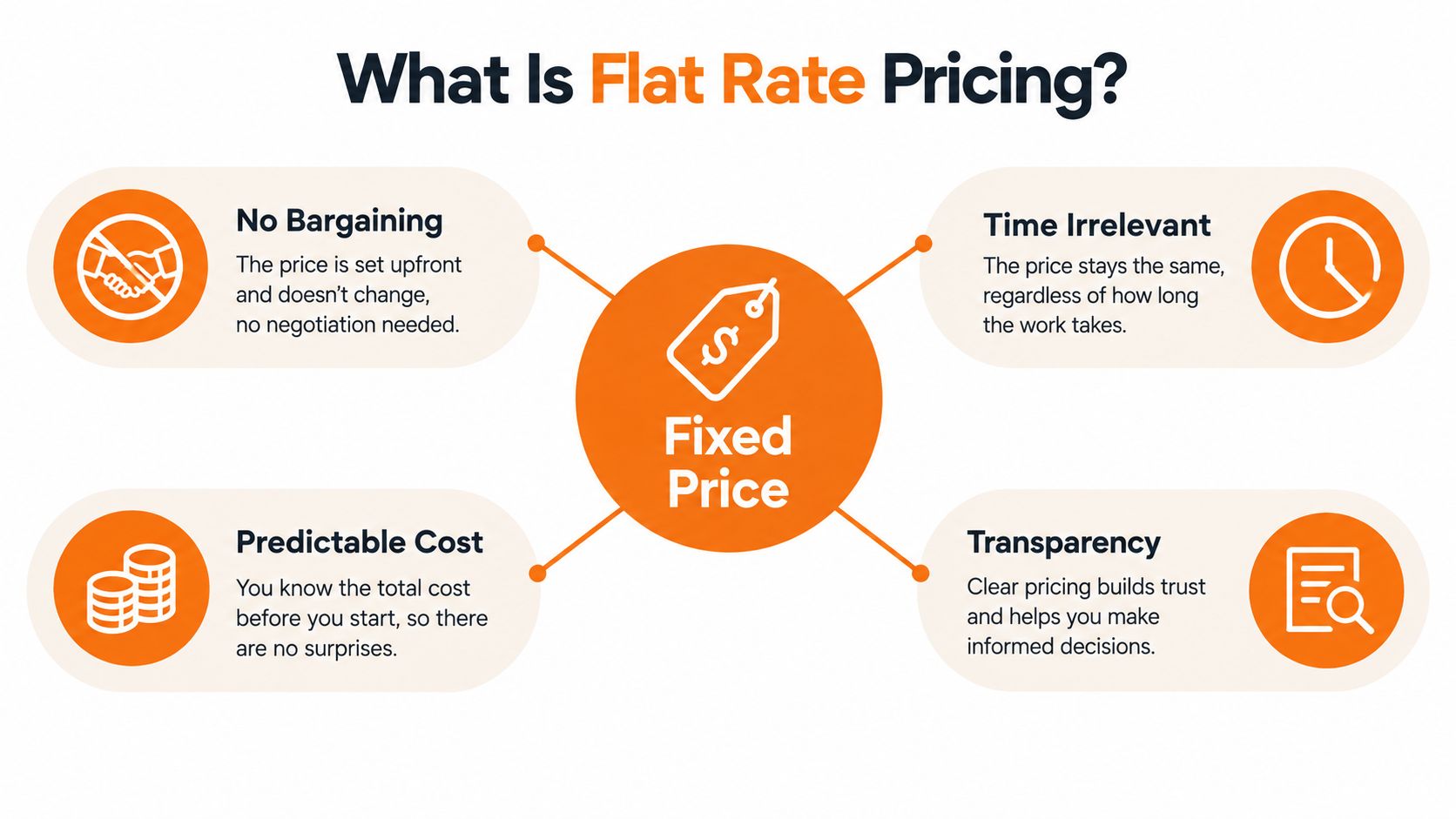
Flat rate pricing, also called fixed pricing or fixed-fee pricing, means one predetermined price applies regardless of bargaining, time spent, or resource consumption within the agreed scope. A firm-fixed-price contract in U.S. federal procurement follows the same basic logic. The price isn't adjusted according to the contractor's actual cost experience, so the buyer receives a predictable amount while the seller carries more cost risk, as described in the Federal Acquisition Regulation's firm-fixed-price guidance.
In auto repair, the difference is easy to understand. With hourly billing, a seat belt repair might start as an estimate and change if removal takes longer, a technician finds another fault, or the diagnostic process expands. With a flat fee, the shop defines the service first and gives the vehicle owner one price for that service. The customer can approve the work without trying to predict how long a technician will need.
Why customers respond to certainty
A fixed amount reduces billing friction. The owner doesn't need to negotiate labor time, watch the clock, or wonder whether a revised invoice is coming. That clarity can matter as much as the repair itself, especially after an accident when the customer is already dealing with transportation, insurance, and safety concerns.
The shop doesn't get free protection. It must estimate labor, handling, materials, shipping, overhead, warranty exposure, and profit before publishing the price. If the average job is predictable, that calculation can work well. If every vehicle creates a different technical problem, the same price can quickly become unprofitable.
Practical rule: A flat fee earns trust only when the customer understands exactly what the fee includes and what falls outside the scope.
The same principle appears in a shop's written terms. A clear terms and conditions page can define exclusions, customer responsibilities, and what happens when the requested work differs from the listed service. Flat rate pricing is not just a number on a checkout button. It is a promise supported by a precise service boundary.
How Flat Rate Pricing Actually Works
A provider builds a flat rate from the inside out. It estimates the normal labor involved, adds expected overhead and indirect costs, accounts for materials or processing, and includes a profit margin. The customer sees one amount, but that amount contains the economic assumptions needed to deliver the work.
That makes cost estimation and variance control the technical center of the model. A shop must know which jobs fit the standard process, how often unusual cases appear, and how much operational capacity those cases consume. If the provider underestimates the work, the customer may still receive a fair deal while the shop absorbs the loss.
The calculation behind one price
A useful internal formula is straightforward:
- Expected labor: The normal technician or processing time for the defined service.
- Direct costs: Parts, supplies, testing, packaging, or shipping connected to the job.
- Overhead allocation: Facility, equipment, administration, software, and support costs.
- Risk allowance: A margin buffer for jobs that take longer or require additional handling.
- Profit margin: The return the provider needs to keep the service viable.
The customer doesn't need to see every internal input, but the seller needs to track them. A flat rate that looks attractive in a quote can become a recurring problem if warranty returns, difficult units, or supplier changes aren't included in the pricing review.
Fixed prices are common in standardized markets because they reduce negotiation and make repeat transactions easier to administer. Economics commentary describes prices as relatively sticky, with businesses often changing them only occasionally for promotions or significant cost changes, as discussed by Living Economics. That stability helps buyers plan, but it can create pressure for sellers when labor, parts, or supplier costs move faster than the published price.
Where the risk lands
Hourly billing places more cost uncertainty on the buyer. Flat rate pricing reverses that arrangement. The buyer gets certainty, while the seller must protect the margin through accurate estimates, repeatable workflows, and clearly defined exceptions.
The model works best when the service can be described before the job begins. A seller can price a standard repair more reliably than an open-ended investigation. That doesn't mean every flat-fee service must be identical, but the provider needs enough similarity between jobs to make the average cost meaningful.
The customer sees simplicity at checkout. The shop manages complexity behind the scenes.
A price review should respond to actual operating conditions rather than guesswork. Inflation, supplier volatility, and labor shortages can erode the margin inside a fixed amount, a risk also noted in guidance on flat-rate pricing mechanics. The provider should monitor completed jobs, identify recurring outliers, and update the price or scope before a small variance becomes a large pattern.
Flat Rate vs Hourly Billing in Auto Repair
Hourly billing and flat rate pricing solve different problems. Hourly billing gives the shop flexibility when the work is difficult to predict. Flat rate pricing gives the customer a firm amount when the service can be standardized.
| Consideration | Hourly billing | Flat rate pricing |
|---|---|---|
| Customer's total | Can change as time accumulates | Set before the defined work begins |
| Best fit | Open-ended diagnosis and variable repairs | Repeatable repairs with a stable scope |
| Main customer concern | Uncertain final invoice | Whether exclusions are clear |
| Main shop concern | Tracking time and explaining revisions | Controlling labor and cost variance |
| Quote experience | May require updates | Faster approval with less negotiation |
Where hourly billing still earns its place
A technician diagnosing an intermittent SRS fault may not know the cause at the start. The vehicle could need scanning, wiring inspection, connector testing, module assessment, or a different repair entirely. Charging for the time spent can be more honest than forcing uncertain work into a price that was designed for a routine service.
Hourly billing also gives a shop a way to handle jobs with widely different levels of access, corrosion, prior modifications, or damage. The customer accepts more uncertainty in exchange for a process that can adapt as the technician learns more.
Where flat pricing creates a better repair conversation
Seat belt retractor repairs, pretensioner restoration, SRS airbag module resets, and webbing replacement can be suitable for a fixed-fee structure when the provider has defined the service and its limits. The owner knows the charge before sending or authorizing the component, while the provider can run a repeatable inspection and repair workflow.
The distinction matters. Flat rate pricing doesn't mean every possible problem costs the same. It means the listed service has a known price, and unusual work is handled through stated guardrails rather than an unexpected invoice.
For shop owners, PTL Insurance Associates covers auto repair shops with insurance resources that can sit alongside pricing and risk planning. Insurance doesn't replace a sound pricing model, but a responsible operator should consider both the commercial risk of variable jobs and the operational risk of working on safety-related components.
The same customer expectation appears in other service categories. A clear exterior door installation cost breakdown helps illustrate why scope, materials, and exclusions need to be explained before work starts. In auto repair, the lesson is identical. A fixed amount builds confidence only when the customer can tell what has been priced.
Real-World Example Safety Restore $99 Flat Fee
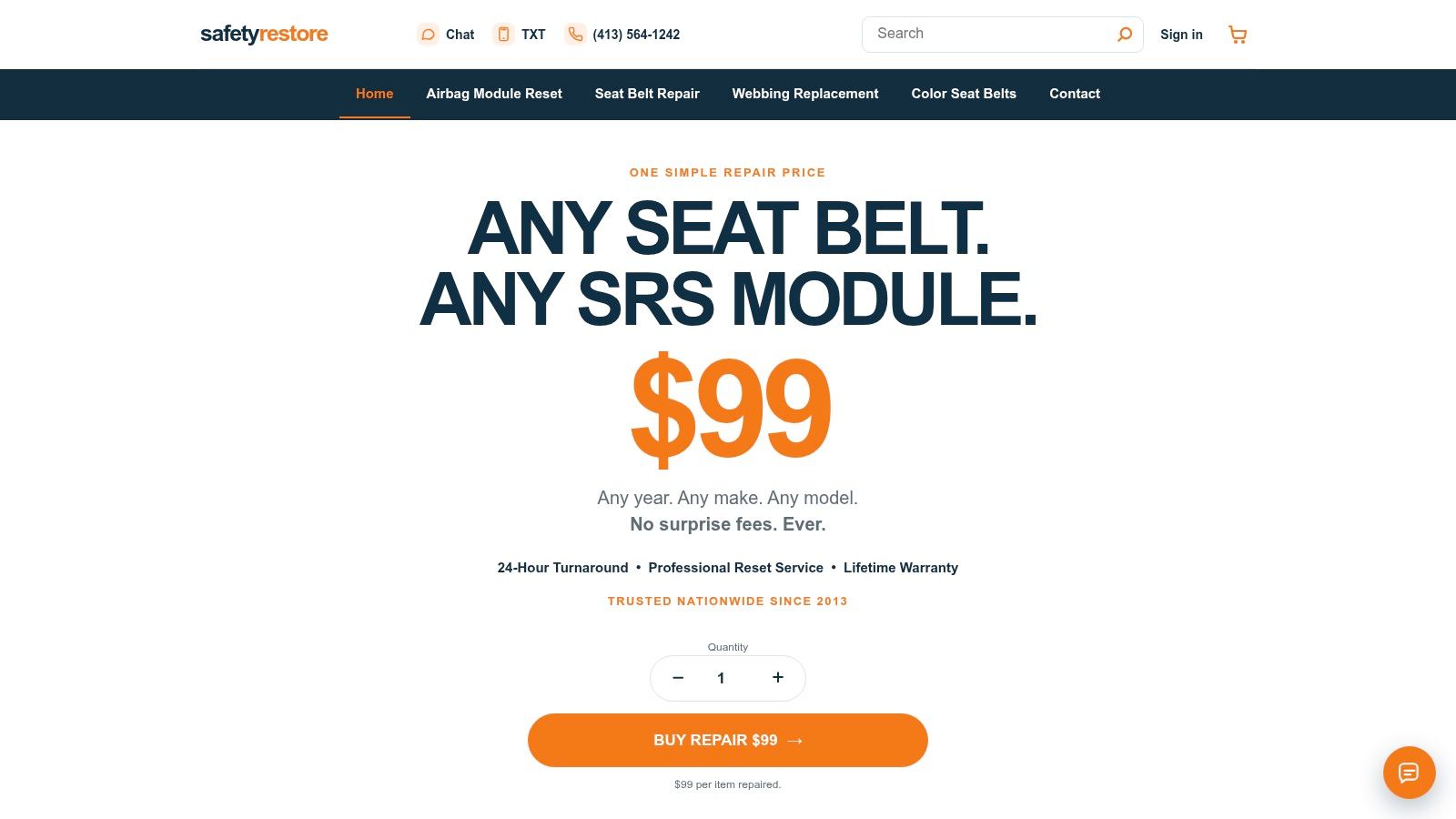
Safety Restore provides a practical example of how a fixed-fee repair workflow can operate. The company has offered a $99 flat fee per item for seat belt and SRS airbag module services since 2013, with pricing described as independent of vehicle year, make, or model. Its model is built around customer-supplied parts rather than a full vehicle visit.
The process starts online. A customer selects the relevant service, places an order, removes the eligible component, and ships it to the repair provider. Once the part arrives, the provider performs the defined service and returns the repaired component for reinstallation.
The workflow behind the fee
A useful way to assess this example is to follow the customer's decisions:
- Identify the component. The owner or shop determines whether the part is a seat belt retractor, pretensioner, SRS module, or webbing that fits the listed service.
- Place the order. The online process establishes the service selection and quantity before shipping.
- Send the removable part. The customer packages the component and follows the provider's shipping instructions.
- Receive the repaired unit. The provider completes the repair and sends the part back for reinstallation.
The fixed price works because the service provider has narrowed the scope. It isn't promising to repair every problem on the vehicle for one amount. It's pricing a defined component service through a workflow designed to handle repeatable categories of parts.
The company states that repaired components carry a lifetime warranty and that the service uses OEM-quality parts and methods. Those details matter because a flat fee alone doesn't establish value. Customers also need to understand what happens if the component returns with a problem, what the warranty covers, and what vehicle-side faults remain outside the component repair.
What the example teaches shop owners
Standardization makes the model scalable. Online ordering, quantity selection, shipping instructions, inspection procedures, and return handling reduce the number of decisions staff must make for every customer. A typical 24-hour repair turnaround is also stated by the company, which can help reduce waiting time when the part arrives and the service falls within the normal workflow.
The operational lesson is more important than the advertised amount. A provider can offer a predictable price when it controls the service definition, tracks common failure patterns, and communicates exceptions before the customer commits. Without those controls, a fixed fee becomes an optimistic estimate rather than a dependable promise.
When Flat Rate Pricing Benefits Shops and Owners
Flat rate pricing fits a service mix when three conditions line up: the work is repeatable, the customer value is reasonably similar from job to job, and the provider can define exceptions without creating an argument at checkout. This is why standardized seat belt and module services can suit a fixed fee better than open-ended electrical diagnosis.
For a shop owner, the attraction is operational. A published price reduces quote conversations, simplifies invoices, and makes revenue easier to forecast. The provider can train staff around a known workflow instead of asking every employee to negotiate labor and materials from scratch.
The owner-side test
Vehicle owners usually care about a different outcome. They want to know what the repair will cost before they commit, especially when the vehicle has already created an unexpected expense. A clear flat fee can remove price anxiety and make it easier to compare providers.
The benefit disappears when the service description is vague. A customer may accept a fixed amount for a listed SRS module reset, but may object if the shop later adds unexplained charges for inspection, handling, or a fault that was never included.

When the model becomes unfair
The difficult question is whether a flat price stays fair when job complexity varies widely. A simple unit may take less effort than the price assumes, while an unusually difficult unit may consume much more. The fixed amount can become a cross-subsidy, where easier jobs help pay for harder ones.
That isn't automatically a flaw. Businesses often price around an average cost, and customers value the certainty. The problem starts when outliers are frequent enough to damage quality, turnaround, or margin.
A practical guardrail system should answer these questions:
- Scope: Which components and failure conditions are included?
- Condition: What happens if the part is physically damaged beyond the normal repair?
- Diagnosis: Is vehicle-side troubleshooting included, or only component service?
- Returns: How are warranty concerns and repeat inspections handled?
- Updates: What triggers a price or policy review when labor and supplier costs change?
Fair pricing isn't identical pricing for every possible problem. It's a clear price for a clearly described service.
The flat-rate pricing guidance from Zuora makes the same broader point. Fixed pricing is easy to explain and forecast, but it can disadvantage heavy users or unusually complex jobs. Shop owners should protect both sides with transparent boundaries, not with vague promises that sound simple until the work becomes difficult.
Getting Started with Flat Rate Pricing
A shop considering flat rate pricing should begin with its service history, not a competitor's price list. Review completed jobs, group similar work, and identify which services follow the same steps most of the time. If technicians routinely encounter different problems under the same label, the service needs a narrower definition or a diagnostic stage before a fixed quote.
The internal checklist is practical:
- Define the deliverable: State exactly what the customer receives, such as component repair, module reset, or webbing replacement.
- Record cost drivers: Track labor, parts, shipping, handling, equipment, warranty work, and administrative time.
- Set boundaries: Explain exclusions before approval, including vehicle-side diagnosis or damage outside the normal service.
- Test the workflow: Start with a limited group of repeatable services and review the results.
- Review the price: Revisit the amount when supplier costs, staffing conditions, or failure patterns change.
Customer communication should be just as specific. A shop's ordering page should show the price, the service category, the customer's responsibility, shipping instructions, expected turnaround, and the process for exceptions. A clear ordering process can reduce avoidable errors before the part arrives.
Vehicle owners should ask direct questions before sending a component. Is the price per item? Does it include return shipping or testing? What happens if the part can't be repaired? Does the provider repair the component or replace it? What warranty applies, and is vehicle diagnosis separate?
A collision creates enough uncertainty without adding a vague invoice. When a shop can price a stable service accurately, flat rate pricing aligns the customer's need for predictability with the provider's need for an efficient workflow. When the job is open-ended, hourly billing or a paid diagnostic stage may be the more honest choice.
The model will keep facing pressure from changing labor costs, supplier volatility, and stronger demand for transparent pricing. Providers that review their assumptions and explain their limits will protect trust better than providers that publish a low number and improvise the rest later.
Safety Restore offers mail-in repair services for automotive seat belt mechanisms, SRS airbag modules, and seat belt webbing through a defined per-item flat-fee model, with a typical 24-hour turnaround and lifetime warranty stated for repaired components. If you need a clear starting point after a collision, review the service options and shipping instructions at Safety Restore.