
Flat rate car repair means the shop charges a fixed price based on an industry-standard labor time multiplied by its hourly rate, not the actual minutes a mechanic spends on the job. In the U.S., those shop labor rates can run from about $50 to $220 per hour, and the quote is usually built from book time rather than a stopwatch. AAA explains that repair shops typically quote labor using a flat-rate manual or computer program, and those guides are meant to make the price predictable before anyone loosens a bolt.
You’re probably looking at a repair estimate right now, or you’ve got one sitting in your inbox with line items that don’t make much sense yet. A small collision can turn into a page full of abbreviations, labor hours, and totals that feel oddly fixed even though the car hasn’t moved.
Table of Contents
- What Flat Rate Car Repair Actually Means When You Read an Estimate
- How Book Time and Labor Rates Build the Flat-Rate Price
- What Shops and Vehicle Owners Each Get Out of the Flat-Rate Model
- Flat Rate Pricing Compared With Itemized Repair Estimates
- When a Fixed Per-Item Price Beats a Per-Hour Quote
- How to Read a Flat-Rate Quote Before You Sign It
- Why Flat Rates Are Rising and What That Means for 2026
What Flat Rate Car Repair Actually Means When You Read an Estimate
You drop off a car after a minor fender-bender, open the estimate on your phone, and see something like R&I front bumper cover, 1.2 hr. That decimal isn’t a running clock. It’s the shop saying, “This operation is worth 1.2 book hours under our labor guide,” then multiplying that time by the shop’s posted labor rate before you ever saw the quote.
That’s the key to understanding flat rate car repair. The estimate isn’t a receipt for time already spent, it’s a priced menu of operations. The shop may have used an OEM guide, an aftermarket guide, or software built from average experienced-technician times, but the number you’re approving is already packaged into a fixed labor charge. AAA notes that flat-rate labor is based on estimated labor time from manuals or software, while the historical labor-time system behind that model grew out of standardized factory guides in the 1920s as automakers expanded their dealer networks, according to the Open Labor Project’s summary of labor-time history.
What you’re actually agreeing to
When you sign, you’re not agreeing to pay by the minute. You’re authorizing the shop to perform the listed operations at the posted labor rate, with the labor time already baked in. That’s why two shops can quote the same repair differently even when neither one is “making it up.” Their guides, rates, and assumptions may not match.
Practical rule: read the estimate as a contract for the listed operation, not a promise about how long one technician will stand at the car.
That matters because flat rate can sound like a shortcut until you realize it’s built to standardize pricing across shops, not to describe the technician’s day. Once you know that, the line items stop looking mysterious and start looking like a coded translation of the job itself.
How Book Time and Labor Rates Build the Flat-Rate Price
Think of the math in two pieces. First, the shop posts a labor rate, which is the dollar amount charged per hour. Second, the estimate uses book time, also called labor guide time, which is the standard repair duration assigned to a specific operation.
A simple example makes it plain. If an alternator replacement is listed at 2.4 hours and the shop rate is $120 per hour, the line comes out to $288 before parts and other charges. If the technician finishes in 90 minutes, the customer still pays the same labor amount. If rust, access issues, or hidden fasteners turn it into a four-hour wrestling match, the quote usually doesn’t change either.
| Flat-Rate Price Calculation Example | ||
|---|---|---|
| Component | Value | Notes |
| Book time | 2.4 hours | Standard labor guide time |
| Shop labor rate | $120 per hour | Posted shop rate |
| Labor charge | $288 | 2.4 × 120 |
| Actual wrench time | 90 minutes to 4 hours | Does not change the quoted labor line |
Why two shops can quote different hours
The hours can differ because the labor guide itself can differ. One guide may come from the vehicle maker’s repair information, while another comes from an aftermarket estimating source. Those systems don’t always assign the same time to the same repair, especially when the job includes removal, diagnostic steps, or related operations.
The manuals behind the standard time also matter. Independent flat-rate manuals say the labor allowance includes the full job cycle, not just wrench time. That means pulling the vehicle into the bay, looking up parts, retrieving stock, filling out repair-order notes, cleanup, and pulling the car back out are all part of the allowance, and diagnosis is treated as a separate flat-rate job. That guidance is laid out in NCM Associates’ flat-rate manual, which also says the time is based on the law of averages for a reasonably experienced technician with the right tools and parts availability.
Practical rule: when the guide says 2.4 hours, it’s describing a standardized repair allowance, not the single fastest or slowest way one person might complete the work.
That is why flat rate can feel rigid on paper and still be inconsistent from one estimate to the next. The formula is simple, but the sources feeding it are not.
What Shops and Vehicle Owners Each Get Out of the Flat-Rate Model
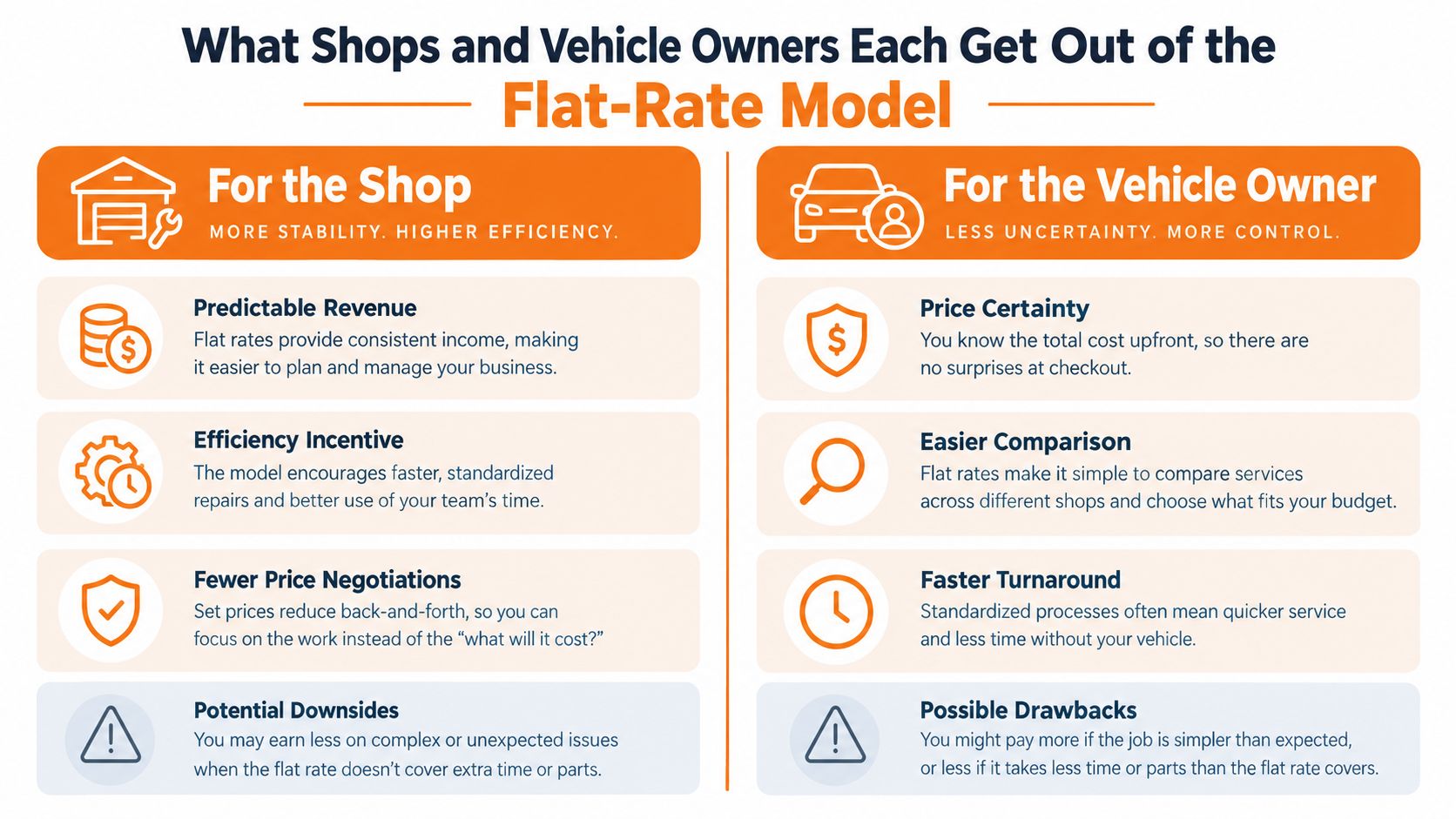
For a shop, flat rate gives the front counter something useful right away, a quote that’s easier to build and explain. It also creates predictable revenue per ticket, because labor is tied to billed guide time instead of the exact minutes one technician spent on one car. That makes it easier to price over the phone and to warrant labor time in a standardized way.
But the shop also inherits the downside when a clean-looking job turns ugly. A rust-fastened bolt, a brittle connector, or a trim clip that breaks on removal can turn a neat book-time operation into a messy repair day. The shop still has to finish the car, even if the original labor allowance no longer reflects what really happened.
For vehicle owners, the upside is obvious. Flat rate makes it easier to compare estimates because you’re looking at a quoted price instead of an open-ended clock. It also reduces the anxiety that comes with hourly billing, where every extra minute can feel like a new surprise.
The downside is transparency. You don’t always see how much actual labor was performed, and you have to trust that the shop didn’t pad the book time or stack related operations in a way that inflates the total. That’s why seat belt and restraint work, including post-accident repair, deserves special attention on the estimate and on the warranty side. A useful reference point for that kind of work is Safety Restore’s seat belt repair service, because it shows how fixed-pricing models can be structured around specific components rather than open-ended labor.
The real trade-off
Flat rate rewards consistency, but it can also reward clever quoting. The best estimates are clear enough that the owner can see what’s being charged and why, without needing to decode shop jargon.
Flat Rate Pricing Compared With Itemized Repair Estimates
Flat rate and itemized billing solve different problems. Flat rate puts one labor price on each job based on book time. Itemized billing breaks labor into smaller billed increments, often by tenths of an hour, and lists parts, materials, and sublet work separately.
A straightforward brake job shows the difference. On a domestic sedan, a flat-rate quote might show “front brake service” as one labor line. An itemized estimate might split out pad replacement, rotor replacement, caliper cleaning, and diagnostics if the customer complained of pulsation or noise.
| Flat-Rate vs Itemized Estimates Three Real Scenarios | Flat-Rate Quote | Itemized Estimate | Best Fit |
|---|---|---|---|
| 4-hour brake job on a domestic sedan | One bundled labor line based on guide time | Multiple labor lines plus parts and possible corrections | Flat rate for price certainty, itemized for repair transparency |
| Alternator replacement on a European model with long book time | Fixed labor charge based on the guide | Labor by operation, often showing access and removal steps separately | Flat rate if you want a clear quote, itemized if access issues are likely |
| Post-accident SRS module reset plus seat belt pretensioner replacement | Separate fixed labor or component charges | Diagnosis, reset, and replacement itemized one by one | Itemized when insurance review needs detail |
The brake job is where flat rate usually feels easiest. You know the likely cost, and the shop knows what it needs to collect if the job goes smoothly. The alternator example gets trickier because access can vary a lot by vehicle design, so two estimates can diverge even before the wrench turns.
The SRS case is where itemization can help most. Safety-system work often needs diagnosis, parts replacement, and verification spelled out clearly, especially after a collision. CrashFix’s estimate guide is a useful reminder that diagnostics, hidden damage, and supplemental estimates all matter when you’re trying to understand what the shop is charging for.
If the repair is routine and predictable, flat rate usually reads cleaner. If the job is layered, insurance-driven, or likely to uncover more damage, itemization gives the owner more visibility.
That’s the simplest way to choose between them. Use the model that matches how much certainty the repair really has.
When a Fixed Per-Item Price Beats a Per-Hour Quote
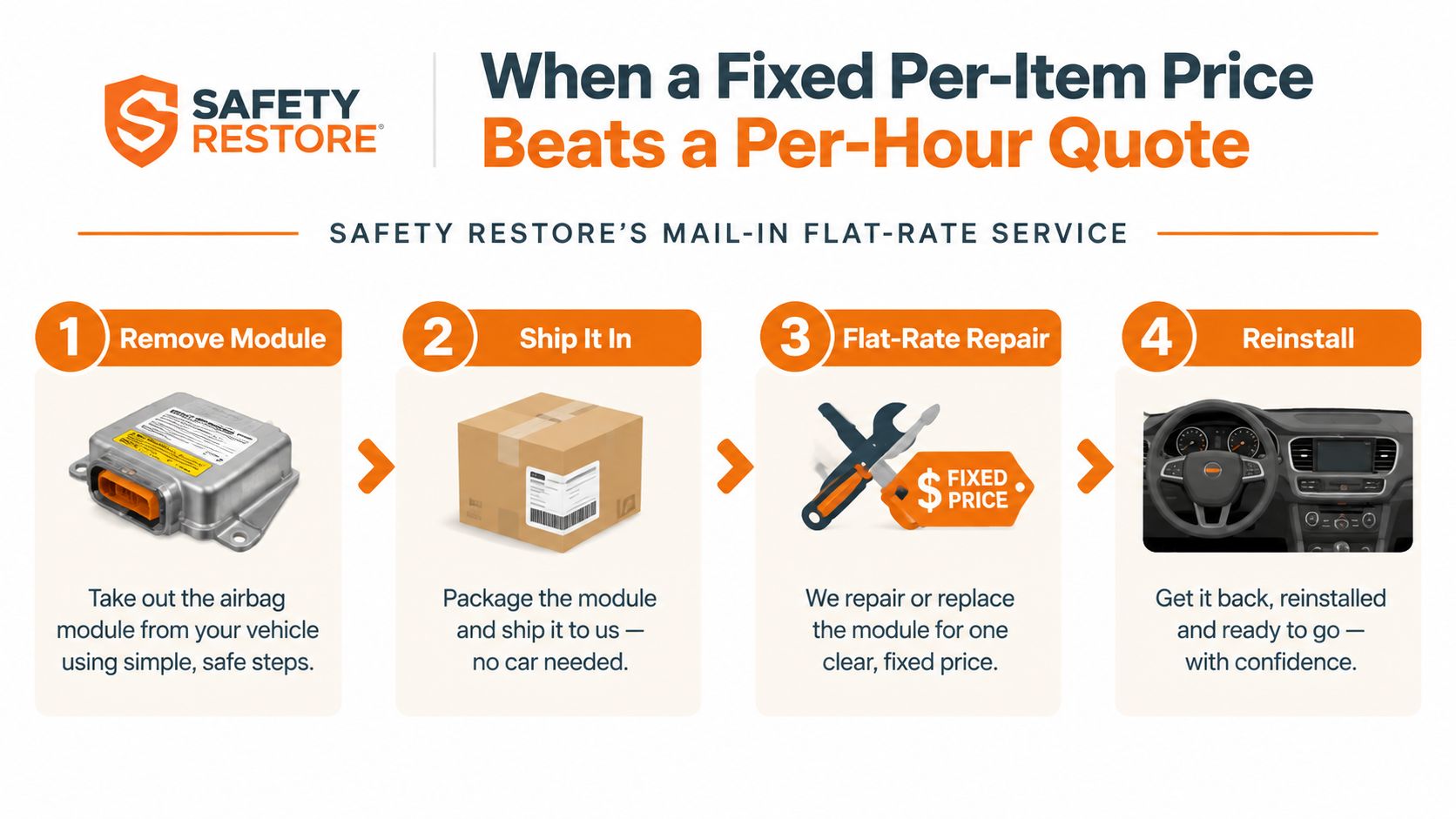
Some flat-rate work isn’t tied to bay time at all. A fixed per-item price can make more sense when the part comes off the car and ships out for repair, because the workflow isn’t “park a car in a bay and spend an hour on it.” It’s “remove one component, send it, rebuild it, reinstall it.”
That’s the logic behind Safety Restore’s airbag module reset service. The part is removed, shipped in, repaired at a fixed price, and sent back for reinstallation. That model works well for SRS repairs because the customer is paying for a specific component service, not for the uncertainty of live diagnostic time in a crowded bay.
The customer flow is simple. Remove the module or other safety component, pack it carefully, ship it in a padded box, and wait for the rebuilt unit to come back ready for reinstallation. The appeal is obvious when the alternative is sourcing a replacement assembly that may be harder to find or more expensive than repairing the original unit.
Why this model fits safety-system parts
Airbag modules, seat belt pretensioners, and related SRS components don’t always need the same kind of hands-on shop time that a mechanical repair needs. The work is more about restoring the unit itself than spending hours physically attached to the vehicle. That makes a posted fixed price easier to understand and easier to negotiate in an insurance conversation.
The trade-off is turnaround. Mail-in repair adds shipping time, so the process is not instant the way a local bay repair can be. For some owners that delay is fine, for others it’s the limiting factor.
Practical rule: use fixed per-item pricing when the repair is really about a removable component, not a vehicle sitting on a lift.
That’s also why this kind of pricing can feel more honest to owners. The scope is narrow, the price is visible, and the part either comes back ready or it doesn’t.
How to Read a Flat-Rate Quote Before You Sign It
The quote review is the moment that matters most. Once you authorize the work, the numbers on that page turn into the bill you’ll be discussing later, so this is the time to slow down and read line by line.
Start with the labor split. Make sure each line shows the operation description and the labor rate or hours clearly enough that you know what you’re approving. Then check whether diagnosis is listed separately, because flat-rate manuals treat diagnosis as its own job, not as a hidden part of some other repair.
Next, look for bundled items and extras. Sublet lines, shop supplies, disposal charges, and related operations can be legitimate, but they should be visible. If a quote combines unrelated work into one line, ask the writer to break it apart before you sign.
A quick checklist that catches most bad quotes
- Confirm the labor source: Ask whether the hours came from OEM, aftermarket, or software-based labor guides.
- Match the wording to the diagnosis: The repair description should reflect what the technician found, not a generic template.
- Watch for bundled operations: Separate tasks should not be hidden inside one inflated line.
- Check for extra fees: Sublet work and surcharges should be listed plainly.
- Save the quote: Keep the printed or digital copy for warranty claims and future reference.
If you’re looking at safety-system work, the FAQ page on Safety Restore’s site is a good example of how customers often try to understand what is covered and what isn’t.
A few red flags deserve attention. Rounded book times can hide inflated totals, missing diagnostic lines can obscure real work, and quotes that lump unrelated repairs together usually need a second look. If the estimate can’t be explained in plain language, don’t sign it yet.
Why Flat Rates Are Rising and What That Means for 2026
Flat rate pricing still works, but the people doing the work are harder to find. Recent industry data says the U.S. collision-repair pipeline is filling only 42% of annual demand and needs about 73,354 new entrant technicians from 2025 to 2029, while the broader auto service sector faces an annual shortfall of roughly 20,780 technicians in 2026. That staffing picture comes from recent industry reporting, and it helps explain why the same quoted price can lead to very different wait times from one shop to the next.
The price formula may look stable, but the shop’s reality is not. Book-time values don’t always update fast enough when parts costs shift, procedures get more complex, or newer vehicles demand more electronics and calibration work. That pressure shows up in rising posted labor rates too, with mechanical labor rates reported up 11.6% year over year to $163 per hour in mid-2026 in the same industry coverage. See the labor-rate reporting here.
What that means for owners
Flat rate isn’t broken. It’s a standardized pricing system that’s under stress from staffing, training, and repair complexity. The customer still gets a quote, but the shop may need longer to get the car back because the bay schedule is tighter and the repair mix is harder.
That’s why owners should ask sharper questions before authorizing work.
- Ask for the labor-time source: Know whether the shop used OEM or aftermarket guide times.
- Ask about technician training: Complex vehicles need shops that can properly staff the job.
- Ask for a completion window in writing: A price quote is not the same thing as a time-to-finish promise.
- Stay alert on common jobs: If a familiar repair suddenly comes back with a very different book time, ask why.
The best shop answer is still a plain one. If the labor time changed, they should be able to explain the reason without hiding behind jargon.
Flat rate car repair only feels confusing until you see the math underneath it. Once you know how the estimate is built, you can read it with a sharper eye, and you can make better calls about which repairs belong in a shop, which ones can be mailed in, and which quote needs a second look. If you’re dealing with seat belt or SRS work after an accident, Safety Restore handles fixed-price component repairs and reset services that fit this model, so visit Safety Restore to compare the repair path that makes the most sense for your part and your timeline.