- What a Mail-In Seat Belt Repair Service Actually Does
- Step 1: Identify What Needs Repair
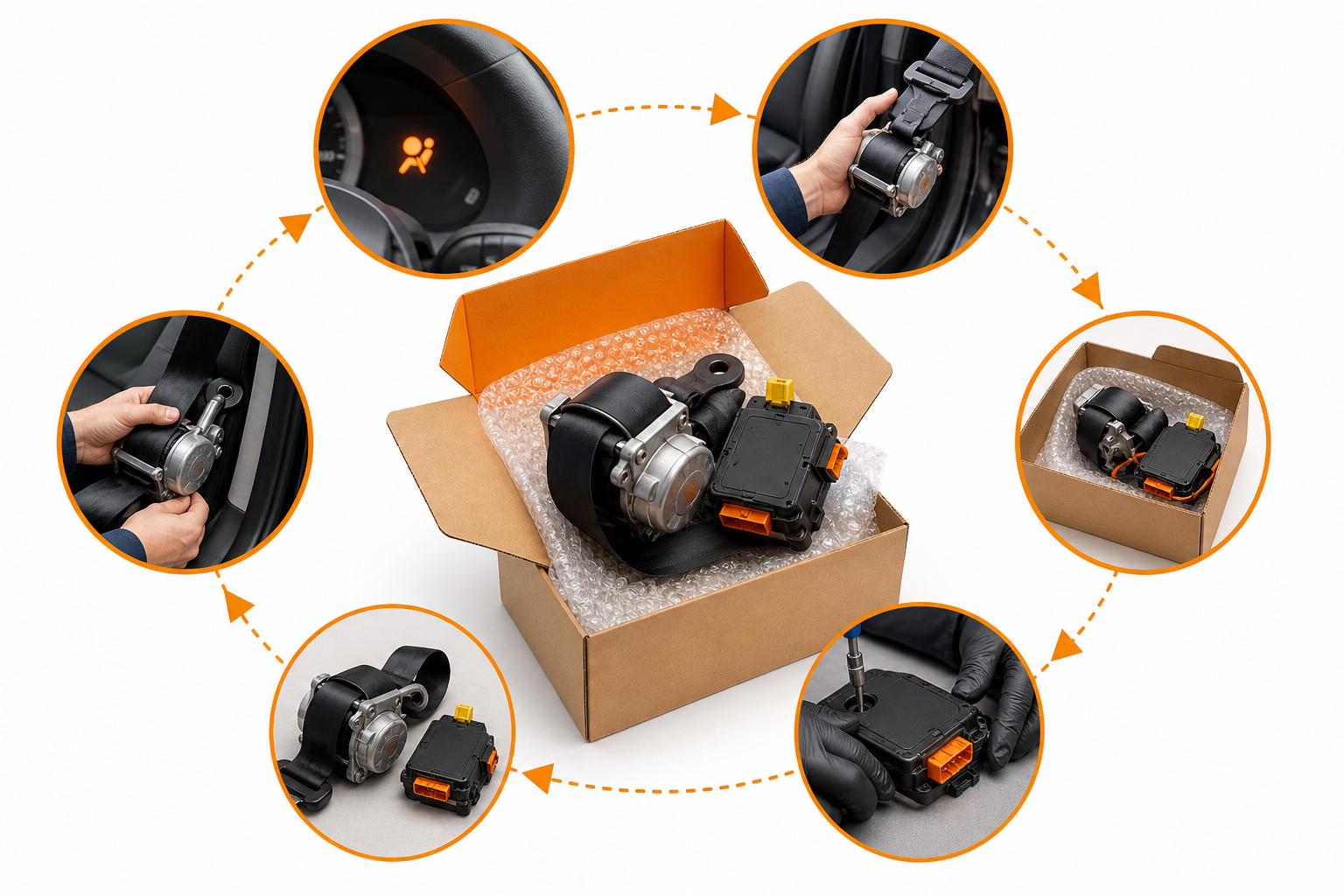
- Step 2: Remove the Part From Your Vehicle
- Step 3: Place Your Order and Ship the Part
- Step 4: The Repair Itself
- Step 5: Shipping Back to You
- Step 6: Reinstall and Verify
- Why Body Shops and Salvage Rebuilders Use Mail-In Repair
- Common Questions Before You Ship
- What the $99 Flat Rate Covers
- FAQs
- Get Your Part Repaired
If you need a seat belt repair service but want to skip the dealer appointment, the week-long wait, and the $400-plus bill, the mail-in model is worth understanding. Whether you’re a body shop working through a stack of Copart rebuilds or a driver whose belt locked up after a collision, the process is straightforward — but it helps to know what to expect at each step.
Here’s the full workflow, from diagnosis to reinstallation.
What a Mail-In Seat Belt Repair Service Actually Does
A mail-in service repairs your seat belt pretensioner or SRS airbag module at a dedicated facility and ships it back ready to reinstall. You’re not getting a replacement part — you’re getting your original part restored to factory function.
That distinction matters. A new OEM seat belt assembly from a dealer can run $300 to $800-plus. A new airbag module or full SRS replacement can cost $1,000 to $6,000-plus depending on the vehicle. Mail-in repair restores what you already have for a fraction of that.
At Safety Restore, every repair — seat belt pretensioner, SRS airbag module reset, or webbing replacement — is a flat $99. No stages, no tiers, no surprise fees, regardless of make, model, or year.
Step 1: Identify What Needs Repair
Before you ship anything, you need to know which component is the problem. There are two main failure types a mail-in service handles.
Locked or Blown Seat Belt Pretensioner
When a collision occurs, the pretensioner fires to lock the belt tight against the occupant. Once it fires, the gas charge is spent and the belt stays locked — it won’t retract, won’t feed out, and can’t be reset by hand. The pretensioner needs to be rebuilt with a new gas charge and reset to factory spec.
Belts can also lock from a hard jolt, a minor impact that triggered the sensor, or general wear over time. If the belt won’t retract or feels stiff and won’t pull out smoothly, the pretensioner is the likely culprit.
SRS Airbag Module Reset
The SRS module stores crash data after a deployment event. Even if you replace the airbags themselves, the module still holds those crash codes and will keep the airbag warning light on. It needs to be reset to clear the stored data and return to pre-accident condition.
If your airbag light is on after a collision — or you’ve acquired a salvage vehicle where airbags deployed — the module reset is what clears the system and allows the vehicle to pass inspection.
Step 2: Remove the Part From Your Vehicle
This is the only hands-on work you do. For most vehicles, pulling a seat belt pretensioner takes 20 to 45 minutes with basic hand tools. The pretensioner is typically bolted to the B-pillar or lower seat track and connects to the wiring harness with a single plug.
SRS module location varies by make and model — common spots include under the center console, beneath the driver’s seat, or behind the dash. Disconnect the battery before removing the module to avoid triggering any remaining sensors.
A few things worth keeping in mind:
- Label your parts if you’re processing multiple vehicles. Body shops running several rebuilds at once should mark each pretensioner with the VIN or job number before it goes in the box.
- Package carefully. Bubble wrap or foam padding protects the pretensioner in transit. The SRS module is a circuit board assembly — treat it accordingly.
- You don’t need to ship the full seat belt assembly. Just the pretensioner unit itself, unless you’re also requesting a webbing replacement.
Step 3: Place Your Order and Ship the Part
Once you know what you’re sending, place your order at safetyrestore.com and add the appropriate service to cart. The price is the same flat $99 whether you’re sending a single-stage pretensioner from a 2019 Honda Civic or a dual-stage unit from a 2024 F-150.
After checkout, pack your part, include the order details in the box, and ship to the address provided. You choose your carrier and shipping speed. Safety Restore does not provide free return shipping, so factor that into your timeline when deciding how to send the part.
For body shops and rebuilders processing multiple units, shipping several pretensioners together in one box is common. Each part gets its own $99 service charge, but combining them in a single shipment reduces your outbound cost per unit.
Step 4: The Repair Itself
This is where the mail-in model earns its value. Once your part arrives at Safety Restore’s facility, the repair is completed within 24 hours.
What Happens to a Pretensioner
The pretensioner is disassembled, the spent gas charge is removed, and the unit is rebuilt using 100% OEM parts and OEM programming. No aftermarket components, no refurbished parts. The finished pretensioner is functionally identical to a new factory unit.
Single-stage, dual-stage, triple-stage, and buckle pretensioners are all handled through the same process, with the repair accounting for each specific deployment type.
What Happens to an SRS Module
The module is connected to Safety Restore’s programming equipment, crash data is cleared, and the module is reset to its pre-accident state using OEM programming. This isn’t a generic code clear with an OBD scanner — the reset writes the correct factory data back to the module so the SRS system recognizes it as a clean unit.
Every completed repair and reset carries a lifetime warranty.
Step 5: Shipping Back to You
Once the repair is done, the part ships back. With a 24-hour repair turnaround, total round-trip time comes down to how fast your outbound and return shipping moves.
A body shop in the Midwest using ground shipping might see a 5 to 7 day total cycle. Someone using expedited shipping on both legs can often close the loop in 3 to 4 days. Planning your workflow around that window keeps vehicles moving through reconditioning without holding a bay open waiting on parts.
For individual owners, the timeline works the same way. Ship Monday, repaired Tuesday, back on the road by end of the week in most cases.
Step 6: Reinstall and Verify
Reinstallation is the reverse of removal. Reconnect the pretensioner to the harness, bolt it back into the pillar or seat track, and feed the webbing through any guides.
For the SRS module, reconnect the harness, reconnect the battery, and start the vehicle. The airbag warning light should clear on startup once the module recognizes the reset. If it stays on, there may be a secondary fault elsewhere in the system — a sensor, a clock spring, or a different module — that needs to be diagnosed separately.
A few post-reinstallation checks worth doing:
- Pull the belt out fully and let it retract to confirm smooth operation
- Buckle and unbuckle several times to verify the buckle pretensioner engages and releases correctly
- Confirm the SRS light is off after a full ignition cycle
- For salvage rebuilds, check the repair against your state’s rebuilt-title inspection requirements before scheduling the inspection
Why Body Shops and Salvage Rebuilders Use Mail-In Repair
The math is simple. A shop or Copart rebuilder processing 10 to 20 salvage vehicles per month will run into locked pretensioners and blown SRS modules on nearly every unit. Replacing those parts at dealer prices makes the economics of salvage rebuilding hard to sustain.
At $99 flat per unit, the cost is predictable — whether you’re working on a domestic pickup, a European sedan, or a Japanese import. There are no surprise fees when a vehicle turns out to have a dual-stage system instead of single-stage. The price doesn’t change.
The 24-hour turnaround means parts aren’t sitting in a queue for days. A shop can pull pretensioners from Monday’s arrivals, ship them out, and have them back by Thursday or Friday — keeping vehicles on schedule through the reconditioning process.
The lifetime warranty matters here too. If a repaired pretensioner fails after the vehicle is sold, the shop isn’t eating the cost of a second repair. It’s covered.
Common Questions Before You Ship
Does the service work on any vehicle?
Yes. Safety Restore handles all makes and models, domestic and import, going back many years. There’s no exclusion list.
What if I don’t know whether I have a single-stage or dual-stage pretensioner?
You don’t need to know in advance. The repair process identifies and accounts for the specific type once the part is inspected.
Can I send multiple parts at once?
Yes. Body shops and rebuilders regularly ship several pretensioners or modules together. Each part is processed individually at $99 per service.
What if a repair I paid for elsewhere didn’t work?
Safety Restore handles this regularly. The service is the same $99, and the repair uses OEM parts and programming regardless of what was done previously.
What the $99 Flat Rate Covers
The $99 covers labor, OEM parts, OEM programming, and the lifetime warranty on the completed repair. It applies to every pretensioner type — single-stage, dual-stage, triple-stage, buckle pretensioner — and every SRS airbag module reset. It also covers color seat belt webbing replacement if you need the webbing itself replaced rather than just the pretensioner repaired.
What it doesn’t cover is shipping. You pay to send the part to Safety Restore and pay for the return shipment. Factor that into your per-unit cost when comparing against dealer pricing or local shop quotes.
Even with two-way shipping added, the total for most customers stays well below what a dealer charges for a single seat belt assembly replacement.
FAQs
What is a mail-in seat belt repair service?
It lets you remove a locked or blown seat belt pretensioner from your vehicle, ship it to a repair facility, have it rebuilt with OEM parts and programming, and receive it back ready to reinstall — no dealer visit required.
How long does the process take from start to finish?
Safety Restore completes repairs within 24 hours of receiving your part. Total round-trip time depends on your shipping choices, but most customers finish the full process in 3 to 7 days.
Do I need to know what type of pretensioner I have before shipping?
No. You don’t need to identify whether your vehicle has a single-stage, dual-stage, or triple-stage system before sending the part. All types are handled at the same flat $99 rate.
Is the repaired part covered by a warranty?
Yes. Every repair and reset carries a lifetime warranty. If the part fails due to the repair, it’s covered.
Can body shops and salvage rebuilders send multiple parts at once?
Yes. Multiple pretensioners or SRS modules can go in a single shipment. Each part is processed individually at $99 per service, keeping per-unit cost predictable for high-volume workflows.
Will the SRS airbag light turn off after the module reset?
In most cases, yes. Once the reset module is reinstalled, the airbag warning light clears on startup. If it stays on, there’s likely a secondary fault elsewhere in the SRS system that needs separate diagnosis.
Does Safety Restore handle all vehicle makes and models?
Yes. The service is compatible with all makes and models. There is no exclusion list based on manufacturer, year, or market.
Get Your Part Repaired
The mail-in process removes the two biggest friction points in seat belt and SRS repair: the dealer appointment and the dealer price. You remove the part, ship it, and get it back repaired with OEM parts, OEM programming, and a lifetime warranty.
For body shops and rebuilders working through salvage vehicles at volume, the flat $99 per unit and 24-hour turnaround fit cleanly into any reconditioning workflow. For individual owners, it’s the fastest way to resolve a locked belt or a lit airbag warning light without paying dealer replacement prices.
Start your order at safetyrestore.com.