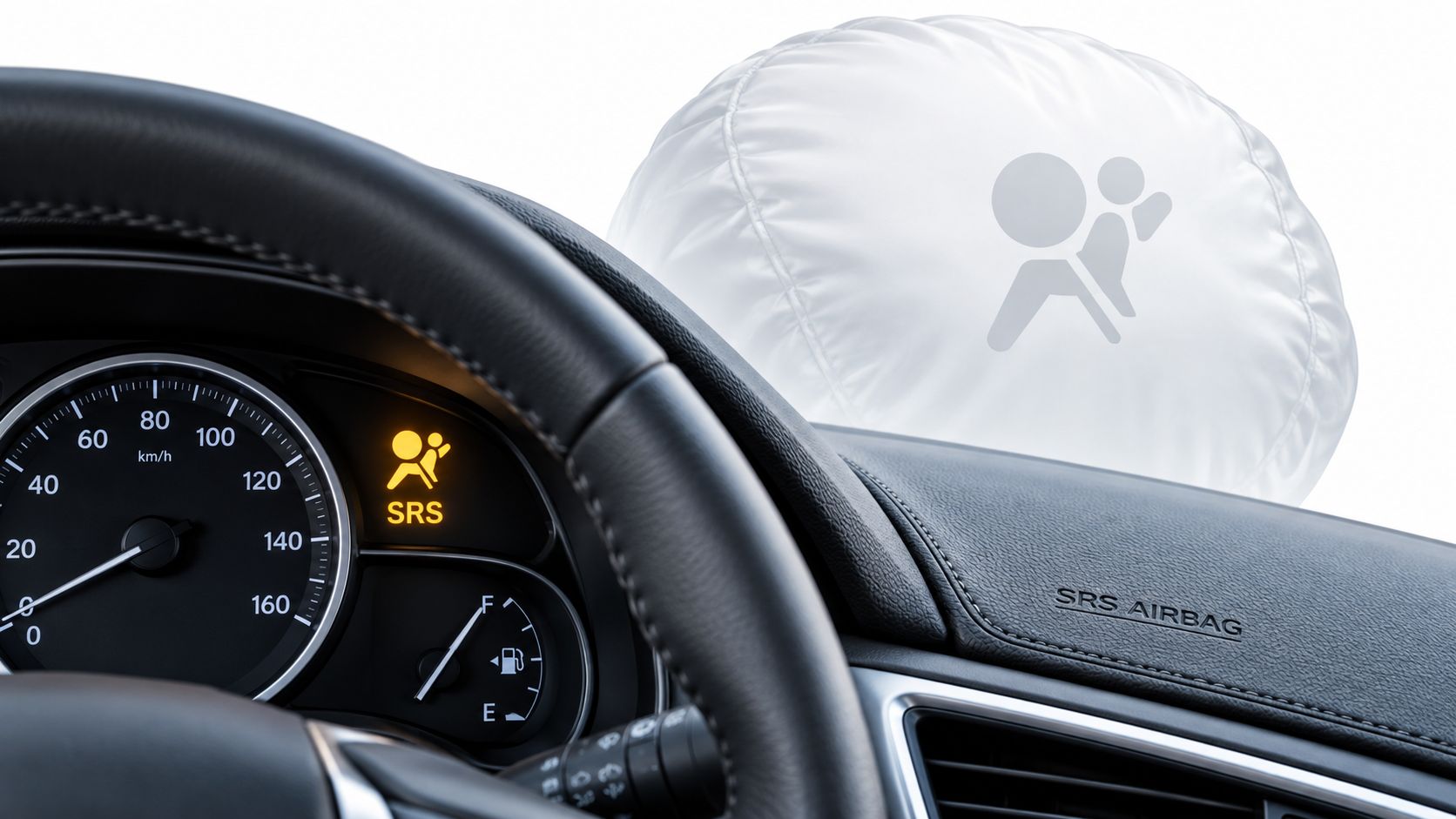
An illuminated airbag warning light means your vehicle has detected a fault in the supplemental restraint system, and one or more airbags or seat-belt pretensioners may not deploy as designed.
You've started the car, buckled your seat belt, and watched the other dashboard lights disappear. But the little seated figure with a circle in front of it is still glowing. The engine sounds normal, so you're left wondering whether this is an electrical nuisance or something that needs immediate attention.
The calm, practical response is to arrange diagnosis rather than guess. Before you do, check exactly which indicator you're seeing, because an SRS warning and a Passenger Air Bag Off message mean different things.
Table of Contents
- What the Airbag Warning Light Actually Means
- Why the Light Is a Serious Safety Signal
- Airbag Light vs Passenger Air Bag Off Indicator
- Reading the Light's Behavior on Your Dashboard
- Common Causes Behind the Warning Light
- How Technicians Diagnose the Airbag System
- Why Clearing the Light Is Not the Same as Fixing It
- Repair Options and When Mail-In Service Makes Sense
What the Airbag Warning Light Actually Means
When the airbag symbol stays illuminated after startup, treat it as a fault announcement, not confirmation that the airbags are ready. The letters SRS stand for supplemental restraint system, the network responsible for crash-related restraint functions.
That network can include frontal and side airbags, crash sensors, seat-belt pretensioners, wiring, and an electronic control module. A problem anywhere in a monitored circuit can trigger the warning, which explains why a light with an airbag symbol can lead a technician to a seat-belt component or wiring connector.
Think of the SRS as a connected safety system
The control module needs usable information from the system's sensors and functioning connections to its restraint components. If it detects an abnormal condition, it alerts you through the dashboard lamp. The symbol doesn't identify which component failed or how much protection remains available.
A real example shows why that distinction matters. In a 2025 NHTSA recall report covering 171,412 Mazda vehicles, an internal sensing-and-diagnostic-unit fault could illuminate the warning light, and the identified condition meant the airbags wouldn't deploy in a crash.
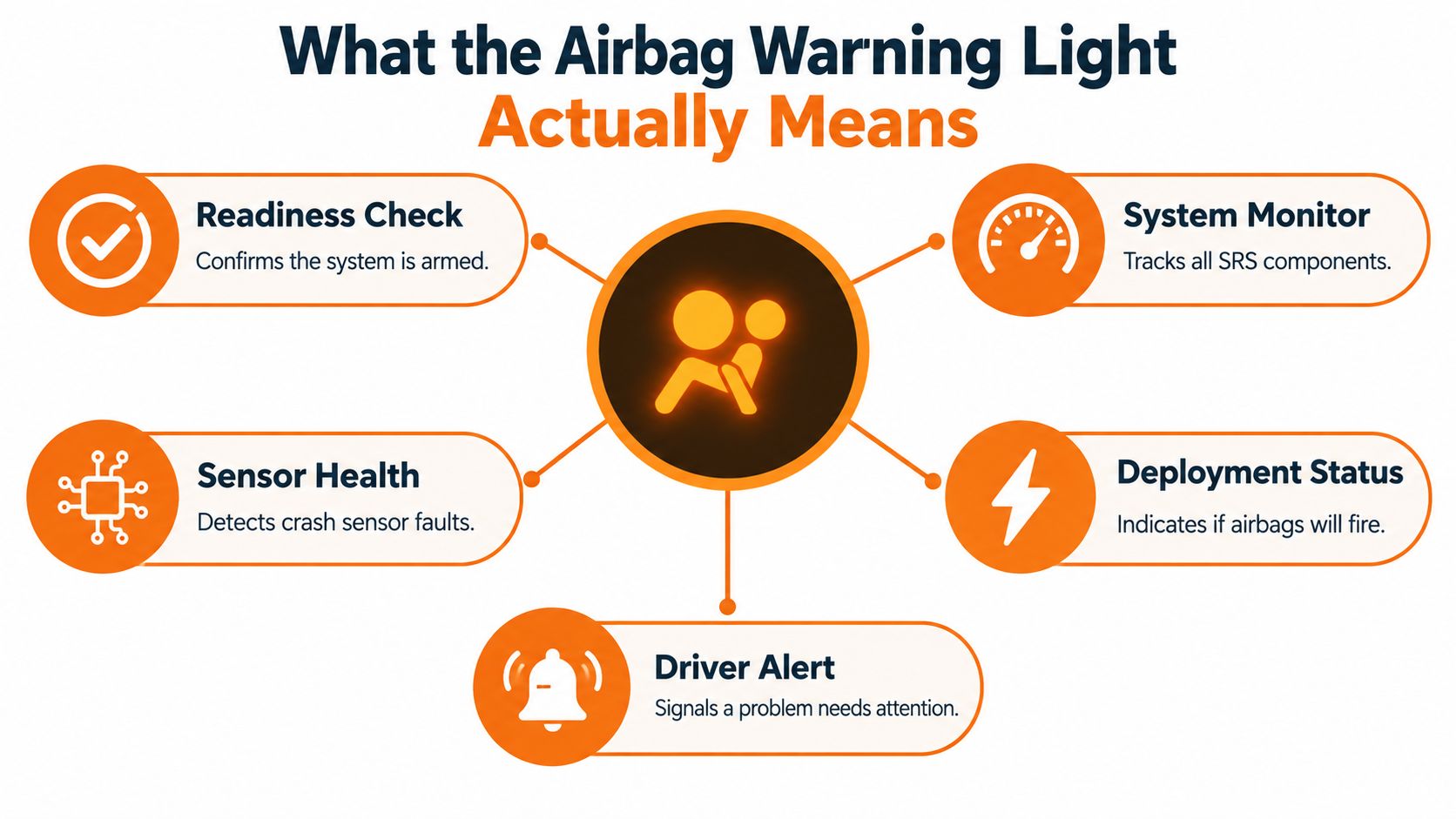
Read this diagram as a map of the system's responsibilities, not as a promise that the dashboard light can tell you whether an individual airbag will fire. That requires vehicle-specific diagnosis.
Practical rule: A glowing SRS lamp tells you that something needs attention. It doesn't tell you which part to buy.
If you're asking, “What does an airbag warning light mean?” the useful answer is broader than “an airbag problem.” It means a fault somewhere in the restraint system needs investigation. That working definition also helps you avoid confusing the warning with a separate passenger-airbag status display.
Why the Light Is a Serious Safety Signal
A car that accelerates, brakes, and steers normally can still have an unresolved restraint-system fault. How the vehicle feels on an ordinary drive isn't a test of what its airbags or pretensioners will do during a collision.
The safety value of working airbags is measurable. NHTSA estimated that frontal airbags saved 2,790 lives in 2017 and 50,457 lives from 1987 through 2017; the same publication reports fatality reductions of approximately 14% for unbelted occupants and 11% for occupants wearing seat belts.
Those figures describe the benefits of functioning frontal airbags. They don't calculate the risk for your particular vehicle, and they don't reveal which restraints a specific fault has affected.
Seat belts and airbags belong in the same conversation
Airbags supplement seat belts; they don't replace them. A pretensioner fault therefore belongs in the same safety discussion as an airbag fault, even though the warning symbol may not show a seat belt.
Keep wearing your seat belt, but don't interpret that as a substitute for repairing the SRS. The intended protection depends on the restraint systems working together.
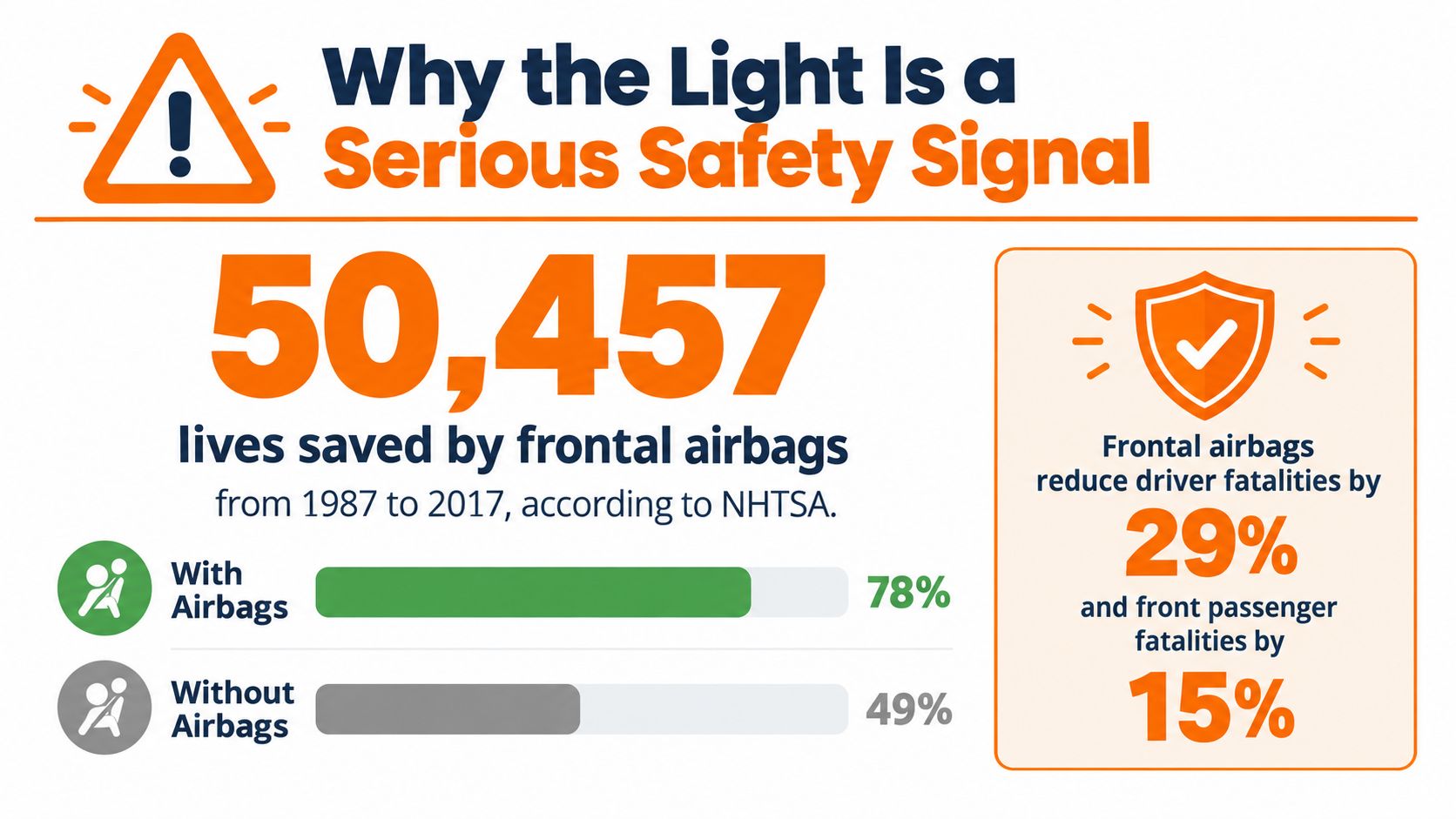
For the effectiveness figures discussed here, use the NHTSA values in the linked publication above rather than any differing percentages displayed in the illustration.
You don't need to panic about the light. You do need to stop treating it as an ordinary maintenance reminder.
Can you drive with it illuminated? The lamp alone can't establish that the vehicle is safe for normal use. Arrange inspection promptly, explain the warning to the repairer, and ask whether the vehicle should be transported rather than driven.
This is especially important after a collision or when the passenger-airbag display also behaves unexpectedly. Don't wait for a change in handling or engine performance before acting, because those observations don't answer the restraint-system question.
Airbag Light vs Passenger Air Bag Off Indicator
The SRS readiness warning and Passenger Air Bag Off indicator serve different purposes. The first reports a restraint-system fault when its behavior is abnormal. The second tells you that the passenger airbag is deactivated.
Under U.S. FMVSS 208, the passenger-airbag-off telltale is distinct from the general malfunction lamp and remains illuminated while the deactivated condition exists. Manufacturer service information submitted to NHTSA describes this distinction, alongside the SRS lamp's service-warning function.
SRS Lamp vs Passenger Air Bag Off Telltale
| Dashboard Light | What It Signals | Typical Cause | Driver Response |
|---|---|---|---|
| SRS or airbag warning that remains on | A detected restraint-system fault | A monitored component, circuit, or module problem | Arrange SRS diagnosis |
| Passenger Air Bag Off with an empty seat | Passenger-airbag deactivation status | Intentional suppression based on occupancy classification | Check the owner's manual for expected behavior |
| Unexpected Passenger Air Bag Off with a passenger present | A deactivation state that needs clarification | Occupant classification or a possible sensor problem | Follow the manual and obtain diagnosis if unexpected |
| Both indicators behaving unexpectedly | A fault warning alongside passenger-airbag status | A classification problem or broader SRS fault | Record both displays and seek inspection |
An empty passenger seat with an illuminated Passenger Air Bag Off message may be normal. That's different from an SRS symbol that stays on after startup.
NHTSA's interpretation of airbag telltale requirements distinguishes readiness monitoring from passenger-airbag suppression. The practical lesson is to read the exact wording, not just notice that something says "airbag."
Use the passenger's presence as context
If someone is sitting in the passenger seat and the status seems wrong, consult the vehicle's manual rather than assuming the system has made a safe decision. Don't use an indicator alone to decide where a child should sit or how a child restraint should be installed.
Tell the technician whether the seat was empty or occupied, what each light displayed, and whether the behavior changed. Those details help separate an expected suppression state from a fault requiring repair.
Reading the Light's Behavior on Your Dashboard
Timing matters as much as illumination. During the normal ignition self-check, the SRS indicator appears briefly and then extinguishes after several seconds. The exact expected sequence should be checked against your owner's manual.
A lamp that remains on, flashes abnormally, returns while driving, or fails to illuminate during the expected check needs investigation. Don't assign a failed part based on the pattern alone, because manufacturers use different diagnostic behavior.
Observe before you describe
The technical material discussed earlier also explains that some systems use lamp behavior to communicate diagnostic information. A useful observation is therefore more precise than “the airbag light sometimes acts up.”
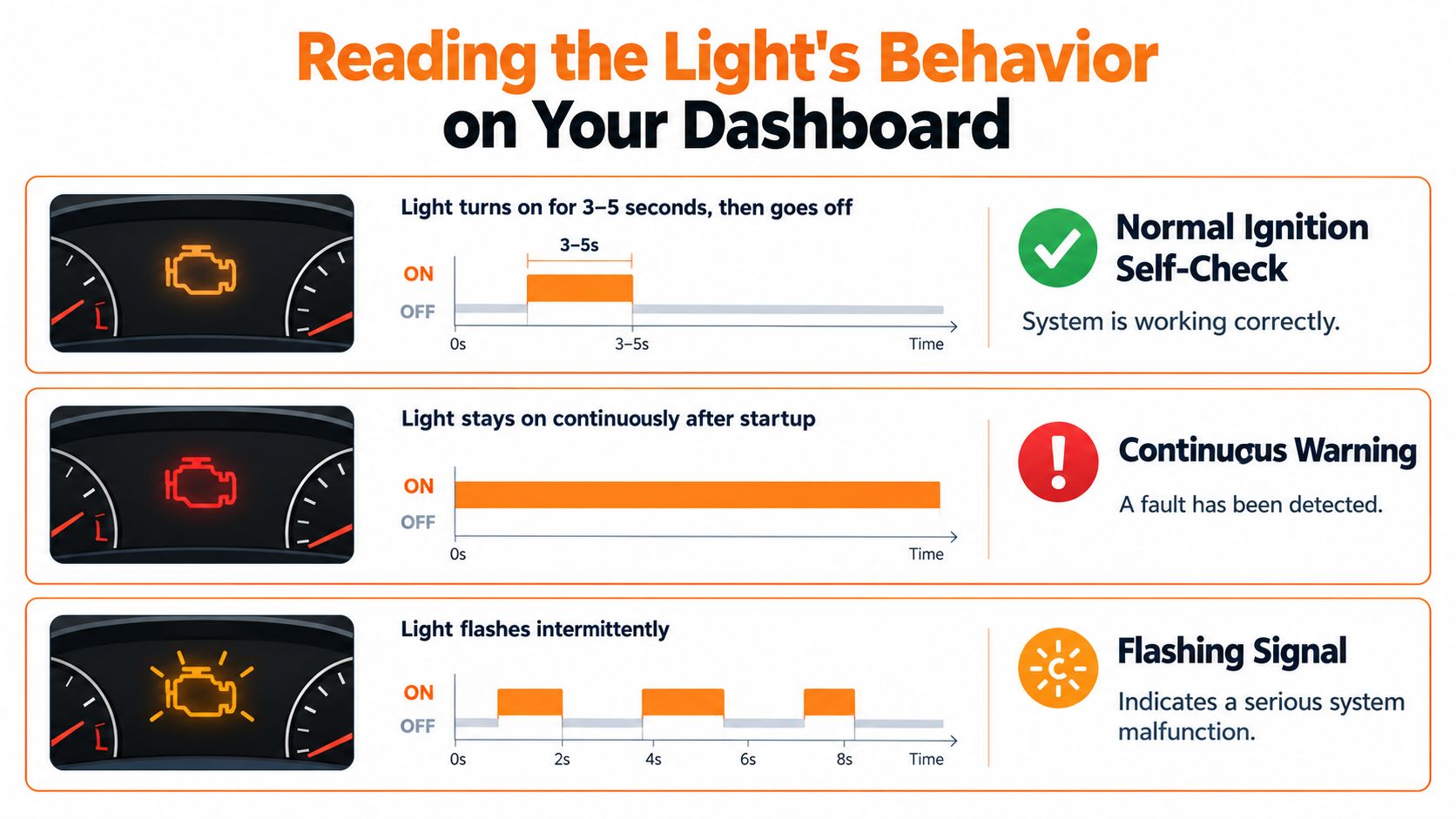
This illustration presents a general warning-light sequence. For an airbag concern, watch the SRS indicator, not the check engine light, and use your manual rather than a universal timing rule.
Use this mental checklist when you start the vehicle:
- Did it appear? Note whether the SRS lamp illuminated during the expected startup check.
- Did it go out? Record whether it stayed on or flashed instead.
- Did it return? Tell the technician if it reappeared after startup or while driving.
Avoid repeatedly restarting the car just to produce a dark dashboard. That doesn't establish the cause of the warning.
If you can safely record the startup sequence while parked, a short video can help you explain an intermittent pattern. Also note recent events such as a collision, seat removal, interior repairs, or battery work. Your job is to capture the symptoms, not decode the lamp into a repair instruction.
Common Causes Behind the Warning Light
The same dashboard symbol can result from very different faults. Rather than rank causes without a diagnosis, group them by the part of the restraint system involved and the work or event that preceded the warning.
A light appearing after seat removal makes disturbed wiring relevant. A warning following a collision makes deployment-related damage and stored crash information relevant. Neither situation proves the cause by itself.
Connections and sensor inputs
Wiring and connectors can develop open or high-resistance conditions, including loose or incompletely seated connections. If interior work happened recently, tell the technician which seats or panels were removed, but don't reach underneath a seat and start unplugging restraint connectors.
Occupant-classification sensors are another possible source. If the passenger-airbag status doesn't match the seating situation, that's useful diagnostic context rather than a reason to replace the seat sensor immediately.
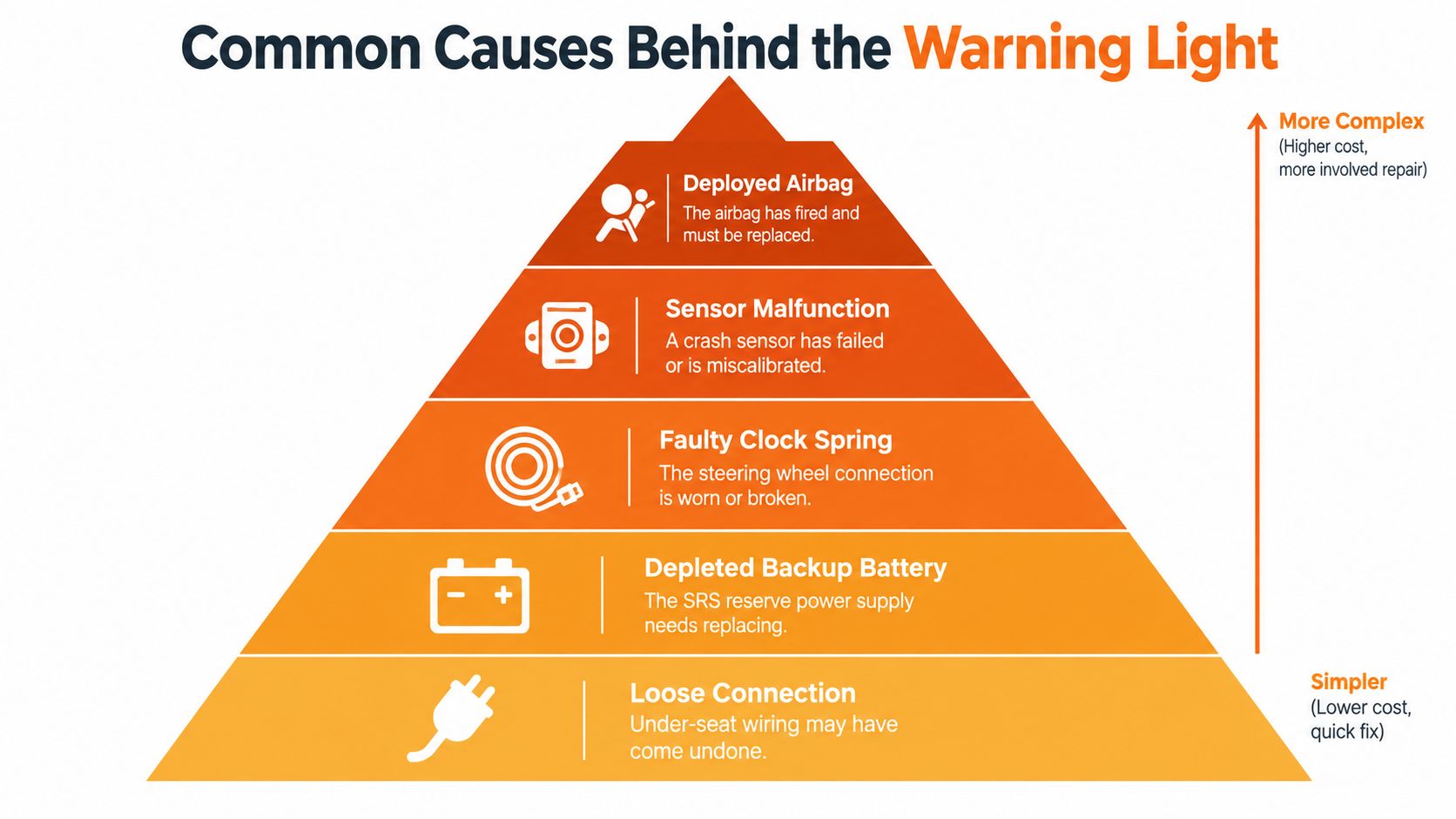
Treat the illustration as a grouping aid, not a frequency ranking or parts-replacement guide. A voltage-related warning, for example, doesn't by itself establish that an SRS reserve-power component needs replacement.
Restraint components and control faults
Other possible causes include:
- Clock spring faults. This component is among the restraint-circuit items a technician may investigate when the relevant codes direct attention there.
- Impact-sensor problems. Failed sensors or damaged associated wiring can require inspection, especially when collision history is relevant.
- Pretensioner faults. A deployed or damaged seat-belt pretensioner can be part of the unresolved SRS problem.
- Low-voltage events. Recent battery trouble is worth mentioning, but it shouldn't become an excuse to dismiss the warning.
- Control-module faults or stored crash data. The module itself may need attention, particularly after an accident.
The post-collision situation deserves care. Replacing visibly damaged parts doesn't necessarily resolve crash-related information or every restraint-circuit fault. Ask for a complete SRS assessment, not a check of the airbags you can see.
How Technicians Diagnose the Airbag System
A proper diagnosis starts with access to the restraint control module, not just the engine computer. A generic powertrain OBD-II reader may report no codes because it can't access the information relevant to your warning.
An SRS-capable scan tool can retrieve manufacturer-specific diagnostic trouble codes from the airbag system. Manufacturer instructions published through NHTSA illustrate the importance of restraint-specific diagnosis and the consequences of control-unit faults for airbag deployment.
What a useful diagnostic visit includes
The technician should connect the scan results to the vehicle's history and inspect the circuits or components identified by the service procedure. A fault code provides a diagnostic direction; it isn't automatically a command to replace the component named in its description.
For example, a circuit fault may require investigation of its wiring and connectors before anyone condemns an airbag or pretensioner. Active and historical information can also help the technician understand whether the problem is present now or has occurred intermittently.
Ask the shop for:
- The exact SRS codes. Keep the code descriptions with your repair records.
- The inspection findings. Ask what testing established the cause, not just what the scanner displayed.
- The repair plan. Confirm which components or circuits need work and why.
- The verification results. Ask how the technician will confirm readiness after the repair.
Restraint wiring needs special handling
Don't probe yellow SRS wiring, apply test power to an airbag connector, or substitute resistance values outside the manufacturer's procedure. Mishandling inflator circuits can cause deployment.
Workshop boundary: Ordinary electrical troubleshooting habits aren't automatically safe around pyrotechnic restraint components.
Leave connector handling and component removal to someone following vehicle-specific service instructions. A competent shop should be able to explain both the diagnosis and the precautions without making you feel foolish for asking.
Why Clearing the Light Is Not the Same as Fixing It
A reset changes stored information. A repair addresses the cause. Sometimes both belong in the completed job, but one doesn't replace the other.
An intermittent connector fault may stop triggering the lamp while its diagnostic history remains in memory. Manufacturer service guidance submitted to NHTSA documents loose or incompletely seated airbag connectors and active and historical fault codes, showing why current lamp behavior isn't the whole diagnostic picture.
Temporary improvement needs interpretation
Disconnecting the battery, moving a seat, or clearing codes doesn't establish that a failed sensor, damaged pretensioner, or collision-related problem has been corrected. It may change what you see without supplying the evidence needed to return the vehicle to service.
Consider a hypothetical post-collision repair: a technician corrects a disturbed connector, and the lamp's behavior changes. That still doesn't answer whether the control module contains crash-related information or whether another restraint component needs attention.
The correct response is to inspect the remaining diagnostic information, not declare success because the dashboard looks better. This distinction is particularly important when body repairs and SRS repairs happen at different stages.
Repair standard: Aim for verified system readiness, not merely an extinguished warning lamp.
What to ask before accepting the vehicle
A useful handover should answer these questions:
- What caused the warning? The repairer should identify the confirmed defect or post-collision condition.
- What was corrected? Ask which components, connections, or stored-data issues were addressed.
- What passed afterward? Confirm that the technician completed the applicable diagnostic checks.
A reset-only offer without a confirmed diagnosis leaves those questions unanswered. Clearing historical codes can be appropriate after a verified repair, but erasing information first can make an intermittent problem harder to understand.
Keep the diagnostic report and repair record together. They give the next technician context if the warning returns and help distinguish a recurring fault from a different issue.
Repair Options and When Mail-In Service Makes Sense
After a collision, the repair decision should follow the findings: what deployed, what was damaged, what codes remain, and what the manufacturer requires. Don't choose a module reset because the warning began after an accident.
Replacement through a dealership or qualified repair shop may be necessary for affected modules or restraint assemblies. A specialist service for eligible original components is another option to investigate, but suitability depends on the component's condition and the vehicle's repair requirements.
Compare the complete repair path
Ask the repairer to compare compatibility, required setup, total expense, and downtime rather than considering the component price alone. Reusing an original part may preserve its existing fitment, but that doesn't make every damaged part a candidate for restoration.
A mail-in airbag-module service becomes relevant when diagnosis identifies stored crash data or a supported module fault. A seat-belt repair service becomes relevant when a specialist can service the affected retractor or pretensioner assembly. Neither service replaces the remaining vehicle-level repairs or final SRS checks.
Before sending anything away, clarify:
- Service eligibility. Provide the component identification and diagnostic findings so the provider can assess the request.
- Repair requirements. Have the installing technician confirm what the manufacturer's procedure permits or requires.
- Logistics and terms. Confirm pricing, warranty coverage, repair timing, and shipping arrangements directly with the provider.
- Reinstallation responsibility. Decide who will reinstall the part and verify the complete restraint system.
Keep the vehicle and component repairs connected
Have a qualified technician remove restraint components using the applicable safety procedure. Send the service provider the relevant fault information rather than only reporting that the dashboard light is on.
When the component returns, the installing shop still needs to complete the repair and verify readiness. A serviced module can't compensate for an unresolved sensor fault, damaged wiring, or an untreated pretensioner problem.
The reassuring part is that a persistent warning has a diagnostic path. Start with the SRS findings, choose the appropriate repair, and require confirmation that the system is ready before returning to normal use.
Safety Restore offers mail-in airbag control module reset and seat-belt retractor and pretensioner repair services for customer-supplied components. If your technician has identified stored crash data or a deployment-related seat-belt fault, visit Safety Restore to check service eligibility and shipping instructions, then arrange professional reinstallation and final SRS verification.