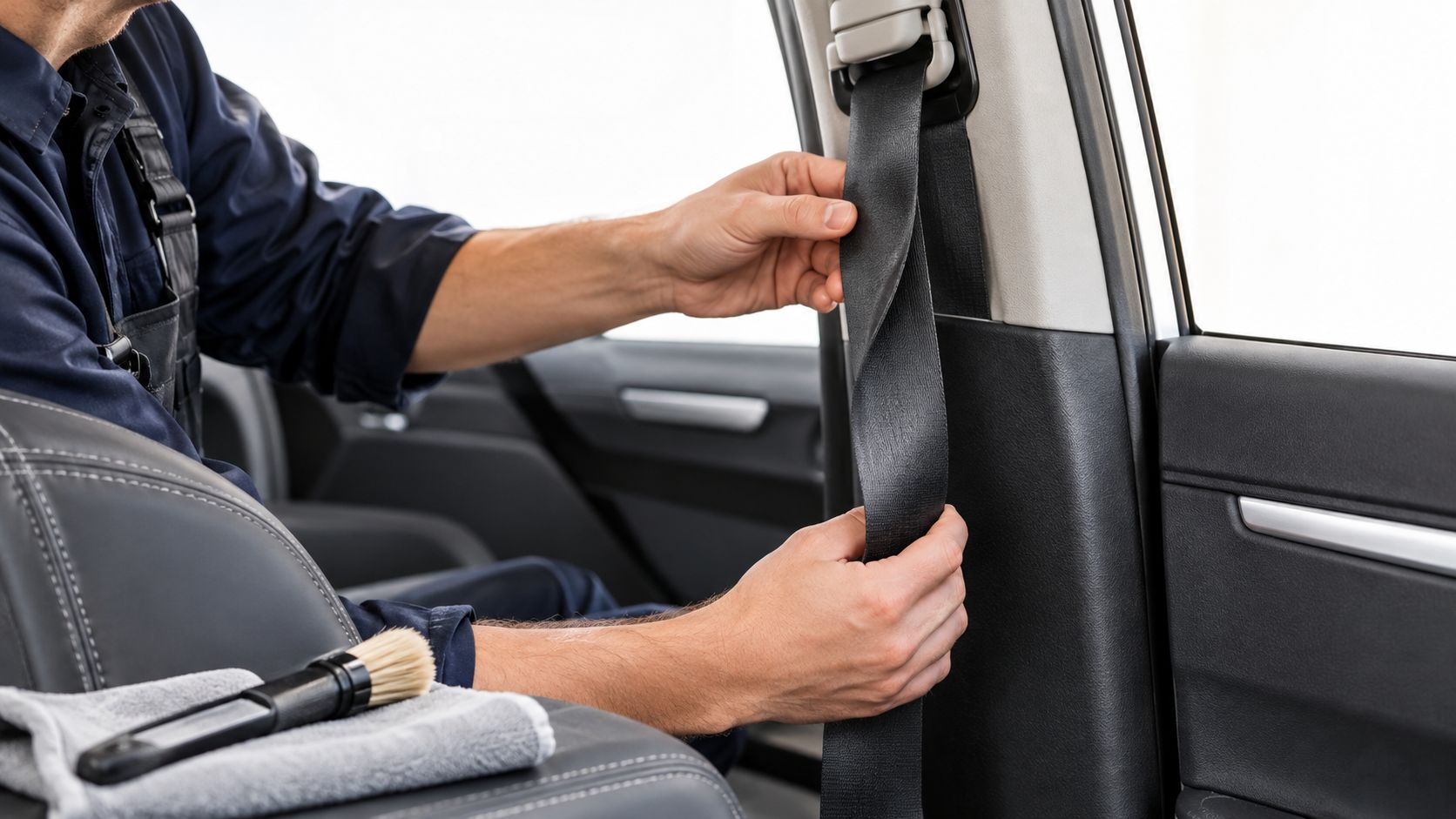
You pull the belt across your chest and it sags back into the pillar instead of staying put. Or it sticks halfway, fights you on the way out, then feels dead when you let go. Either way, seat belts not retracting is the kind of fault that changes from annoying to serious fast, because the belt's job is to remove slack before and during a crash.
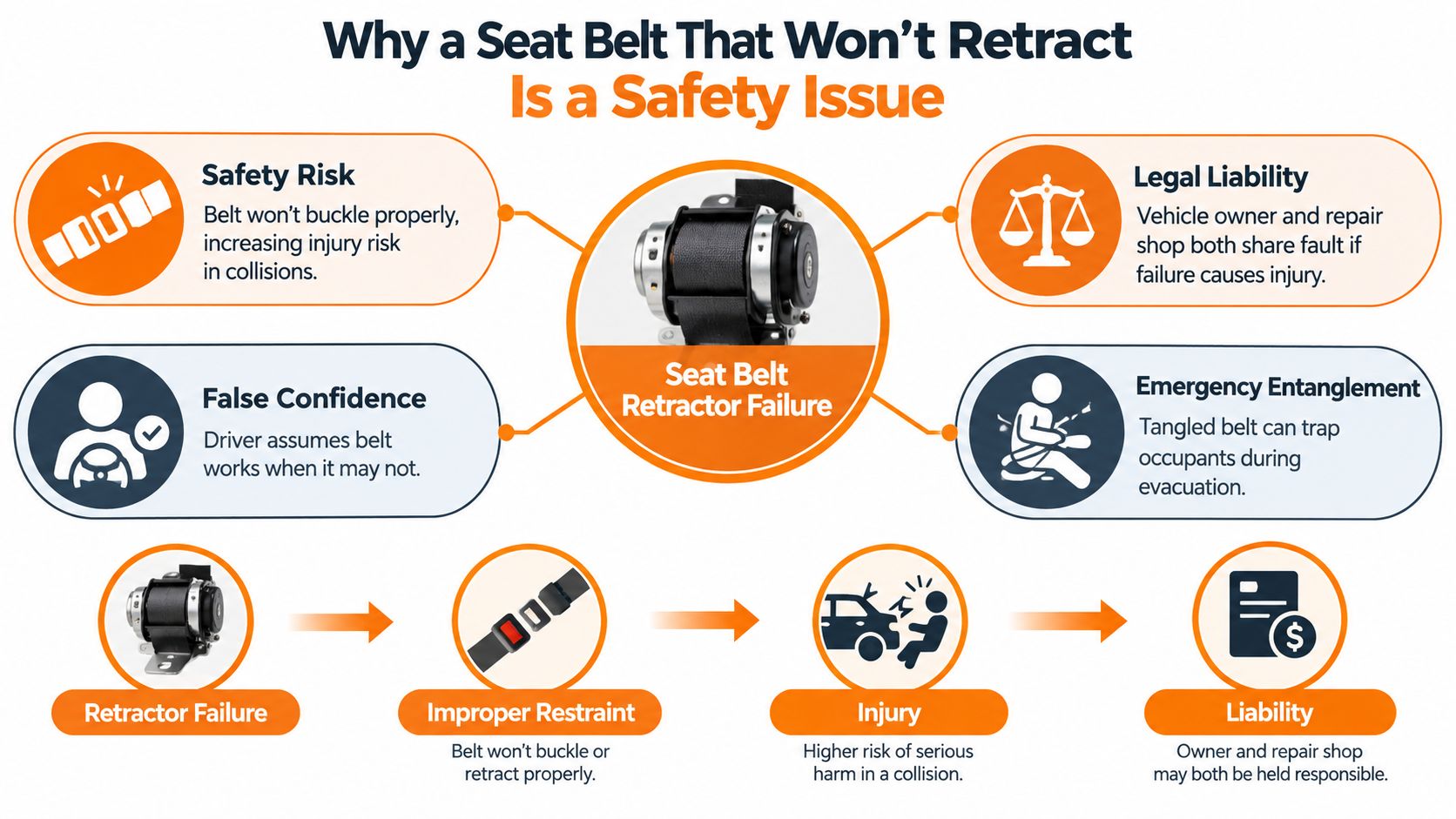
A belt that won't retract isn't one problem, it's a symptom. On some cars the webbing is twisted or trapped. On others, contamination, reverse lock-up, a worn retractor, or a deployed pretensioner is the underlying cause. The restraint system has evolved from the 1960s inertia reel to modern retractors and pretensioners, and that history matters because a “stuck belt” can mean the spool, spring, locking sensor, pretensioner, or crash-deployment system is involved IRCObi lecture PDF.
I've seen owners assume a loose belt is just an annoyance, then discover the car's restraint system had already told them something was wrong. I've also seen the opposite, a belt that felt locked because it was in a temporary child-seat locking mode, not broken at all. A good diagnosis starts with the right question, not the fastest replacement.
Table of Contents
- Why a Seat Belt That Won't Retract Is a Safety Issue
- Safe Checks You Can Do Before Removing the Belt
- What “Retracting” Has to Mean to Be Safe
- Five Distinct Reasons a Belt Stops Retracting
- Why a Locked Belt After a Crash Is a Recall-Level Problem
- DIY Fixes, Dealer Replacement, and Mail-In Retractor Repair Compared
- What Happens When You Mail In a Retractor for Repair
Why a Seat Belt That Won't Retract Is a Safety Issue
You buckle in, and the webbing stays loose against your body or hangs back in the pillar instead of pulling itself home. That is a restraint problem, not a comfort issue. A belt that will not retract leaves slack in the system, and slack is what the belt is supposed to remove before a crash loads it.
The retractor's job is straightforward. It pulls in excess webbing, holds the belt in the right position, and still gives you room to move normally. If the belt does not return cleanly, it can ride poorly on the shoulder or lap and fail to keep the occupant positioned before impact, which is the point where restraint geometry starts to matter most IRCObi lecture PDF.
A belt that drags, stays out, or locks up after you let go deserves restraint-system attention, not a shrug.
Modern complaints are also more varied than they were in older vehicles because the system is no longer just a spring and spool. Retractor pretensioners and buckle pretensioners were added later to tighten the belt during a collision, so a dead-feeling belt can reflect a spring fault, a locking issue, or a deployed pyrotechnic device. That is why two belts with the same symptom can call for completely different repairs.
When the belt is stuck after a crash, the problem may be tied to deployment history rather than wear. I have seen belts that only needed routing corrected, and I have seen belts that were done the moment a pretensioner fired. The repair path changes fast once you know which condition you are looking at.
The same slack-removal principle applies outside cars, which is why wheelchair seat belt replacements are specified with similar retention and routing requirements.
A practical check starts with that distinction. A belt that is merely threaded wrong is a different job from one that is jammed, loaded after impact, or tied to a deployed restraint component. That is the line between a simple correction and a hands-off replacement.
Safe Checks You Can Do Before Removing the Belt
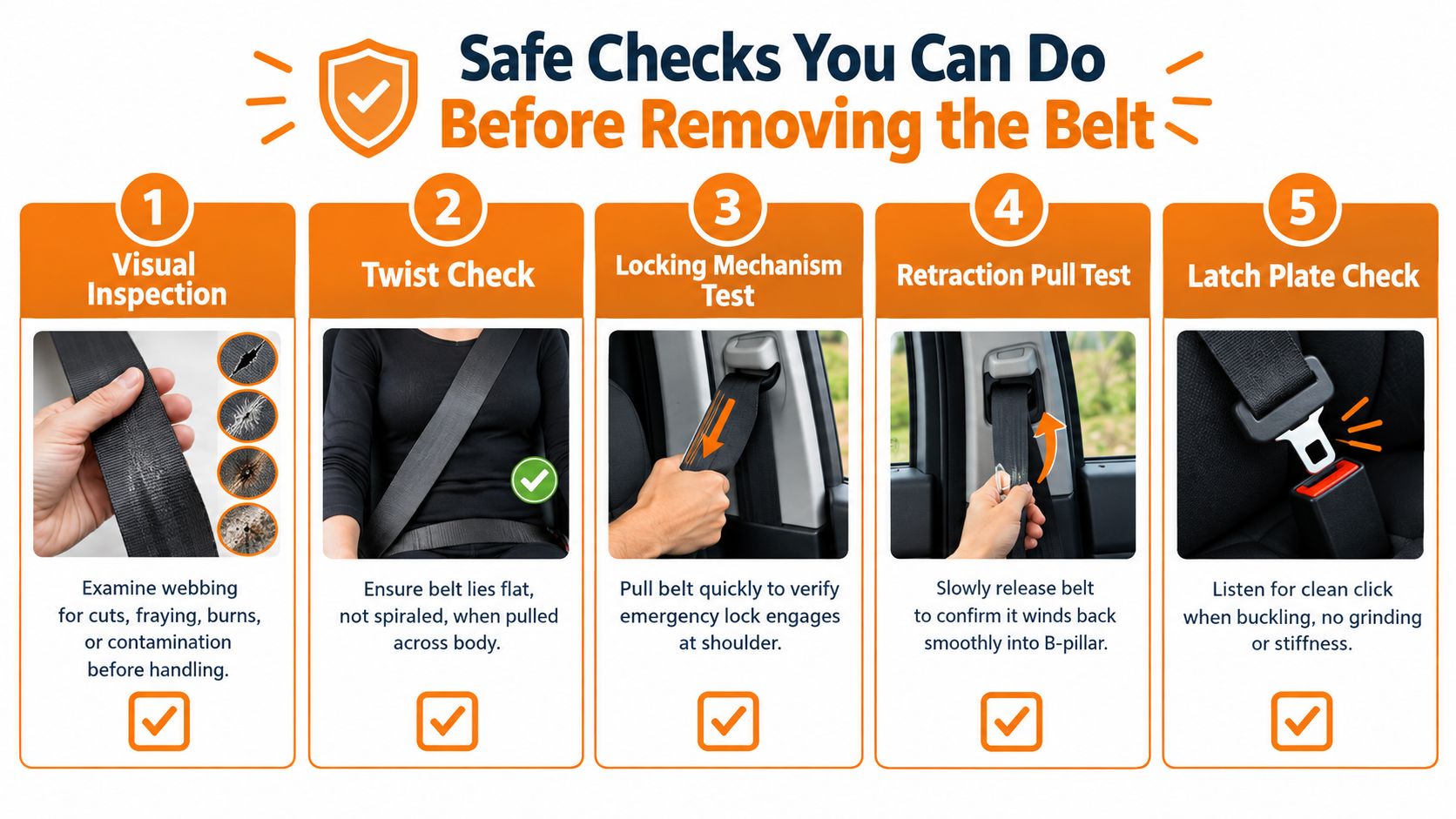
Start with the least aggressive checks and don't skip the obvious stuff. A surprising number of “bad retractors” are really belts that are twisted behind trim, routed wrong through the shoulder guide, or hanging on debris at the opening.
What to inspect first
- Visual inspection: look for cuts, fraying, burns, heavy contamination, or a belt that's pinched under trim before you do anything else.
- Twist check: pull the webbing out and make sure it lies flat. A spiral twist can create enough drag to mimic a failed retractor.
- Mounting orientation: verify the retractor is mounted the way the vehicle expects. Many inertia-sensitive units can lock when they're installed at the wrong angle.
- Guide path: make sure the shoulder belt isn't trapped in the upper guide or rubbing hard on trim.
- Stationary pull test: with the vehicle unloaded, slowly extract and release the webbing while keeping it aligned with the guide.
A useful OEM-style inspection uses a control point of 8 inches (203 mm) from the retractor for first-row positions and 12 inches (305 mm) for second-row positions, then checks for full extraction and audible ratcheting as the automatic-locking retractor function engages NHTSA service procedure PDF.
Don't test a belt under occupant load and don't yank at an angle. Both can create a false diagnosis.
Where people go wrong
The common mistakes are easy to make. Somebody tests the belt while sitting in it, pulls sideways instead of straight, misses a partially deployed pretensioner, or clears an SRS code before fixing the mechanical problem. None of those tell you the retractor is healthy.
If the belt is still jammed after those checks, stop forcing it. A belt that remains locked after obstruction and alignment checks needs professional evaluation, especially if a pretensioner may have fired.
What “Retracting” Has to Mean to Be Safe
A belt that moves in and out is not automatically a safe belt. It has to retract with the right force, lock when it should, and pass the material and function checks set by the standard.
The numbers that matter
Under FMVSS 209 test methodology, the webbing is cycled through 10 full extension and retraction cycles before retraction-force measurement, then tested for extension force limits of 18 N for a general retractor, 13 N for a pelvic restraint, and 5 N per shoulder-contacting strap in the applicable configuration 49 CFR 571.209.
| FMVSS 209 Force and Locking Limits for Retractors | Limit | Diagnostic meaning |
|---|---|---|
| Conditioning cycles | 10 full cycles | Confirms performance after repeated movement |
| Extension force, general retractor | 18 N maximum | Too much drag means the system may bind |
| Extension force, pelvic restraint | 13 N maximum | Lower ceiling for that configuration |
| Extension force, shoulder strap | 5 N maximum per strap | Sensitive to spool drag and webbing resistance |
| Retraction-force check point | Near 75% extension | Weak springs and drag show up here first |
| Webbing-sensitive locking | 0.3 g limit in test interval | Locking must happen only when intended |
That 75 percent extension point is useful in the shop because weak springs, spool drag, contamination, and damaged webbing usually show up there first. If the belt feels fine at the start but slows down or hangs up later in travel, I look for friction or internal wear before I blame the whole assembly.
Material condition matters too
The standard also rejects webbing that is cut, frayed, chemically damaged, heat-damaged, or visibly distorted. Federal test material also specifies minimum Type 2 webbing breaking strengths of 22,241 N for the pelvic portion and 17,793 N for the upper-torso portion. The same standard also makes clear that a belt can fail on condition alone, even if it still moves.
A belt can look serviceable and still fail the function side of the test. So before you call a belt fixed, cycle it through the full travel and check the webbing condition against the standard.
Five Distinct Reasons a Belt Stops Retracting
The fastest way to waste time is to call every stuck belt a broken retractor. The symptom looks the same. The causes do not.
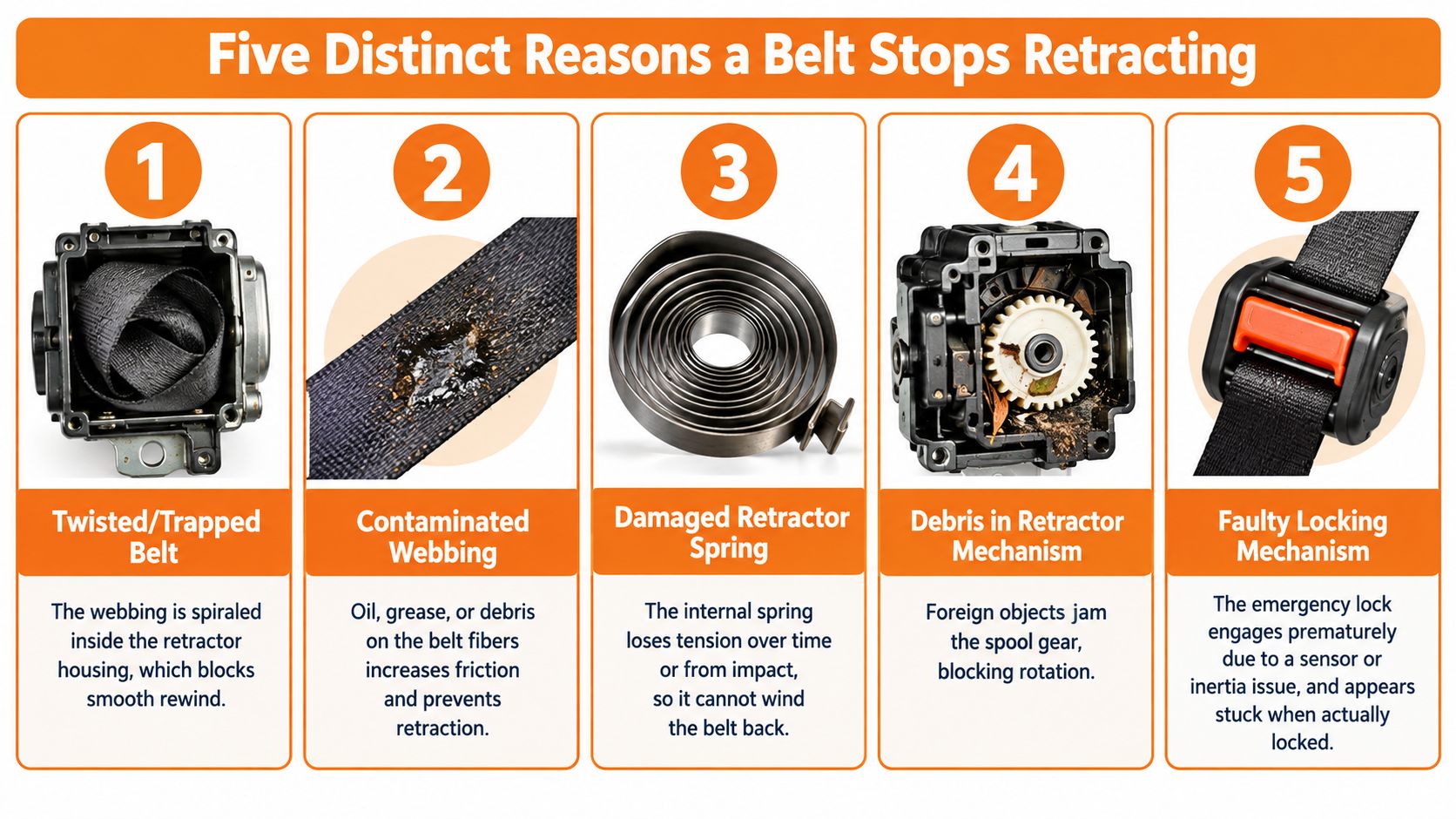
The five failure modes I see most
- Twisted or trapped belt. The webbing spirals in the path or gets pinched behind trim, and the drag feels like a weak spring.
- Contaminated webbing. Oil, grease, grime, or debris raises friction and keeps the belt from sliding back cleanly.
- Reverse lock-up. Too much webbing was spooled before installation, then the belt locks against itself until tension is applied and released.
- Genuine retractor fault. The spring, spool, or locking mechanism is worn, damaged, or out of spec.
- Deployed pretensioner. After a crash, the restraint can stay locked because the pretensioner did its job and the assembly is no longer acting like a normal belt.
Manufacturer guidance reflects those differences. One 2025 NHTSA bulletin tells technicians to clean the guide before replacing the assembly and also explains the tension-and-release reset for a reverse-locked retractor NHTSA TSB PDF. That matters because a belt that seems broken might only need a safe reset, while a post-crash belt may need removal and professional evaluation.
Practical rule: do not disassemble, force, lubricate, or bench-test a belt casually. A retractor can contain a pretensioner or pyrotechnic device, and improper handling can turn a repair into an injury problem.
Temporary lock versus real fault
Child-seat locking mode causes a different kind of hold-up. The same NHTSA bulletin describes an automatic locking retractor that releases only after the belt is unlatched and fully retracted. That is normal behavior, not a damaged restraint.
Here is the shop test I use. If the belt frees up after alignment, cleaning, or the correct reset, you likely found a temporary condition. If it stays jammed, especially after a collision, the assembly deserves more than a casual tug.
Why a Locked Belt After a Crash Is a Recall-Level Problem
A belt that stays locked after a collision is a restraint-system problem, not a routine repair estimate. Treat it that way before anyone starts pulling trim or ordering parts.
Ford's 2025 recall covered about 112,949 vehicles, including 94,718 Ford Expeditions and 18,231 Lincoln Navigators NHTSA recall report. The concern was possible inadvertent deployment of the front seat-belt retractor pretensioner, which could leave the belt locked so it would not retract or extend. Ford's analysis also noted 17 U.S. warranty or dealer reports between December 1, 2023 and February 15, 2025 for the expanded vehicle population, with no related crashes or injuries known as of March 20, 2025 NHTSA recall report.
What the recall data means for owners
The suspected cause was oxidation at pretensioner squib pins, which could create high resistance or an open circuit and trigger a diagnostic trouble code and airbag warning light. That points to a restraint system that may have a deployed or damaged component and needs formal inspection, not a casual tug.
A separate NHTSA recall for Autocar heavy-duty trucks showed a different failure path, where seat-belt retractor interference could crack the cover, loosen the spring, and make the mechanism inoperable NHTSA recall report. A belt that will not move after a crash can therefore be electronic, mechanical, or both.
The before-you-pay checklist
- Check the VIN: look for open recalls tied to the restraint system.
- Confirm pretensioner activity: determine whether the belt fired in the event.
- Scan the SRS: review crash data and hard fault codes before ordering parts.
- Inspect anchors and webbing: look for physical damage before calling it a dead belt.
- Follow manufacturer post-collision rules: some makers require the complete system to be replaced after specified crash conditions.
GM's collision guidance calls for replacing the complete seat-belt system after moderate-to-severe collisions, not just the fired pretensioner. Check the maker's post-collision inspection procedure before ordering a single part.
For owners who need legal context after a crash, a resource like the Houston car accident lawyers page from The Law Office of Bryan Fagan, PLLC is relevant because restraint failures can become liability questions as well as repair questions.
DIY Fixes, Dealer Replacement, and Mail-In Retractor Repair Compared
Once a belt has passed the basic checks for twists, contamination, and bad installation, the next decision is simple: fix the obvious fault yourself, replace the assembly through a dealer, or send the retractor out for repair. Which route makes sense depends on whether the belt is only temporarily locked, the mechanism is worn, or the unit has already been through a crash event.
The three options
| Comparing the Three Paths for a Non-Retracting Belt | Typical cost per belt | Downtime | Warranty | Fitment risk |
|---|---|---|---|---|
| DIY reset or cleaning | Low | Short if the issue is minor | None | Low only if the belt passes afterward |
| Dealer replacement | Often high | Depends on parts availability | Manufacturer-backed | Low on fitment, but part availability can be an issue |
| Mail-in retractor repair | $99 per item | Typical 24-hour turnaround | Lifetime warranty | Low, because the original OEM assembly is preserved |
For a worn retractor on an older vehicle, the mail-in repair path at Safety Restore is often the practical middle ground. The flat $99 per item price gives you a fixed repair cost, and the original assembly stays in service instead of being swapped for a mismatched dealer unit. The typical 24-hour turnaround helps when the car needs to get back on the road quickly, and the lifetime warranty matters more than a sales pitch when you are deciding whether to keep an OEM belt or buy new.
How to think about the workflow
DIY work is triage. Straightening a twist, clearing debris from the guide, or resetting a reverse lock is worth trying if the belt retracts normally afterward. If the belt still binds, the mechanism is telling you the problem is deeper.
Dealer replacement is the cleanest parts-counter answer, but it can be expensive and slow, especially on older or less common vehicles. Mail-in repair sits between those two because the original hardware is rebuilt instead of thrown away, which reduces fitment risk and keeps the repair tied to the belt that already belongs in the car.
If the belt passes a proper pull and retract test after the fix, the repair held. If it still drags or sticks, stop treating it as a quick save.
What Happens When You Mail In a Retractor for Repair
The mail-in path is simple when it's handled in the right order. You order the repair for the number of belts you're sending, remove the assembly from the vehicle, package it carefully, and ship it to the repair facility in Westfield, Massachusetts. A clear mail-in process guide like the one at managing mail-in repairs helps first-time customers avoid the usual packaging mistakes.
The physical steps
Remove the belt using the normal anchor and retractor fastener points, then keep track of the hardware so reinstalling it later isn't guesswork. If the webbing is frayed, include that note with the order. If the pretensioner or buckle is part of the assembly being serviced, send those removable components with it, but do not package the SRS airbag module in the same box.
Once the belt arrives, the internal mechanism is restored rather than replaced, and the original OEM fitment is preserved. That matters because the mounting points, tags, and vehicle-specific shape stay with the part. The repaired unit comes back ready for reinstallation, which keeps the job focused on the original belt instead of a mismatched replacement.
What to include and what to skip
- Include the belt assembly: send the retractor and any related pieces that belong to the service order.
- Include damaged webbing notes: if the webbing is cut, frayed, or otherwise compromised, note that clearly.
- Include the pretensioner when applicable: if it's part of the belt assembly and the service requires it, pack it with the unit.
- Do not send the airbag module in the same package: that's a separate SRS component.
The decision checklist is simple. Confirm whether the symptom is twist, contamination, reverse lock, true retractor wear, or a deployed pretensioner. Run the safe physical checks first. Verify recall status and stored SRS faults. Then choose the path that matches the fault, the downtime you can tolerate, and the repair you can trust.
If your belt won't retract cleanly, Safety Restore offers mail-in retractor and pretensioner repair that keeps your original part in service instead of forcing a full dealer replacement. If you're dealing with a locked, slow, or crash-deployed belt, visit Safety Restore and compare the repair options for your vehicle.