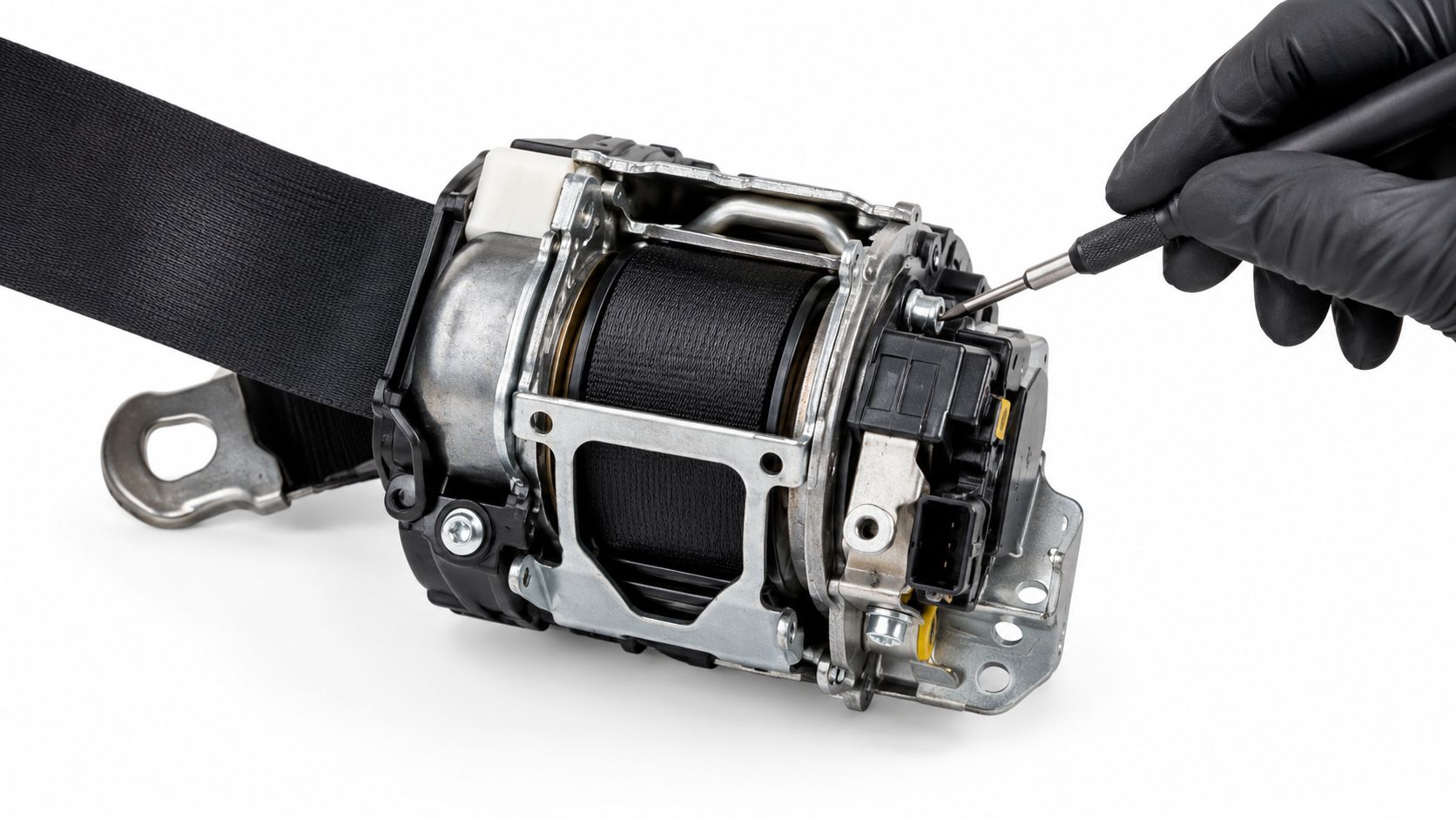
A seat belt retractable unit that won't release or won't rewind is usually dealing with a locked retractor, a deployed pretensioner, or a twisted webbing path. Some of those problems can be serviced, but not all of them are safe to drive with.
The moment is familiar. You slide into the seat, pull the belt across, and the webbing either hangs limp, stops halfway back in, or comes out with that odd gritty feel that tells you something inside isn't tracking normally.
That's where owners get stuck, because a belt can feel “stuck” without being the same as “unsafe,” and it can also feel almost normal while hiding a crash-related fault. The difference matters. A retractable belt is part of a safety system that uses a spring-loaded spool, an inertia lock, and, in many vehicles, a pretensioner that fires during a crash. If you want to judge whether your belt needs service, rebuild, or full replacement, you have to look at the system as a whole.
Table of Contents
- What Happens When a Retractable Belt Misbehaves
- How a Seat Belt Retractable Mechanism Works
- Inside the Retractor and Its Core Components
- Pretensioners and What They Add to the System
- Common Retractor and Pretensioner Faults
- Stuck Versus Dangerous and How to Tell the Difference
- Diagnosis Repair and the Mail-In Service Workflow
- Drive Ship or Replace a Clear Decision Framework
What Happens When a Retractable Belt Misbehaves
A driver often notices the problem at the worst possible time, right after getting in, closing the door, and trying to buckle up quickly before traffic starts moving. The latch plate reaches the buckle, but the webbing feels lazy coming back, or it binds before it reaches the shoulder, or it twists so badly that the belt sits wrong across the body. What should be a one-motion routine turns into a small fight with the car.
That little fight tells you something, though. A belt that retracts slowly may be dealing with dirt, a tired spring, or webbing that isn't feeding cleanly. A belt that won't retract at all may have a bent frame, a seized spool, or a lockup that's no longer responding the way it should. A belt that clicks loudly but feels wrong can be even more confusing, because the sound alone doesn't tell you whether the system is still doing its job.
The symptoms usually fall into a few patterns
The easiest mistake is treating every bad belt like a simple jam. In real shops, the question is broader, because the same driver complaint can point to very different hardware problems. A belt that stays loose after release is not the same thing as one that locks hard on a sharp pull, and neither is the same as a belt that has already been tensioned by a crash device.
Practical rule: If the belt only acts strange during normal use, the issue may be mechanical. If it feels wrong after a crash, or the SRS light is involved, treat it as a safety fault first.
The patent history helps explain why the modern design has so many layers. A published emergency-locking retractor patent in 1982 shows manufacturers formalizing the design that lets webbing extend normally and then lock under sudden force, while earlier patent records from 1973, 1971, and 1969 show the idea developing well before it became common in passenger vehicles (EPO patent record). That matters because today's “retractable” belt is not just about convenience, it's about managing slack without taking away normal movement.
The benefit is huge at population scale. NHTSA says seat belts reduce death risk for front-seat passenger car occupants by 45%, reduce moderate-to-critical injury risk by 50%, and reduce death risk for light-truck occupants by 60%. NHTSA also estimated seat belts saved 14,955 lives in the United States in 2017, and reported that 91.6% of people in the U.S. buckled up in 2023 (NHTSA data). That's why a small retracting problem deserves attention. It sits inside a system that works at national scale.
How a Seat Belt Retractable Mechanism Works
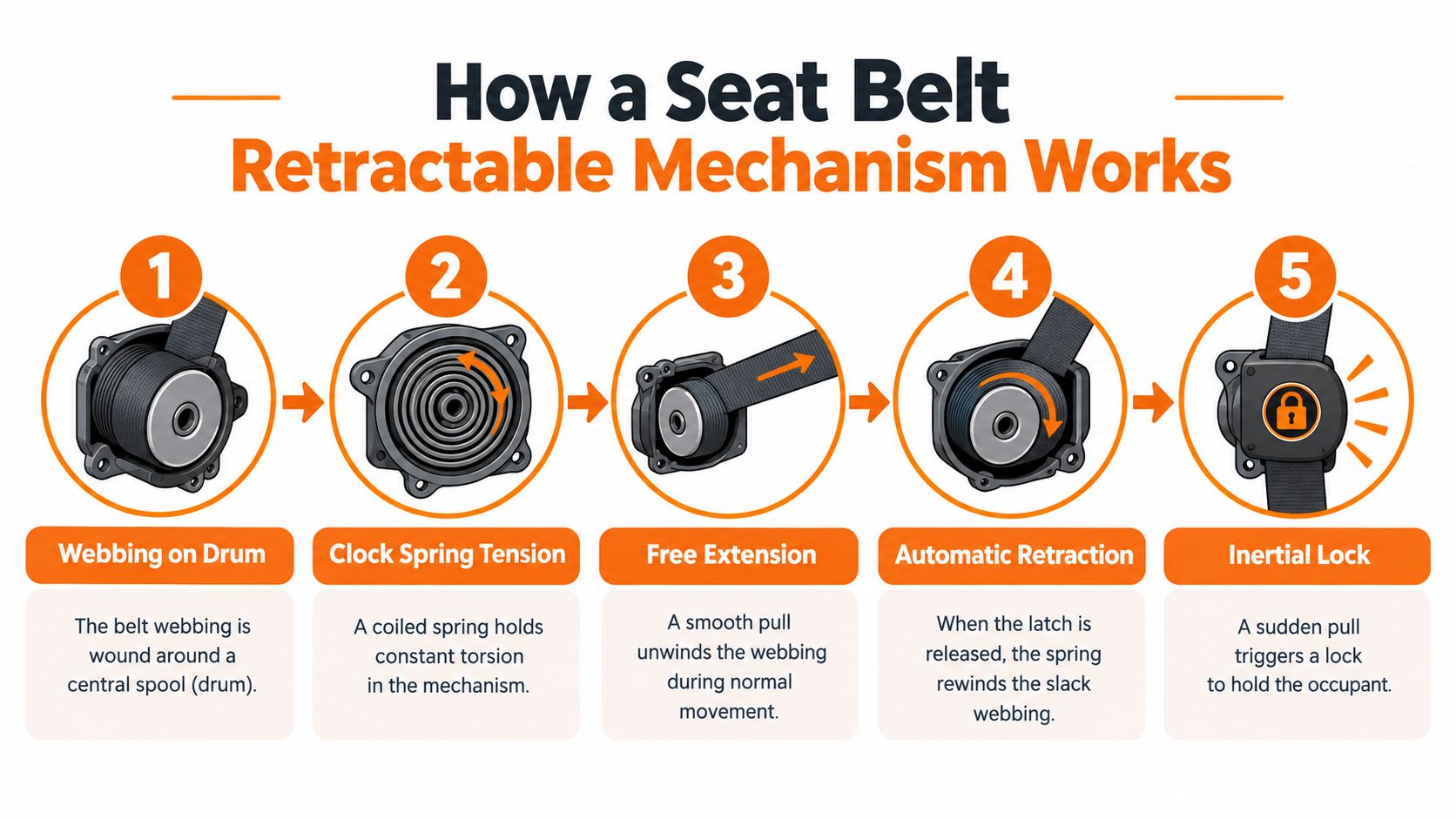
A retractable belt works like a spring-loaded spool. The webbing is wound around a central drum, and a coiled spring keeps constant torsion on that drum so the belt wants to wind itself back up whenever you let go. When you pull the belt across your body, you're turning the spool against that spring.
The basic motion is simple
The belt extends, the spring resists it, and when you release the latch plate, the spring pulls the webbing back in. That's why a good belt feels smooth when it feeds out and steady when it rewinds. The housing usually sits at the B-pillar or near the door frame, where it can anchor the spool and keep the webbing aligned as it comes off and returns.
That basic rewind action is only half the story. The other half is the lock. In an Emergency Locking Retractor, or ELR, the webbing moves freely during normal use, then the spool locks when the mechanism senses rapid deceleration, a sharp tilt, or a sudden pull. In an Automatic Locking Retractor, or ALR, the belt changes behavior as it is pulled farther out, then holds that length so a child seat can be installed securely. The two modes solve different problems, and confusing them is one reason people think a belt is broken when it's just in the wrong mode.
The lock threshold is not casual. FMVSS 209 requires the retractor to lock before webbing extends 25 mm when subjected to 0.7 g acceleration, which shows how tightly regulated the system is for crash protection (AAFS PDF). That's the technical reason the belt can move normally in a parking lot but stop instantly during a sudden event.
Where the pretensioner fits
The pretensioner is a separate stage. It doesn't handle everyday retraction, and it's not the same thing as the ELR or ALR. Its job is to tighten the belt during a crash so there's less slack before the occupant loads the restraint. That distinction matters later, because a belt can still click and rewind after a crash yet still be unsafe if the pretensioner has already fired.
Inside the Retractor and Its Core Components
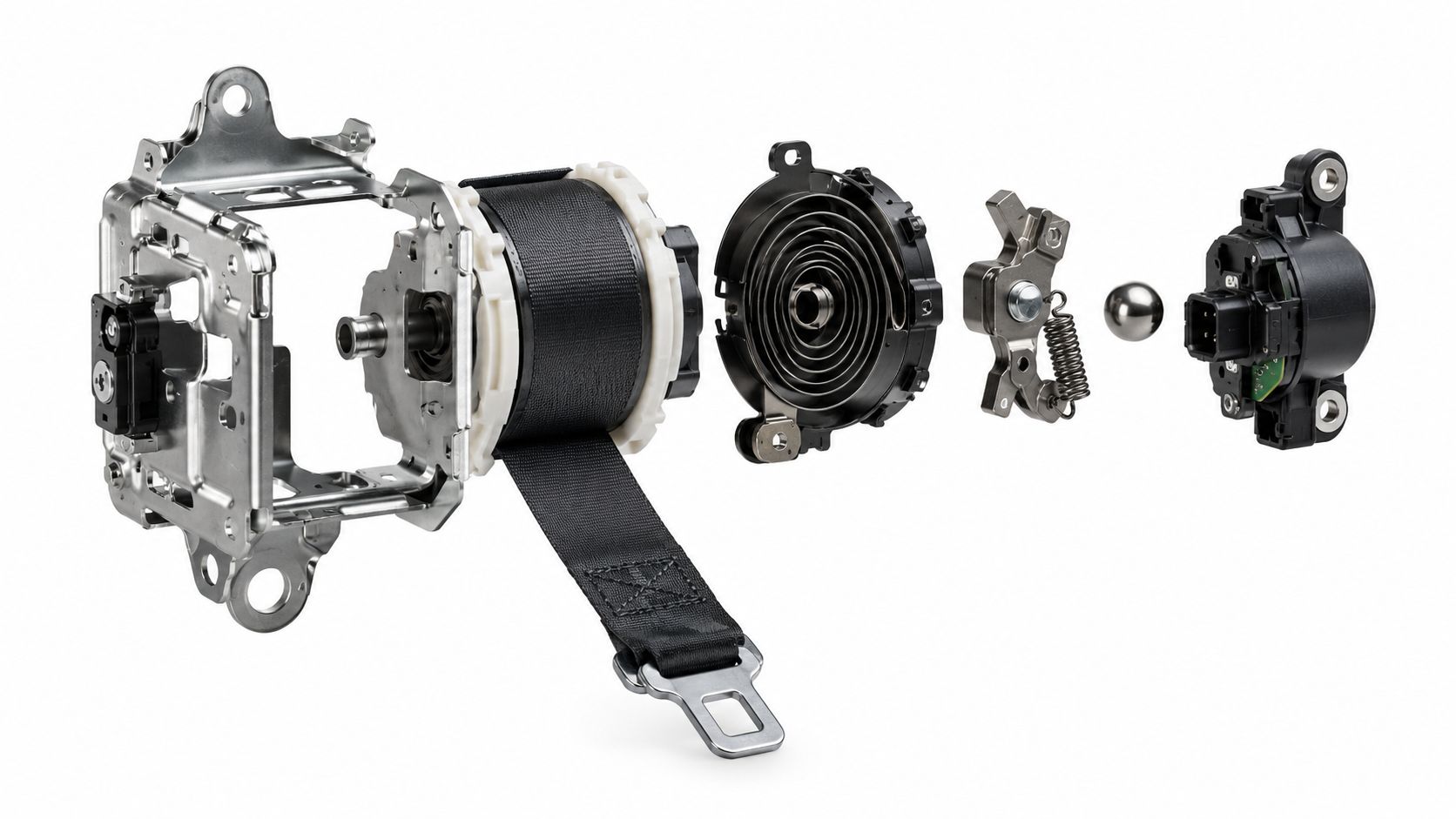
A retractor is more than a spool in a box. It's a small mechanical system where each part has a job, and each job becomes more important when the car takes a hard hit. The spool stores and releases webbing, the pre-wound spring keeps tension on the drum, and the steel frame holds everything in alignment so the mechanism doesn't twist under load.
The parts you're really dealing with
The sensor is what turns motion into lockup. In many designs, an inertial ball or pendulum reacts to sudden deceleration or tilt, then pushes the lock into place. Once that happens, the locking pawl engages the ratchet teeth on the spool, and the drum can't keep turning forward. That physical stop is the difference between controlled movement and forward excursion.
The webbing guide matters too, even though it's easy to overlook. If the belt feeds off the drum at a bad angle, the spool can't rewind cleanly, and the webbing starts to ride unevenly. That's how a belt that “just feels off” can slowly become a belt that binds or stays twisted even when nothing looks obviously broken from the outside.
Crash loading makes all of this harsher at once. The sensor trips, the pawl locks, the spring stops helping, and the webbing has to hold the occupant under a sudden load instead of just managing day-to-day movement. If a frame is bent, the spool is seized, or the locking parts have been stressed, the belt may still look complete while no longer behaving as OEM intended.
A technician cares less about how the housing looks and more about whether the spool rotates, the sensor reacts, and the pawl releases and re-locks correctly.
For anyone who wants a deep technical rabbit hole, the discussion on technical speculations and related seat belt mechanisms is a useful reference point for how people often misread the symptoms. But the shop-level takeaway is simpler. Every complaint usually maps back to one of the core parts, and the next step is matching the symptom to the failing component before deciding whether the unit can be rebuilt.
Pretensioners and What They Add to the System
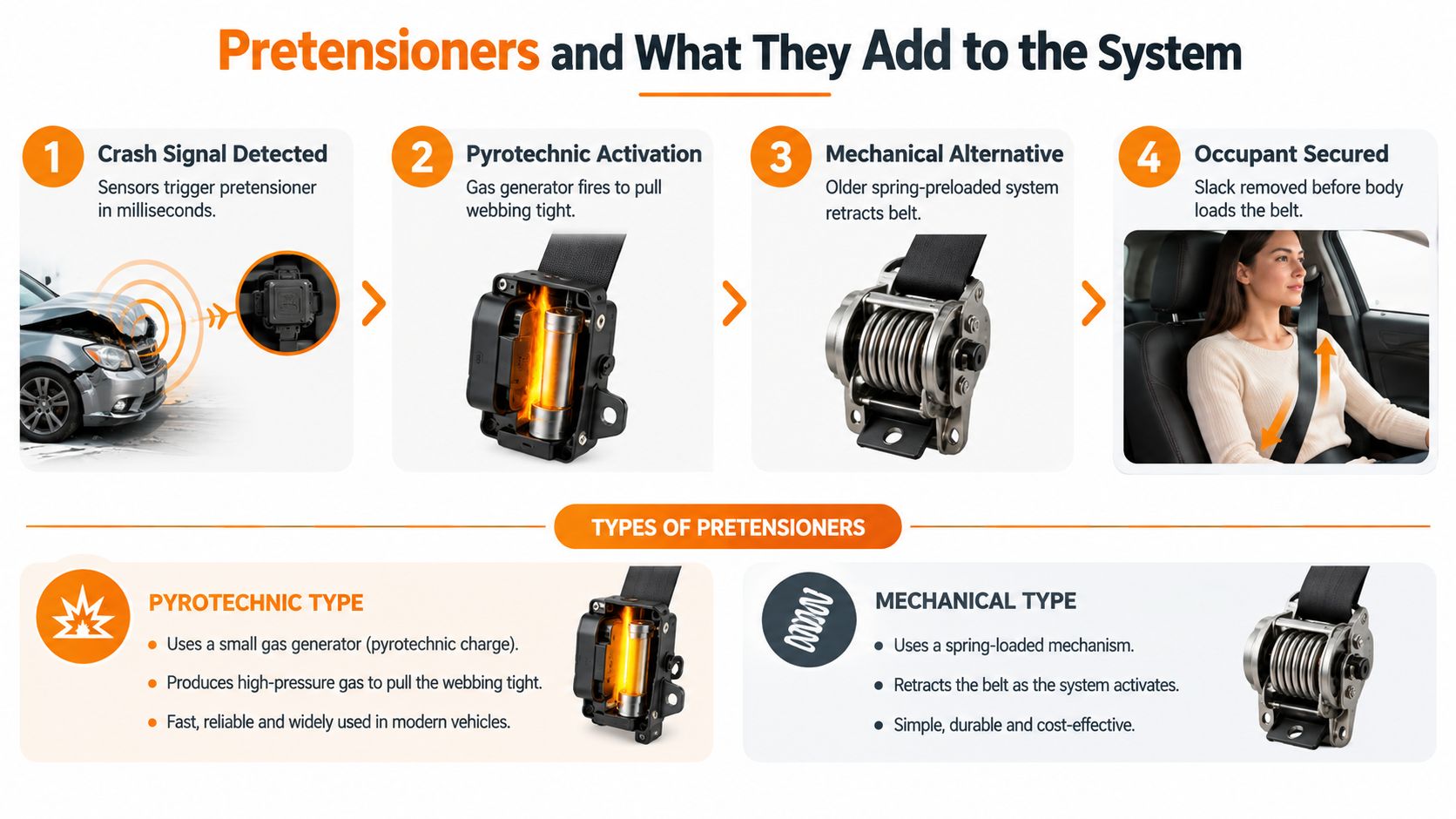
A pretensioner is the crash-activated stage that tightens the belt before the occupant starts moving much. In practice, that means it works with the retractor, not instead of it. The retractor manages normal use, then the pretensioner takes over in a crash to remove slack fast.
Pyrotechnic and mechanical pretensioners do the same job in different ways
Modern systems usually use a pyrotechnic unit, which relies on a gas generator to pull the belt tight when the control module commands it. Older systems may use a mechanical, spring-preloaded design that does the same basic tightening job without a pyrotechnic charge. Either way, the goal is the same. The belt should be snug before the body loads the restraint.
The trigger chain is straightforward. Crash sensors report the event to the airbag control module, the module decides whether the conditions meet deployment criteria, and reserve power in the system helps the command complete even if the electrical supply is interrupted. Once a pretensioner fires, it's a one-use event. That's why it isn't something you “reset” the way you would re-spool a belt after a child-seat installation.
Pretensioners also come in different layouts. Buckle pretensioners tighten from the latch side, anchor pretensioners pull at the mounting point, and retractor-integrated pretensioners act inside the belt assembly itself. You'll also see single-stage, dual-stage, and triple-stage units, which tells you how the system sequences the tightening force rather than whether it is somehow more or less important.
Why shops treat fired pretensioners as replacement items
A fired pretensioner changes the whole assembly. The SRS light, stored crash data, and the pyrotechnic charge itself are the big reasons the OEM unit is treated as a one-use service item rather than a simple mechanical part. Once it's deployed, the belt may still click and move, but the crash function is gone.
That's why post-collision diagnosis has to separate the spool problem from the crash event problem. A jammed belt might be repairable. A fired pretensioner usually isn't, at least not as a reset-and-reuse job.
Common Retractor and Pretensioner Faults
The fault patterns are more predictable than they first seem. A belt that is slow to retract usually points to spring tension, drag on the webbing, or contamination inside the guide path. A belt that won't retract at all usually has a seizure, a bend, or a spool that isn't free to turn. A locked-up belt often means the inertial sensor or pawl is staying engaged when it shouldn't.
How the symptoms usually line up
| Common Retractable Seat Belt Faults at a Glance | Symptom | Likely Cause | First Check |
|---|---|---|---|
| Slow retract | Belt creeps back instead of snapping home | Weak torsion spring, dirty webbing, drag in the guide | Pull test and full rewind |
| Will not retract | Webbing stays out or stops hard | Bent frame, seized spool, damaged spring path | Visual inspection and extension test |
| Locked up | Belt won't pay out normally | Sticky inertia sensor or pawl | Sudden-pull lock test |
| Deployed | Belt feels tight after a crash | Pretensioner has fired | SRS scan and crash history |
| Twisted webbing | Belt lays flat badly or feeds unevenly | Reversed routing, twisted anchor, poor reinstall | Full extension and visual check |
| Child-seat ALR confusion | Belt won't release until fully re-spooled | ALR mode engaged | Rewind until the mode resets |
The confusing one is the ALR. People install a child seat, hear the clicking mode engage, then think the buckle is broken when the belt won't free up later. Most of the time, that's not a failure, it's the belt doing exactly what it was designed to do. The fix is understanding whether the belt is in emergency mode, automatic-lock mode, or true fault mode.
One more detail matters here. NHTSA recall data from 2026 shows that retractors can fail in distinct ways, including ALR deactivation before the webbing fully retracts, twisted belts that don't maintain tension, and pretensioners that lock the belt or keep it from extending at all (NHTSA recall report). That's why “it feels stuck” is not a diagnosis. It's only the starting complaint.
Stuck Versus Dangerous and How to Tell the Difference
The safest way to think about a bad belt is to separate a mechanical jam from a crash-related safety fault. A slow rewind, a twist in the webbing, or a belt that's in ALR mode can often be serviced if the structure is intact. A deployed pretensioner, crash-damaged belt path, or frayed load-bearing webbing is a different category.
Run the inspection in order
- Full extension test. Pull the belt all the way out and look for twists, rough spots, or a hard stop that doesn't belong.
- Smooth rewind check. Let go slowly and see whether the webbing retracts fully without hesitation.
- Sudden-stop lock. Give the belt a sharp pull and confirm the emergency lock engages.
- Tilt lock test. Move the retractor angle and see whether the sensor responds as designed.
- Buckle release. Make sure the latch plate clicks in and out cleanly.
- Visual inspection. Check for fraying, cuts, scorch marks, or stretch damage on the webbing.
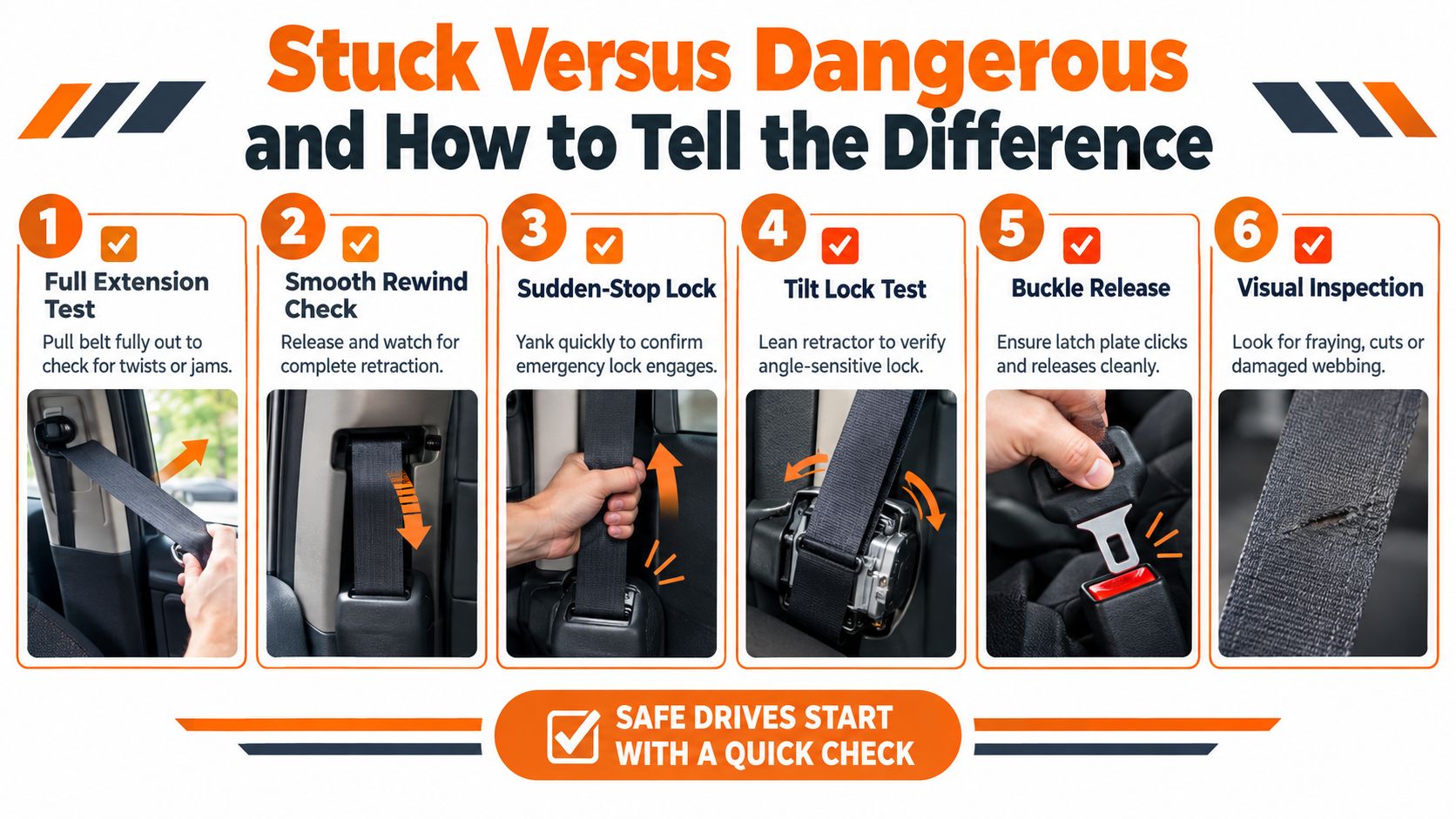
What you can usually keep driving with
A belt that locks only on sudden extension and otherwise retracts cleanly is usually the safest kind of “odd but usable” problem. That points to a functional ELR with a service issue, not a failed restraint. A twisted belt or a belt stuck in child-seat mode is annoying, but it doesn't automatically mean the assembly has lost all protective value.
What should stop the driving decision
A belt that has fired, smells like a pyrotechnic event, or keeps an illuminated SRS warning after collision work should not be treated as normal. The same goes for visible damage to the webbing or a buckle that won't latch securely after impact. If the belt is marked by crash history, it belongs in replacement territory until the system is verified again.
Diagnosis Repair and the Mail-In Service Workflow
Repair decisions make more sense when you use three filters, warranty status, part cost, and whether the unit can be restored to OEM function. If the belt is jammed or the retractor is locked without a deployed crash component, a rebuild may be sensible. If the frame is bent, the pretensioner has fired, or the mechanism can't be trusted to hold tension, replacement becomes the cleaner answer.
What a careful removal and rebuild process looks like
A proper workflow starts with confirming the fault using a slow-pull and jerk test, plus a visual check of the webbing path. After that, technicians photograph the buckle, connector, and mounting points so the rebuild shop can match the assembly correctly. The anchor bolt comes out, the seat-mounted trim panel is removed, and the complete assembly is packed with the SRS serial number attached so the return part can be traced to the correct vehicle.
Reinstallation should be controlled, not improvised. The anchor gets torqued to spec, the trim goes back without pinching the webbing, and the warning system is scanned to make sure the airbag light is clear before the car goes back into service. If the frame is bent, the spool teeth are damaged, or the housing shows deformation from a crash, rebuilding is the wrong answer because the core geometry is no longer reliable.
For shops that ship parts out instead of replacing the whole assembly, the process usually needs a clean handoff and a clear fault note. Safety Restore contact page is one example of a mail-in workflow entry point for parts that need bench service rather than immediate replacement.
Where reconditioning stops and replacement starts
A stripped bolt hole, distorted bracket, or collision-bent frame changes the repair decision. Those are not “just clean it up” problems. They are signs that the assembly lost the structural alignment the spool and pawl depend on.
In practice, that's the boundary that matters most. If the internal mechanism is intact, a specialist can often restore it. If the crash altered the shape of the housing, the belt shouldn't go back into service as though nothing happened.
Drive Ship or Replace a Clear Decision Framework
If the belt retracts slowly but still locks correctly on a sharp pull, the vehicle may be drivable while you arrange service. If it sticks, clicks without locking, or shows pretensioner behavior without a crash event, ship the retractor to a specialist and stop guessing. If the pretensioner has fired, the webbing is frayed, or the buckle won't latch cleanly, replace the assembly.
Keep the decision tied to the mechanism
That rule lines up with the parts you've already looked at. The spool and spring control everyday rewind, the pawl and sensor control crash lockup, and the pretensioner handles the one-time tightening event. If one of those layers has failed, the symptom usually tells you which layer is at fault.
When transport is part of the equation, it helps to use a service that moves the vehicle or the part without adding more handling stress. A door-to-door option like National Car Transport door-to-door auto transport can make sense when a repair plan depends on coordinated pickup, delivery, or shop transfer rather than a quick local fix.
If you're checking the order process for a mail-in repair, the ordering process page is the kind of step-by-step reference that keeps the part, the fault note, and the return flow organized. That matters because a belt assembly is only useful when it's matched back to the right vehicle and installed cleanly.
If your retractable belt is stuck, deployed, or not retracting properly, Safety Restore repairs seat belt retractors and pretensioners so the original OEM assembly can be put back into service correctly. Visit Safety Restore to review the mail-in process and send in the part that needs bench service.